Skin & Longevity
Red Light Therapy for Skin:
Mechanism, Evidence & Limitations
Our Laser Skin Rejuvenation article covered selective photothermolysis — using targeted heat to deliberately damage specific tissue and trigger repair. Red light therapy works through a genuinely different, non-thermal principle entirely, and its evidence base tells a more complicated story than either enthusiastic marketing or blanket skepticism suggests. This article covers the actual proposed mechanism — including a genuinely important scientific debate about whether that mechanism is even fully understood — and what the evidence realistically supports.
Quick Summary
- →Red light therapy (photobiomodulation) works through a fundamentally different principle than laser resurfacing — it uses low-power red and near-infrared light that doesn't heat or damage tissue, unlike the thermal injury mechanism covered in our Laser article
- →The leading proposed mechanism involves cytochrome c oxidase, a mitochondrial enzyme thought to absorb red/near-infrared light and increase cellular energy (ATP) production — but recent research has genuinely challenged whether this enzyme is the sole or even primary explanation, an active, unresolved scientific debate worth knowing about
- →Photobiomodulation follows a "biphasic dose response" — a well-documented phenomenon where both too little and too much light exposure reduce or eliminate the benefit, meaning more light or more frequent sessions isn't automatically better
- →Over 2,000 combined laboratory and clinical studies exist on photobiomodulation broadly, but researchers themselves acknowledge a genuine, unresolved problem: a lack of consensus on which specific parameters (wavelength, dose, timing) are appropriate for which condition, contributing to inconsistent and sometimes conflicting results across studies
- →This is genuinely one of the safer procedures covered in this series — non-invasive, no meaningful downtime, and a strong safety profile — even where the efficacy evidence for specific skin outcomes remains more mixed than for some other treatments in this series
Key numbers at a glance
| Measure | Figure |
|---|---|
| Typical red light wavelength range | ~630-660nm |
| Typical near-infrared wavelength range | ~810-850nm |
| Combined laboratory and clinical PBM studies published | 2,000+ |
| Dose-response pattern | Biphasic (more isn't automatically better) |
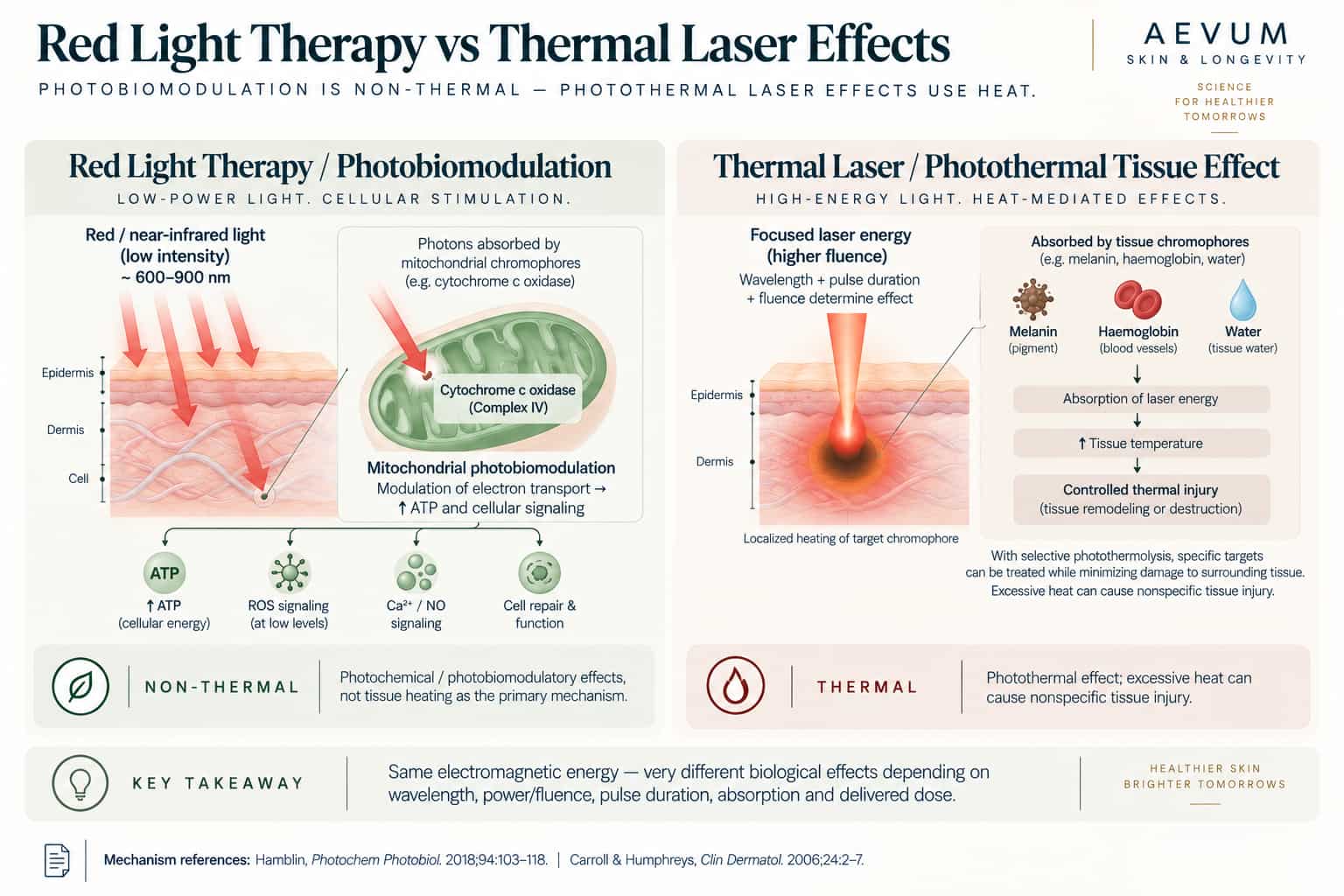
How it works — including a genuine, unresolved scientific debate
Red light therapy, more precisely called photobiomodulation (PBM), works through a fundamentally different principle than the laser treatments covered in our previous article. Rather than using enough energy to heat and deliberately damage a specific target (the basis of selective photothermolysis), PBM uses low-power red and near-infrared light intended to produce a biological effect without generating meaningful heat or tissue damage at all.
The leading proposed mechanism centres on cytochrome c oxidase (CCO), an enzyme in the mitochondrial electron transport chain. The theory holds that red and near-infrared light is absorbed by CCO, displacing inhibitory nitric oxide that can build up in stressed cells, thereby restoring the enzyme's normal function — increasing mitochondrial membrane potential, oxygen consumption, and ultimately ATP (cellular energy) production. In skin specifically, this proposed cascade is thought to stimulate fibroblast activity and modulate reactive oxygen species, theoretically supporting collagen and elastin production alongside general tissue repair.
Here's the genuinely important part often left out of consumer-facing explanations: this mechanism isn't as settled as it's usually presented. Recent research has directly challenged whether CCO is even the primary light-absorbing target — one 2024 review noted that cells genetically lacking cytochrome c oxidase still show the typical photobiomodulation response, and proposed an alternative or additional explanation involving light absorption by mitochondria-bound water itself, rather than CCO specifically. This doesn't mean photobiomodulation doesn't work — plenty of research finds real biological effects — but it does mean the exact mechanism remains a genuine, active area of scientific investigation, not settled textbook fact.
The biphasic dose response is a real, consistently observed limitation, not a hypothetical caution. Following a principle related to the Arndt-Schulz law, PBM research has repeatedly found that increasing dose improves outcomes only up to a certain point — beyond that point, effects plateau, disappear, or in some cases actually reverse into inhibitory territory. This has genuine practical implications: unlike many skincare interventions where "more" is often assumed to help, more light exposure, higher intensity, or more frequent sessions isn't automatically better with photobiomodulation, and researchers themselves note a persistent lack of consensus on which specific parameters are optimal for any given condition.
What to expect
- →The procedure itself is genuinely simple and low-risk — sitting under or near a red/near-infrared light source (a panel, mask, or handheld device) for a set period, with no injections, no anaesthesia, and essentially no recovery time required
- →Multiple sessions over weeks are typically involved, reflecting the gradual, cumulative nature of the proposed cellular mechanism rather than an acute, single-treatment effect
- →Side effects are minimal — this is genuinely one of the lower-risk procedures covered in this entire series, a real point in its favour even where efficacy evidence is more mixed
Evidence strength and genuine limitations
The sheer volume of research is substantial — but volume isn't the same as consistency. Photobiomodulation has been the subject of over 1,000 laboratory studies and another 1,000-plus clinical studies across a wide range of applications, from wound healing to joint conditions to skin outcomes specifically. Despite this large body of research, reviewers directly acknowledge that variation in study design has produced conflicting results, including negative trials that have generated genuine controversy within the field — this isn't a case of uniformly positive evidence being dismissed by skeptics, but a genuinely mixed evidence picture even among researchers actively working in the space.
A core, honestly-acknowledged problem is the lack of standardised parameters. Wavelength, power density, treatment duration, and session frequency all vary considerably across both commercial devices and published studies, and researchers themselves note the field lacks consensus on which specific combination is appropriate for which condition — making it genuinely difficult to compare results across studies, or to know whether a specific consumer product matches the parameters used in any particular positive trial.
Given how much dose and device specifications matter to the biphasic response described above, there's a genuine, common gap between the power output of research-grade devices used in published studies and the power output of many consumer at-home panels and masks — meaning a positive finding from a clinical study doesn't automatically transfer to a lower-powered consumer device, even one using a similar wavelength.
Recommendations by skin concern
- 1Anyone seeking a genuinely low-risk, gentle addition to an existing skincare routine
Red light therapy's strong safety profile makes it a reasonable, low-stakes option to try, with realistic expectations calibrated to the mixed, still-developing evidence base rather than dramatic promised transformations.
- 2Anyone expecting results comparable to microneedling or laser treatment, covered in our previous two articles
It's worth recalibrating expectations — the evidence for those mechanical and thermal approaches is generally more consistent and better-established than the current evidence for photobiomodulation's skin-specific anti-ageing claims.
- 3Anyone purchasing an at-home device
Checking the device's stated wavelength and power output against parameters used in published research, where this information is available, is a reasonable, informed step — though given the field's own acknowledged lack of parameter consensus, this remains an imperfect exercise even when attempted carefully.
- 4Anyone drawn to red light therapy specifically for its mechanism ("boosting mitochondria" or similar language)
Worth knowing this specific framing rests on a genuinely still-debated scientific mechanism, not settled cellular biology — a reason for realistic curiosity rather than either dismissal or full confidence.
- 5General / longevity-focused
Red light therapy is a good example of a genuinely active, legitimate area of ongoing research that hasn't yet resolved into the kind of clear, consistent evidence base seen for retinoids, vitamin C, or even microneedling covered elsewhere in this series — worth following as the research develops, without over-relying on it as a primary strategy today.
Practical notes
- →Red light therapy works through a non-thermal mechanism, genuinely distinct from the heat-based lasers covered in our previous article — a real difference in risk profile, not just marketing language
- →The core proposed mechanism (cytochrome c oxidase) is under genuine, active scientific debate — this is worth knowing rather than assuming the biology is fully settled
- →More light or more frequent sessions isn't automatically better — the biphasic dose response is a real, well-documented limiting factor
- →The field's own researchers acknowledge inconsistent results and a lack of parameter consensus — a genuinely honest starting point for calibrating expectations
- →This remains one of the safer options in this series even given the mixed efficacy evidence — a reasonable, low-risk complement to better-established approaches, not necessarily a primary strategy on its own
Red light therapy sits in a genuinely interesting position within this series — a legitimate, actively-researched mechanism with real safety advantages, but an evidence base for specific skin outcomes that remains more mixed and less standardised than several other treatments already covered. For the thermal mechanism this contrasts with, see our Laser Skin Rejuvenation article, and for the mechanical collagen-induction alternative, see our Microneedling article. If you'd like personalised guidance on where red light therapy might reasonably fit into your own routine, our Longevity Doctors offer a free consultation as a starting point.
How does your skin
score on your longevity assessment?
Take the free Aevum Protocol assessment to see how your skin & longevity and 6 other longevity domains are performing — and get a personalised 90-day plan.
Take the Free Assessment →