Skin & Longevity
Botulinum Toxin:
More Than Just Wrinkles?
Our Peptides article covered Argireline, the "topical Botox" peptide, and found that a 2025 peer-reviewed review directly acknowledged its actual mechanism when applied topically "remains incompletely understood." This article covers the real thing — how injectable botulinum toxin actually works, why its evidence base is so much more robust, and the surprisingly broad range of medical applications built on the exact same underlying mechanism as its cosmetic use.
Quick Summary
- →Botulinum toxin works by cleaving SNAP-25, a protein required for acetylcholine release at the neuromuscular junction — the identical molecular target Argireline claims to affect topically, but achieved here through direct injection with decades of confirmed clinical evidence behind it
- →The FDA approval timeline reflects a genuinely rigorous, staged evidence process: cervical dystonia in 2000, cosmetic glabellar lines in 2002, hyperhidrosis in 2004, and chronic migraine and overactive bladder in the years since
- →Botulinum toxin works best on dynamic wrinkles — those caused by repeated muscle movement — rather than static wrinkles already present at rest, which are more a function of the collagen loss covered in our Collagen Loss article and generally need a different or combined approach
- →Effects typically appear within 24-48 hours, peak around two weeks, and last 3-6 months before the nerve terminal regenerates new SNAP-25 protein and normal muscle signalling resumes — the treatment is reversible by biological design, not permanent nerve damage
- →The same acetylcholine-blocking mechanism extends well beyond wrinkles — to excessive sweating, chronic migraine, jaw tension, and several other conditions, all working through the identical core biology
Key numbers at a glance
| Measure | Figure |
|---|---|
| FDA approval: cervical dystonia / cosmetic glabellar lines / hyperhidrosis | 2000 / 2002 / 2004 |
| Onset of visible effect | 24-48 hours (sometimes within hours) |
| Peak effect | ~10-14 days |
| Typical duration before re-treatment needed | 3-6 months |
How it works, and why the peptide comparison actually matters
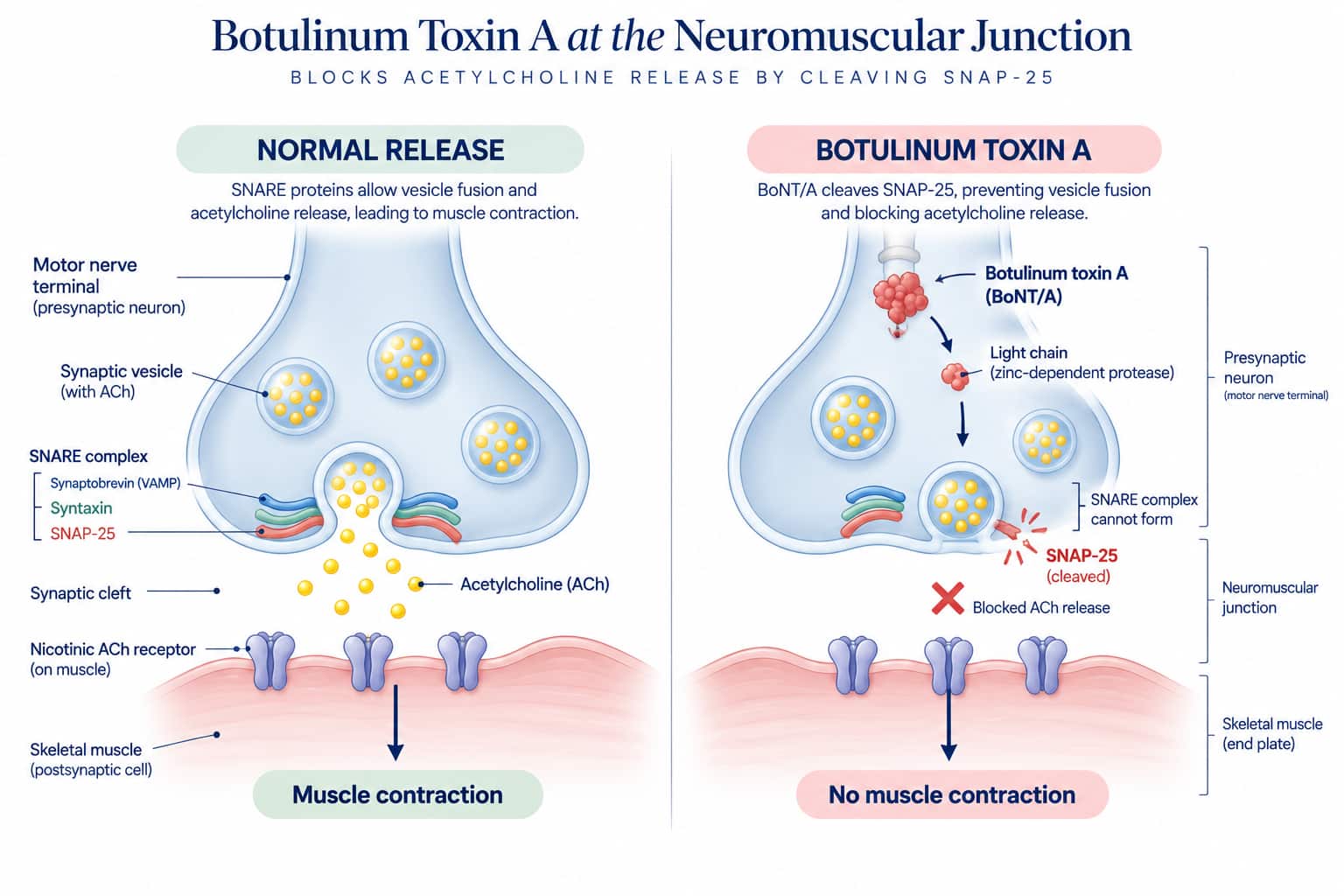
Botulinum toxin is a neurotoxin produced by the bacterium Clostridium botulinum. Once injected, it's taken up by nerve terminals and cleaves SNAP-25, a protein essential for the docking and release of acetylcholine-containing vesicles at the neuromuscular junction. Without functional SNAP-25, the nerve can no longer signal the muscle to contract — producing temporary, localised muscle relaxation at the injection site.
This is the same molecular target our Peptides article covered for Argireline — both are designed to interrupt the SNARE-protein machinery controlling acetylcholine release. The genuinely important difference is one of actual, demonstrated mechanism versus theoretical target: botulinum toxin, delivered by injection, reliably reaches and cleaves SNAP-25 with an enormous, decades-deep body of confirmed clinical evidence behind it, while a 2025 peer-reviewed review of Argireline concluded that its ability to achieve a comparable effect when applied topically "remains incompletely understood," specifically flagging limited skin penetration as an unresolved barrier. Both target the same biology; only one has clearly demonstrated it actually gets there.
Wrinkle type matters for whether botulinum toxin is even the right tool. Wrinkles form through two different processes: dynamic wrinkles, caused by repeated contraction of underlying facial muscles (crow's feet, frown lines, forehead lines), and static wrinkles, present even at rest, driven more by the collagen and structural changes covered in our Collagen Loss and Biology of Skin Aging articles. Botulinum toxin directly addresses dynamic wrinkles by relaxing the muscle causing them — but static wrinkles generally require a different or combined approach (fillers, collagen-stimulating treatments like the microneedling covered in our previous article), since there's no problematic muscle contraction to relax in the first place.
What to expect
- →Onset is relatively fast: visible effects typically begin within 24-48 hours, occasionally within hours, with full effect developing over roughly 10-14 days
- →Duration is genuinely temporary and predictable: effects typically last 3-6 months, ending as the nerve terminal regenerates new SNAP-25 protein and normal signalling resumes — this is a designed, reversible mechanism, not permanent nerve damage
- →Repeat treatment is standard practice, not a sign of "needing more" — most patients return for re-treatment roughly every 3-4 months to maintain results
- →The procedure itself is quick, typically completed in a single short office visit with minimal downtime, though temporary bruising or mild swelling at injection sites is common
More than just wrinkles: the broader medical applications
The same core mechanism — blocking acetylcholine release — extends well beyond facial muscles, and this is genuinely where botulinum toxin's evidence base becomes particularly interesting.
Hyperhidrosis (excessive sweating) received FDA approval in 2004. Sweat glands, like muscles, rely on acetylcholine signalling to activate — blocking this signal reduces sweat production at the injection site, giving this the same underlying mechanism as the cosmetic application, just directed at a different type of target tissue.
Chronic migraine is an FDA-approved indication as well, following a specific, standardised injection protocol. The precise mechanism here is less fully settled than the straightforward muscle-relaxation story — some research suggests effects on sensory nerve signalling and neuropeptides involved in pain transmission, beyond simple muscle relaxation, making this a genuinely still-developing area of mechanistic understanding even though the clinical efficacy itself is well-established through controlled trials.
Jaw tension, teeth grinding (bruxism), and masseter reduction are common off-label uses — repeated treatment of the masseter (jaw) muscle can reduce its bulk over time in addition to relaxing excessive clenching activity, addressing both a cosmetic jawline concern and a functional TMJ-related one simultaneously.
These include myofascial pain, cervical dystonia (one of the original approved indications), and several other conditions involving excessive or dysfunctional muscle activity. Some emerging research has also explored a connection between botulinum toxin injected in the glabellar (frown line) area and mood — this remains a genuinely less established area than the applications above, worth being aware of as an active area of study rather than a settled clinical use.
Evidence strength
Botulinum toxin is one of the more rigorously studied interventions covered in this entire series — the staged FDA approval process itself, spanning cervical dystonia in 2000 through cosmetic and medical indications in the years following, reflects decades of accumulated randomised controlled trial evidence across multiple, quite different applications. This depth of evidence is genuinely difficult to match by comparison to most of the topical actives and even most procedures covered elsewhere in this series — a reasonable reason for its status as the most frequently performed cosmetic procedure in the United States.
Recommendations by skin concern or goal
- 1Anyone primarily bothered by dynamic wrinkles (crow's feet, frown lines, forehead lines caused by expression)
This is botulinum toxin's core, best-evidenced application — a reasonable, well-studied option worth discussing with a qualified injector.
- 2Anyone with static wrinkles present at rest, without significant dynamic movement contributing
Botulinum toxin alone is less likely to be the primary solution here — worth discussing a combined approach involving the collagen-focused treatments covered elsewhere in this series, including our Microneedling article.
- 3Anyone with excessive sweating (hyperhidrosis) significantly affecting daily life
This is a genuine, FDA-approved medical application, not just an off-label cosmetic extension — worth discussing directly with a dermatologist.
- 4Anyone with chronic migraine
Given the FDA-approved status and controlled trial evidence, this is worth raising with a neurologist as a legitimate treatment option, separate from any cosmetic consideration entirely.
- 5Anyone drawn to "topical Botox" peptide products, as covered in our Peptides article
Understanding the gap between injectable botulinum toxin's confirmed mechanism and topical Argireline's still-unresolved penetration question is useful context for calibrating realistic expectations between the two.
Practical notes
- →The same core mechanism (blocking acetylcholine release) explains botulinum toxin's use across wrinkles, sweating, migraine, and jaw tension — this isn't several unrelated treatments, but one biological principle applied to different tissues
- →Dynamic and static wrinkles need different approaches — botulinum toxin addresses the muscle-movement component, not the structural collagen loss covered elsewhere in this series
- →The effect is temporary and reversible by design — regeneration of SNAP-25 protein restores normal function, typically within 3-6 months
- →This has one of the deepest evidence bases of anything covered in this series, reflecting decades of accumulated clinical trials across multiple distinct medical applications, not just cosmetic use
- →The injectable-versus-topical comparison with Argireline is a genuinely instructive case study in the difference between a plausible mechanism and a clinically confirmed one
Botulinum toxin's cosmetic reputation undersells how genuinely well-studied and mechanistically well-understood it actually is — the same core biology extends to several legitimate medical applications well beyond wrinkles. For how this compares to topical alternatives claiming a similar mechanism, see our Peptides article, and for the structural collagen loss that static wrinkles are more directly tied to, see our Collagen Loss article. If you'd like personalised guidance on whether botulinum toxin suits your specific goals, our Longevity Doctors offer a free consultation as a starting point.
How does your skin
score on your longevity assessment?
Take the free Aevum Protocol assessment to see how your skin & longevity and 6 other longevity domains are performing — and get a personalised 90-day plan.
Take the Free Assessment →