Skin & Longevity
Collagen Loss With Age:
When Does It Start and How Fast Does It Happen?
Our Biology of Skin Aging article introduced fibroblast decline and cellular senescence as the underlying drivers of skin ageing, and our How Fast Does Your Skin Actually Age? article covered a broad decade-by-decade picture. This article narrows in specifically on collagen — the single protein most responsible for skin's structural firmness — with the actual, quantified research on when loss begins, how fast it progresses, and why one specific life event causes it to accelerate dramatically.
Quick Summary
- →Collagen production begins a measurable annual decline starting in the mid-to-late 20s, at a rate of roughly 1-1.5% per year — a peer-reviewed study tracking collagen secretion from age 25 to 80 found a cumulative 38% reduction
- →This is a net balance, not a simple production slowdown — fibroblasts both produce less new collagen and existing collagen breaks down faster, and critically, fragmented collagen itself signals fibroblasts to produce even less, creating a self-reinforcing cycle
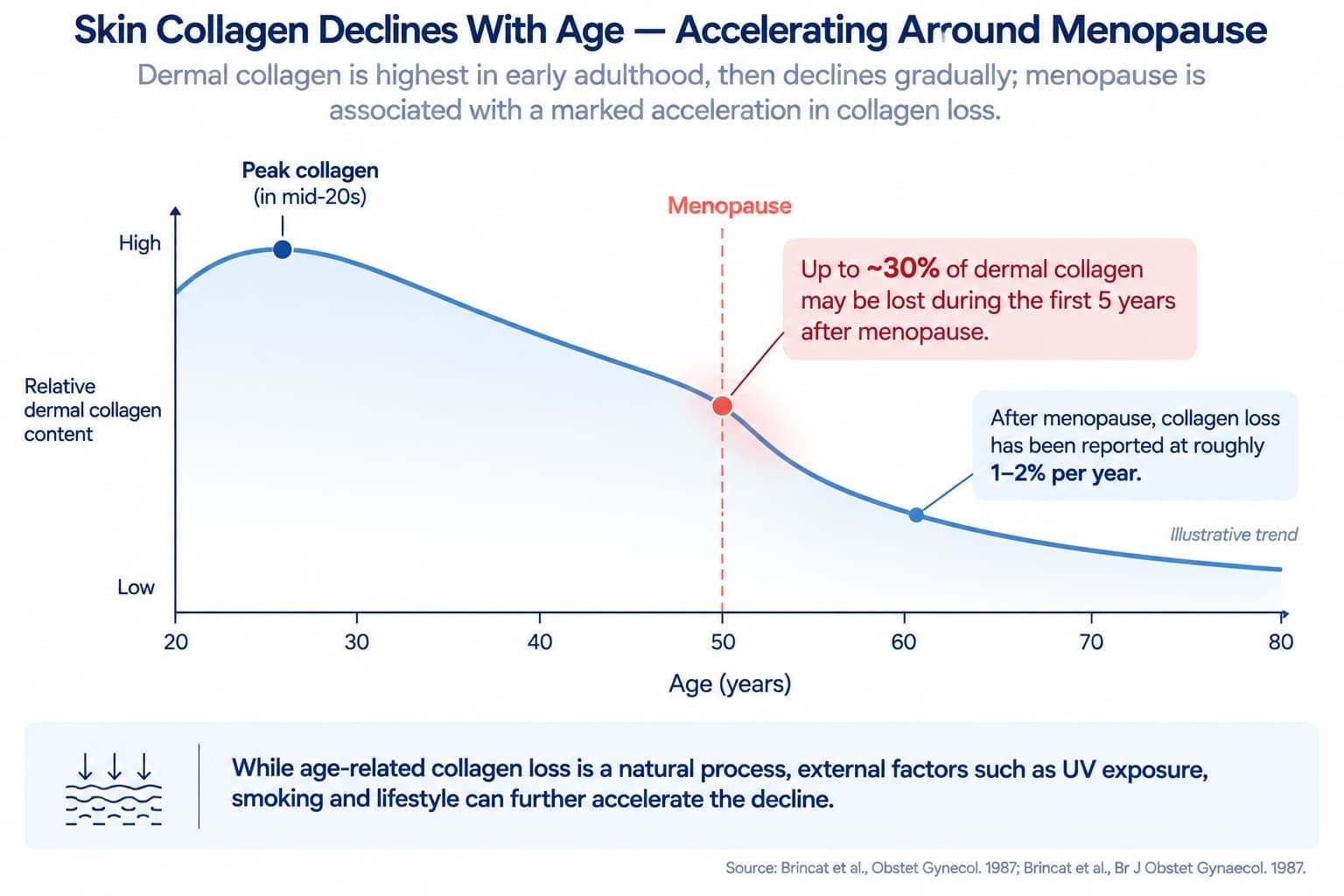
- →Menopause causes a dramatic, well-documented acceleration — classic research found women lose up to 30% of skin collagen in just the first five years after menopause, then continue losing roughly 2% per year for up to two more decades
- →By the 50s, cumulative collagen loss from peak levels can reach 30-50% or more, depending on UV exposure history, hormonal status, smoking, and genetics
- →Type I collagen makes up roughly 80% of dermal collagen, with Type III making up most of the remainder — understanding this composition is relevant to how several skincare actives and procedures, covered later in this series, are designed to work
Key numbers at a glance
| Measure | Figure |
|---|---|
| Annual collagen production decline, from mid-to-late 20s | ~1-1.5%/year |
| Total collagen secretion decline, age 25 to 80 (peer-reviewed) | ~38% |
| Collagen loss in first 5 years post-menopause | Up to ~30% |
| Ongoing annual collagen decline post-menopause | ~1-2%/year for ~15-20 years |
| Cumulative collagen loss from peak by the 50s | ~30-50%+ |
| Type I collagen share of dermal collagen | ~80% |
How it works: what collagen is, and why loss compounds
Collagen is the most abundant protein in the human body and makes up roughly 75-80% of skin's dry weight. In skin specifically, it exists predominantly as Type I collagen (roughly 80% of dermal collagen), which provides tensile strength, alongside Type III collagen (roughly 15%), which contributes more to elasticity and is especially prominent in younger skin. Collagen fibres are produced by fibroblasts — covered in depth in our Biology of Skin Aging article — as long, triple-helix protein strands that interweave into a dense structural scaffold, distinct from elastin, the separate protein responsible for skin's ability to stretch and recoil.
Collagen content in skin peaks in the mid-20s to early 30s, at the point where fibroblast activity is highest and the balance between collagen synthesis and natural breakdown favours net accumulation. What happens afterward isn't a simple, one-directional slowdown in production — it's a shift in balance, and one that compounds over time. As covered in our Biology of Skin Aging article, ageing fibroblasts increasingly enter senescence and release matrix metalloproteinases (MMPs), enzymes that actively degrade existing collagen. This creates a genuinely important, self-reinforcing mechanism: fragmented collagen fibres, once broken down, send a biochemical signal that further reduces fibroblasts' collagen production — meaning the damage from earlier degradation actively suppresses the body's ability to replace it, rather than the two processes running independently.
What the research shows
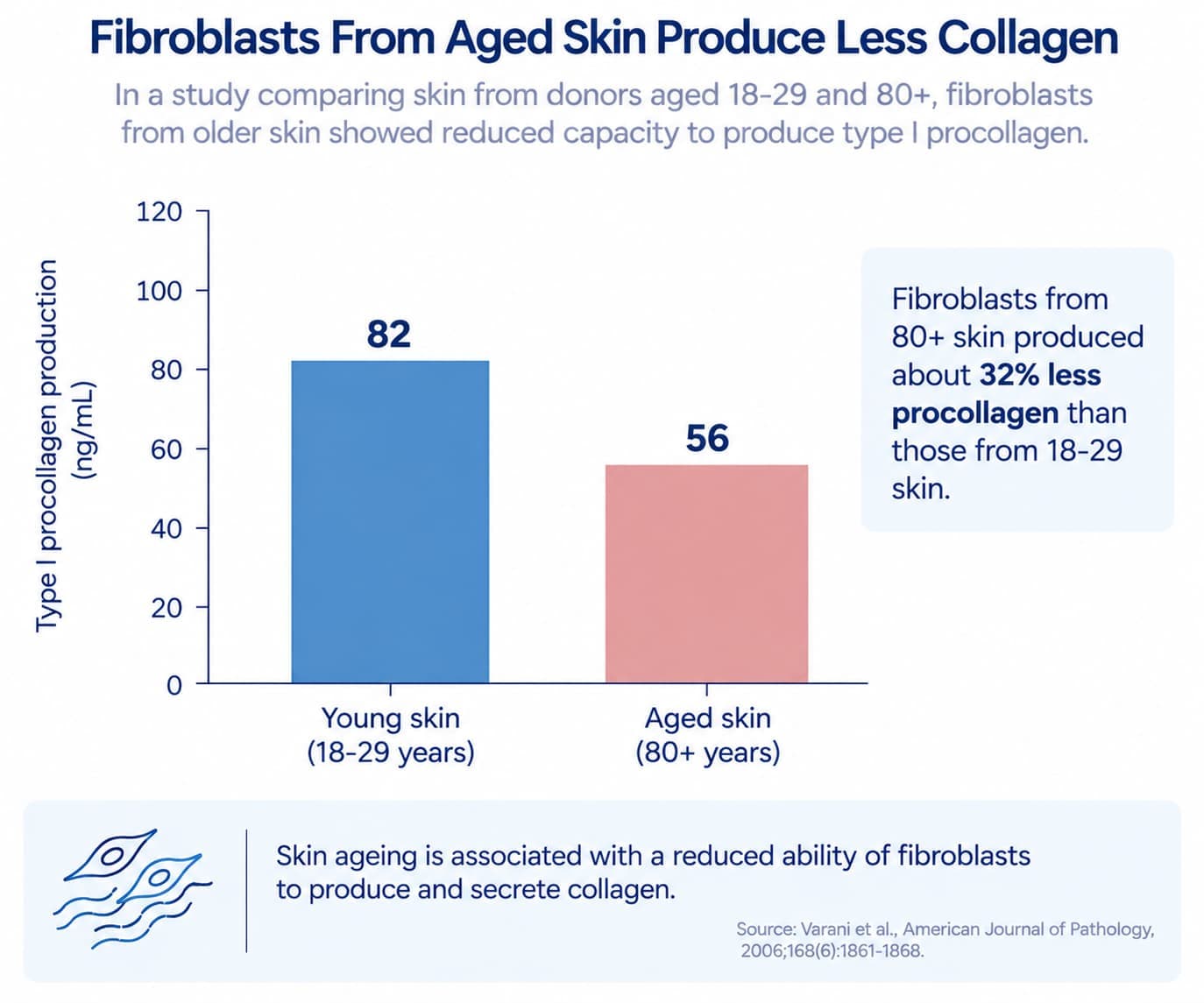
The baseline decline: roughly 1-1.5% a year, adding up substantially. Multiple independent studies converge on a similar figure for the general, age-related decline in collagen production, beginning in the mid-to-late 20s: roughly 1-1.5% per year. A peer-reviewed study specifically measuring collagen secretion from human skin fibroblasts found a 38% decrease in collagen secretion capacity between age 25 and age 80 — a substantial, cumulative reduction over that span, even before accounting for the additional acceleration described below. A separate study tracking collagen content across the population found a peak between ages 25-34, followed by an approximate 25% decrease over the following four decades.
Menopause causes a dramatic, well-documented acceleration. This is genuinely one of the more striking findings in skin ageing research, and the topic of dedicated treatment in our upcoming Hormones & Skin article — but the scale of the numbers deserves mention here directly. Classic research on postmenopausal women found collagen content declines by up to 30% in just the first five years after menopause, followed by a continued decline of roughly 1-2% per year for up to 15-20 years afterward. This acceleration is tied to declining estrogen specifically, which plays a direct, measurable role in regulating collagen synthesis — research has also found that hormone replacement therapy can measurably increase skin collagen content in postmenopausal women, further supporting a direct hormonal mechanism rather than a coincidental correlation. Related research has found postmenopausal skin thickness declining at roughly 1.13% per year, correlating closely with the ongoing 2% annual collagen decline — a consistent, structurally-linked pattern rather than two unrelated measurements.
The cumulative picture by the 50s. Taking the baseline age-related decline and, for women, the menopausal acceleration together, cumulative collagen loss from peak levels can reach 30-50% or more by the 50s, with the exact figure depending heavily on UV exposure history, smoking status, and individual hormonal and genetic factors — the same environmental factors covered in quantified detail in our How Fast Does Your Skin Actually Age? article. This is also the point at which the dermis becomes measurably thinner and the remaining collagen network becomes increasingly fragmented and disorganised, rather than simply present in a smaller but still well-structured quantity.
Recommendations by skin concern
- 1Anyone in their 20s or early 30s
Given that collagen content is likely at or near its lifetime peak during this window, this is the highest-leverage period for prevention (sun protection, avoiding smoking) rather than correction — protecting existing collagen is mechanically easier than rebuilding lost collagen later.
- 2Perimenopausal and menopausal women
Given the magnitude of the acceleration described above — up to 30% in five years — this is a genuinely distinct phase requiring its own consideration, not simply a continuation of the same gradual decline; our upcoming Hormones & Skin article covers this transition and its management in more depth.
- 3Anyone noticing a relatively sudden change in skin firmness rather than a gradual one
This lines up with genuine research findings — collagen loss isn't perfectly linear, and the menopausal acceleration in particular can make changes feel abrupt rather than gradual, which is a real phenomenon rather than a sign of unusually poor skin health.
- 4Anyone considering collagen-supporting skincare actives or procedures
Understanding that collagen loss involves both reduced production and accelerated breakdown (via MMPs) is relevant context for later articles in this series — effective interventions generally need to address both sides of this balance, not just one.
- 5General / longevity-focused
The self-reinforcing nature of collagen fragmentation and reduced synthesis is a good example of why earlier intervention tends to be more effective than later correction — breaking the cycle is more achievable before it's had years to compound.
Practical notes
- →Collagen decline starts earlier than most people assume — the mid-to-late 20s, not the 40s or 50s, even though visible effects take longer to appear
- →This is a compounding process, not a steady, independent decline — fragmented collagen actively suppresses new collagen production, which is part of why earlier intervention tends to be more effective than later correction
- →Menopause represents a genuinely distinct acceleration, not just a continuation of gradual ageing — up to 30% loss in five years is a substantial, well-documented shift specific to this life stage
- →By the 50s, most people have lost roughly a third to half of their peak collagen — a useful, concrete way to understand why skin structure changes so noticeably by this stage
- →Type I and Type III collagen serve different structural roles — worth knowing as background for later articles on skincare actives and procedures, several of which are specifically designed to target collagen production and organisation
Collagen loss is one of the most quantifiable processes in skin ageing, with a clear baseline rate, a well-documented menopausal acceleration, and a genuine, compounding mechanism behind why it gets harder to reverse the longer it continues. For the cellular biology behind why this happens, see our Biology of Skin Aging article, and for the hormonal mechanism behind the menopausal acceleration specifically, see our upcoming Hormones & Skin article. If you'd like a clearer picture of your own skin's collagen health, our Longevity Doctors offer a free consultation as a starting point.
How does your skin
score on your longevity assessment?
Take the free Aevum Protocol assessment to see how your skin & longevity and 6 other longevity domains are performing — and get a personalised 90-day plan.
Take the Free Assessment →