Skin & Longevity
The Biology of Skin Aging:
What Happens Inside Your Skin as You Age?
Skin is the body's largest organ, and it ages through genuinely well-mapped cellular and structural processes — not a vague, unavoidable fade, but a set of specific, partly modifiable changes happening at the cellular level. This article is the foundation for the rest of our Skin & Longevity series: what actually happens inside skin as it ages, why it happens, and why understanding this matters for anyone thinking about skin health as part of a broader longevity strategy, not just cosmetics.
Quick Summary
- →Skin ages through two distinct pathways that combine — intrinsic (chronological, genetically driven) ageing and extrinsic (environmental, mostly UV-driven) ageing, covered in more depth in our Photoaging vs Natural Ageing article; this article focuses on what happens regardless of sun exposure
- →Fibroblasts — the cells that produce collagen — decline substantially in number and function with age, with one study finding roughly 35% fewer fibroblasts in skin over 80 compared to skin in the 18-29 age range
- →A significant share of visible skin ageing is now understood to be driven by "senescent" cells — cells that stop dividing but don't die, and instead release inflammatory signals that actively damage surrounding healthy tissue, a process with direct parallels to whole-body ageing biology
- →The skin's structure changes measurably, not just its surface appearance — the junction between the epidermis and dermis flattens, reducing the surface area available for nutrient exchange between layers, and immune surveillance cells in the skin decline significantly, which is part of why skin cancer risk rises with age
- →This is a genuinely modifiable process, not a fixed timeline — understanding the specific mechanisms below is what makes targeted interventions (covered throughout this series) plausible rather than speculative
Key numbers at a glance
| Measure | Figure |
|---|---|
| Fibroblast count, skin aged 80+ vs. 18-29 | ~35% fewer |
| Melanocyte decline per decade of age | ~8-20% |
| Key senescent cell marker used in research | p16INK4a |
| Skin's status as the body's largest organ | ~15% of total body weight |
How it works: skin structure and the two paths of ageing
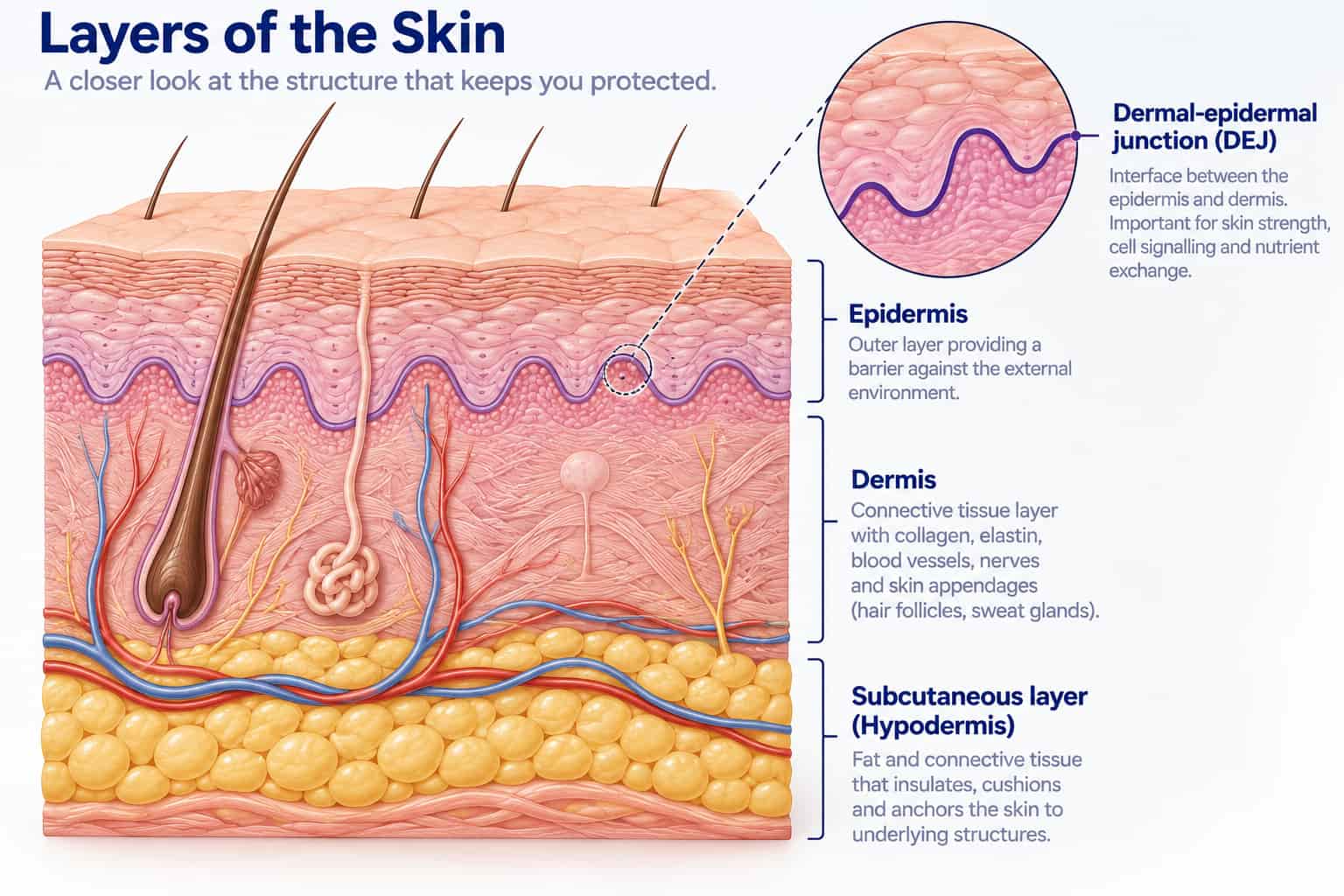
Skin is organised into three main layers. The epidermis is the outermost, protective layer, constantly renewing itself through a cycle of cell production and shedding. The dermis, beneath it, contains the structural proteins — collagen and elastin — along with the fibroblasts that produce them, blood vessels, and nerve endings. The subcutaneous layer, deepest of the three, is made up largely of fat tissue that provides insulation, cushioning, and facial volume.
Ageing affects skin through two distinct pathways that combine in practice: intrinsic ageing, the genetically-programmed, time-dependent process that happens regardless of environment, and extrinsic ageing, driven overwhelmingly by UV exposure (photoageing), along with smoking and pollution — covered in dedicated depth in our Photoaging vs Natural Ageing article. This article focuses on the intrinsic process: what happens to skin simply as a function of time, independent of sun exposure.
What the research shows
Fibroblasts decline, and the ones that remain often stop working properly. Fibroblasts are the cells responsible for producing collagen and elastin, the structural proteins that give skin its firmness and elasticity — covered in more depth in our Collagen Loss article. Research comparing skin biopsies across age groups has found fibroblast numbers decline substantially with age, with one study finding roughly 35% fewer fibroblasts in skin from people over 80 compared to skin from people in their 20s. Just as significant as the reduced count is what happens to the fibroblasts that remain.
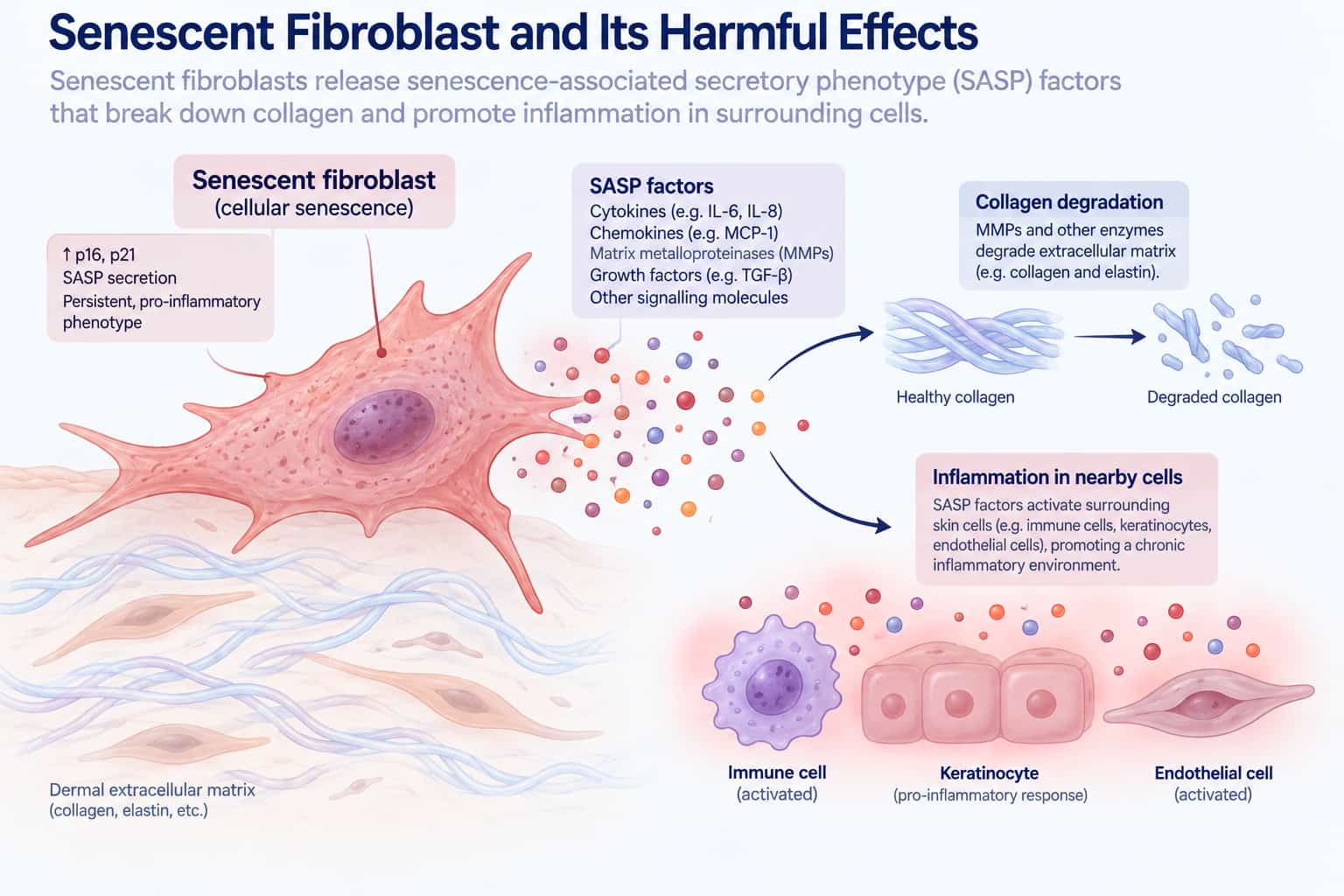
Cellular senescence — the "zombie cell" problem. A growing share of ageing fibroblasts don't simply decline in number — they enter a state called cellular senescence, where a cell permanently stops dividing but doesn't die off and get cleared away the way it normally would. These senescent cells accumulate over time and actively secrete a mix of inflammatory signals, growth factors, and enzymes collectively known as the senescence-associated secretory phenotype (SASP). This matters enormously: SASP signalling includes matrix metalloproteinases (MMPs), enzymes that actively break down existing collagen in the surrounding tissue, meaning senescent cells don't just fail to produce new collagen — they actively degrade what's already there, and their inflammatory signalling can push nearby healthy cells toward senescence too, creating a self-reinforcing cycle. This same senescence process is a major, active area of research in whole-body longevity science generally, connecting visible skin ageing to the same fundamental biology implicated in many other age-related conditions — a genuine link between how skin ages and how the rest of the body does.
The skin's structure itself changes, not just its surface. Beyond collagen and fibroblast changes, several other structural shifts occur with age. The dermal-epidermal junction — the interlocking boundary between the epidermis and dermis — gradually flattens, reducing the surface area available for nutrient and signal exchange between the two layers, and contributing to the increased fragility and slower wound healing seen in older skin. Melanocytes, the pigment-producing cells, decline by roughly 8-20% per decade, contributing to more uneven skin tone with age. Langerhans cells, the skin's frontline immune surveillance cells, decline markedly in both number and function — a change believed to be part of why skin cancer risk rises substantially with age, since fewer functional immune cells are available to identify and eliminate abnormal cells before they progress. Epidermal turnover — the cycle of new skin cells forming and old ones shedding — also slows, contributing to the thinner, less resilient outer layer seen in aged skin.
Recommendations by skin concern
- 1Anyone starting to notice early signs of ageing (loss of firmness, slower recovery from irritation)
Understanding that fibroblast decline and senescence are the underlying drivers reframes the goal of skincare and treatment less as "reversing time" and more as directly supporting fibroblast function and reducing senescent cell burden — the mechanistic basis for several interventions covered later in this series, including retinoids and certain procedures.
- 2Anyone interested in a longevity-focused approach to skin, not just cosmetic results
The senescence and SASP mechanisms covered here are the same biology studied in whole-body ageing research — skin is a genuinely useful, visible window into processes happening throughout the body, not an isolated cosmetic concern.
- 3Anyone noticing increased skin fragility, slower healing, or more visible sun damage with age
The flattened dermal-epidermal junction and declining Langerhans cell function described above are the structural basis for these very common, often under-explained complaints — worth understanding as a real physiological shift, not just "skin getting older" in an abstract sense.
- 4Anyone with a personal or family history of skin cancer
Given the decline in immune surveillance (Langerhans cells) with age, regular skin checks become more important with age specifically because of this documented decline in the skin's own cancer-surveillance capacity, not just cumulative sun exposure.
Practical notes
- →Skin ageing has specific, identifiable cellular drivers — fibroblast decline, cellular senescence, and structural changes at the dermal-epidermal junction — rather than being a single, undifferentiated process
- →Senescent cells are an active area of longevity research generally, not just a skin-specific concept — this connects visible skin ageing directly to broader ageing biology
- →Declining immune surveillance in skin (Langerhans cells) is part of why skin cancer risk rises with age — a genuine, mechanistic reason regular skin checks matter more later in life
- →This article covers intrinsic ageing specifically — for how sun exposure changes this picture substantially, see our Photoaging vs Natural Ageing article
- →Understanding mechanism is what makes the rest of this series useful — later articles on collagen, actives, and procedures make more sense once the underlying cellular biology here is clear
Skin ageing is a genuinely well-understood biological process, driven by specific, identifiable changes at the cellular level rather than being an unknowable, purely cosmetic concern. For how sun exposure changes this picture, and for the deeper mechanics of collagen loss specifically, see our upcoming Photoaging vs Natural Ageing and Collagen Loss articles. If you'd like a clearer picture of your own skin health as part of a broader longevity assessment, our Longevity Doctors offer a free consultation as a starting point.
How does your skin
score on your longevity assessment?
Take the free Aevum Protocol assessment to see how your skin & longevity and 6 other longevity domains are performing — and get a personalised 90-day plan.
Take the Free Assessment →