Skin & Longevity
Photoaging vs Natural Aging:
Why They Are Not the Same
Our Biology of Skin Aging article covered intrinsic ageing — the genetically-programmed cellular processes that happen regardless of environment. This article covers the other, larger piece of the picture: photoaging, the damage caused specifically by UV exposure — a genuinely distinct process, with its own visual signature, its own mechanism, and, most importantly, its own near-total preventability.
Quick Summary
- →An estimated 80% of visible facial skin ageing is attributable to UV exposure, according to a widely cited dermatological study — meaning the large majority of what people perceive as "ageing" is actually photoaging, not the unavoidable passage of time
- →Photoaging and intrinsic ageing look genuinely different, not just more or less severe — intrinsic ageing produces fine wrinkles and gradual thinning, while photoaging produces coarse wrinkles, leathery texture, mottled pigmentation, and visible blood vessels
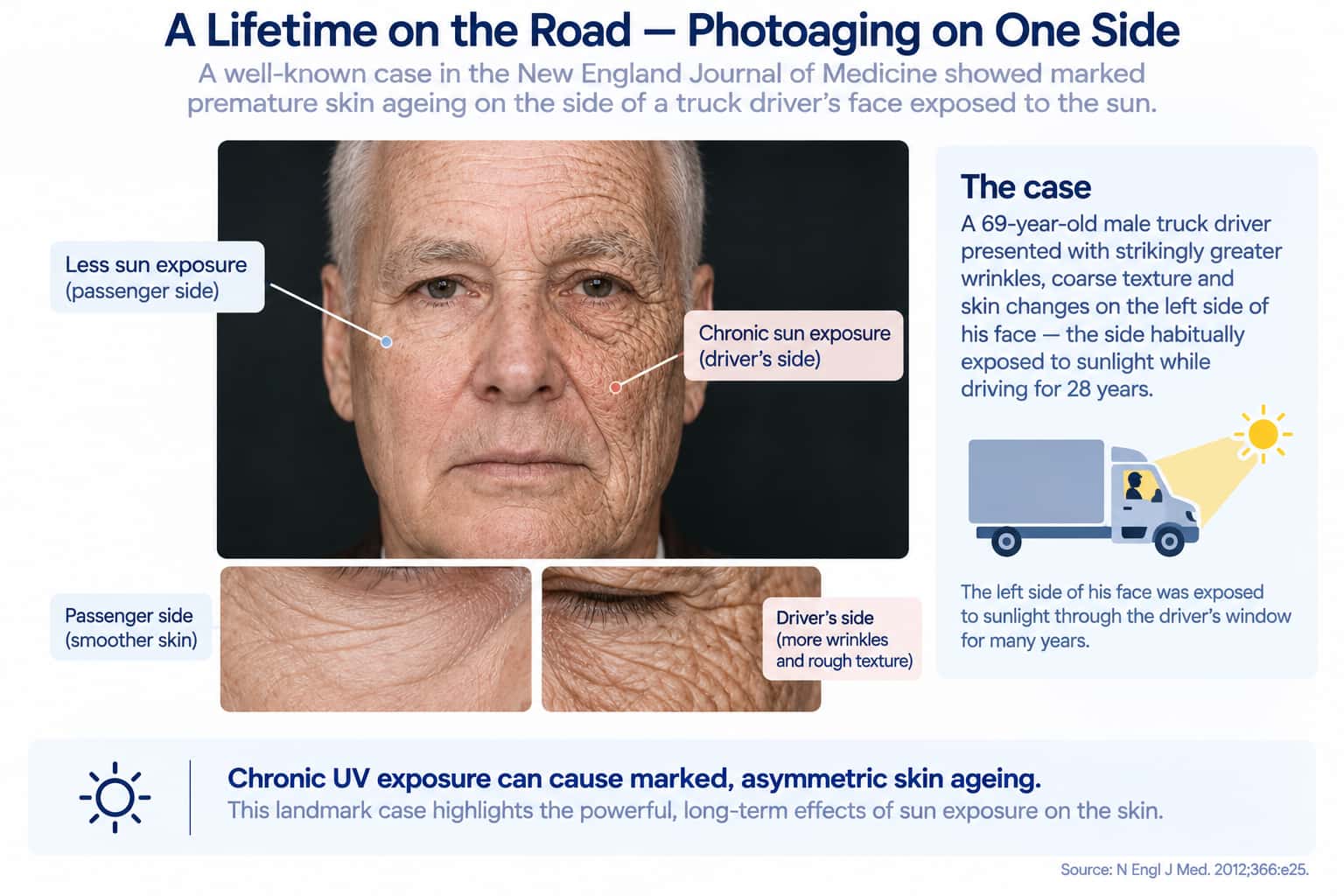
- →A famous 2012 medical case report documented a 69-year-old truck driver whose face had aged asymmetrically — 25-28 years of UVA exposure through his driver's-side window left one side of his face looking roughly two decades older than the other, a striking, real-world illustration of cumulative UV damage
- →This asymmetric-exposure effect has been studied more rigorously too, not just in a single dramatic case — a controlled pilot study of 10 people with long-term one-sided window exposure confirmed measurable, consistent physiological differences between the more- and less-exposed sides of their faces
- →Because photoaging is a separate, largely external process, it's also largely preventable — unlike intrinsic ageing, which is substantially driven by fixed biological timing, covered in our Biology of Skin Aging and Collagen Loss articles
Key numbers at a glance
| Measure | Figure |
|---|---|
| Visible facial ageing attributable to UV exposure | ~80% |
| Share of UV radiation reaching Earth's surface that is UVA | ~95% |
| Years of asymmetric UVA exposure in the well-known truck driver case | ~25-28 years |
| Participants in the controlled asymmetric sun-exposure pilot study | 10 |
How it works: two different mechanisms, not just two different speeds
Intrinsic ageing, covered in our Biology of Skin Aging and Collagen Loss articles, is driven by internally-programmed processes — fibroblast senescence, gradually declining collagen synthesis, and hormonal changes — proceeding on a broadly predictable biological timeline regardless of environment. Photoaging works through a genuinely different mechanism. UV radiation penetrates the skin and generates reactive oxygen species (ROS) — highly reactive molecules that directly damage DNA, proteins, and cell membranes — while also directly activating the same matrix metalloproteinases (MMPs) responsible for collagen breakdown, but doing so acutely and repeatedly with each significant UV exposure, rather than gradually as part of the slower, senescence-driven process covered in our Collagen Loss article. Because this is a direct, externally-triggered response rather than a programmed internal one, its severity tracks cumulative UV exposure specifically — not simply chronological age.
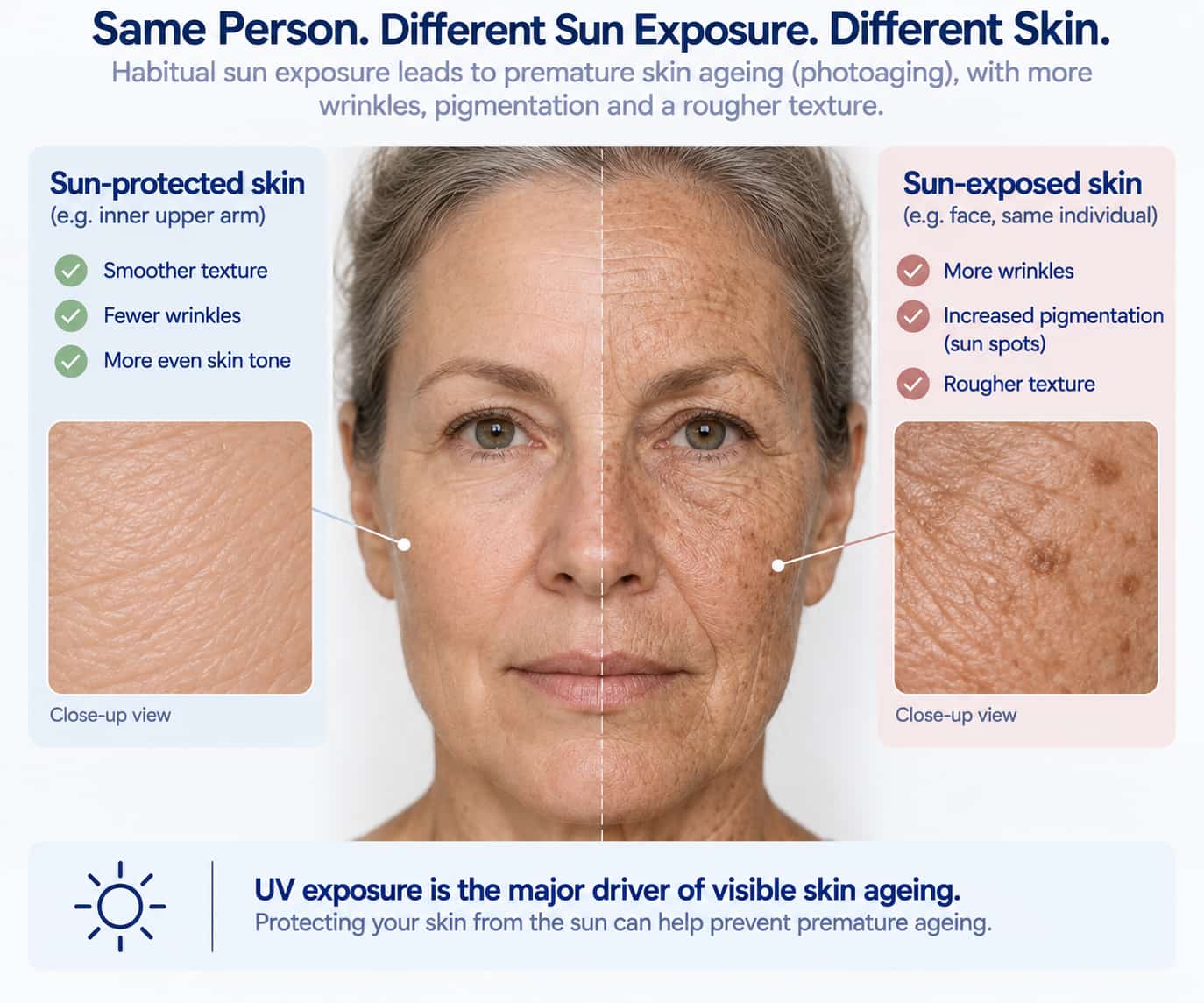
This mechanistic difference produces a genuinely distinct visual signature. Intrinsically aged skin tends to show fine, shallow wrinkles, gradual thinning, and even-toned but drier skin. Photoaged skin tends to show coarse, deep wrinkles, a thickened, leathery texture, mottled and uneven pigmentation (including sunspots, or solar lentigines), visible small blood vessels (telangiectasia), and rough, precancerous patches (actinic keratosis) in more severe cases. A dermatologist examining sun-protected skin (such as the underside of the upper arm or the buttocks) versus habitually sun-exposed skin (the face, neck, and forearms) on the same person can typically see this distinction directly, since the sun-protected areas reflect intrinsic ageing alone.
What the research shows
The 80% figure, and where it comes from. A frequently cited dermatological study (Flament et al.) examining visible clinical signs of ageing in Caucasian skin concluded that UV exposure accounts for approximately 80% of visible facial ageing signs — a figure now widely repeated across dermatology literature and reflected in subsequent reviews of photoaging and prevention. This is a genuinely significant number: it means the large majority of what's commonly perceived as "just getting older" is, more precisely, cumulative sun damage layered on top of a comparatively smaller intrinsic ageing process.
The truck driver case: a vivid, real-world illustration. In 2012, the New England Journal of Medicine published a case report that went on to become widely circulated internationally — a 69-year-old man, a truck driver for roughly 25-28 years, who had never worn sunscreen. Because UVA radiation passes through window glass largely unfiltered (unlike UVB, which is mostly blocked), his left side — the side facing the driver's window for decades — had developed dramatically more severe photoaging than his right: thicker, more deeply wrinkled skin that appeared roughly two decades older than the comparatively well-preserved right side of his face. The condition is formally known as unilateral dermatoheliosis, and the case became a genuinely powerful, visual demonstration of cumulative UV exposure's effect, isolated from every other variable, since it occurred within a single person.
Beyond the single case: a controlled study confirms the pattern. A pilot study published in Clinical Interventions in Aging went further than the single dramatic case, recruiting 10 people (8 women and 2 men, mostly drivers, teachers, shopkeepers, and salespeople) who had noticed asymmetric facial ageing they attributed to long-term one-sided window exposure. Using objective clinical skin measurements rather than visual impression alone, the researchers confirmed measurable underlying differences in skin physiology and morphology between the more- and less-exposed sides — providing controlled, if small-scale, scientific support for what the truck driver case illustrated dramatically.
Recommendations by skin concern
- 1Anyone who assumes visible skin ageing is largely fixed or inevitable
The 80% figure is worth internalising directly — it reframes skin ageing as a substantially preventable process, not a predetermined one, which is the practical foundation for the sun protection content covered in our upcoming UVA vs UVB and Sunscreen Labels articles.
- 2Drivers, and anyone spending significant time near windows (office workers, frequent flyers)
Given that UVA penetrates ordinary window glass largely unfiltered, and the truck driver case and follow-up study both confirm this causes measurable, asymmetric damage over time, sun protection habits shouldn't stop at the car or office door.
- 3Anyone trying to distinguish which of their own skin changes are "just age" versus sun-related
The visual differences described above — fine versus coarse wrinkles, even versus mottled tone, presence or absence of visible blood vessels — offer a genuinely useful, practical way to think about which changes are more responsive to sun protection and photoaging-targeted treatments versus those tied to the more fixed, intrinsic timeline covered elsewhere in this series.
- 4Anyone starting sun protection later in life, wondering if it's "too late"
Because photoaging and intrinsic ageing are separate, largely independent processes, reducing further UV exposure at any age stops adding to the photoaging component specifically, even though it can't reverse intrinsic ageing's separate, ongoing timeline.
- 5General / longevity-focused
Photoaging is arguably the single most modifiable major driver of visible skin ageing covered in this entire series — a genuinely disproportionate amount of leverage for a comparatively simple daily habit, covered in practical depth in our upcoming sunscreen-focused articles.
Practical notes
- →Roughly 80% of visible facial ageing is attributable to UV exposure, not the simple passage of time — a genuinely reframing statistic for anyone assuming ageing is mostly fixed
- →Photoaging and intrinsic ageing look visually different, not just differently severe — fine wrinkles and even, gradual thinning point toward intrinsic ageing; coarse wrinkles, mottled pigmentation, and visible blood vessels point toward photoaging
- →UVA penetrates ordinary window glass largely unfiltered — car and office windows don't provide meaningful protection, as the truck driver case and its follow-up study both demonstrate
- →Because photoaging is externally driven, it's also substantially preventable — unlike the more fixed biological timeline of intrinsic ageing covered elsewhere in this series
- →It's genuinely never "too late" to reduce further photoaging — stopping additional UV-driven damage remains valuable at any age, even though it doesn't reverse damage already accumulated
Photoaging and intrinsic ageing are frequently discussed as though they're the same process happening at different speeds, but the evidence shows they're mechanistically distinct — one substantially preventable, the other more fixed. For the biology behind intrinsic ageing specifically, see our Biology of Skin Aging and Collagen Loss articles, and for the practical detail on UV radiation and sun protection, see our upcoming UVA vs UVB and Sunscreen Labels articles. If you'd like a clearer picture of your own skin's ageing profile, our Longevity Doctors offer a free consultation as a starting point.
How does your skin
score on your longevity assessment?
Take the free Aevum Protocol assessment to see how your skin & longevity and 6 other longevity domains are performing — and get a personalised 90-day plan.
Take the Free Assessment →