Skin & Longevity
UVA vs UVB:
Which One Actually Ages Your Skin?
Our Photoaging vs Natural Ageing article established that UV exposure drives roughly 80% of visible facial ageing. This article breaks that down further — UV radiation isn't one uniform thing, and UVA and UVB behave, penetrate, and damage skin in genuinely different ways. Understanding the distinction matters practically, not just academically, and it sets up the sunscreen-label content in our next article.
Quick Summary
- →UVA and UVB differ in wavelength, and that difference determines how deep each one penetrates skin — UVA (315-400nm) reaches well into the dermis, where collagen and fibroblasts live, while UVB (280-315nm) is mostly absorbed by the epidermis
- →The common shorthand "UVA ages, UVB burns" is directionally useful but incomplete — UVA is indeed the dominant driver of photoaging, but UVB is actually three to four orders of magnitude more potent per unit of exposure at causing the direct DNA damage linked to skin cancer, according to IARC-reviewed research
- →UVA is far more abundant and far more constant — it makes up roughly 90-95% of UV radiation reaching the Earth's surface, penetrates clouds and ordinary window glass largely unfiltered, and stays relatively consistent across the day and across seasons, unlike UVB
- →Tanning beds emit predominantly UVA — specifically because UVA causes less immediate burning than UVB while still producing a tan, and the WHO's International Agency for Research on Cancer classifies tanning bed use as a Group 1 carcinogen, its highest-certainty category
- →Because UVB varies dramatically by time, season, and location while UVA doesn't, "it's cloudy" or "it's not summer" are unreliable reasons to skip sun protection — the photoaging-driving UVA component is present at meaningful levels essentially year-round
Key numbers at a glance
| Measure | Figure |
|---|---|
| UVA wavelength range | 315-400nm |
| UVB wavelength range | 280-315nm |
| Share of surface UV radiation that is UVA | ~90-95% |
| UVB's relative potency vs. UVA for direct DNA damage/cancer (animal research) | ~3-4 orders of magnitude more potent |
| IARC classification of tanning bed use | Group 1 (carcinogenic to humans) |
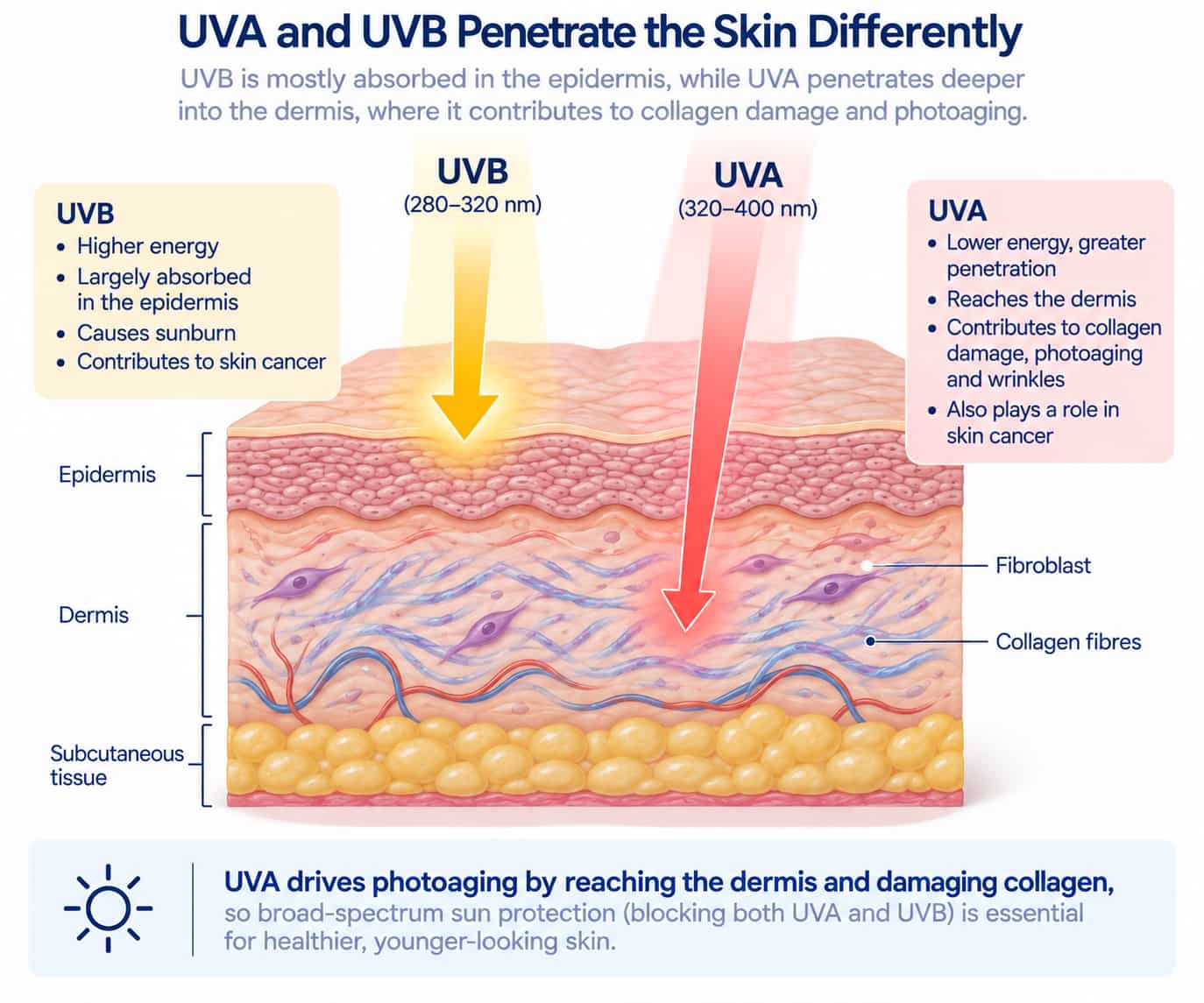
How it works: wavelength determines depth, and depth determines damage
UVA and UVB are defined by their wavelength — UVA spans roughly 315-400 nanometres, UVB spans roughly 280-315nm — and this difference directly determines how far each one penetrates into skin. UVA's longer wavelength allows it to reach well into the dermis, the layer containing collagen, elastin, and the fibroblasts that produce them, covered in our Collagen Loss article. UVB, with its shorter wavelength, is mostly absorbed within the epidermis, the outer layer, and comparatively little reaches the dermis at all.
This depth difference explains most of what each type of radiation actually does. UVA is highly efficient at generating reactive oxygen species (ROS) within the dermis, causing indirect DNA damage and directly activating the collagen-degrading MMPs covered in our Photoaging article — this is the primary mechanism behind photoaging. UVA also causes immediate, short-lived tanning by oxidising existing melanin already present in skin, noticeable within hours and fading within days. UVB, concentrated in the epidermis, is the dominant cause of sunburn (erythema) and causes direct DNA damage through a specific photochemical reaction (forming pyrimidine dimers) — the primary mechanism most directly linked to skin cancer development. UVB also drives the slower, delayed tanning response (new melanin production, appearing over days and lasting weeks) and is the specific wavelength range responsible for vitamin D synthesis in skin.
What the research shows
The "aging vs. burning" shorthand is useful, but the cancer risk picture is more nuanced than it suggests. It's genuinely true that UVA is the dominant driver of photoaging and UVB is the dominant driver of sunburn — but it would be a mistake to conclude UVA is "safe" simply because it doesn't burn. Research reviewed by the International Agency for Research on Cancer, using hairless mice models, found that UVB is roughly three to four orders of magnitude more effective than UVA at causing the specific carcinogenic damage studied — meaning, photon for photon, UVB is a dramatically more potent driver of DNA damage linked to skin cancer. However, this doesn't mean UVA is inconsequential for cancer risk: because UVA makes up such an overwhelming share of ambient UV exposure and penetrates so much more deeply and consistently, its cumulative contribution to overall skin cancer risk remains genuinely significant despite being less potent per unit — both wavebands matter for cancer risk, just through different weightings of potency versus volume.
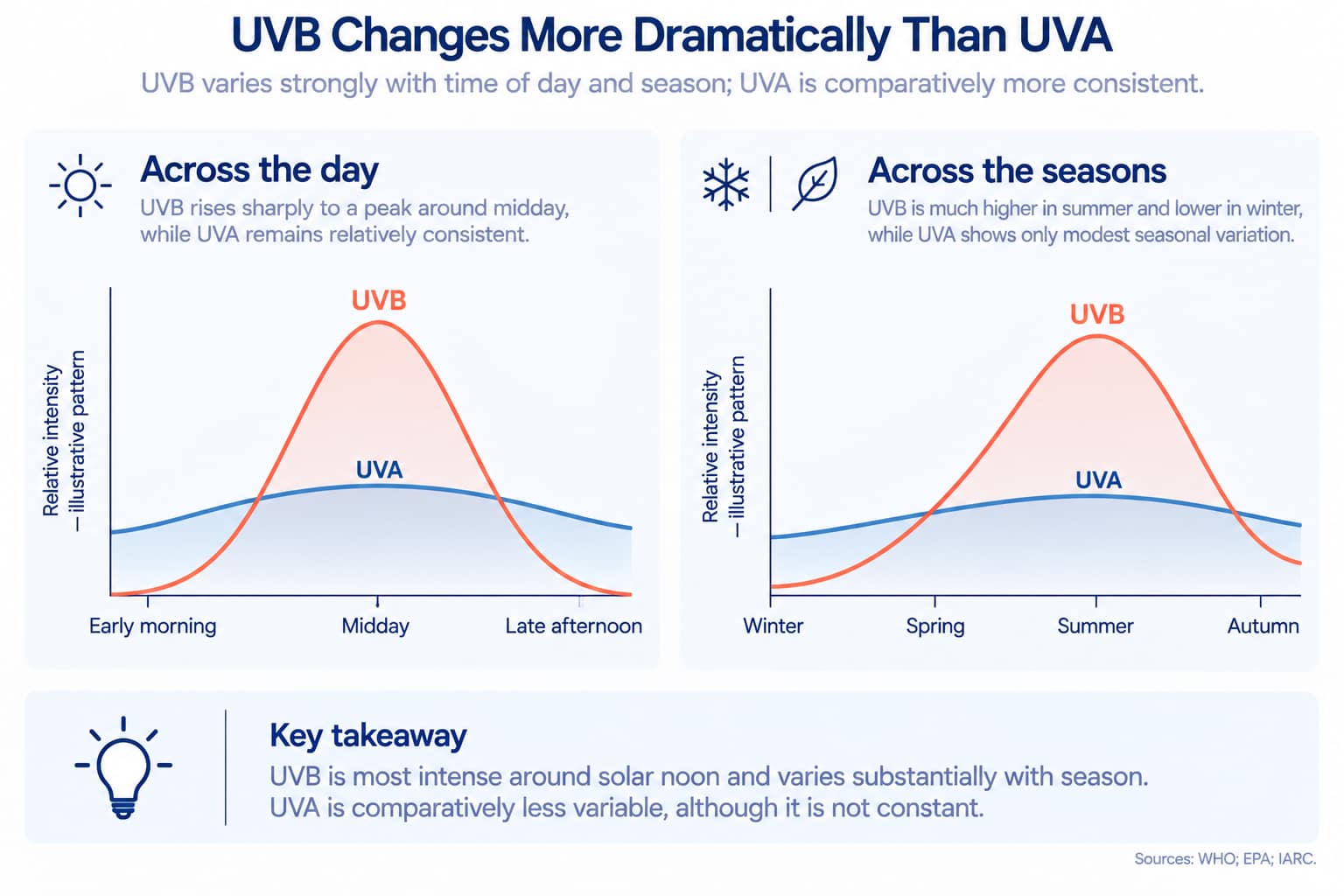
UVA's abundance and constancy is the more practically important point for everyday sun protection. UVA makes up roughly 90-95% of the UV radiation that reaches the Earth's surface (UVC, the third UV band, is almost entirely absorbed by the atmosphere's ozone layer and doesn't reach skin under normal conditions). Unlike UVB, which varies dramatically by time of day, season, and latitude — concentrated around midday and summer months — UVA intensity stays comparatively constant throughout the day and across the year, and passes through cloud cover and ordinary window glass largely unfiltered. This is the mechanism behind the asymmetric facial photoaging covered in our Photoaging article's truck driver case and the follow-up controlled study — UVB would have been substantially blocked by the vehicle's glass, but the UVA driving his photoaging was not.
Indoor tanning devices are generally designed to emit predominantly UVA radiation — precisely because UVA produces a tan with less of the immediate burning sensation UVB causes, making the experience more comfortable for users even though the underlying UV exposure, and its associated photoaging and cancer risk, remains substantial. Given this, and the broader body of research on UV exposure and skin cancer, the World Health Organization's International Agency for Research on Cancer classifies the use of tanning beds and devices as a Group 1 carcinogen — its highest level of certainty, the same category as tobacco smoking — a classification worth being genuinely aware of given how casually tanning bed use is sometimes treated.
Recommendations by skin concern
- 1Anyone who only applies sun protection on sunny, midday summer outings
Given that UVA — the dominant driver of photoaging — remains relatively constant across seasons, cloud cover, and time of day, this pattern leaves substantial photoaging-driving exposure unaddressed; our upcoming Sunscreen Labels article covers how to actually check for UVA-specific protection, not just general sun protection.
- 2Regular drivers, office workers near windows, or anyone spending significant time indoors near glass
As covered in our Photoaging article, ordinary window glass does little to block UVA specifically — this is a genuine, often-overlooked source of cumulative photoaging exposure.
- 3Anyone using or considering tanning beds
Given the Group 1 carcinogen classification and the concentrated UVA exposure involved, this is worth treating with the same seriousness as other major, avoidable cancer risk factors, not as a cosmetically neutral alternative to sun exposure.
- 4Anyone specifically concerned about skin cancer risk rather than cosmetic aging
While UVA's abundance makes it relevant to overall risk, UVB's substantially higher per-unit potency for direct DNA damage means protecting against peak UVB conditions (midday, summer, high altitude, reflective surfaces like snow or water) remains a genuinely important, distinct consideration from year-round UVA protection.
- 5General / longevity-focused
Understanding that "no visible burning" doesn't mean "no meaningful UV damage" is one of the more practically important reframes in this article — UVA does its damage silently and cumulatively, without the immediate feedback signal sunburn provides.
Practical notes
- →UVA penetrates deeper (into the dermis) and is far more abundant and constant than UVB — this combination is what makes it the dominant driver of photoaging specifically
- →UVB is far more potent per unit at causing direct DNA damage, which is why it's the dominant driver of sunburn and a major contributor to skin cancer risk despite being a much smaller share of total UV exposure
- →"No burning" doesn't mean "no damage" — UVA-driven photoaging and DNA damage accumulate without the warning sign sunburn provides
- →Ordinary window glass and cloud cover block UVB far more effectively than UVA — a genuinely important, often-missed distinction for anyone assuming being indoors or on a cloudy day means no meaningful UV exposure
- →Tanning beds are a concentrated UVA exposure with a Group 1 carcinogen classification — a serious, evidence-backed risk, not a minor cosmetic shortcut
Understanding UVA and UVB as genuinely different forms of radiation — not just "strong sun" versus "weak sun" — is the foundation for making sense of sunscreen labelling, covered in our next article. For the broader picture on photoaging this sets up, see our Photoaging vs Natural Ageing article. If you'd like a clearer picture of your own skin's sun exposure history and risk profile, our Longevity Doctors offer a free consultation as a starting point.
How does your skin
score on your longevity assessment?
Take the free Aevum Protocol assessment to see how your skin & longevity and 6 other longevity domains are performing — and get a personalised 90-day plan.
Take the Free Assessment →