Skin & Longevity
PA++++, UVA-PF & Broad-Spectrum:
Understanding Sunscreen Labels
Our UVA vs UVB article established that these two types of radiation cause genuinely different damage, and that UVA — the dominant driver of photoaging — needs its own, separate protection measure, since SPF alone doesn't cover it. This article is the practical payoff: what SPF actually measures, why "Broad Spectrum" alone isn't as informative as it sounds, and how to actually read PA and UVA-PF ratings so you can choose a sunscreen that protects against both types of damage, not just sunburn.
Quick Summary
- →SPF measures UVB protection only — it says nothing directly about UVA protection, the wavelength responsible for most photoaging, covered in our UVA vs UVB article
- →The SPF scale has steep diminishing returns, not a straight-line improvement — SPF 15 blocks about 93% of UVB, SPF 30 blocks about 97%, and SPF 50 blocks about 98%; going from SPF 50 to SPF 100 only closes the last one percentage point
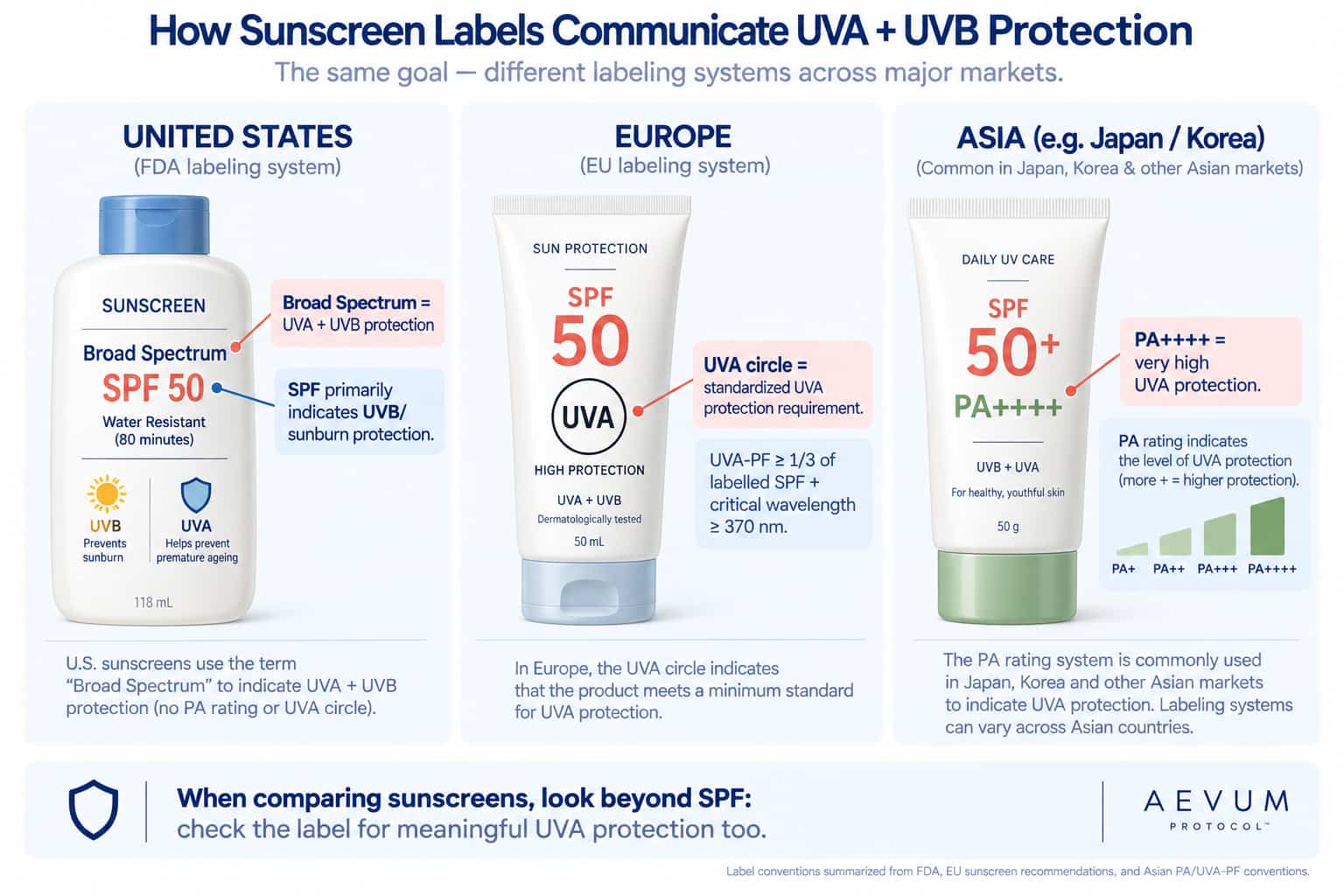
- →"Broad Spectrum" in the US confirms some UVA protection exists, but doesn't tell you how much — unlike the EU and several Asian markets, which require an actual UVA protection number or rating on the label
- →PA ratings (PA+ to PA++++), common across Asian markets, directly quantify UVA protection — PA++++ indicates the strongest tier, based on a standardised UVA exposure test
- →In the EU, a sunscreen's UVA-PF must be at least one-third of its labelled SPF to display the "UVA in a circle" symbol — meaning an SPF 50 product must provide a UVA-PF of at least 16.7 to qualify as genuinely balanced protection
Key numbers at a glance
| Measure | Figure |
|---|---|
| UVB blocked at SPF 15 / 30 / 50 / 100 | ~93% / ~97% / ~98% / ~99% |
| PA+ / PA++ / PA+++ / PA++++ (PPD value range) | 2-4 / 4-8 / 8-16 / 16+ |
| EU minimum UVA-PF, relative to labelled SPF | ≥1/3 of SPF |
| EU minimum critical wavelength for "broad spectrum" | ≥370nm |
| Maximum SPF number permitted on US labels | "50+" (regardless of measured value) |
How it works: what SPF actually measures, and what it doesn't
SPF (Sun Protection Factor) is based entirely on UVB — specifically, how much longer skin takes to show sunburn (erythema) with the product applied compared to without it. The underlying maths is simple: UVB transmission is roughly 1 divided by the SPF number. SPF 30 lets through about 1/30th, or roughly 3.3%, of UVB radiation; SPF 50 lets through about 1/50th, or 2%.
This produces a scale with genuinely steep diminishing returns, not the straight-line improvement the numbers suggest. SPF 15 blocks approximately 93% of UVB, SPF 30 blocks approximately 97%, SPF 50 blocks approximately 98%, and SPF 100 blocks approximately 99% — meaning the jump from SPF 50 to SPF 100 closes only the final one percentage point of UVB transmission, even though the number itself doubles. This is why most dermatology guidance settles on SPF 30-50 as the practical sweet spot for daily use, and why the US FDA caps sunscreen labels at "50+" regardless of how much higher the measured SPF actually is.
Critically, none of this says anything about UVA. A sunscreen can carry an impressively high SPF number while offering comparatively weak UVA protection — which is exactly the gap the ratings below exist to close.
What the research shows: how regions actually measure UVA protection
"Broad Spectrum" (United States): confirms UVA protection exists, but not how much. In the US, a sunscreen can only be labelled "Broad Spectrum" after passing a test confirming it protects up to a critical wavelength of at least 370 nanometres — meaningful coverage across the UVA range, not just UVB. This is a genuine, real requirement, not a marketing term used loosely. But it's also the least informative of the major systems: it confirms a minimum threshold was met, without giving consumers an actual number or rating to compare one broad-spectrum product's UVA strength against another's, the way SPF does for UVB.
PA ratings (Japan, South Korea, and other Asian markets): a direct, tiered UVA measurement. The PA (Protection Grade of UVA) system is based on the Persistent Pigment Darkening (PPD) test, which measures how much longer UVA-induced skin darkening takes to appear with the product applied. The result is converted into a tiered rating:
| PA Rating | PPD Value | Protection Level |
|---|---|---|
| PA+ | 2-4 | Some UVA protection |
| PA++ | 4-8 | Moderate UVA protection |
| PA+++ | 8-16 | High UVA protection |
| PA++++ | 16+ | Very high UVA protection |
This gives shoppers a genuinely comparable, quantified way to judge UVA protection strength, in the same spirit as the SPF number for UVB — PA++++ is the strongest widely-available tier, and worth specifically looking for if photoaging prevention, not just sunburn prevention, is the goal.
UVA-PF and the "UVA in a circle" symbol (European Union): a proportional requirement. The EU takes a different, ratio-based approach. Rather than a standalone tier, European regulation requires a sunscreen's UVA Protection Factor (UVA-PF) to be at least one-third of its labelled SPF number in order to display the "UVA" inside a circle symbol on packaging. In practice, this means an SPF 30 product needs a UVA-PF of at least 10, and an SPF 50 product needs a UVA-PF of at least 16.7 — a system designed to ensure UVA protection scales proportionally alongside UVB protection, rather than allowing a high SPF number to mask comparatively weak UVA coverage.
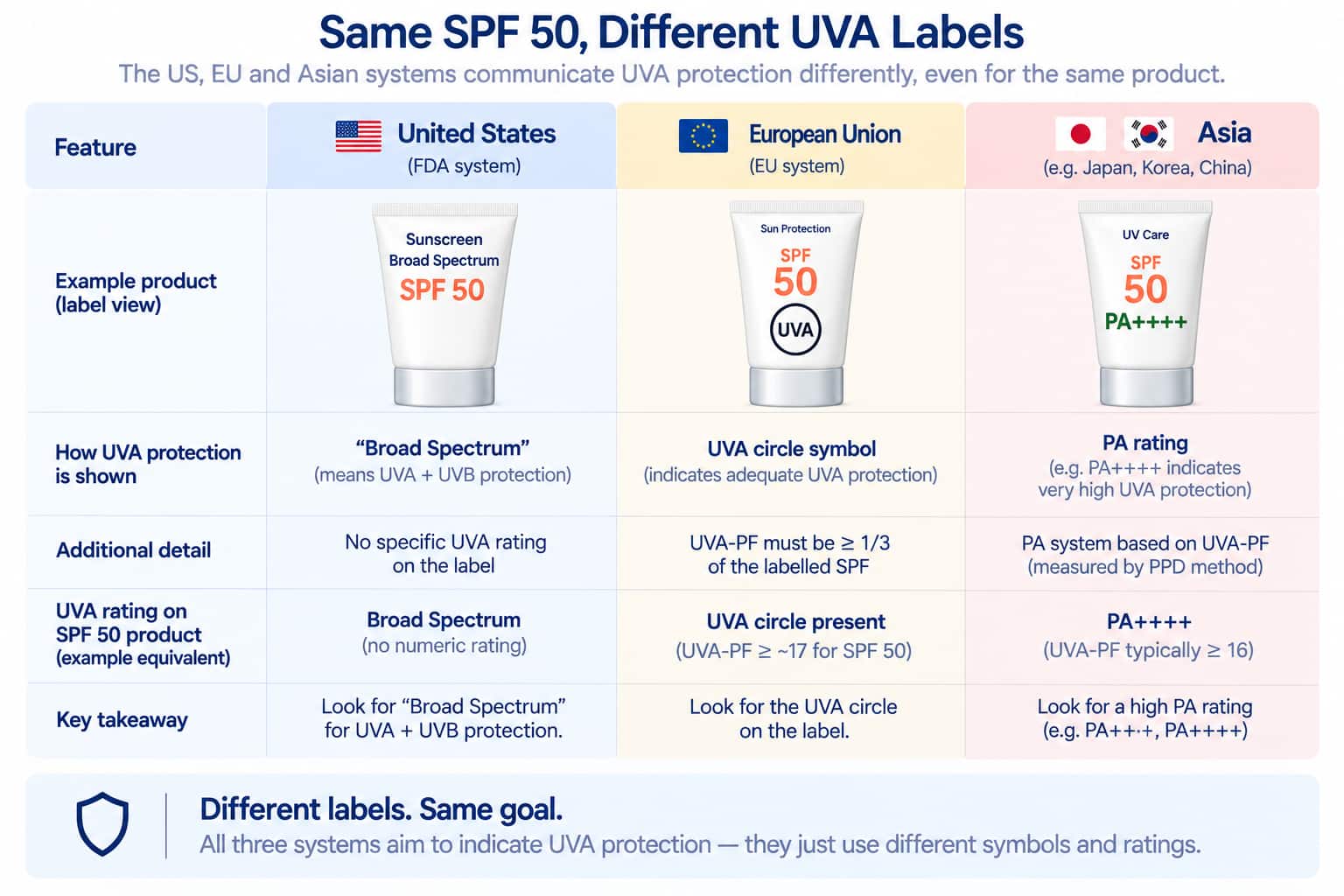
United States — "Broad Spectrum": UVA protection meets a minimum threshold (critical wavelength ≥370nm) — pass/fail only, no strength rating. European Union — UVA-in-circle symbol + UVA-PF number: UVA-PF is at least 1/3 of SPF — a proportional, scaled guarantee. Japan / Korea / Asia — PA+ to PA++++: a direct, tiered UVA protection rating, independent of the SPF number.
Recommendations by skin concern
- 1Anyone shopping primarily by SPF number alone
This article's core practical takeaway is to stop doing that — check specifically for "Broad Spectrum" (US), the UVA-in-circle symbol (EU), or a PA rating (Asia) as well, since SPF alone says nothing about the UVA protection driving most photoaging.
- 2Anyone prioritising anti-ageing specifically, not just sunburn prevention
Given that UVA is the dominant driver of photoaging covered in our UVA vs UVB article, actively seeking out PA+++ or PA++++ rated products, or EU products with a high UVA-PF relative to their SPF, is more directly relevant to this goal than simply choosing the highest SPF number available.
- 3Anyone buying sunscreen while travelling, or ordering from overseas retailers
Given how differently the US, EU, and Asian systems communicate UVA protection, the comparison table above is worth referring back to when a product's labelling looks unfamiliar.
- 4Anyone tempted by SPF 100+ products expecting dramatically better protection
Worth knowing this delivers a marginal, roughly one-percentage-point UVB improvement over SPF 50 — reapplication frequency and actually using enough product matter considerably more in practice than chasing an extremely high SPF number.
- 5General / longevity-focused
Given this entire series' emphasis on photoaging as a substantially preventable process, understanding how to actually verify UVA protection on a label — not just trusting a high SPF number — is a genuinely practical, everyday skill worth having.
Practical notes
- →SPF measures UVB only — always check separately for UVA protection via "Broad Spectrum," a UVA-in-circle symbol, or a PA rating, depending on where the product is sold
- →SPF 30-50 covers the practical sweet spot — the jump to SPF 100 delivers a marginal, roughly one-percentage-point improvement in UVB protection
- →PA++++ is the strongest widely available UVA rating — worth specifically seeking out if photoaging prevention is a priority
- →The EU's UVA-PF-to-SPF ratio (at least 1/3) is a genuinely useful proportional check — it prevents a high SPF number from masking weak UVA protection
- →"Broad Spectrum" in the US confirms a pass/fail threshold, not a strength rating — it's the least informative of the three major systems for comparing UVA protection between products
Reading a sunscreen label properly means checking two things, not one — UVB protection via the SPF number, and UVA protection via Broad Spectrum, PA rating, or UVA-PF, depending on where the product is from. For the underlying reason UVA protection matters as much as UVB, see our UVA vs UVB article. If you'd like personalised guidance on sun protection as part of a broader skin longevity plan, our Longevity Doctors offer a free consultation as a starting point.
How does your skin
score on your longevity assessment?
Take the free Aevum Protocol assessment to see how your skin & longevity and 6 other longevity domains are performing — and get a personalised 90-day plan.
Take the Free Assessment →