Skin & Longevity
How Fast Does
Your Skin Actually Age?
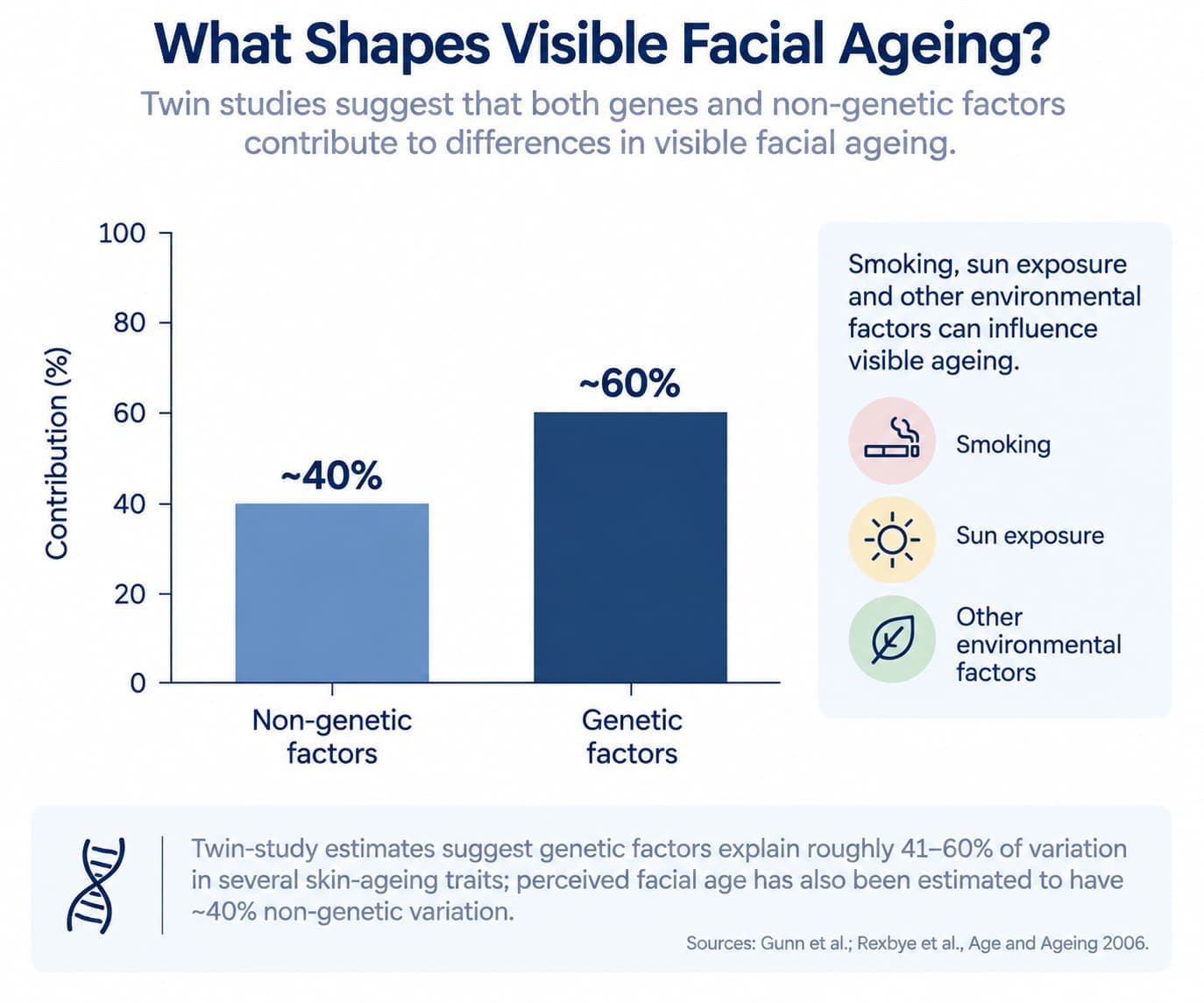
Our Biology of Skin Aging article covered what happens inside skin as it ages — fibroblast decline, cellular senescence, structural changes. This article covers a different, genuinely practical question: how fast does this actually happen, does it progress steadily or in bursts, and how much of the rate is really down to genetics versus what a person actually does. The honest answer, backed by a genuinely elegant piece of research, is that environment accounts for far more of visible skin ageing than most people assume.
Quick Summary
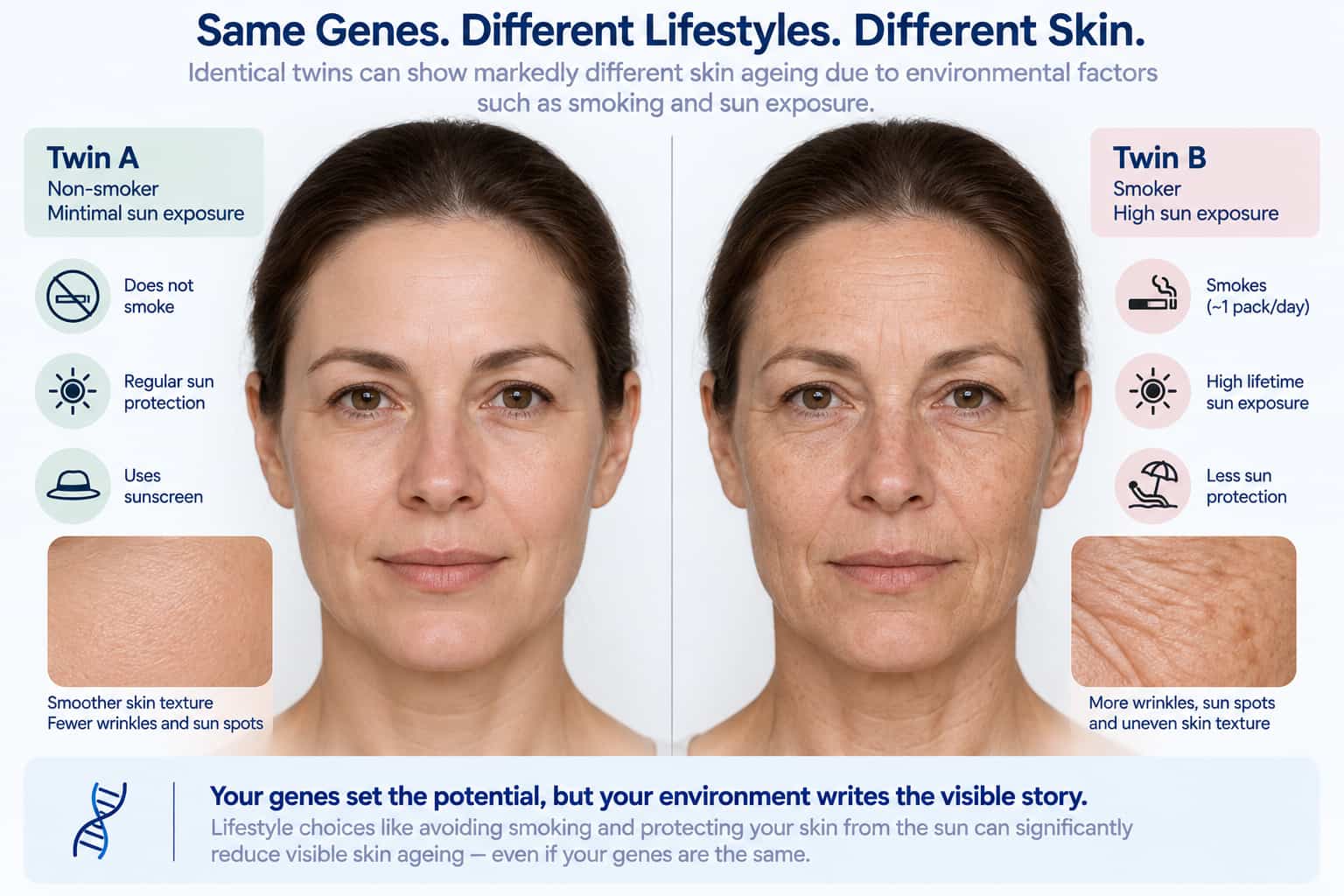
- →Up to 40% of visible facial ageing has been attributed to non-genetic, environmental factors in a landmark twin study — a substantial share, given that skin ageing is often assumed to be mostly predetermined by genetics
- →Smoking has a specific, quantified effect: in the same twin study, smoking twins were perceived as roughly 2.5 years older than their non-smoking twin for every decade they had smoked
- →Skin ageing doesn't progress at a perfectly steady rate — research using standardised facial imaging found certain signs (sagging, wrinkling, texture change) become statistically significant at specific decade thresholds rather than accumulating in a smooth, linear line
- →The timing of visible sun damage varies significantly by skin type — one histological study found signs of sun-related skin damage (elastosis) appearing in the 40s for Caucasian skin, but not until the 60s for Chinese and Hispanic skin in the same study, with African-American skin showing minimal change across the observed age range
- →This means "how fast" is genuinely a partly answerable, partly controllable question — not a fixed, predetermined timeline identical for everyone
Key numbers at a glance
| Measure | Figure |
|---|---|
| Facial ageing attributed to non-genetic factors (twin study) | Up to ~40% |
| Perceived age increase per decade of smoking (twin study) | ~2.5 years older |
| Perceived age difference in one twin pair (20-year smoking gap) | ~6.25 years |
| Perceived age difference in another twin pair (40-year smoking gap) | ~8.25 years |
| Elastosis (sun damage) onset, Caucasian vs. Chinese/Hispanic skin | 40s vs. 60s |
How it works: genetics, environment, and whether ageing is linear
Skin ageing rate is determined by a combination of intrinsic, genetically-programmed processes (covered in our Biology of Skin Aging article) and extrinsic, environmentally-driven ones — but the balance between these two is more heavily weighted toward environment than most people assume, a point the research below addresses directly.
Ageing also doesn't appear to progress in a perfectly smooth, linear fashion. Research using standardised, AI-graded facial imaging across a wide age range found that specific facial signs became statistically significant at different, fairly specific points — skin sagging became a significant, measurable change after the 20s, while wrinkling and texture changes became significant later, after the 30s, with certain features (like cheek pore size) showing distinct plateaus at particular decades rather than a constant, steady progression. This supports what many dermatologists describe anecdotally: skin ageing can feel like it happens in noticeable jumps at certain life stages rather than one smooth continuum.
What the research shows
The twin study: a genuinely elegant way to isolate environment from genetics. Because identical twins share essentially the same genetic code, studying twins with different lifestyle histories offers a rare, naturally-controlled way to measure how much of skin ageing is actually driven by environment and behaviour rather than genetics. A landmark study published in Plastic and Reconstructive Surgery examined 186 pairs of twins with differing smoking and sun exposure histories, and found that up to 40% of aging-related facial changes were attributable to non-genetic factors — smoking, sun exposure, body weight, and sun protection habits chief among them. The smoking-specific finding was particularly precise: smoking twins were perceived, by independent raters unaware of which twin smoked, as roughly 2.5 years older per decade of smoking history, compared to their non-smoking twin. Individual twin pairs in the study illustrated this vividly — one pair with a 20-year smoking gap showed a perceived age difference of 6.25 years, while another pair with a 40-year smoking gap showed an 8.25-year difference. A separate identical-twin case study, published in Archives of Dermatology, reinforced this, finding the twin with a roughly 52-pack-year smoking history showed visibly more severe skin ageing than her non-smoking twin, despite both having spent most of their lives at the same latitude with comparable sun exposure.
While individual timelines vary considerably based on genetics, skin type, and the environmental factors above, a broadly consistent pattern emerges across the literature. 20s: The foundational, largely invisible stage — antioxidant capacity in skin begins a gradual decline, and cumulative sun exposure starts building toward changes that won't become visible for years. Skin sagging becomes a statistically measurable change by the end of this decade in some research. 30s: Often described as the first decade where changes become subjectively noticeable — fine lines, early texture changes, and the first visible effects of accumulated sun exposure (particularly pigmentation) tend to emerge here. 40s: A more substantial shift for many people — collagen decline accelerates, and for Caucasian skin specifically, this is when sun-related elastosis typically becomes histologically evident. 50s and beyond: Often the most significant structural shift, particularly for women, given the accelerated collagen loss associated with the hormonal changes of menopause — covered in dedicated depth in our upcoming Hormones & Skin article.
Skin type and ethnicity affect timing meaningfully, not just severity. A histological study comparing skin biopsies across Caucasian, Hispanic, Chinese, and African-American women by decade found genuinely significant differences in when sun-related changes became visible, not just how severe they eventually became. Elastosis — a marker of cumulative sun damage — was evident starting in the 40s for Caucasian skin, but not until the 60s for Chinese and Hispanic skin in the same study, and African-American skin in the study showed no significant decrease in epidermal thickening at any age examined. This reflects genuine, biologically-based differences in melanin's photoprotective effect, and is a useful reminder that "how fast" doesn't have one universal answer even before accounting for individual lifestyle factors.
Recommendations by skin concern
- 1Anyone in their 20s
Given how much of the twin study's 40% environmental contribution is accumulated early and shows up later, this decade is genuinely the highest-leverage window for prevention — consistent sun protection and avoiding smoking matter more here than any product or procedure will later.
- 2Smokers, or anyone considering quitting
The twin study's smoking findings are about as concrete and personally motivating as skin-ageing research gets — a roughly 2.5-year perceived age cost per decade of smoking is a specific, quantified number worth knowing, beyond the more commonly cited general health risks.
- 3Anyone in their 40s or 50s noticing a more noticeable shift than previous years
This lines up with genuine research findings — both the accelerated collagen decline typical of this stage and, for women specifically, hormonal changes are legitimate contributors, not a sign that something has gone unusually wrong.
- 4Anyone with darker skin tones wondering why sun damage looks different or appears later than for lighter-skinned peers
This reflects genuine, documented biological differences in photoprotection, not a reason to skip sun protection — skin cancer and some degree of photoageing still occur across all skin tones, just on a different visible timeline.
- 5General / longevity-focused
The 40% figure is genuinely worth sitting with — it reframes skin ageing from a largely predetermined process into one where meaningful, evidence-backed behavioural choices measurably change the outcome, which is the central premise behind this entire Skin & Longevity series.
Practical notes
- →Environment accounts for a genuinely large share of visible skin ageing — up to 40% in the best available twin research, meaning this is a substantially modifiable process, not a fixed genetic timeline
- →Smoking's effect on perceived age is specific and quantifiable — roughly 2.5 years older per decade smoked, based on blinded rater assessment of twin pairs
- →Skin ageing likely progresses in noticeable shifts at certain life stages rather than a perfectly smooth line — this matches common anecdotal experience and has some support in standardised imaging research
- →"How fast" genuinely varies by skin type, particularly for sun-related changes — this is about biological photoprotection differences, not one group ageing "better" than another
- →The earlier preventive habits start, the more they matter — given how much of the environmental contribution accumulates silently in earlier decades before becoming visible later
Skin ageing rate is a genuinely more answerable, and more modifiable, question than it's often treated as — twin research puts real numbers on how much of it comes down to choices rather than fixed genetics. For the underlying cellular mechanisms behind these changes, see our Biology of Skin Aging article, and for how sun exposure specifically drives much of this environmental contribution, see our upcoming Photoaging vs Natural Ageing article. If you'd like a clearer picture of your own skin's ageing trajectory, our Longevity Doctors offer a free consultation as a starting point.
How does your skin
score on your longevity assessment?
Take the free Aevum Protocol assessment to see how your skin & longevity and 6 other longevity domains are performing — and get a personalised 90-day plan.
Take the Free Assessment →