Skin & Longevity
Hormones & Skin: Estrogen,
Menopause, and Accelerated Collagen Loss
Our Collagen Loss article covered the numbers — up to 30% collagen loss in the first five years after menopause — but deliberately deferred the underlying hormonal mechanism to this article. This piece covers why estrogen specifically has such a direct, measurable effect on skin structure, what happens when it declines, and what the actual clinical trial evidence shows about hormone therapy's effect on skin specifically — a genuinely real, if still-developing, area of research.
Quick Summary
- →Skin fibroblasts and keratinocytes carry estrogen receptors directly, making skin a genuine, direct hormonal target organ — not a passive bystander to hormonal changes happening elsewhere in the body
- →Estrogen supports collagen through two separate mechanisms simultaneously: it increases TGF-β1 signalling, which stimulates fibroblasts to produce more collagen, while separately decreasing MMP-1 (a collagen-degrading enzyme) — the same dual "produce more, break down less" pattern covered for retinoids in our Retinoids article
- →A controlled study found topical estrogen significantly increased collagen-producing fibroblasts — 57.5 versus 17.3 procollagen-positive cells per field compared to a vehicle control — and separate laboratory research found estradiol increased fibroblast collagen production to 132% of control levels
- →Randomised trials of oral hormone therapy have found genuinely measurable structural effects — one year of treatment increased dermal thickness by roughly a third in one trial, while a separate six-month trial found a 6.49% increase in skin collagen
- →Timing appears to matter: research suggests estrogen's effect is more restorative in women with already low collagen levels, and becomes more of a maintenance, preventive effect in women who intervene earlier, with only mild collagen loss
Key numbers at a glance
| Measure | Figure |
|---|---|
| Procollagen-positive fibroblasts, topical estrogen vs. vehicle | 57.5 vs. 17.3 cells/field |
| Fibroblast collagen production increase (in vitro, estradiol) | ~132% of control |
| Dermal thickness increase, 1-year oral conjugated estrogen RCT | ~33% |
| Skin collagen increase, 6-month oral estrogen RCT | ~6.49% |
| Participants in the Sauerbronn et al. HRT collagen trial | 41 postmenopausal women |
How it works: skin as a genuine hormonal target organ
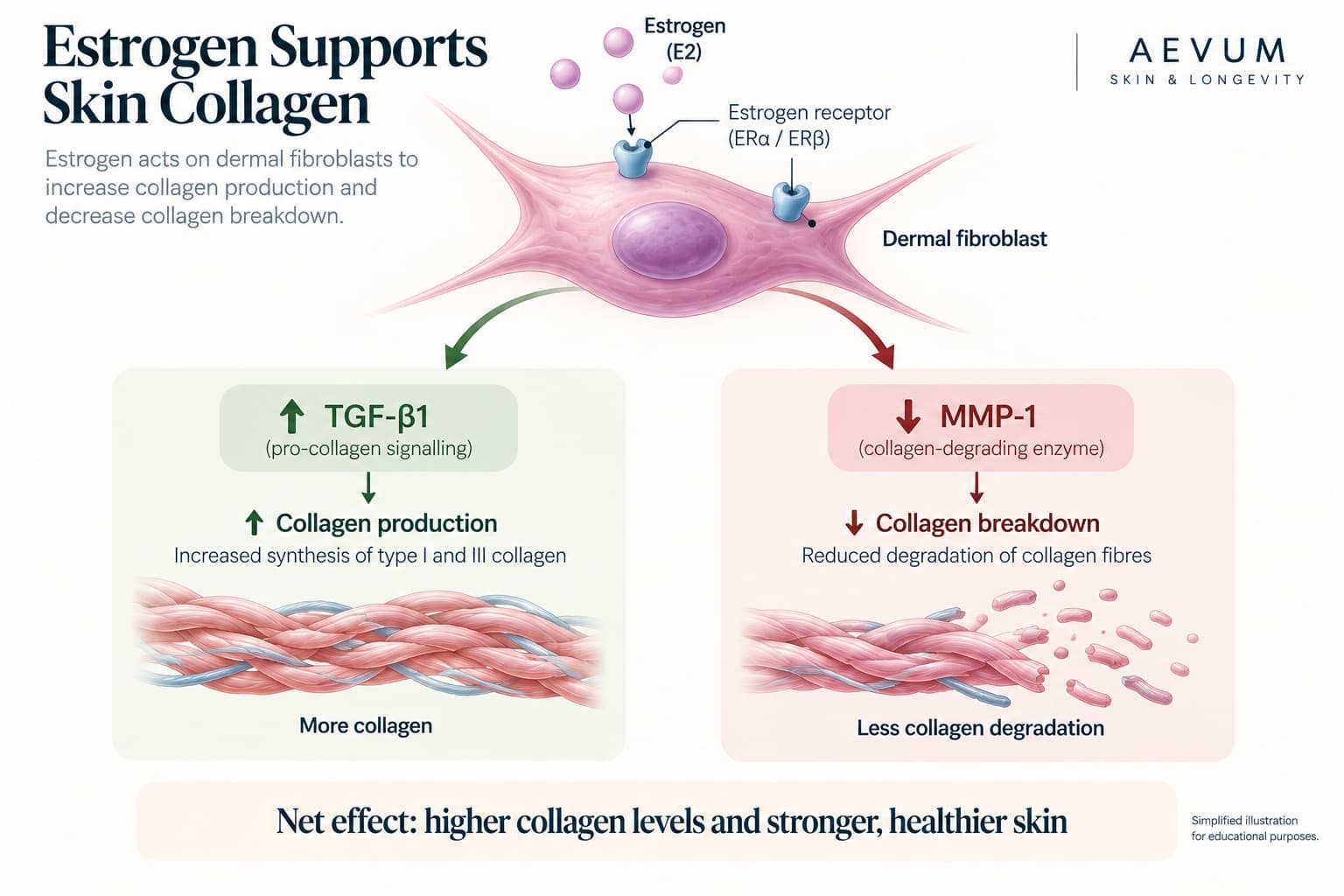
Since the 1990s, research has established that skin fibroblasts and keratinocytes carry functional estrogen receptors (ERα and ERβ) — meaning skin isn't simply an indirect casualty of hormonal change happening elsewhere in the body, but a direct, responsive target tissue in its own right. This is part of why the menopausal collagen acceleration covered in our Collagen Loss article is so pronounced and well-documented, compared to the more gradual, less hormonally-driven intrinsic ageing process covered in our Biology of Skin Aging article.
Estrogen supports skin structure through two separable mechanisms working together. It increases TGF-β1 signalling, a growth factor that stimulates fibroblast proliferation and extracellular matrix production — directly increasing new collagen synthesis. At the same time, it decreases MMP-1 expression, one of the collagen-degrading enzymes covered in our Collagen Loss article — reducing the rate of collagen breakdown. This is genuinely the same "produce more, break down less" dual mechanism covered for retinoids in our Retinoids article, just achieved hormonally rather than through a topical active ingredient. Beyond collagen specifically, estrogen also supports hyaluronic acid production (affecting skin hydration and water retention), skin thickness more broadly, and wound healing capacity — research has found estrogen accelerates cutaneous wound healing through this same TGF-β pathway.
What the research shows
Direct evidence of estrogen stimulating collagen-producing cells. A study examining topical estrogen's effect on skin found a striking difference in fibroblast activity: 57.5 procollagen-positive fibroblasts per field in estrogen-treated skin, compared to 17.3 in vehicle-treated skin — a statistically significant difference (p<0.01) directly demonstrating increased collagen-producing cellular activity. Complementary laboratory research on cultured dermal fibroblasts found estradiol directly increased type I procollagen protein synthesis to 132% of control levels — genuine, cell-level confirmation of the mechanism, not just an indirect population correlation.
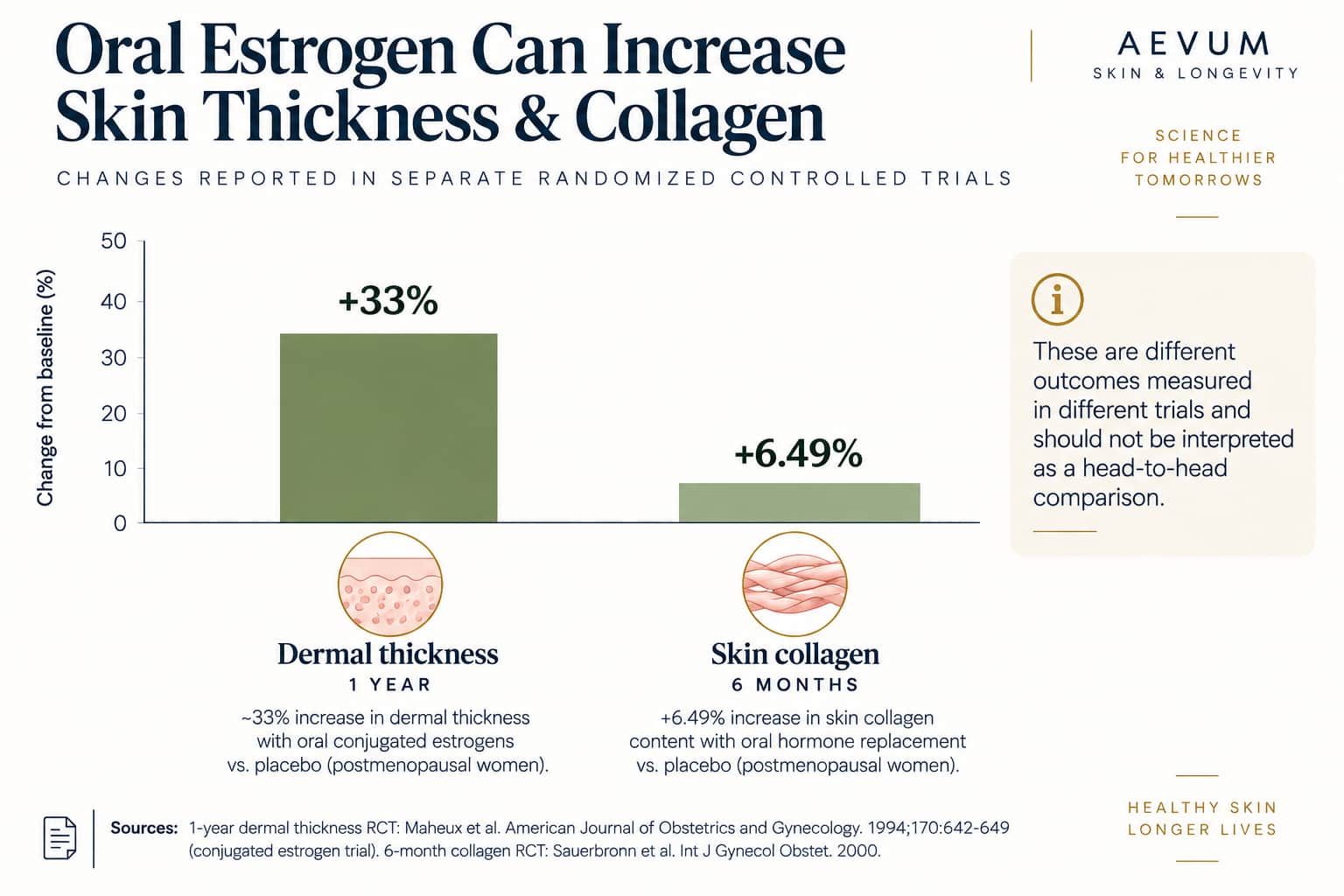
Randomised controlled trials confirm measurable structural changes in real patients. A randomised, double-blind, placebo-controlled trial of postmenopausal women found that one year of oral conjugated estrogen therapy increased dermal thickness by approximately 33% compared to placebo. A separate trial found six months of oral estrogen increased skin collagen by 6.49%. In a specific RCT of 41 postmenopausal women (Sauerbronn et al.), six months of hormone therapy produced a statistically significant increase in collagen — though notably, the same trial found no significant change in elastin content, a genuinely important nuance: estrogen's benefit appears more consistently established for collagen than for elastin, and not every structural skin protein responds equally.
Topical estrogen shows a similar direction of effect, with more limited evidence overall. A clinical trial of topical 0.01% estradiol over 16 weeks found a significant increase in both dermal thickness and collagen content. It's worth being honest about the state of this specific evidence base, though: a recent review notes that the use of prescription and off-label topical estrogen creams has grown rapidly in recent years despite limited clinical evidence, with most supporting trials involving small sample sizes (some as few as 6 participants) — genuinely promising, mechanistically coherent findings, but not yet the scale of evidence available for the retinoids or vitamin C covered earlier in this series.
Timing appears to genuinely matter. Research suggests that estrogen's effect on skin collagen relates to a person's starting collagen level — in women with already significantly reduced collagen, estrogen therapy appears genuinely restorative, while in women who begin treatment earlier, with only mild collagen loss in the years immediately following menopause, the effect functions more as prevention of further loss than active restoration. This is a useful, practical distinction: earlier intervention appears to preserve more of what's already present, rather than needing to rebuild significant loss later.
When topical estradiol was applied to the skin of young men in one study, similar collagen-stimulating effects were observed — indicating the underlying mechanism isn't exclusive to female biology, even though the clinical relevance of the menopausal transition specifically is what makes this such a pronounced, well-studied phenomenon in women.
Recommendations by skin concern
- 1Perimenopausal and menopausal women considering hormone replacement therapy
The skin-specific evidence for collagen and dermal thickness benefit is genuinely real and measurable — but HRT is a significant medical decision involving considerably more than skin outcomes alone, and is worth discussing comprehensively with a doctor rather than pursued for skin benefit in isolation.
- 2Women not pursuing systemic HRT, but interested in topical options
Topical estrogen shows a similar direction of benefit in early research, though the evidence base remains smaller and less established than systemic HRT — worth discussing with a dermatologist or doctor familiar with this specific, still-developing area, particularly given usage has grown faster than the supporting evidence in some markets.
- 3Anyone in early perimenopause, before significant collagen loss has occurred
Given the research suggesting earlier intervention functions more preventively than restoratively, this may be a particularly relevant window for discussing options proactively, rather than waiting until collagen loss is already substantial.
- 4Anyone who has already experienced several years of postmenopausal collagen loss
The research suggesting a more restorative effect in women starting from lower collagen levels is worth knowing — it's not necessarily "too late" to see a measurable benefit, based on the trial data above.
- 5General / longevity-focused
The estrogen-collagen relationship is one of the more mechanistically well-explained hormonal connections in this entire series, directly bridging the "why does menopause specifically accelerate skin ageing" question left open in our Collagen Loss article.
Practical notes
- →Skin genuinely responds to estrogen directly, via its own receptors — this isn't an indirect, secondary effect of hormones acting elsewhere in the body
- →The dual mechanism (more collagen production, less collagen breakdown) mirrors how retinoids work, just through a different, hormonal pathway rather than a topical active ingredient
- →Collagen and elastin don't necessarily respond equally to estrogen — trial evidence is more consistent for collagen specifically
- →Topical estrogen's evidence base is real but still developing, with smaller trials than more established actives — worth approaching with realistic expectations and professional guidance rather than assuming it's as thoroughly proven as retinoids or vitamin C
- →Earlier intervention appears more preventive, later intervention more restorative — both are supported by research, but the practical goal differs depending on timing
Estrogen's role in skin isn't a minor hormonal footnote — it's a direct, receptor-mediated relationship with real, measurable effects on collagen production and breakdown, explaining much of why the menopausal transition accelerates skin ageing so distinctly. For the collagen loss timeline this explains, see our Collagen Loss article, and for the broader ageing picture this fits into, see our Biology of Skin Aging article. If you'd like a clearer, personalised picture of your own hormonal and skin health, our Longevity Doctors offer a free consultation as a starting point.
How does your skin
score on your longevity assessment?
Take the free Aevum Protocol assessment to see how your skin & longevity and 6 other longevity domains are performing — and get a personalised 90-day plan.
Take the Free Assessment →