Skin & Longevity
Retinoids for Skin Aging:
Retinol vs Retinal vs Tretinoin
Our Collagen Loss article covered how fragmented collagen actively suppresses fibroblasts' ability to produce new collagen, and our Skin Barrier article covered how much barrier disruption skin can tolerate before permeability increases significantly. Retinoids sit directly at the intersection of both: the most evidence-backed ingredient class for directly countering collagen loss, and one of the most common causes of temporary barrier irritation when used incorrectly. This article covers what actually distinguishes the different forms, and how to use them without unnecessary irritation.
Quick Summary
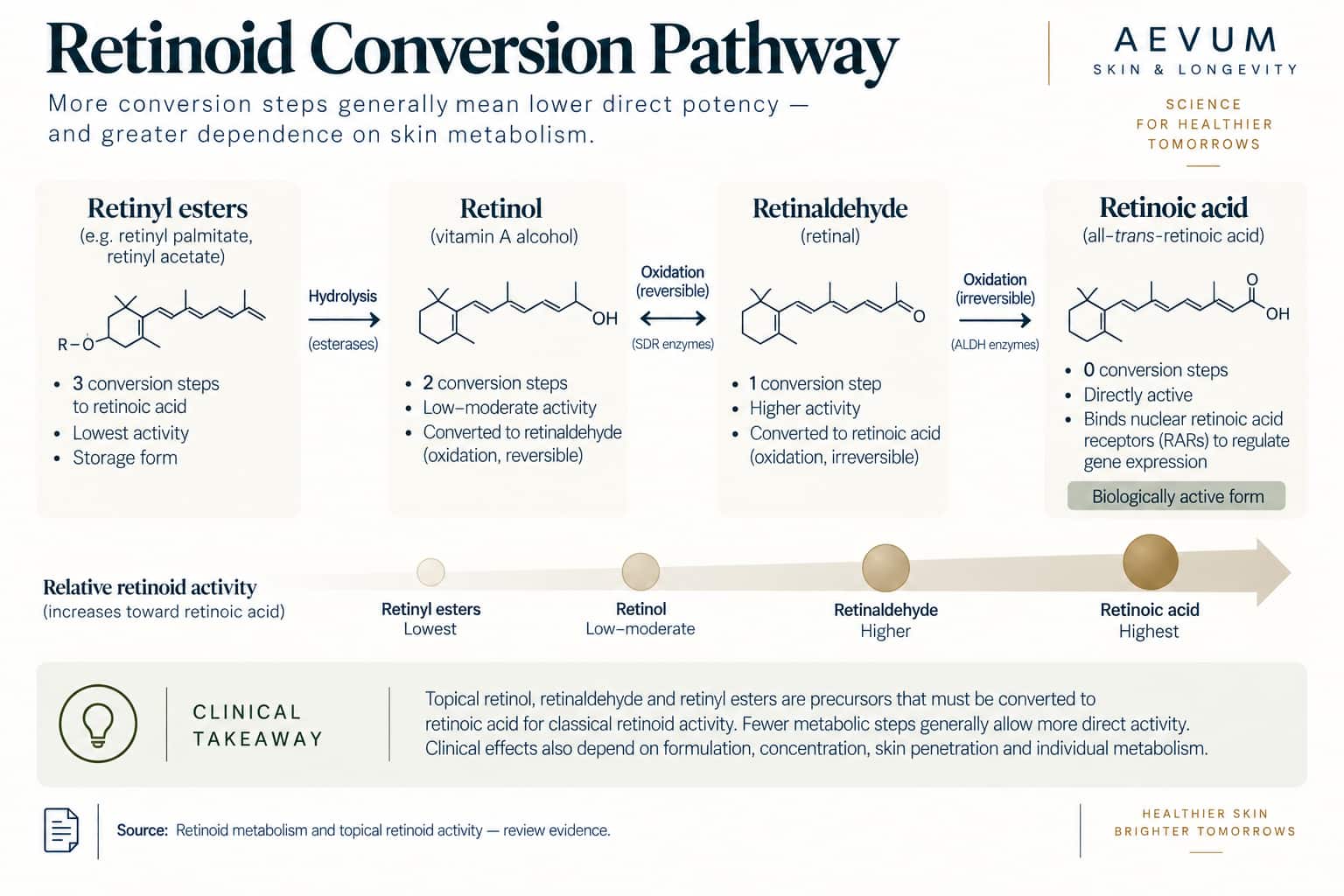
- →All retinoids are vitamin A derivatives that must convert into retinoic acid to work — the number of conversion steps required determines potency, speed, and irritation: retinol needs two steps, retinaldehyde (retinal) needs one, and tretinoin (retinoic acid) needs none, since it's already the active form
- →Retinaldehyde is roughly 10-20 times more potent than retinol at the same concentration, and tretinoin is roughly 20 times more potent than retinol — meaning a small percentage difference on a label can represent a very large difference in actual delivered effect
- →Retinol's real-world results vary considerably between individuals because the conversion efficiency from retinol to active retinoic acid ranges from roughly 5% to 20% person to person — a genuine, biological reason some people see much more from retinol than others
- →A 2025 network meta-analysis of 23 randomised controlled trials and nearly 4,000 participants confirmed that tretinoin, retinol, and isotretinoin all significantly improve fine wrinkles — this is one of the most robust evidence bases of any ingredient category covered in this series
- →Retinal and retinol show meaningfully lower irritation than tretinoin in comparative studies, while retinal delivers results closer to tretinoin's — making it a genuinely useful middle option for people who've plateaued on retinol but aren't ready for a prescription-strength product
Key numbers at a glance
| Measure | Figure |
|---|---|
| Conversion steps: retinol / retinal / tretinoin | 2 / 1 / 0 |
| Retinal's potency relative to retinol | ~10-20x more potent |
| Tretinoin's potency relative to retinol | ~20x more potent |
| Individual variation in retinol-to-retinoic-acid conversion efficiency | ~5-20% |
| Participants in the 2025 network meta-analysis confirming efficacy | ~3,905 (23 RCTs) |
Why this matters: how retinoids actually work
Once converted to retinoic acid, retinoids work by binding directly to retinoic acid receptors (RARs) inside skin cell nuclei, directly regulating gene transcription. This has two effects highly relevant to the collagen biology covered in our Collagen Loss article: retinoids upregulate genes involved in new collagen production, while simultaneously downregulating the matrix metalloproteinases (MMPs) responsible for breaking existing collagen down. This is genuinely significant given the self-reinforcing collagen fragmentation cycle described in that article — retinoids work on both sides of the same balance, not just one.
Comparing the forms: conversion, potency, and evidence
| Retinyl Esters | Retinol | Retinaldehyde (Retinal) | Tretinoin | |
|---|---|---|---|---|
| Conversion steps to active form | 3 | 2 | 1 | 0 (already active) |
| Relative potency vs. retinol | ~5x weaker | Baseline | ~10-20x stronger | ~20x stronger |
| Availability | Over-the-counter | Over-the-counter | OTC in most markets | Prescription-only (most countries) |
| Typical irritation level | Lowest | Low-moderate | Low-moderate (similar to retinol) | Highest |
| Clinical evidence depth | Limited | Substantial | Growing, smaller trials | Most extensive (40+ years) |
| Typical timeline to visible results | Slow (months+) | Moderate (2-3 months) | Faster than retinol | Fastest (weeks-months) |
Why the conversion pathway explains everything else in this table. Every enzymatic conversion step loses some of the applied product to inefficiency along the way — retinol's two-step journey to retinoic acid means a meaningful portion never completes the conversion, which is both why it's gentler (less active ingredient actually reaches the receptor) and why results vary so much between individuals (conversion efficiency itself varies from person to person, estimated at roughly 5-20%). Retinaldehyde skips that first, less efficient step, delivering more of the applied dose as active retinoic acid — which is why a well-formulated 0.05-0.1% retinaldehyde product can outperform a 0.5% retinol product despite the far lower percentage on the label. Comparing retinoid products by percentage alone is genuinely misleading — the form matters more than the number.
How to actually use retinoids
- →Start low and slow, regardless of which form you choose. Begin with 2-3 nights a week, gradually building toward nightly use over several weeks as tolerance develops — this applies even to "gentle" retinol, and especially to retinaldehyde or tretinoin
- →Apply to fully dry skin, and consider the "buffer" technique — applying a bland moisturiser before the retinoid (or immediately after) to dilute its initial penetration and reduce irritation without meaningfully reducing effectiveness over time
- →Expect a "retinization" period — initial dryness, flaking, or mild irritation in the first 2-6 weeks is common and usually temporary as skin adjusts, rather than a sign the product is wrong for you
- →Sun protection isn't optional while using any retinoid. Retinoids increase how vulnerable freshly-turned-over skin is to UV damage — pairing with the sun protection habits covered in our UVA vs UVB and Sunscreen Labels articles is essential, not just a general good habit
- →Retinoids are contraindicated during pregnancy and breastfeeding. This is a genuine, well-established safety consideration, not an overcautious guideline — topical retinoid risk is debated and considered lower than oral isotretinoin's well-established teratogenicity, but the standard, precautionary medical guidance is to avoid all forms during this period
Recommendations by skin type or goal
- 1Beginners, or anyone with sensitive skin as covered in our Sensitive Skin article
Start with retinol or retinaldehyde at a low concentration rather than jumping straight to tretinoin — both show meaningfully lower irritation in comparative studies, and retinaldehyde specifically offers a faster, stronger effect than retinol while maintaining a similar tolerability profile.
- 2Anyone who has used retinol consistently for 6+ months without further improvement
Retinaldehyde is a reasonable next step before considering a prescription — it delivers results approaching tretinoin's while staying closer to retinol's gentler tolerability.
- 3Anyone seeking maximum, fastest results, or managing acne alongside aging concerns
Tretinoin remains the evidence-based gold standard with the deepest clinical trial history, best pursued through a dermatologist who can guide concentration and frequency given its higher irritation potential.
- 4Anyone pregnant, breastfeeding, or trying to conceive
Avoid all retinoid forms during this period — our Peptides and Niacinamide articles cover alternative actives with different, pregnancy-compatible safety profiles worth discussing with a doctor.
- 5General / longevity-focused
Given the exceptionally strong evidence base — a 2025 meta-analysis of nearly 4,000 participants confirming efficacy across multiple retinoid types — this is one of the more confidently recommendable categories in skincare, provided the introduction is gradual enough to avoid unnecessary barrier disruption.
Practical notes
- →The conversion pathway (3 steps → 0 steps) explains potency, speed, and irritation all at once — fewer steps means more delivered active ingredient, which means faster results but also more irritation potential
- →Comparing products by percentage alone is misleading — a low-percentage retinaldehyde product can outperform a much higher-percentage retinol product
- →Retinol's inconsistent results across different people have a real biological explanation — individual conversion efficiency genuinely varies, not just skincare routine or product quality
- →The "retinization" adjustment period is normal, not a sign to stop — most irritation resolves within 2-6 weeks of consistent, gradual use
- →Sun protection is non-negotiable while using any retinoid — this isn't a minor caveat, but a necessary pairing given retinoids' effect on UV sensitivity
Understanding the conversion pathway — not just brand names or marketing tiers — is the key to choosing the right retinoid form and setting realistic expectations for both results and irritation. For the collagen biology retinoids directly target, see our Collagen Loss article, and for managing the barrier disruption that can accompany starting a new retinoid, see our Skin Barrier article. If you'd like personalised guidance on introducing retinoids into your routine, our Longevity Doctors offer a free consultation as a starting point.
How does your skin
score on your longevity assessment?
Take the free Aevum Protocol assessment to see how your skin & longevity and 6 other longevity domains are performing — and get a personalised 90-day plan.
Take the Free Assessment →