Skin & Longevity
The Skin Barrier:
Why It's the Foundation of Everything Else
Nearly every topic later in this series — sensitive skin, skin pH, retinoids, chemical exfoliation — ultimately comes back to one structure: the skin barrier. This article covers what it actually is, what it does, and why understanding it changes how to think about nearly every other skincare decision, since a compromised barrier is often the real, underlying reason a product or routine stops working or starts causing irritation.
Quick Summary
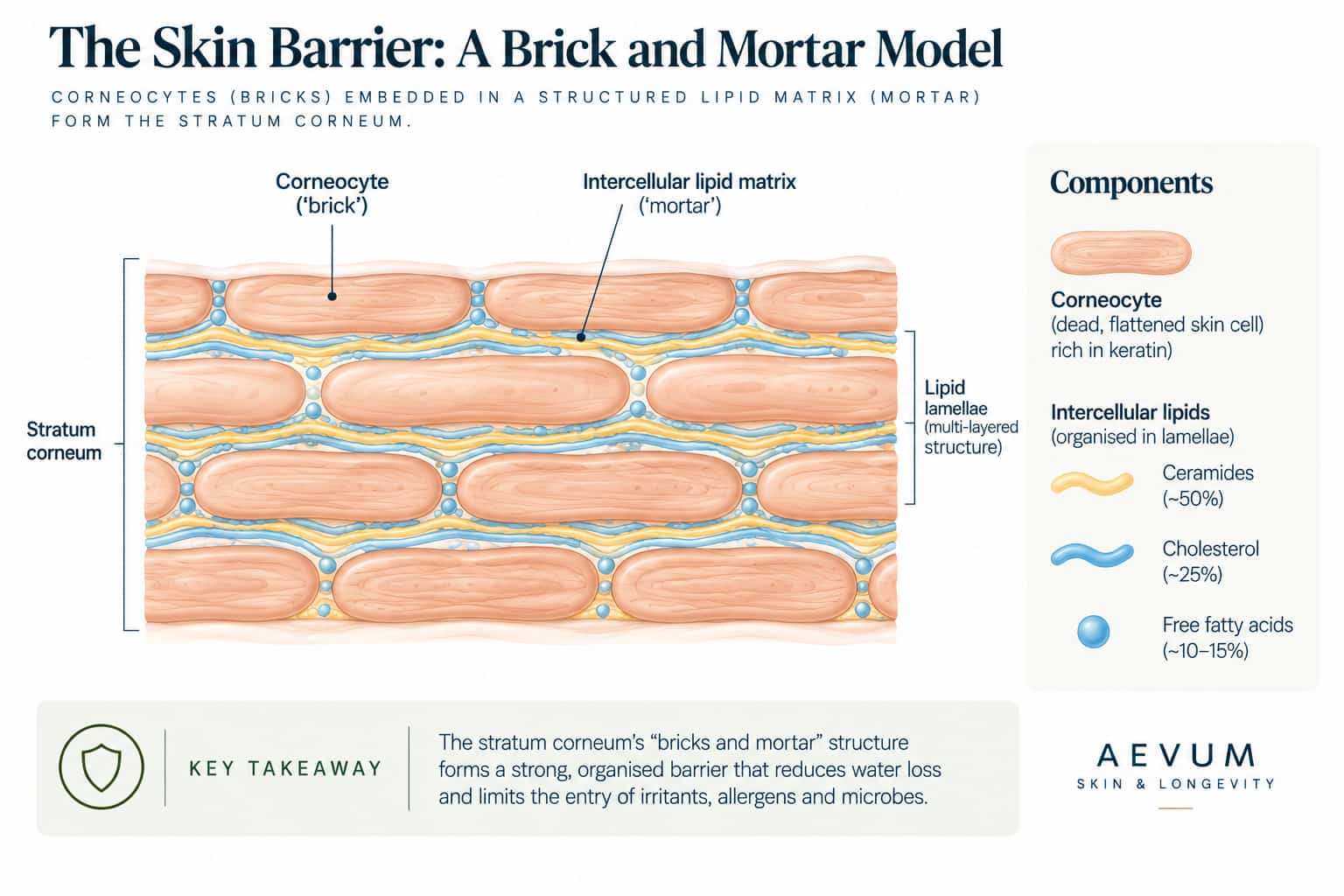
- →The outermost layer of skin, the stratum corneum, works like a brick wall — corneocytes (the "bricks") are held together by a structured lipid matrix (the "mortar") made up of ceramides, cholesterol, and free fatty acids in roughly equal proportions
- →Reducing ceramide content by as little as 30% significantly increases skin permeability in controlled research — a relatively small disruption is enough to measurably compromise the barrier's protective function
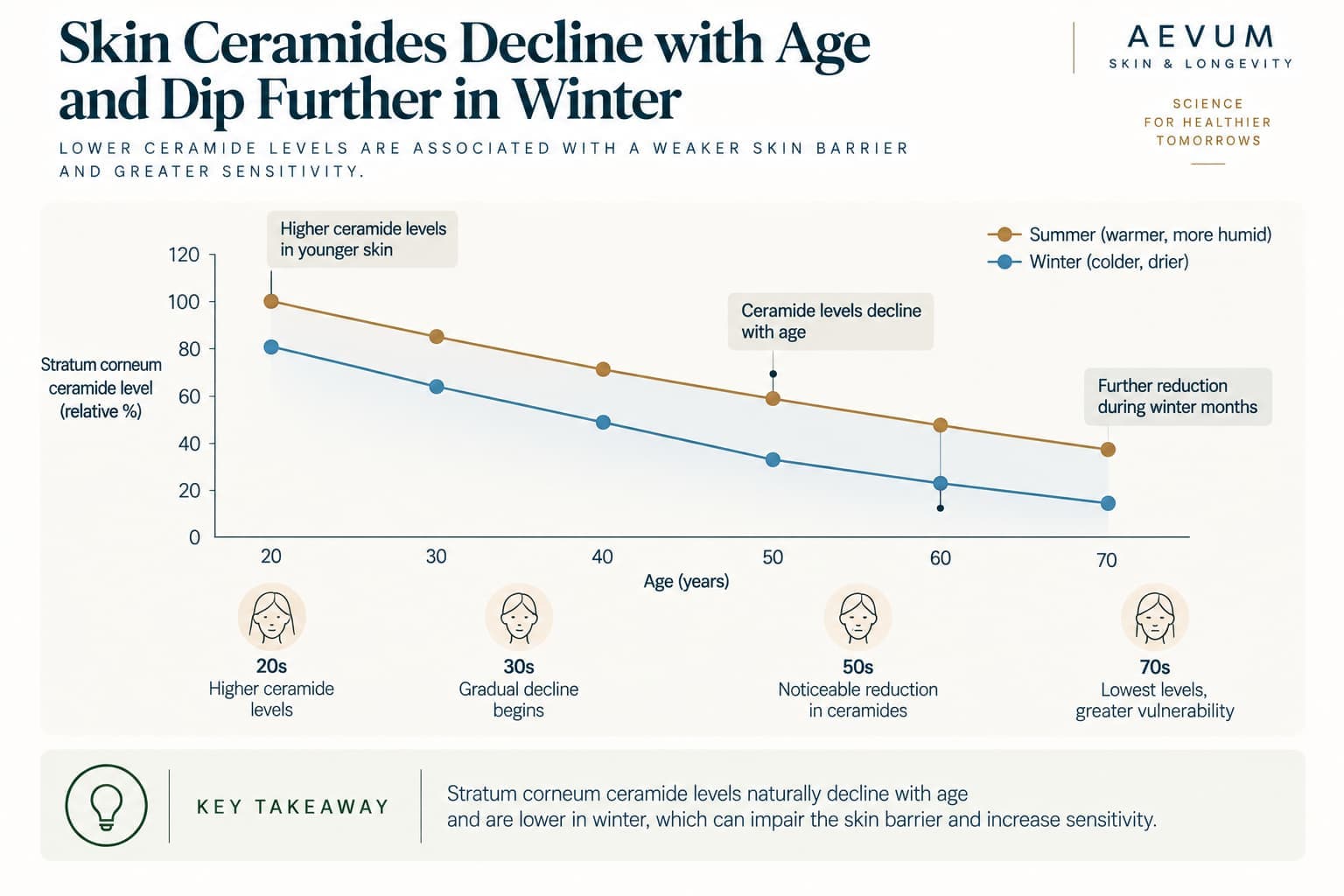
- →Ceramide levels decline significantly with age, and separately, with the seasons — stratum corneum lipid levels drop notably in winter across all age groups, making barrier support a genuinely seasonal consideration, not just an age-related one
- →Topical lipid replacement (particularly ceramide-containing formulations) has been shown in controlled trials to measurably restore ceramide profiles and strengthen barrier function — this isn't just a marketing claim, but a demonstrated, mechanistic effect
- →Most cases of "sensitive skin," irritation from actives, and stubborn dryness trace back to barrier dysfunction — understanding this reframes many common skin complaints as a single underlying issue rather than separate, unrelated problems
Key numbers at a glance
| Measure | Figure |
|---|---|
| Main stratum corneum lipid classes | Ceramides, cholesterol, free fatty acids |
| Approximate ratio of these three lipid classes | Roughly equal molar amounts |
| Ceramide reduction needed to significantly increase permeability | ≥30% |
| Distinct ceramide species identified in human skin | 1,000+ |
| Seasonal lipid depletion | Significant decrease in winter |
How it works: bricks, mortar, and what the barrier actually does
The outermost layer of skin, the stratum corneum, is often described using a "brick and mortar" model, and the analogy holds up well mechanistically. Corneocytes — flattened, mature skin cells that have completed their journey from the deeper epidermis — act as the bricks, while a highly organised, densely-packed lipid matrix acts as the mortar holding them together. This lipid matrix is made up primarily of three components — ceramides, cholesterol, and free fatty acids — present in roughly equal molar amounts (by weight, ceramides make up roughly 45-50%, cholesterol roughly 25%, and free fatty acids roughly 10-15%, since ceramide molecules are considerably larger than the other two) and arranged into a structured, lamellar (layered) formation. Over 1,000 distinct ceramide species alone have been identified in human skin, and their specific ratios and organisation, not just their total quantity, matter for how well the barrier actually functions.
Inside the corneocytes themselves sits the Natural Moisturizing Factor (NMF) — a mix of amino acids, urea, and other humectant molecules that help the corneocytes hold onto water directly. Together, this structure performs several critical jobs: it prevents transepidermal water loss (TEWL), keeping internal moisture from escaping; it blocks the entry of irritants, allergens, and pathogens; and it helps maintain the skin's surface pH, covered in more depth in our Skin pH article — a factor that itself affects how well the barrier lipids stay properly organised.
What the research shows
A relatively modest ceramide reduction is enough to measurably compromise the barrier. Controlled laboratory research using isolated human stratum corneum has found that reducing ceramide content by 30% or more significantly increases permeability to test markers — a finding attributed to disruption of the lipid matrix's specific layered structure rather than simply "less lipid overall." This is a genuinely useful number: it shows the barrier doesn't fail gradually and proportionally — a specific threshold of lipid loss is enough to meaningfully compromise function.
Ceramide levels decline with age, and with the seasons. Research analysing stratum corneum lipids across different age groups found significantly decreased levels of all major lipid species, particularly ceramides, with increasing age — a finding that helps explain why skin tends to become drier and more reactive later in life, connecting directly to the fibroblast and structural changes covered in our Biology of Skin Aging article. The same body of research found a separate, genuinely practical pattern: stratum corneum lipid levels were dramatically depleted in winter across the age groups studied, at every body site examined — meaning barrier vulnerability isn't just a function of age, but a seasonal reality worth actively planning around regardless of age.
Restoring barrier lipids topically genuinely works, and has been demonstrated in controlled trials. A study published in the British Journal of Dermatology tested topical supplementation with physiological lipids (ceramides, cholesterol, and fatty acids in a formulation designed to mirror the skin's own composition) in adults predisposed to barrier dysfunction, and found it measurably rebalanced the stratum corneum ceramide profile and strengthened barrier function. A separate study found that even a standard moisturising lotion, used over five weeks, increased levels of cholesterol, ceramides, and long-chain fatty acids in the stratum corneum, alongside measurable improvements in overall barrier properties — genuine, demonstrated evidence that appropriately formulated topical products can meaningfully support barrier repair, not just temporarily mask dryness.
Several everyday factors are well-documented to compromise barrier function: over-exfoliation (covered in more depth in our Chemical Exfoliation article), harsh, high-pH cleansers that strip lipids and disrupt the skin's natural acidity, overuse or too-rapid introduction of active ingredients like retinoids (covered in our Retinoids article), and environmental factors including low humidity, cold weather, and pollution.
Recommendations by skin concern
- 1Anyone with chronic dryness, tightness, or unexplained sensitivity
Given how directly ceramide depletion connects to these exact symptoms, barrier-focused, lipid-replenishing products are often a more effective starting point than adding more active ingredients — a compromised barrier tends to make everything else applied on top of it work less well and irritate more easily.
- 2Anyone starting retinoids, chemical exfoliants, or other active ingredients
Given how much lipid disruption a barrier can tolerate before permeability increases significantly (the ~30% threshold above), supporting the barrier alongside a new active — rather than only after irritation appears — is a genuinely proactive, evidence-backed approach covered in more depth in our articles on those specific ingredients.
- 3Anyone noticing their skin becomes drier or more reactive specifically in winter
This is a genuine, well-documented seasonal pattern in stratum corneum lipid levels, not an inconsistency in an otherwise stable skin type — worth adjusting routines seasonally rather than assuming skin type itself has changed.
- 4Older adults, or anyone noticing skin becoming more sensitive with age
Given the documented age-related ceramide decline, this is a legitimate, measurable physiological shift, connecting directly to the broader ageing changes covered in our Biology of Skin Aging article — not simply "skin getting more difficult" without a clear cause.
- 5General / longevity-focused
A healthy, intact barrier is genuinely foundational to nearly every other skin goal covered in this series — collagen support, active ingredient tolerance, and even sun protection efficacy all depend on a functioning barrier underneath them.
Practical notes
- →The skin barrier's "brick and mortar" structure means both components matter — healthy corneocytes and a properly balanced lipid matrix (ceramides, cholesterol, fatty acids) are both necessary for it to function
- →A relatively modest lipid reduction (around 30%) is enough to significantly compromise barrier function — this isn't a slow, forgiving decline, but a real threshold effect
- →Barrier support is a genuinely seasonal consideration, not just an age-related one — winter lipid depletion is well-documented across all ages
- →Topical ceramide and lipid replacement is evidence-backed, not just marketing language — controlled trials have demonstrated measurable barrier improvement from appropriately formulated products
- →Many common skin complaints (sensitivity, irritation from actives, persistent dryness) trace back to barrier dysfunction — worth addressing this foundation before assuming a different, more complex cause
Understanding the skin barrier changes how nearly every other skin decision should be approached — as building on top of a functioning foundation, not as a separate, unrelated concern. This article underpins much of what follows in this series, particularly our Sensitive Skin, Skin pH, Retinoids, and Chemical Exfoliation articles. If you'd like a clearer picture of your own skin barrier health, our Longevity Doctors offer a free consultation as a starting point.
How does your skin
score on your longevity assessment?
Take the free Aevum Protocol assessment to see how your skin & longevity and 6 other longevity domains are performing — and get a personalised 90-day plan.
Take the Free Assessment →