Skin & Longevity
Chemical Exfoliation:
AHAs, BHAs & PHAs Explained
Our Skin pH and Vitamin C articles both established that an active ingredient's effectiveness can depend heavily on formulation pH, not just concentration. Chemical exfoliants are the clearest, most direct example of this principle in practice — and unlike vitamin C, where one form (L-ascorbic acid) dominates the conversation, exfoliating acids split into genuinely distinct categories with different solubility properties, different ideal use cases, and different levels of suitability depending on skin type and tone.
Quick Summary
- →Chemical exfoliants work by dissolving desmosomes — the "glue" holding dead skin cells together — accelerating the skin's natural shedding process, genuinely distinct from physically scrubbing skin
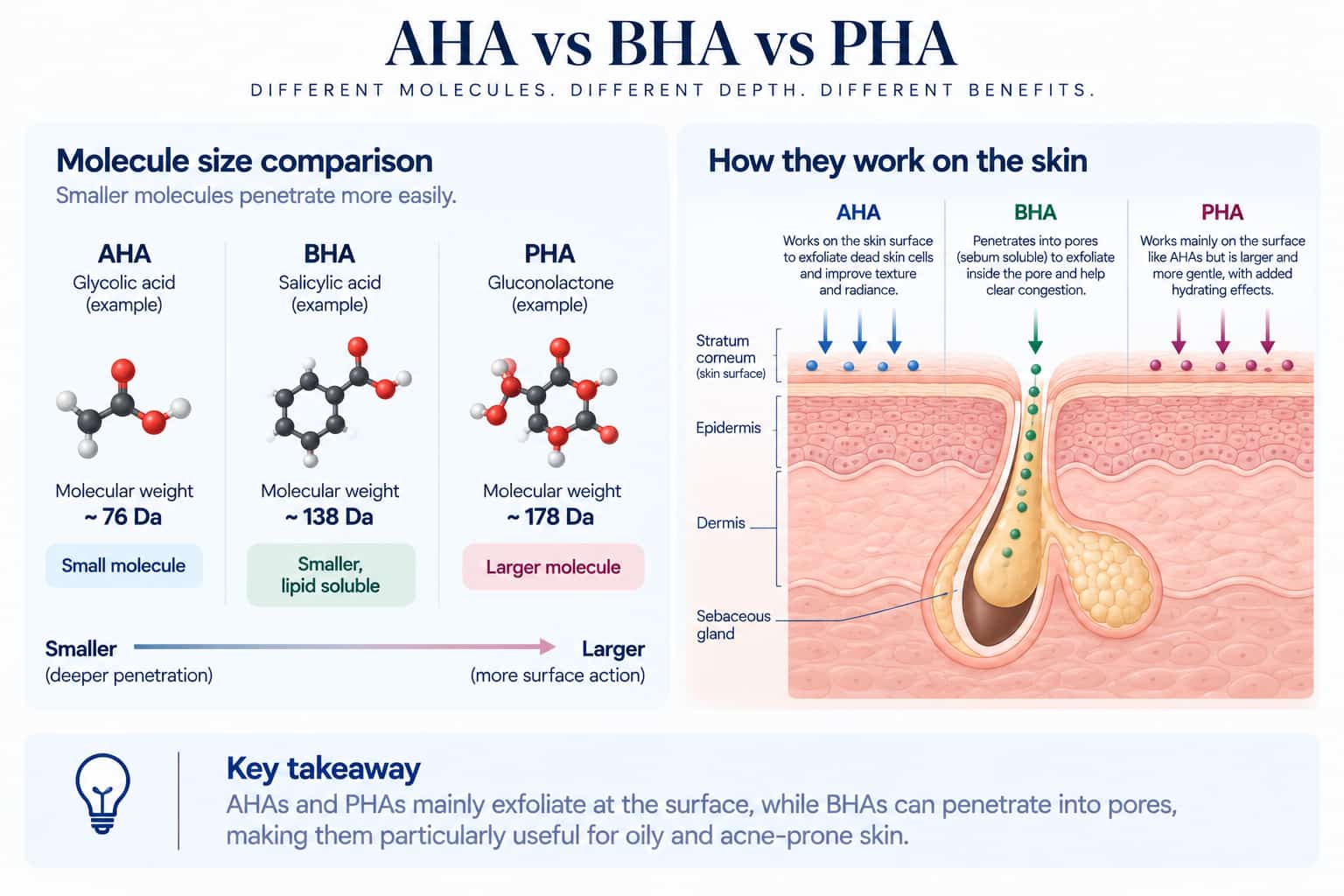
- →AHAs (alpha-hydroxy acids) are water-soluble and work primarily on the skin's surface, while BHAs (beta-hydroxy acids, chiefly salicylic acid) are oil-soluble and can penetrate into sebum-filled pores — a fundamental difference that determines which is better suited to which skin concern
- →Molecular size directly determines both penetration depth and gentleness — glycolic acid (76 g/mol) penetrates fastest and deepest but causes the most irritation, while mandelic acid (152 g/mol) penetrates more slowly and evenly, making it a genuinely better-suited option for sensitive skin and darker skin tones
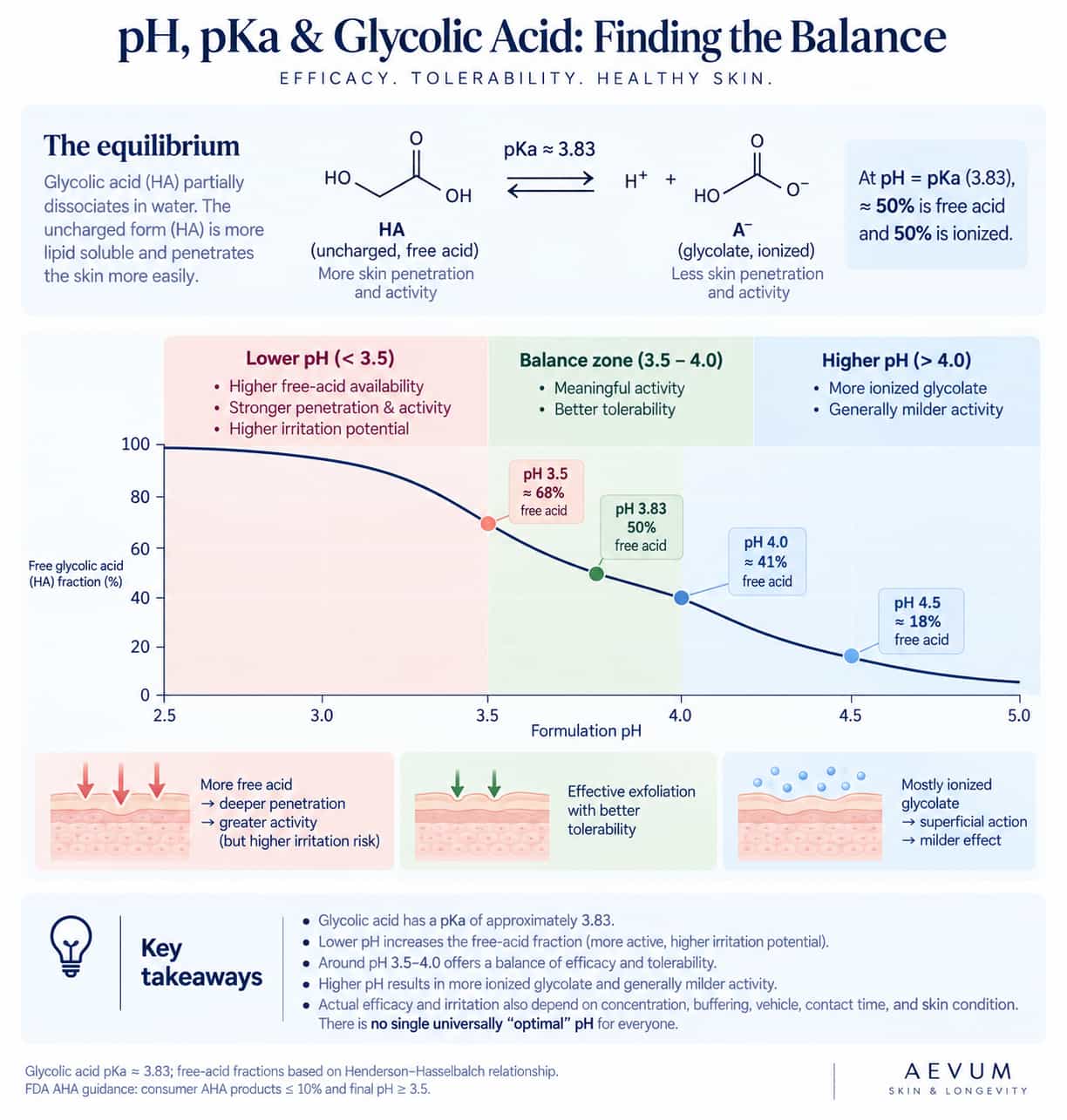
- →Like vitamin C, AHA effectiveness is pH-dependent — glycolic acid's pKa is 3.8, and formulations are generally most effective when pH sits at or just below this point, balancing efficacy against irritation risk
- →A direct comparative study found salicylic-mandelic acid peels meaningfully outperformed glycolic acid peels for both active acne and post-acne hyperpigmentation — useful evidence that gentler doesn't mean less effective, and can even mean more
Key numbers at a glance
| Measure | Figure |
|---|---|
| Glycolic acid molecular weight / pKa | 76 g/mol / 3.8 |
| Lactic acid molecular weight | 90 g/mol |
| Mandelic acid molecular weight | 152 g/mol |
| Optimal formulation pH range for glycolic acid | ~3.3-4.3 |
| Optimal log P (lipophilicity) for salicylic acid skin penetration | ~2.5 |
How it works: desmosome dissolution, solubility, and size
Chemical exfoliants work by dissolving the desmosomes — protein structures that hold corneocytes together in the outer skin layer — loosening the bonds that would otherwise hold dead skin cells in place longer than ideal. This accelerates the skin's natural shedding cycle, distinct from physical exfoliation (scrubs, brushes), which removes cells through mechanical abrasion rather than chemical dissolution.
The solubility difference between AHAs and BHAs is the single most important distinction in this category. AHAs — including glycolic, lactic, and mandelic acid — are water-soluble and work predominantly at the skin's surface. Salicylic acid, the primary BHA, is oil-soluble, giving it a genuinely distinct capability: it can penetrate into the lipid-rich, sebum-filled environment inside pores, where it helps clear the keratin and sebum debris that contribute to congestion and breakouts. This single property difference is why BHA is generally the preferred choice for oily and breakout-prone skin, while AHAs are more commonly chosen for surface texture, tone, and general photoaging concerns.
Molecular size determines how deep and how fast each acid penetrates. Glycolic acid, at 76 g/mol, is the smallest common AHA, allowing it to penetrate skin most deeply and quickly — making it the most researched and often most effective AHA, but also the one carrying the highest irritation risk. Lactic acid, at 90 g/mol, penetrates more slowly and is itself a component of the skin's Natural Moisturizing Factor covered in our Skin Barrier article, giving it an additional hydrating quality. Mandelic acid, at 152 g/mol, is larger still, penetrating more slowly and evenly — a property that makes it particularly well-suited to sensitive skin and darker skin tones, where faster, more aggressive penetration carries a higher risk of triggering post-inflammatory hyperpigmentation, relevant to the pigmentation concerns covered in our Melasma article.
Comparing the categories
| Glycolic Acid (AHA) | Lactic Acid (AHA) | Mandelic Acid (AHA) | Salicylic Acid (BHA) | Gluconolactone (PHA) | |
|---|---|---|---|---|---|
| Molecular weight | 76 g/mol | 90 g/mol | 152 g/mol | ~138 g/mol (oil-soluble) | 178 g/mol |
| Solubility | Water | Water | Water (with partial oil affinity) | Oil | Water |
| Penetration | Deepest, fastest | Moderate | Slow, even | Into pores specifically | Slowest, most surface-level |
| Best suited for | Texture, photoaging, most-studied option | Dry/dehydrated skin, gentler AHA choice | Sensitive skin, darker skin tones, acne | Oily/acne-prone/congested skin | Sensitive or rosacea-prone skin |
| Irritation potential | Highest | Moderate | Lower | Moderate | Lowest |
What the research shows
The pH-efficacy relationship mirrors what we covered for vitamin C. As with L-ascorbic acid, AHA effectiveness depends on how much of the acid exists in its active, non-ionised form — determined directly by formulation pH relative to the acid's pKa. For glycolic acid specifically (pKa 3.8), formulation science literature describes a genuine trade-off: lower pH increases the proportion of active, non-ionised acid, maximising efficacy, but also increases irritation from the formulation's overall acidity. The generally preferred practical range sits at roughly pH 3.3-4.3 — close to, and often just below, the pKa itself — balancing meaningful efficacy against tolerable irritation, rather than simply pushing pH as low as possible. US regulatory guidance sets a floor for consumer AHA products at pH ≥3.5 and concentrations ≤10%, precisely to keep products within this tolerable range.
BHA's oil solubility has a precisely characterised optimal penetration point. Research on salicylic acid's skin penetration describes a parabolic relationship between penetration and lipophilicity, with optimal penetration occurring around a log P of 2.5 — a level of oil-solubility high enough to diffuse through the lipid-rich stratum corneum, while retaining enough water affinity to penetrate the more aqueous, deeper epidermal tissue. This precisely characterised sweet spot is part of why salicylic acid formulation isn't simply "more concentrated is better" any more than AHAs are.
A comparative study (Garg et al., 2009) directly tested 35% glycolic acid peels against combined 20% salicylic-10% mandelic acid peels (SMPs) in 44 patients with active acne and post-acne scarring and hyperpigmentation, treated fortnightly over six sessions. Rather than simply tying, the SMP group came out ahead on essentially every measured outcome: total acne score improved by 52.3% with SMPs versus 27.3% with glycolic acid, comedones dropped by 45.7% versus 20.9%, and post-acne hyperpigmentation improved by 59.8% versus 46.3% — all while both treatments remained safe and well-tolerated. This is genuinely useful evidence that a gentler combination approach doesn't require sacrificing results, and in this case actually outperformed the harsher single-acid option.
How to actually use it
- →Start at 2-3 nights a week regardless of which acid you choose, building tolerance gradually — this applies even to gentler options like lactic or mandelic acid
- →Avoid combining multiple strong acids, or acids with retinoids, in the same application session. Given the barrier permeability threshold covered in our Skin Barrier article — where roughly a 30% reduction in barrier lipids is enough to significantly increase permeability — stacking multiple actively-exfoliating or barrier-thinning ingredients at once meaningfully raises the risk of over-exfoliation and barrier disruption
- →Sun protection is essential after chemical exfoliation, given that freshly exfoliated skin is measurably more vulnerable to UV damage — pairing with the sun protection habits covered in our UVA vs UVB and Sunscreen Labels articles is non-negotiable, not optional
- →Patch test new acids, particularly at higher concentrations, and be especially cautious combining AHAs with niacinamide in the same product, since some formulation research suggests low-pH environments can convert niacinamide into a more irritating compound — worth being aware of if combining products from different brands rather than a single, professionally-formulated blend
Recommendations by skin type or goal
- 1Oily, congested, or acne-prone skin
Salicylic acid (BHA) is the more mechanistically appropriate choice, given its unique ability to penetrate into sebum-filled pores that water-soluble AHAs generally can't reach as effectively.
- 2Dry, dehydrated, or texturally-focused concerns without significant congestion
Glycolic or lactic acid are well-suited, with lactic acid offering a gentler, more hydrating option given its role in the skin's own Natural Moisturizing Factor.
- 3Sensitive skin, as covered in our Sensitive Skin article, or darker skin tones concerned about post-inflammatory hyperpigmentation
Mandelic acid or a PHA like gluconolactone are the better-suited choices, given their larger molecular size, slower penetration, and correspondingly lower irritation risk — the Garg et al. comparative study above supports this approach not requiring a meaningful efficacy trade-off.
- 4Anyone already using retinoids or vitamin C, as covered in our previous articles
Consider using exfoliating acids on alternate nights or sessions rather than layering everything at once, given the cumulative barrier stress multiple active ingredients can create together.
- 5General / longevity-focused
Chemical exfoliation is a good example of a category where the "strongest" option isn't automatically the "best" one — matching the specific acid's properties (solubility, molecular size, pH behaviour) to your actual skin concern tends to outperform simply choosing the most potent product available.
Practical notes
- →AHAs and BHAs solve genuinely different problems — water-soluble AHAs for surface texture and tone, oil-soluble BHA for pore congestion — not simply different strengths of the same thing
- →Molecular size is a real, useful predictor of gentleness — larger molecules like mandelic acid and gluconolactone penetrate more slowly and evenly, a genuine advantage for sensitive or darker skin
- →Formulation pH matters for AHA efficacy in the same way it matters for vitamin C — a well-formulated product balances proximity to the acid's pKa against tolerable irritation, rather than simply minimising pH
- →Combining multiple actives in one session raises real barrier disruption risk — this connects directly to the permeability threshold covered in our Skin Barrier article
- →"Gentler" doesn't necessarily mean "less effective" — direct comparative research has found a milder acid combination actually outperforming a stronger single-acid option for some concerns
Chemical exfoliation is a category where understanding the underlying chemistry — solubility, molecular size, and pH behaviour — leads directly to better, more personalised choices than simply reaching for the strongest available product. For the pH principles this builds on, see our Skin pH and Vitamin C articles, and for how much barrier disruption skin can tolerate before irritation sets in, see our Skin Barrier article. If you'd like personalised guidance on which exfoliating acid suits your skin, our Longevity Doctors offer a free consultation as a starting point.
How does your skin
score on your longevity assessment?
Take the free Aevum Protocol assessment to see how your skin & longevity and 6 other longevity domains are performing — and get a personalised 90-day plan.
Take the Free Assessment →