Skin & Longevity
Vitamin C for Skin:
What Form Actually Matters?
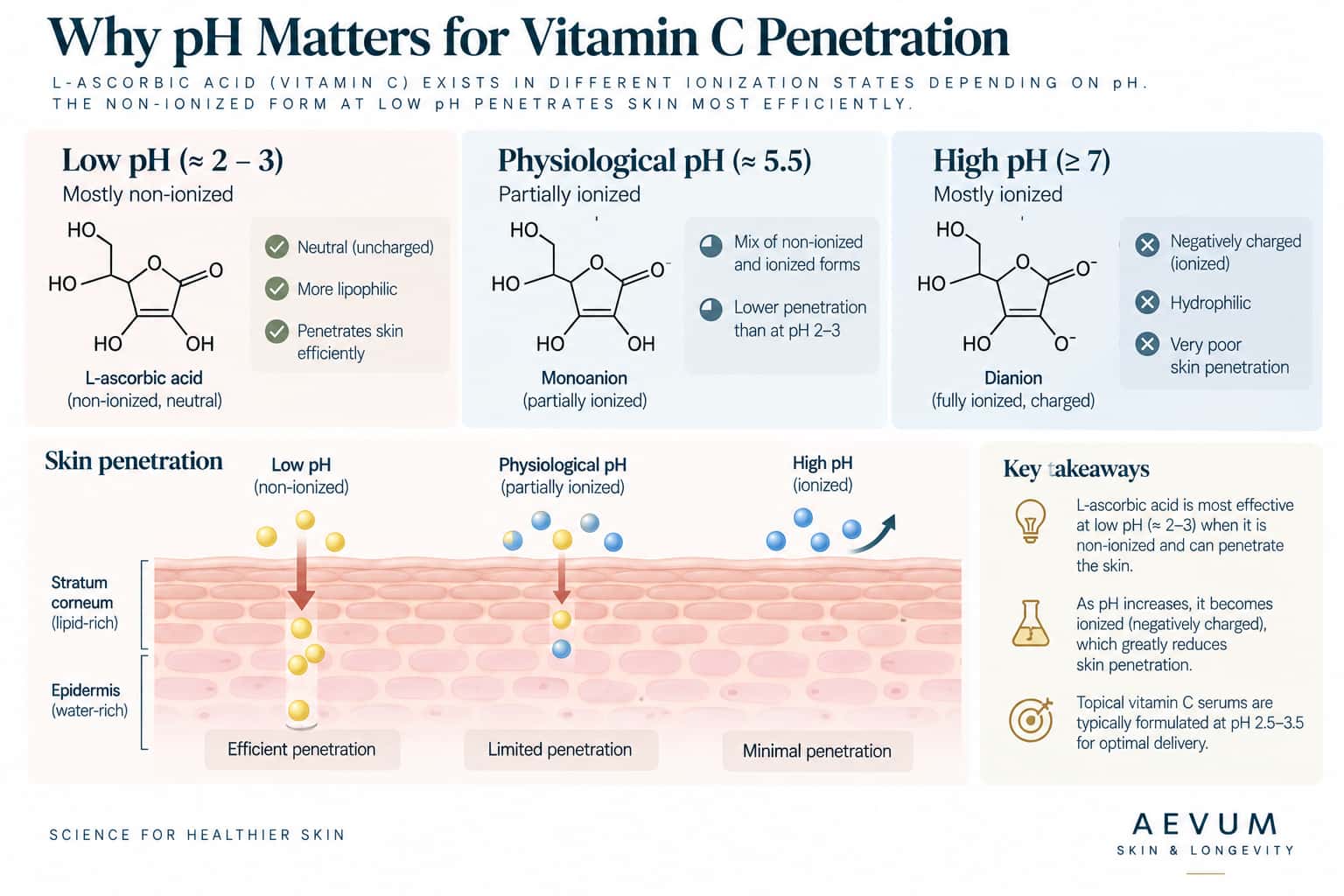
Our Skin pH article established that pH affects far more than cleansers — it directly determines how well certain active ingredients penetrate skin. Vitamin C is the clearest example of this in all of skincare: its most-researched form only works properly within a narrow, specific pH window, and understanding this single fact explains most of the confusion around which vitamin C product is actually worth using.
Quick Summary
- →L-ascorbic acid (LAA), the most clinically studied form of vitamin C, only penetrates skin efficiently at pH 3.5 or below — a direct consequence of its chemistry (a pKa of approximately 4.2), meaning a "vitamin C serum" formulated at a higher, gentler pH may not deliver much active ingredient at all
- →Research from the same lab that established this pH threshold also found a concentration ceiling: absorption increases with LAA concentration up to 20%, then actually decreases above that — higher percentages aren't just wasteful past this point, they're measurably less effective
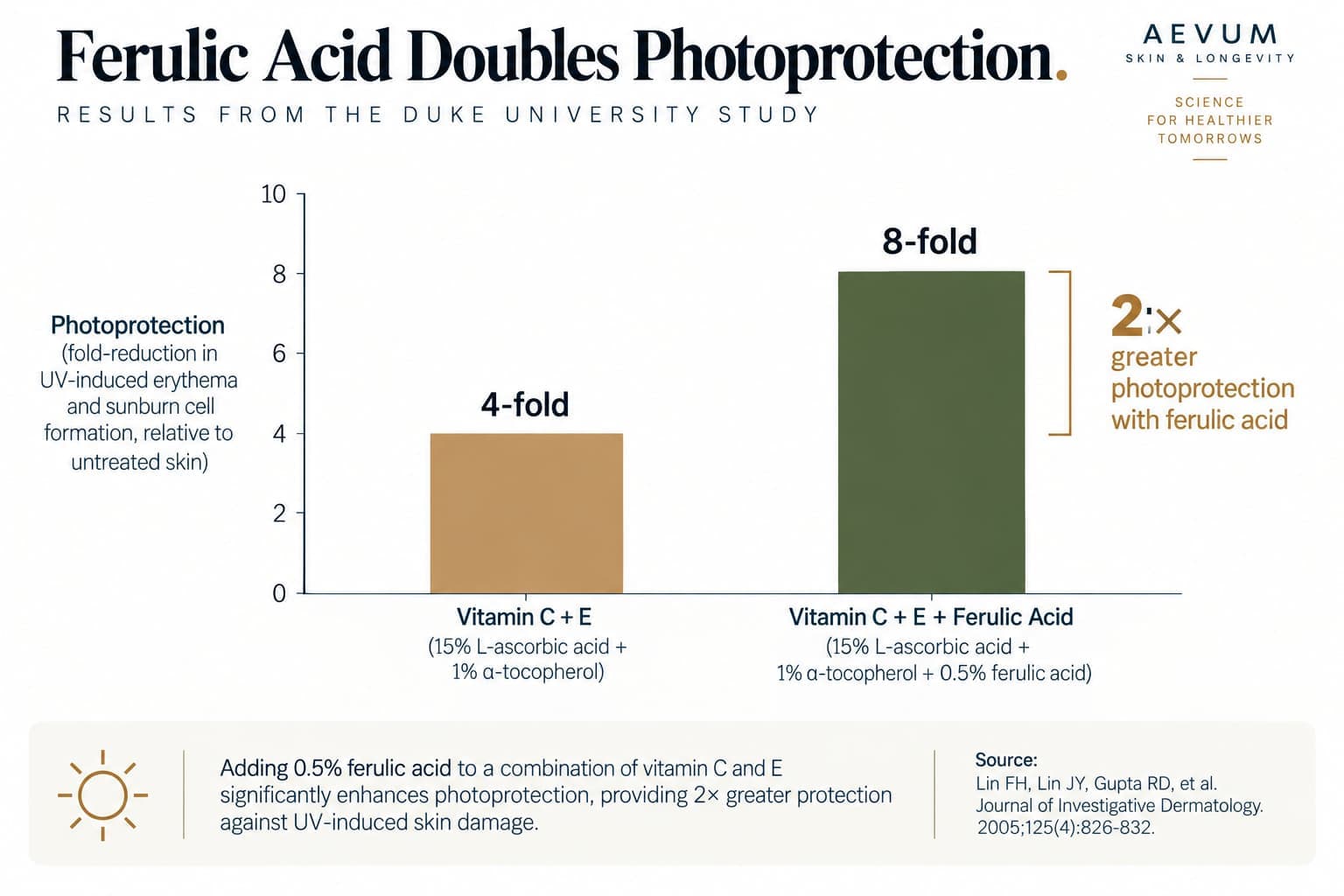
- →Combining L-ascorbic acid with vitamin E and ferulic acid doesn't just stabilise the formula — it roughly doubles photoprotection, from a 4-fold to an 8-fold reduction in UV-induced skin damage in controlled research, one of the more precisely quantified ingredient synergies in skincare
- →Stable derivative forms (like sodium ascorbyl phosphate or tetrahexyldecyl ascorbate) sacrifice some potency for formulation stability and skin-friendlier pH — a genuine trade-off, not simply an inferior alternative, and worth choosing deliberately based on skin type and tolerance
- →A vitamin C serum that has turned yellow or orange has oxidised and lost most of its activity — this is a completely reliable, visible signal the product needs replacing, not a cosmetic issue to ignore
Key numbers at a glance
| Measure | Figure |
|---|---|
| Optimal pH for L-ascorbic acid skin penetration | ≤3.5 |
| L-ascorbic acid's pKa | ~4.2 |
| Concentration ceiling before absorption decreases | ~20% |
| Photoprotection with vitamin C + E alone | ~4-fold |
| Photoprotection with vitamin C + E + ferulic acid | ~8-fold |
Why this matters: what vitamin C actually does
Vitamin C serves several distinct, genuinely well-established functions in skin. As a potent antioxidant, it neutralises the reactive oxygen species generated by UV exposure — directly relevant to the photoaging mechanisms covered in our Photoaging and UVA vs UVB articles. It also acts as a required cofactor for the enzymes that stabilise collagen molecules (prolyl and lysyl hydroxylase), connecting directly to the collagen synthesis process covered in our Collagen Loss article — without adequate vitamin C, these enzymes can't properly complete collagen's structural formation. Separately, it inhibits tyrosinase, an enzyme involved in melanin production, giving it a genuine, evidence-supported role in managing uneven pigmentation, relevant to the discussion in our Melasma article.
Comparing the forms
| L-Ascorbic Acid (LAA) | Sodium/Magnesium Ascorbyl Phosphate | Tetrahexyldecyl Ascorbate | Ascorbyl Palmitate | |
|---|---|---|---|---|
| Requires low pH to work | Yes (≤3.5) | No — works at skin-friendly pH | No | No |
| Stability | Poor (oxidises readily) | Good | Very good | Good |
| Solubility | Water | Water | Oil (lipid-soluble) | Oil (lipid-soluble) |
| Conversion needed | None (already active) | Yes, to ascorbic acid | Partial | Yes |
| Clinical evidence depth | Extensive (decades) | Moderate, growing | Growing | Older, more limited |
| Best suited for | Those wanting maximum, best-studied potency | Sensitive skin, or pH-conflicting routines | Combination with oil-based formulations | Older formulations, less commonly favoured now |
The core trade-off running through this entire table is the same one covered in our Retinoids article: L-ascorbic acid is the direct, already-active form, so it delivers the strongest, best-documented effect — but that same directness makes it unstable and pH-fussy. The derivative forms require conversion within skin to become active, which sacrifices some potency and directness, but buys considerably better stability and compatibility with skin's natural, more neutral-to-mildly-acidic pH range.
What the research shows
The pH and concentration research traces back to a specific, highly-cited body of work. A research group at Duke University, led by Dr. Sheldon Pinnell, established the foundational absorption science still cited today: L-ascorbic acid, protonated (non-ionised) at pH 3.5 or below, is efficiently absorbed into skin, while at higher pH the molecule becomes ionised and penetrates far less effectively — a direct consequence of its chemical pKa of approximately 4.2. The same research established a genuinely important, often-overlooked finding: absorption increases with concentration only up to about 20%, then decreases above that — meaning a 25% or 30% vitamin C product isn't simply "extra strength," it may actually deliver less active ingredient into skin than a well-formulated 15-20% product.
Combining vitamin C with vitamin E and ferulic acid produces a precisely measured synergy, not just a marketing pairing. The same Duke research group found that combining 15% L-ascorbic acid with vitamin E alone provided roughly a 4-fold increase in protection against UV-induced skin damage. Adding 0.5% ferulic acid to this combination did two things simultaneously: it substantially improved the chemical stability of both vitamins in the formula, and it doubled the photoprotection to approximately 8-fold — a precisely quantified, genuinely synergistic effect, not simply three separate ingredients working alongside each other. Vitamin C and E also work through direct chemical cooperation: vitamin E neutralises free radicals but becomes a radical itself in the process, and vitamin C reduces it back to its active form, allowing the pair to regenerate each other's antioxidant capacity repeatedly rather than being used up in a single reaction.
A visible, reliable sign of degradation. L-ascorbic acid oxidises over time when exposed to light, air, and water — and this oxidation is visible: a fresh, effective LAA serum is typically clear to pale yellow, while a noticeably darker yellow or orange colour indicates the vitamin C has substantially degraded into inactive compounds. This isn't a safety concern, but it is a genuine efficacy one — a browned serum is essentially spent, regardless of how recently it was purchased.
How to actually use it
- →If using an L-ascorbic acid product, check or trust the formulation's pH — reputable brands using this form generally formulate at or below pH 3.5 specifically because the science requires it; a "gentle" LAA serum at a higher pH is working against its own active ingredient's chemistry
- →Store LAA products away from light and air, and in opaque, airtight packaging where possible — this genuinely extends usable shelf life given how readily this form oxidises
- →Don't assume a higher percentage is automatically better — the 20% ceiling from the research above is a genuine, practical guide, not an arbitrary industry convention
- →Consider a vitamin C + E + ferulic acid combination specifically for daytime antioxidant photoprotection, given the precisely measured synergy described above — this combination is worth prioritising over a single-ingredient vitamin C product if photoprotection is the primary goal
- →If LAA consistently irritates your skin, a stable derivative (sodium ascorbyl phosphate, tetrahexyldecyl ascorbate) formulated at a more skin-friendly pH is a legitimate alternative, not a downgrade in every sense — it trades some potency for meaningfully better tolerability
Recommendations by skin type or goal
- 1Anyone prioritising maximum, best-evidenced antioxidant and collagen-support benefit, with reasonably resilient skin
L-ascorbic acid at 10-20%, formulated at or below pH 3.5, ideally combined with vitamin E and ferulic acid, represents the most rigorously studied option available.
- 2Anyone with sensitive skin, as covered in our Sensitive Skin article, or who has found LAA irritating
A stable derivative formulated at a more neutral, skin-friendly pH is a reasonable, legitimate choice — less potent per the evidence, but considerably more tolerable and still genuinely active.
- 3Anyone using pH-dependent exfoliating acids (AHAs/BHAs) in the same routine
This is worth planning around explicitly, covered in more depth in our Chemical Exfoliation article, since layering multiple pH-sensitive actives in one routine requires some genuine formulation awareness, not just applying everything at once.
- 4Anyone whose vitamin C serum has changed colour
Replace it — a browned or darkened LAA product has oxidised past the point of meaningful effectiveness, regardless of how much product remains in the bottle.
- 5General / longevity-focused
Vitamin C's photoprotective synergy with vitamin E and ferulic acid is one of the more precisely quantified, genuinely evidence-backed combinations in this entire series — a good example of ingredient science that holds up to real scrutiny rather than just being repeated marketing language.
Practical notes
- →L-ascorbic acid's effectiveness is genuinely pH-dependent, not a minor formulation detail — this single fact explains most of the real differences between vitamin C products
- →More concentrated isn't always more effective — the roughly 20% ceiling is a real, research-backed limit, not an arbitrary marketing number
- →The vitamin C, E, and ferulic acid combination has precisely measured, doubled photoprotection behind it — a genuinely well-evidenced combination worth seeking out specifically
- →Colour change in a vitamin C serum is a reliable, visible sign of oxidation and lost potency — trust this signal over the product's remaining quantity or purchase date
- →Derivative forms are a legitimate choice, not an inferior compromise — they trade some potency for stability and tolerability, which is the right trade-off for many people
Vitamin C is a genuine case where the specific chemical form and formulation pH matter as much as, or more than, the percentage on the label — understanding the pH-dependence established decades ago by dedicated research explains most of the real-world variation in how well different products actually work. For the underlying pH mechanism this builds on, see our Skin pH article, and for the collagen biology vitamin C supports, see our Collagen Loss article. If you'd like personalised guidance on building an antioxidant-focused skincare routine, our Longevity Doctors offer a free consultation as a starting point.
How does your skin
score on your longevity assessment?
Take the free Aevum Protocol assessment to see how your skin & longevity and 6 other longevity domains are performing — and get a personalised 90-day plan.
Take the Free Assessment →