Skin & Longevity
Skin pH:
Does It Actually Matter?
Our Skin Barrier article mentioned that the barrier helps maintain skin's surface pH, and flagged this as a factor affecting how well barrier lipids stay properly organised. This article answers the question directly: yes, pH genuinely matters, with a specific, well-documented mechanism behind why — though the marketing use of "pH-balanced" often outpaces the more nuanced reality of the underlying science.
Quick Summary
- →Healthy skin surface pH averages 4.7, and is naturally acidic — this "acid mantle" isn't incidental, but actively maintained by the skin itself through several distinct biological mechanisms
- →The enzymes responsible for producing ceramides — the barrier lipids covered in our Skin Barrier article — only function properly within a specific, mildly acidic pH range, roughly 4.6 to 5.6; outside this range, their activity drops off
- →A separate set of enzymes responsible for normal skin shedding (kallikreins) becomes measurably more active as pH rises — one specific kallikrein's activity has been found to double with every 0.5-unit increase in pH, directly linking alkaline skin to excessive, disruptive shedding
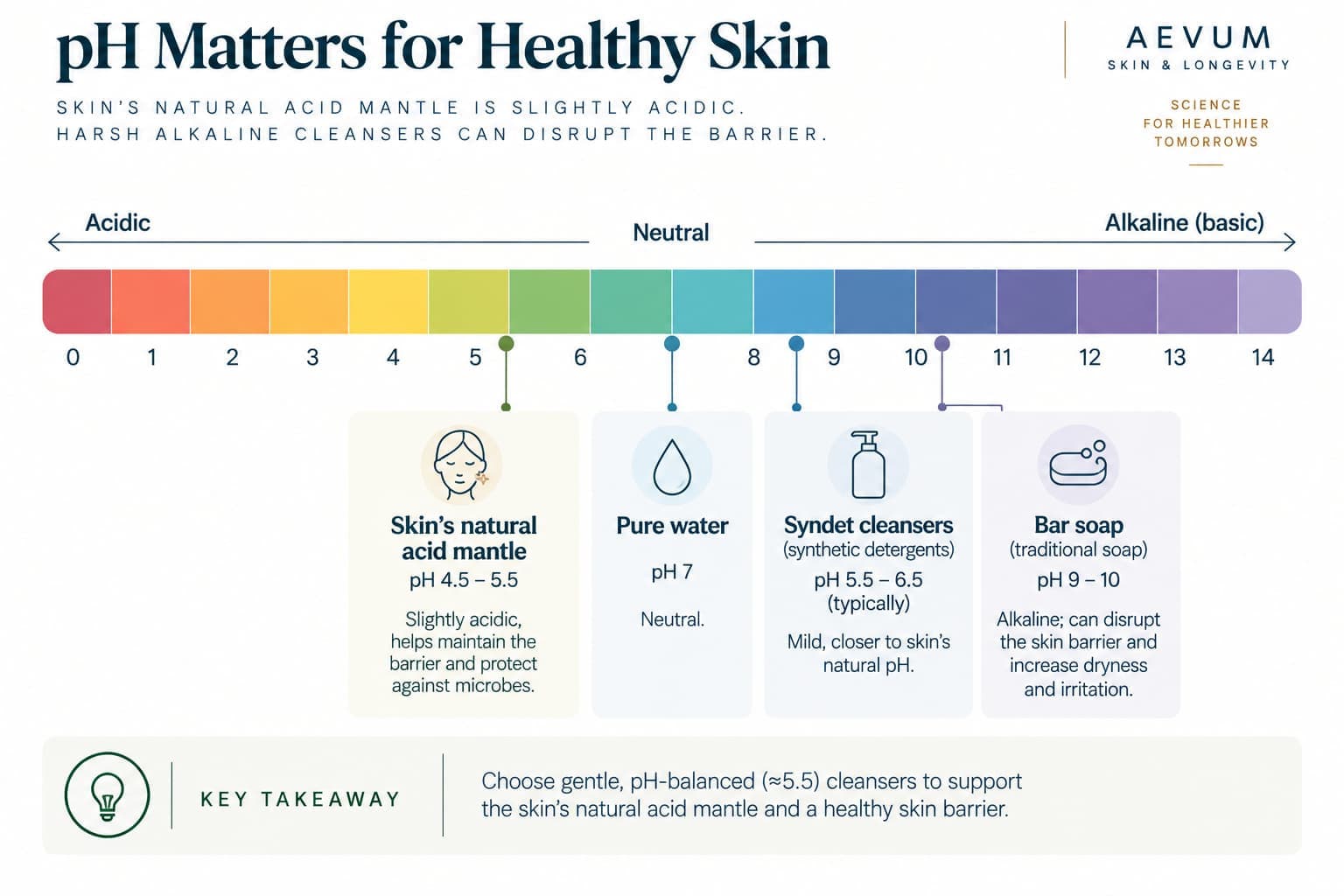
- →Traditional bar soap sits at pH 8-11, well outside skin's natural range, while modern "syndet" (synthetic detergent) cleansers are typically formulated closer to pH 4.5-6.5 — a genuine, measurable formulation difference, not just a marketing distinction
- →The evidence that mildly acidic cleansers are gentler than alkaline soap is genuinely solid — but the evidence that pushing pH even lower than skin's natural range adds further benefit is much thinner, according to researchers directly reviewing this literature
Key numbers at a glance
| Measure | Figure |
|---|---|
| Average natural skin surface pH | ~4.7 |
| Optimal pH range for ceramide-producing enzymes | ~4.6-5.6 |
| Kallikrein 7 (desquamation enzyme) activity increase per 0.5 pH unit rise | Doubles |
| Typical bar soap pH | ~8-11 |
| Typical pH-balanced syndet cleanser pH | ~4.5-6.5 |
How it works: why an acidic surface actually matters
Skin's naturally acidic surface — averaging pH 4.7, well below the neutral pH 7 of pure water — is often called the acid mantle, maintained through a combination of sebum, sweat secretions, and the breakdown products of skin's own natural processes. This acidity isn't incidental; it directly regulates several distinct biological processes at once.
Ceramide production is pH-dependent. The enzymes responsible for converting lipid precursors into the mature ceramides covered in our Skin Barrier article — specifically beta-glucocerebrosidase and acid sphingomyelinase — only function efficiently within a narrow, mildly acidic range, roughly pH 4.6 to 5.6. When skin surface pH rises above this range, these enzymes become less effective, directly reducing the skin's ability to produce and maintain its own barrier lipids.
Skin shedding (desquamation) is also pH-dependent, in the opposite direction. A separate family of enzymes called kallikreins control the normal, gradual shedding of corneocytes from the skin surface. Research has found that kallikrein 7 activity roughly doubles with every 0.5-unit increase in surface pH — meaning even a modest pH shift toward alkaline meaningfully accelerates shedding, disrupting the normal, gradual turnover process and contributing to a compromised barrier.
Microbiome balance shifts with pH too. Skin's natural acidity helps favour beneficial resident bacteria (like Staphylococcus epidermidis) while inhibiting potentially harmful ones (including Staphylococcus aureus). An elevated, more alkaline pH tips this balance toward the less favourable organisms — a genuine, demonstrated shift in the skin's microbial ecosystem, not just a chemistry abstraction.
What the research shows
Alkaline soap measurably disrupts barrier function compared to pH-balanced cleansers. This is one of the more directly tested claims in skincare, and the evidence holds up. Research comparing traditional alkaline soap to neutral-or-acidic-pH synthetic detergent cleansers (syndets) has found a well-documented "destabilizing effect" of high-pH soap on skin's lipid structure, compared to syndets. A classic controlled study from the 1990s comparing regular soap against an acidic syndet bar in patients prone to acne found the acidic syndet group showed meaningfully better outcomes — one of several studies establishing that cleanser pH isn't just a formulation detail, but a factor with measurable clinical consequences. A more recent 2025 clinical study of a soap-free cleansing formulation found significant, measurable improvements in skin hydration, barrier function score, and overall dryness after 30 days of use.
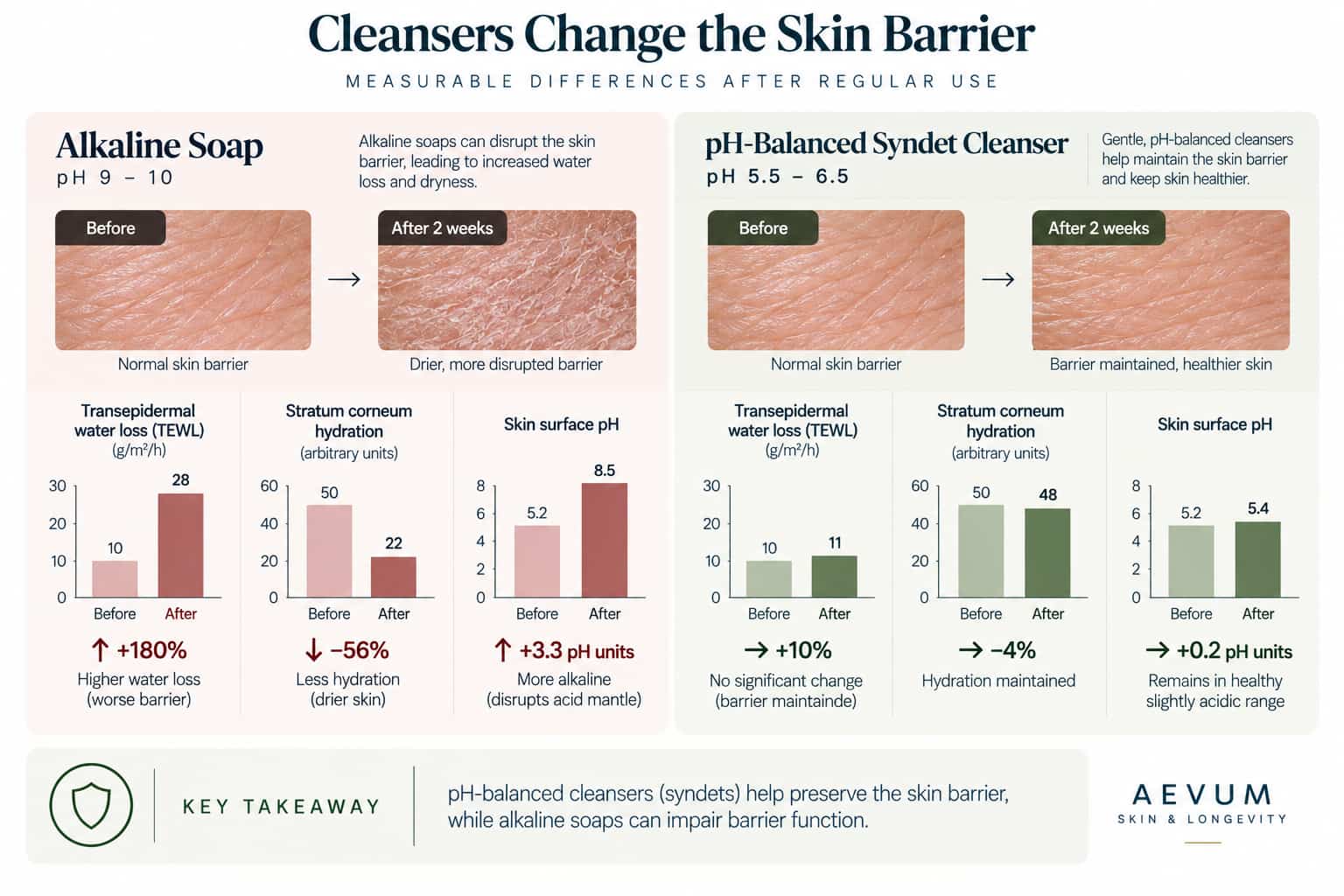
Real product testing confirms the gap between soap and syndets is substantial, not marginal. A study directly measuring the pH of commercially available cleansing products found bar soaps ranged from pH 8.01 to 11.01, while syndet products ranged from pH 4.99 to 7.78 — with syndets landing meaningfully closer to skin's natural range in every case tested. This wasn't a theoretical distinction: every single bar soap tested exceeded pH 8, while the majority of syndets fell within or near the physiological range.
It's worth being precise here, since the evidence is genuinely asymmetric. Researchers directly reviewing this literature have noted that while the harm caused by high-pH alkaline soap relative to skin's natural range is well documented, the hypothesis that pushing cleanser pH even lower than skin's natural range provides additional, superior barrier benefit is not yet well validated — more research is specifically needed on this question. In other words: avoiding alkaline products in favour of something closer to skin's natural mildly acidic range is genuinely evidence-backed; assuming an ultra-low-pH product is automatically better than a moderately acidic one is a claim the current research doesn't clearly support.
Recommendations by skin concern
- 1Anyone with sensitive, eczema-prone, or reactive skin
Given how directly pH affects both ceramide production and shedding enzyme activity, choosing cleansers formulated closer to skin's natural pH range (roughly 4.5-5.5) is a genuinely evidence-backed choice for this group specifically, not just a marketing preference.
- 2Anyone using traditional bar soap on the face
Given the substantial pH gap demonstrated in direct product testing (bar soap 8-11 vs. syndets 4.5-6.5), switching to a syndet or liquid cleanser formulated closer to skin's natural range is one of the more concrete, low-effort changes suggested across this series.
- 3Anyone shopping specifically for "pH-balanced" labelled products
Given that pH isn't always disclosed clearly on packaging, and the label alone doesn't guarantee a specific value, checking for an actual stated pH range (or testing with pH strips) is more reliable than the marketing term alone.
- 4Anyone using vitamin C, AHAs, or other pH-dependent actives
pH doesn't just matter for cleansers — it directly affects the stability and efficacy of certain active ingredients, covered in more depth in our Vitamin C and Chemical Exfoliation articles.
- 5General / longevity-focused
Skin pH is a good example of a skincare concept that's genuinely mechanistically important, evidence-backed, and simultaneously prone to overstatement in marketing — the honest answer is "yes, avoid alkaline, but don't assume more acidic is automatically superior."
Practical notes
- →Skin's natural pH averages 4.7 — mildly acidic, not neutral — this is the reference point worth knowing when evaluating cleansers and other leave-on products
- →Alkaline products (traditional bar soap, pH 8-11) measurably disrupt both barrier lipid production and normal shedding — this is well-documented, not a marginal effect
- →A modest pH increase has an outsized effect on skin shedding enzymes — the doubling of kallikrein 7 activity per 0.5 pH unit is a genuinely striking, non-linear relationship
- →"More acidic is always better" isn't well supported — the evidence clearly favours avoiding alkaline products, but doesn't clearly support pushing pH below skin's natural range for additional benefit
- →This connects directly to the barrier content covered in our Skin Barrier article — pH and barrier lipid health are mechanistically linked, not separate topics
Skin pH is one of the more genuinely evidence-backed, if sometimes over-marketed, concepts in skincare — the mechanism is real and well-documented, even if the appropriate response is "choose products near skin's natural range" rather than "always choose the lowest pH available." For the barrier biology this connects to, see our Skin Barrier article. If you'd like a clearer picture of your own skin's condition and product routine, our Longevity Doctors offer a free consultation as a starting point.
How does your skin
score on your longevity assessment?
Take the free Aevum Protocol assessment to see how your skin & longevity and 6 other longevity domains are performing — and get a personalised 90-day plan.
Take the Free Assessment →