Skin & Longevity
Sensitive Skin:
Is It a Skin Type or a Skin State?
Our Skin Barrier and Skin pH articles both touched on how barrier dysfunction produces the sensitivity, irritation, and reactivity many people describe as "sensitive skin." This article addresses the question directly, and the honest, evidence-backed answer turns out to be genuinely more interesting than a simple yes or no: sensitive skin appears to arise from two distinct mechanisms, one closer to a fluctuating "state" and one closer to a fixed "type" — and research increasingly shows some people experience one, the other, or both simultaneously.
Quick Summary
- →Sensitive skin is remarkably common — population surveys find roughly 60-70% of women and 50-60% of men report some degree of it, with substantial variation depending on how the question is asked
- →Research has identified two distinct physiological mechanisms behind sensitive skin, not one — impaired barrier function (covered in our Skin Barrier article) and a separate, genuinely fascinating neurosensory mechanism involving hyperactive nerve receptors
- →A specific receptor called TRPV1 — the same receptor that responds to capsaicin, the compound that makes chilli peppers feel "hot" — has been found dramatically upregulated in sensitive skin, meaning some people's nerve endings are genuinely more reactive, independent of any measurable barrier problem
- →Research directly comparing subjects has found some people with sensitive skin show high sensory reactivity with no impaired barrier function at all — direct evidence that "sensitive skin" isn't one single condition, but at least two different ones that can look identical from the outside
- →This means the honest answer to "type or state" is genuinely both — barrier-driven sensitivity tends to be more situational and treatable (a "state"), while neurosensory-driven sensitivity may be more persistent and trait-like (closer to a "type")
Key numbers at a glance
| Measure | Figure |
|---|---|
| Women reporting some degree of sensitive skin | ~60-70% |
| Men reporting some degree of sensitive skin | ~50-60% |
| Subjects testing positive on the lactic acid sting test (one study) | ~66% |
| Body site most commonly reported as sensitive | Face (~77%) |
| Other commonly affected sites | Hands (58%), scalp (36%), feet (34%) |
How it works: two genuinely different mechanisms
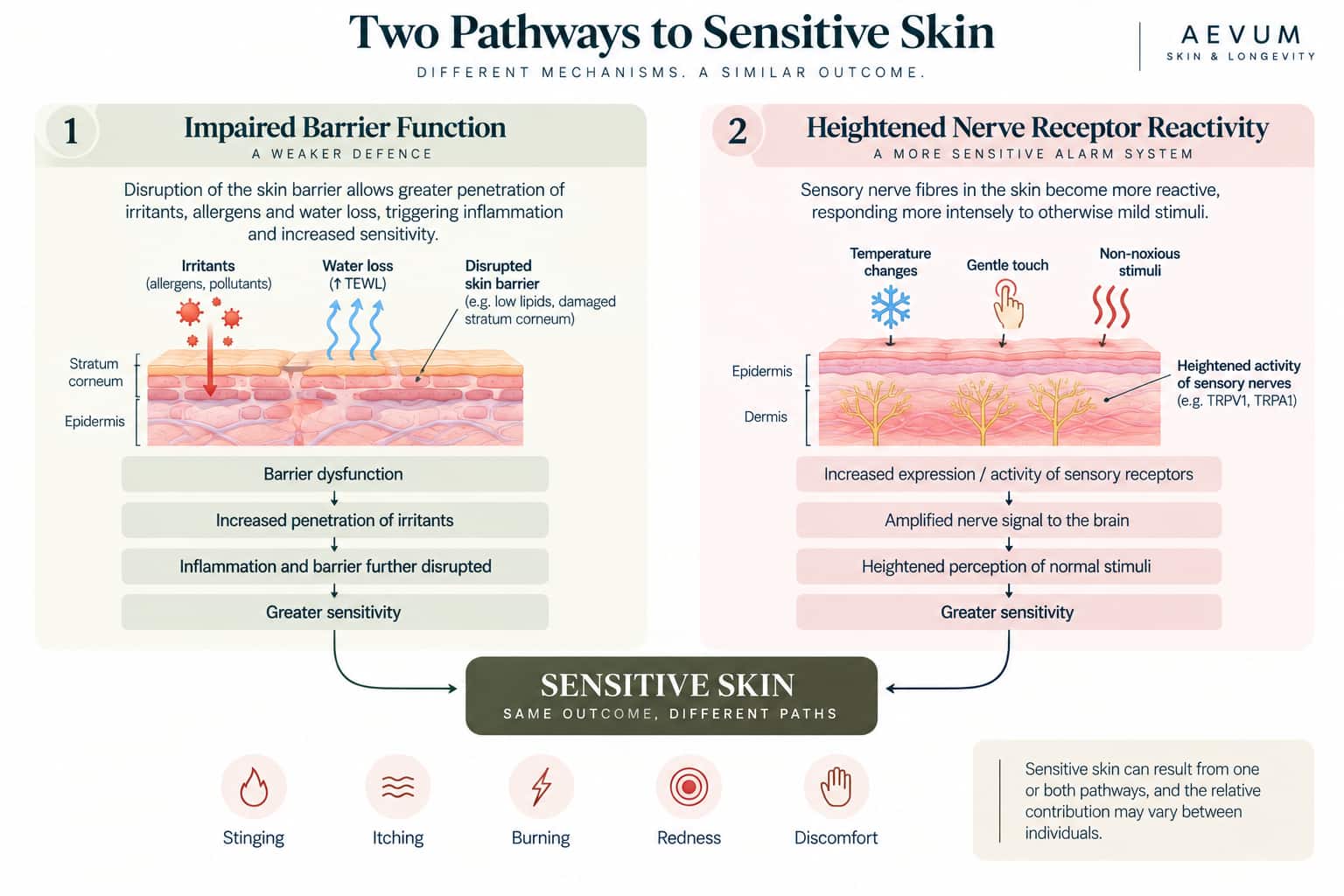
The barrier pathway is the one covered in our Skin Barrier article: sensitive skin frequently shows measurable alterations in barrier function, including disrupted intercellular lipid organisation and reduced ceramide and sphingolipid content. A compromised barrier allows irritants and allergens to penetrate more easily and lets water escape faster, producing the classic sensitive-skin experience of stinging, tightness, and reactivity to products that wouldn't bother well-functioning skin.
The neurosensory pathway is genuinely distinct, and less commonly understood. A growing body of research has identified heightened nerve reactivity as a separate driver of sensitive skin — specifically involving TRPV1, a receptor best known as the one activated by capsaicin (the compound responsible for chilli peppers' heat). TRPV1 also responds to genuine heat and to low pH, and research has found it dramatically upregulated in skin biopsies from people with self-reported sensitive skin. This produces a real, physiologically distinct phenomenon: sensations of burning, stinging, or itching triggered by stimuli that shouldn't provoke them, occurring even when the skin barrier itself shows no measurable impairment — the nerve endings themselves are simply more reactive, not the barrier they sit beneath.
The classic diagnostic tool: the lactic acid sting test. Researchers commonly identify sensitive skin using a standardised test — applying dilute lactic acid to the nasolabial fold (the crease beside the nose) and recording the intensity of any stinging sensation over several minutes. People who report meaningful stinging are termed "stingers," and this remains one of the more established, if imperfect, ways to study sensitive skin under controlled conditions.
What the research shows
Sensitive skin is common enough to be closer to a population norm than an outlier. A comprehensive review of prevalence surveys found that, on average, roughly 70% of people report some degree of sensitive skin when asked broadly, and around 46% report it as "moderate" or "high" specifically — though individual study results vary considerably (from as low as 7% to over 90%) depending on exactly how the question is framed. Broken down by sex, roughly 60-70% of women and 50-60% of men report some degree of sensitivity. The face is the most commonly affected site (reported by about 77% of those with sensitive skin), but sensitivity is also commonly reported on the hands, scalp, feet, neck, torso, and back — suggesting this isn't purely a facial-skincare phenomenon.
Direct evidence that "sensitive skin" isn't one single condition. This is the most important finding for answering this article's core question. Research specifically designed to separate the two mechanisms — testing sensory response (via the lactic acid sting test), barrier function (via a standardised irritation test), and vascular reactivity together in the same subjects — found that some sensitive skin subjects showed high sensory and vascular reactivity with no impaired barrier function whatsoever. This is genuinely important: it means at least some people experience real, measurable sensitivity through the neurosensory pathway alone, without the barrier dysfunction that might otherwise be assumed to explain it.
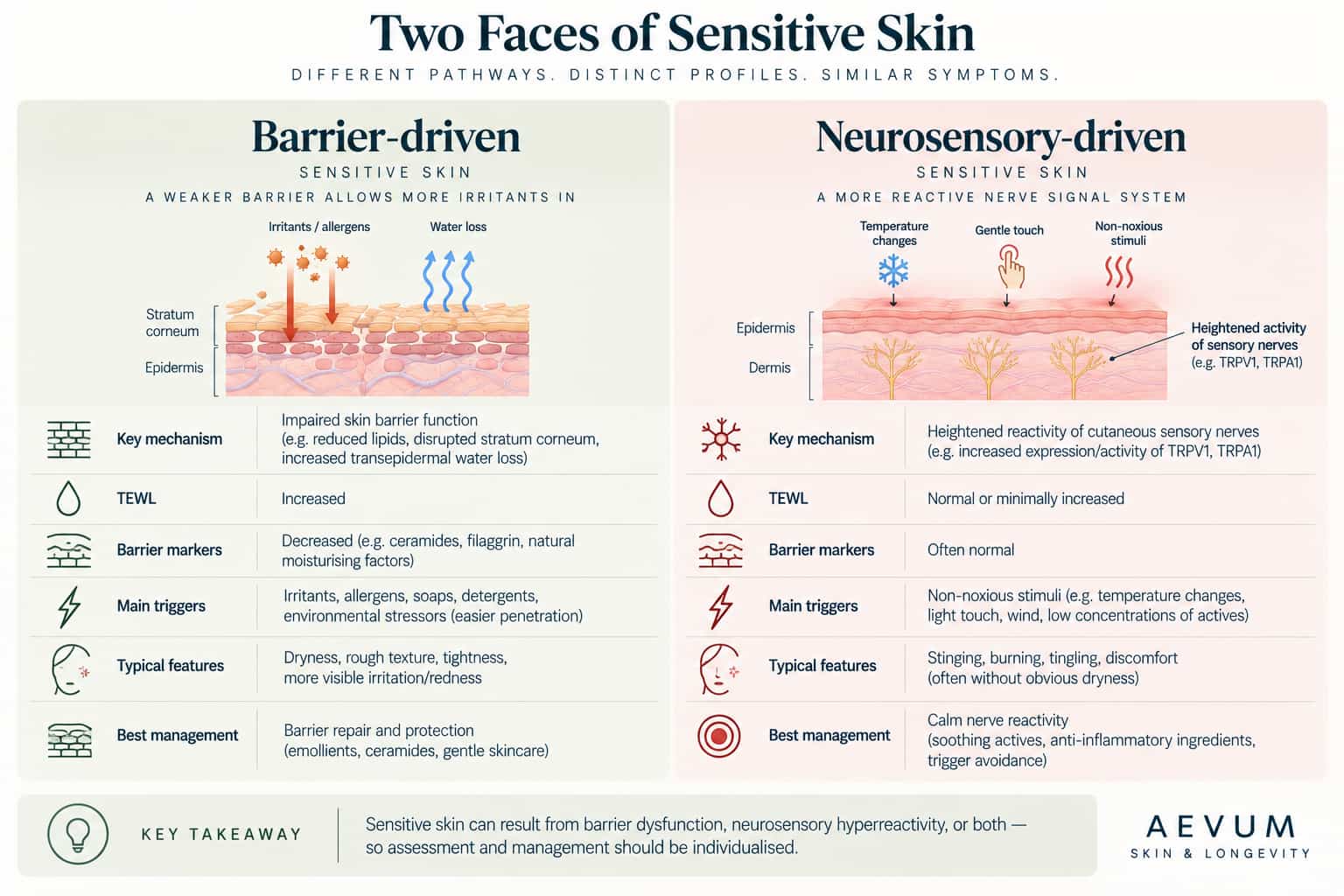
But the two mechanisms aren't entirely separate either. Other research correlating lactic acid sting test results with objective skin measurements has found that "stingers" (those with a positive test result) tend to have measurably higher transepidermal water loss than "non-stingers" — suggesting that, across a population, barrier function and neurosensory reactivity often do move together, even though the study above found genuine exceptions where they don't. One additional, worth-noting nuance connects back to our Skin pH article: TRPV1 is directly activated by low pH, meaning the same mildly acidic environment generally beneficial for barrier health can, in genuinely sensitive or reactive skin specifically, also directly trigger the sensory discomfort this article describes — a reminder that "good for skin generally" and "good for this specific person's sensitive skin" aren't always perfectly identical.
Recommendations by skin concern
- 1Anyone whose sensitivity fluctuates with season, products, or skincare changes
This pattern points more toward the barrier-driven mechanism — the barrier repair strategies covered in our Skin Barrier article (gentle, pH-appropriate cleansing, ceramide-containing moisturisers) are likely to be genuinely helpful here, since this form of sensitivity is closer to a treatable "state."
- 2Anyone who has experienced consistent, lifelong sensitivity regardless of products or routine changes
This pattern is more consistent with the neurosensory mechanism — a more fixed, trait-like tendency that may respond better to ingredients specifically targeting nerve receptor calming, and may benefit from a dermatologist's input given its distinct underlying biology.
- 3Anyone who has tried extensive barrier-repair approaches without full improvement
Given the research showing some sensitive skin exists independent of barrier function, this is a genuine, evidence-backed reason not to assume barrier repair alone will resolve every case — the neurosensory component may be the larger driver for some people.
- 4Anyone introducing new actives (retinoids, acids) on sensitive skin
Understanding which mechanism is more likely at play is genuinely useful context for our Retinoids and Chemical Exfoliation articles — barrier-driven sensitivity may improve with barrier support alongside a new active, while neurosensory sensitivity may require slower introduction regardless of barrier status.
- 5General / longevity-focused
"Sensitive skin" being genuinely two different things is a useful reminder that skin conditions people describe with one word often reflect more than one underlying biology — a more precise understanding of which mechanism applies tends to produce a more effective, less frustrating approach.
Practical notes
- →Sensitive skin is genuinely common — most people experience some degree of it, making it closer to a spectrum than a rare condition
- →There are at least two distinct mechanisms behind sensitive skin, not one — barrier dysfunction and neurosensory (TRPV1) hyperreactivity — and they don't always occur together
- →Barrier-driven sensitivity behaves more like a "state" — fluctuating, situational, and responsive to the barrier-support strategies covered in our Skin Barrier article
- →Neurosensory-driven sensitivity behaves more like a "type" — more persistent and less directly tied to product changes or environmental shifts
- →The same generally beneficial mildly acidic pH environment can directly trigger discomfort in neurosensory-sensitive skin specifically — a genuine, worthwhile nuance rather than a contradiction of our Skin pH article's broader guidance
Sensitive skin turns out to be a genuinely more precise, and more interesting, question than "type versus state" implies — the honest answer is that both patterns exist, driven by different underlying biology, and telling them apart matters for choosing an effective approach. For the barrier and pH mechanisms this connects to, see our Skin Barrier and Skin pH articles. If you'd like a clearer picture of what's driving your own skin's sensitivity, our Longevity Doctors offer a free consultation as a starting point.
How does your skin
score on your longevity assessment?
Take the free Aevum Protocol assessment to see how your skin & longevity and 6 other longevity domains are performing — and get a personalised 90-day plan.
Take the Free Assessment →