Skin & Longevity
Niacinamide: The Most
Versatile Ingredient in Skincare?
Our Skin Barrier, Melasma, and Vitamin C articles each covered a distinct skin concern with its own dedicated mechanism. Niacinamide is genuinely unusual in this series because it touches all three at once, through separate, independently well-documented pathways — barrier support, pigmentation, and antioxidant-adjacent anti-inflammatory activity — making the "most versatile" framing in this article's title a genuinely evidence-backed claim, not just marketing language.
Quick Summary
- →Niacinamide (vitamin B3) works as a precursor to NAD+ and NADP+, coenzymes essential to cellular energy metabolism and DNA repair — a genuinely foundational biochemical role, not a single, narrow cosmetic function
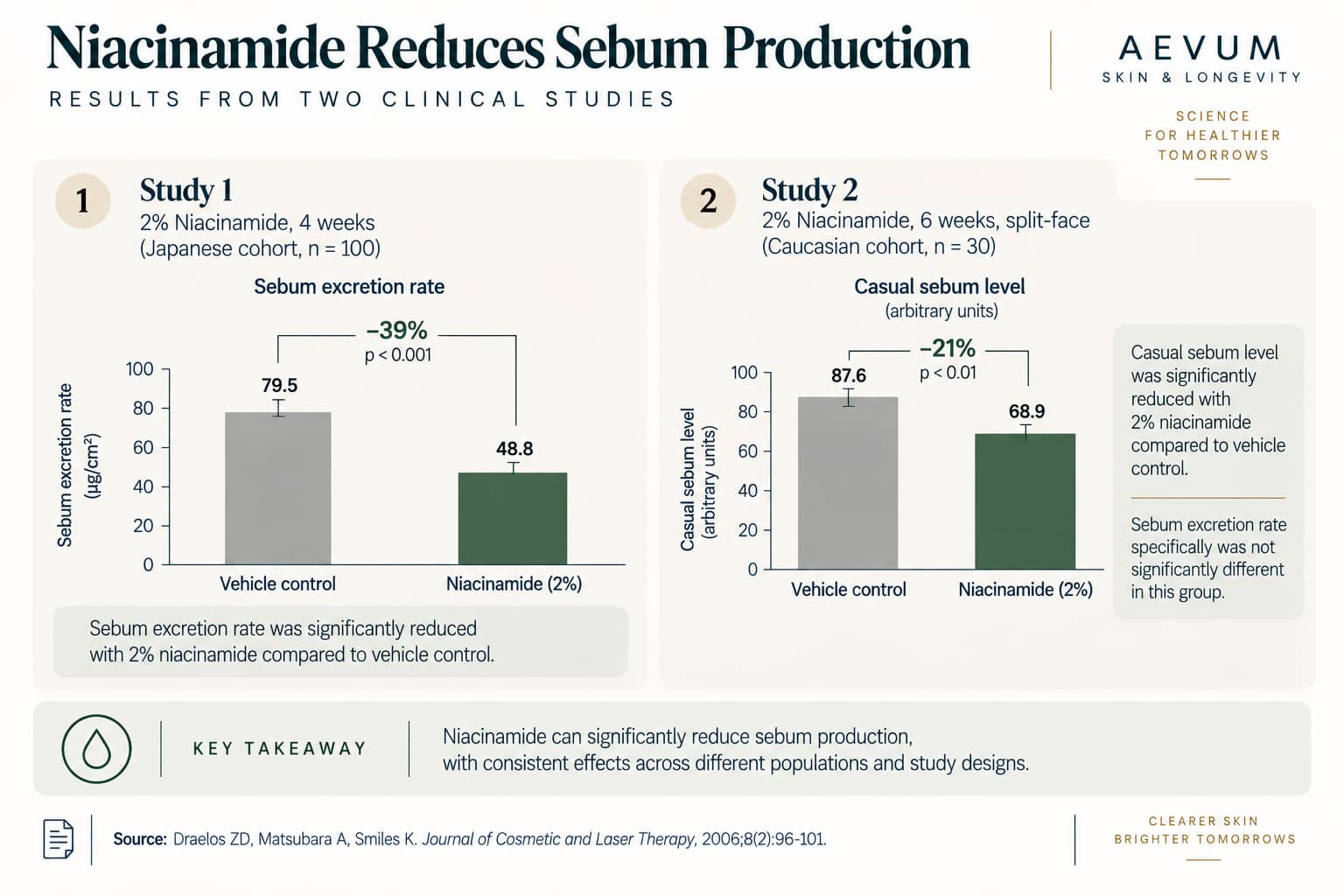
- →A controlled study of 100 participants found 2% topical niacinamide significantly reduced facial sebum excretion rate over 4 weeks, with a companion 30-person split-face study finding a significant reduction in casual sebum level over 6 weeks — a partial rather than complete replication, since sebum excretion rate specifically wasn't significantly different in that second group
- →Niacinamide reduces hyperpigmentation through a genuinely different mechanism than vitamin C — rather than inhibiting the tyrosinase enzyme, it blocks the transfer of melanin-containing melanosomes from melanocytes into surrounding skin cells, making the two ingredients mechanistically complementary rather than redundant
- →A large, year-long, placebo-controlled trial of 386 patients found oral niacinamide reduced the development of new non-melanoma skin cancers by 23% — a significant, distinct finding, though it's important to note this used an oral dose, not a topical one
- →Niacinamide directly increases ceramide, free fatty acid, and cholesterol synthesis in skin cells — connecting directly to the barrier lipid biology covered in our Skin Barrier article, with this effect confirmed in randomised clinical trials
Key numbers at a glance
| Measure | Figure |
|---|---|
| Participants in the foundational sebum-reduction RCT | 100 (plus 30 in a companion split-face study) |
| Typical concentration for barrier/hydration benefit | ~2% |
| Typical concentration for sebum/pore-focused benefit | ~4-5% |
| Non-melanoma skin cancer reduction, oral niacinamide (1-year RCT, 386 patients) | ~23% |
| Niacinamide + tranexamic acid pigmentation trial size | 42 women, 8 weeks |
Why this matters: a genuinely multi-mechanism ingredient
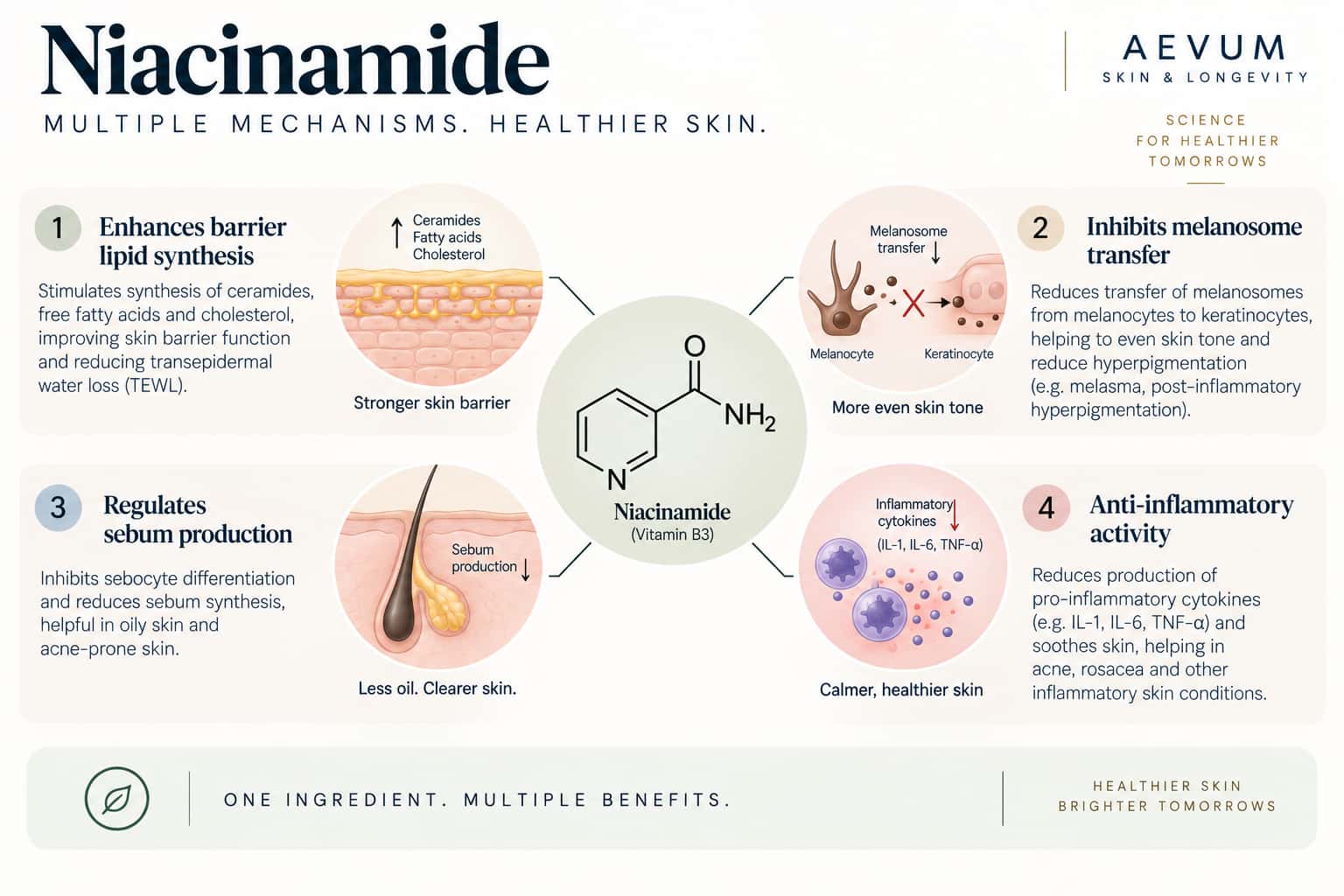
Niacinamide's versatility traces back to its fundamental biochemical role as a precursor to NAD+ and NADP+, coenzymes required throughout cellular energy metabolism and DNA repair — this foundational role is part of why its effects touch so many separate skin processes rather than acting on a single, narrow target the way many actives do. Several distinct, independently studied mechanisms follow from this:
- →Barrier support: niacinamide increases the synthesis of ceramides, free fatty acids, and cholesterol in keratinocytes — the exact barrier lipid components covered in our Skin Barrier article — an effect confirmed in randomised clinical trials, not just cell-culture research
- →Pigmentation: rather than inhibiting the tyrosinase enzyme the way vitamin C does, covered in our Vitamin C article, niacinamide works by inhibiting melanosome transfer — blocking the process by which melanin-containing structures move from melanocytes into surrounding keratinocytes. This distinct mechanism is part of why the two ingredients are often used together for pigmentation concerns rather than being considered interchangeable
- →Sebum regulation: niacinamide has a well-documented ability to reduce sebum production and visible pore size, covered in the research below
- →Anti-inflammatory activity: niacinamide reduces pro-inflammatory cytokine secretion (including interleukin-8), decreases mast cell degranulation, and reduces UVB-induced inflammatory signalling in keratinocytes — a broad anti-inflammatory profile relevant to acne, rosacea, and eczema, alongside general skin resilience
The penetration consideration
Like the peptides covered in our previous article, niacinamide is a hydrophilic (water-loving) molecule, which creates a genuine, documented challenge partitioning into the lipid-rich stratum corneum covered in our Skin Barrier article. Unlike peptides, however, niacinamide is a considerably smaller molecule, which helps its real-world penetration outcomes considerably — but formulators still commonly pair it with penetration-enhancing co-ingredients to improve delivery, an active area of ongoing formulation research rather than a fully solved problem.
What the research shows
Sebum reduction has solid RCT support, with an honest nuance worth keeping. A controlled study evaluated 2% topical niacinamide against a vehicle control in 100 Japanese participants over 4 weeks, finding a statistically significant reduction in sebum excretion rate measured by sebumeter. A companion study enrolled 30 Caucasian participants in a randomised split-face design over 6 weeks: casual sebum level was significantly reduced in this group too, but sebum excretion rate specifically was not significantly different from control — a partial, not complete, replication of the first study's exact outcome measure, worth stating precisely rather than glossing over. Separate research comparing 4% and 5% niacinamide against topical clindamycin (a standard acne treatment) for inflammatory acne found similarly successful outcomes between the two, a genuinely notable comparison given clindamycin's established clinical use.
The pigmentation evidence extends beyond mechanism into real clinical outcomes. An 8-week, double-blind, vehicle-controlled study of 42 Korean women (Fitzpatrick skin types III-V) tested a combination of 2% niacinamide and 2% tranexamic acid for irregular facial hyperpigmentation, finding the treatment significantly more effective than vehicle control — a genuinely relevant finding given the pigmentation and melasma concerns covered in our Melasma article, and a reasonable evidence-backed pairing worth knowing about.
The oral skin cancer prevention finding is significant, but requires a clear caveat. A large, year-long, placebo-controlled clinical trial of 386 patients with a history of non-melanoma skin cancer found that oral niacinamide, 500mg taken twice daily, reduced the development of new non-melanoma skin cancers by approximately 23% — a substantial, clinically meaningful finding. It's genuinely important to be precise here: this trial used an oral dose, not a topical skincare product, and the dose and delivery route are entirely different from anything applied to skin directly. This finding doesn't directly validate topical niacinamide for cancer prevention, but it does reflect meaningfully on the ingredient's broader safety and biological plausibility profile.
How to actually use it
- →Around 2% concentration is well-supported for general barrier support and hydration benefits, with minimal irritation risk — a reasonable default for most skin types, including sensitive skin as covered in our Sensitive Skin article
- →4-5% concentration is the more specifically studied range for sebum regulation and pore appearance, relevant for oilier or acne-prone skin
- →Niacinamide is broadly compatible with other actives, including retinoids and vitamin C, covered in our previous two articles — an older, largely outdated formulation myth suggested niacinamide and vitamin C shouldn't be combined, but modern, stable formulations have generally resolved the underlying chemical concern that myth was based on
- →For pigmentation concerns specifically, pairing niacinamide with tranexamic acid has direct clinical trial support, as covered above, and is a reasonable combination to look for or discuss with a dermatologist
Recommendations by skin type or goal
- 1Anyone with oily or acne-prone skin
The 4-5% concentration range has the most direct sebum-regulation evidence, comparable in some research to standard topical acne treatments.
- 2Anyone with sensitive or barrier-compromised skin, as covered in our Skin Barrier and Sensitive Skin articles
The 2% concentration range offers genuine, evidence-backed barrier and hydration support with a favourable tolerability profile, making niacinamide one of the more broadly gentle actives covered in this series.
- 3Anyone managing hyperpigmentation or melasma, as covered in our Melasma article
Niacinamide's melanosome-transfer mechanism is genuinely complementary to vitamin C's tyrosinase-inhibition mechanism — using both, or specifically seeking out a niacinamide-tranexamic acid combination, has real supporting evidence.
- 4Anyone building a routine with multiple actives
Niacinamide's broad compatibility makes it one of the easier ingredients to layer alongside retinoids and vitamin C without the formulation conflicts sometimes associated with other combinations.
- 5General / longevity-focused
Given how many genuinely distinct, independently-studied mechanisms trace back to one ingredient, niacinamide represents unusually efficient evidence-backed versatility — a reasonable foundational addition to nearly any routine covered in this series.
Practical notes
- →Niacinamide's versatility is grounded in real, separate mechanisms — barrier lipid synthesis, melanosome transfer inhibition, sebum regulation, and anti-inflammatory activity — not a single effect marketed broadly
- →Concentration should match the goal — roughly 2% for barrier/hydration, 4-5% for sebum/pigmentation-focused use
- →The oral skin cancer prevention data is a genuinely different finding from anything topical — worth knowing about, but not a reason to expect the same effect from a skincare product
- →Niacinamide and vitamin C can generally be used together — the historical incompatibility concern is largely outdated given modern, stable formulations
- →This is one of the more broadly gentle, well-tolerated actives covered in this series, making it a reasonable starting point for building a routine before adding more targeted, potentially irritating actives like retinoids
Niacinamide's reputation as a "multitasking" ingredient holds up to genuine scrutiny — its effects trace back to distinct, independently documented mechanisms rather than one narrow action marketed broadly. For the barrier and pigmentation science this connects to, see our Skin Barrier and Melasma articles, and for how it complements vitamin C specifically, see our Vitamin C article. If you'd like personalised guidance on where niacinamide fits into your own routine, our Longevity Doctors offer a free consultation as a starting point.
How does your skin
score on your longevity assessment?
Take the free Aevum Protocol assessment to see how your skin & longevity and 6 other longevity domains are performing — and get a personalised 90-day plan.
Take the Free Assessment →