Skin & Longevity
Microneedling for Skin Rejuvenation:
What Does the Evidence Actually Show?
Our Collagen Loss and Hormones & Skin articles covered two very different routes to stimulating new collagen production — a topical active ingredient, and a hormonal pathway. Microneedling represents a genuinely different third route: deliberate, controlled mechanical injury, designed to trigger the body's own wound-healing cascade into producing new collagen. This article covers how that actually works, what a session realistically involves, and where the evidence is genuinely strong versus where it's more limited than commonly assumed.
Quick Summary
- →Microneedling — clinically known as percutaneous collagen induction therapy — uses fine needles to create controlled micro-injuries, triggering the skin's natural wound-healing cascade to produce new collagen, elastin, and blood vessels
- →Needle depth genuinely matters and varies by purpose, ranging from roughly 0.25mm (superficial, product absorption) to 3.0mm (deeper scarring and texture concerns), with professional devices reaching depths at-home rollers typically can't
- →The evidence is genuinely strongest for acne scarring specifically — including recent, rigorously designed split-face, double-blind, placebo-controlled trials — while evidence for general photoaging and texture improvement is present but comparatively less robust
- →Radiofrequency (RF) microneedling adds thermal injury to the mechanical injury, and histological research has found it produces measurably higher levels of collagen remodelling than laser treatment in comparative studies
- →Specific microneedling devices have received FDA clearance for facial acne scars — SkinPen was the first, cleared in 2018 for patients aged 22 and over, with several other devices cleared since — worth knowing precisely, since "clearance" (the Class II device pathway) is a different, though still genuine, regulatory recognition than the "approval" pathway used for drugs
Key numbers at a glance
| Measure | Figure |
|---|---|
| Needle depth range across microneedling applications | ~0.25mm - 3.0mm |
| Typical sessions for meaningful results | 3-6, spaced 4-6 weeks apart |
| Reported risk of post-procedural hyperpigmentation or scarring | Low |
| FDA regulatory status for facial acne scar treatment | Cleared (Class II device pathway) for specific devices since 2018 |
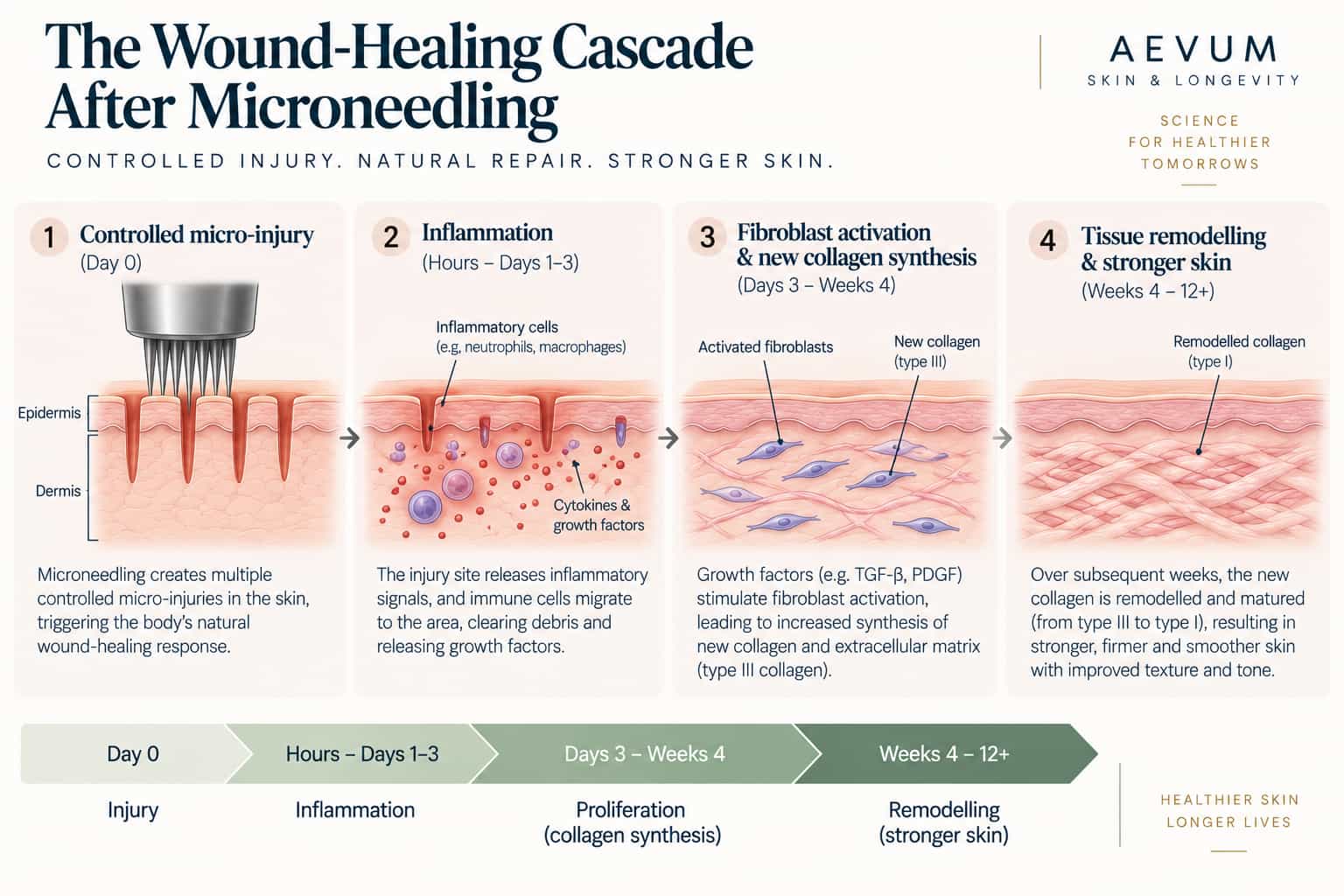
How it works: controlled injury as a collagen trigger
Microneedling uses a device — a roller, a motorised pen, or an automated stamping device — fitted with multiple fine needles to create controlled micro-injuries across the treated skin. This deliberately triggers the body's natural wound-healing cascade: an initial inflammatory response, followed by fibroblast activation and the release of growth factors that stimulate new collagen and elastin production, alongside neovascularisation — the formation of new blood vessels supporting the healing tissue. This is a genuinely different mechanism from the ones covered in our Retinoids and Hormones & Skin articles — rather than a chemical or hormonal signal prompting fibroblasts to work harder, microneedling creates a physical injury the body responds to by rebuilding, more directly analogous to how any wound triggers tissue repair.
Needle depth is a genuinely important variable, not an arbitrary setting. Superficial depths (around 0.25mm) are generally used to enhance absorption of topical products applied during treatment, since the micro-channels created temporarily allow better penetration than intact skin would permit. Moderate depths are used for general skin texture and photoaging concerns, while deeper settings (up to 3.0mm) are reserved for more significant concerns like atrophic acne scarring, and are generally only available through professional devices rather than at-home rollers.
Radiofrequency (RF) microneedling combines this mechanical injury with thermal energy. Devices deliver electrical current through the needles to specific depths, generating heat that denatures existing collagen and stimulates new collagen formation through a heat-induced inflammatory response, layered on top of the mechanical injury itself. Research directly comparing tissue effects has found RF microneedling produces higher levels of collagen remodelling in histological analysis than laser treatment, and clinical experience reported in the dermatology literature suggests more consistent results for certain conditions (including active acne, where RF microneedling can also affect sebaceous gland activity) compared to lasers or oral isotretinoin alone.
What to expect
- →Downtime varies considerably by device and depth. Professional in-clinic treatments typically involve 24-72 hours of visible redness and mild swelling, similar in appearance to a moderate sunburn, while lower-depth at-home devices generally involve minimal to no visible downtime
- →Multiple sessions are typically needed for meaningful results — usually 3-6 sessions, spaced roughly 4-6 weeks apart, reflecting the genuine biological timeline of collagen remodelling rather than a single-treatment fix
- →Cost generally sits in a moderate tier — more involved and expensive than topical actives covered elsewhere in this series, but generally less expensive than more intensive procedures like laser resurfacing, covered in our Laser Skin Rejuvenation article
- →Combination with other treatments is common and often evidence-supported. The micro-channels created during treatment allow enhanced absorption of topicals applied immediately afterward — platelet-rich plasma (PRP), hyaluronic acid, and even topical insulin have all been studied in combination with microneedling specifically for acne scarring, with a 2025 split-face, double-blind, randomised, placebo-controlled trial testing microneedle fractional radiofrequency combined with topical insulin for this exact purpose
Evidence strength: where the research is genuinely solid, and where it's thinner
Acne scarring has the strongest evidence base within this category. Multiple controlled trials, including recent, rigorously designed split-face and placebo-controlled studies, support microneedling's effectiveness for atrophic acne scars specifically — the most common scar type, making up roughly 80% of acne scarring cases. This is a genuine area of active, high-quality research, not just accumulated clinical impression.
General photoaging and texture improvement has real but comparatively less robust evidence. Microneedling is well-documented to improve collagen deposition, skin texture, and elasticity over time through the mechanisms described above, but the depth of controlled trial evidence for general anti-ageing use is less extensive than for the acne scarring application specifically.
Microneedling devices have, in fact, received specific FDA clearance for facial acne scars — SkinPen was the first, cleared in 2018 for patients aged 22 and over, and several other devices have since received similar clearance for facial acne scars, facial wrinkles, or abdominal scars. It's worth being precise about the terminology, though: these devices go through the Class II "clearance" pathway (510(k)), a different regulatory route than the "approval" pathway used for drugs and higher-risk devices — so "not FDA-approved" is technically true in that narrow sense, but doesn't mean this use lacks formal regulatory recognition, which specific devices genuinely have. Separately, in October 2025 the FDA issued a safety communication specifically about certain uses of radiofrequency microneedling devices, following reports of burns, scarring, and other complications — a reminder that device clearance and safe, appropriate use in practice are related but distinct questions, and treatment from a board-certified practitioner using a properly cleared device matters.
Comparative safety profile is genuinely favourable. A recent narrative review found microneedling carries a comparatively low risk of post-procedural hyperpigmentation or scarring — relevant context given the melasma-worsening risk flagged for some more aggressive procedures in our Melasma article, making microneedling a comparatively safer option worth discussing for melasma-prone or darker skin tones, though still worth confirming directly with a qualified practitioner given individual variation.
Recommendations by skin concern
- 1Anyone with atrophic acne scarring specifically
This is the strongest evidence category within microneedling — worth prioritising, and worth discussing RF microneedling specifically given its demonstrated enhanced collagen remodelling compared to standard mechanical microneedling alone.
- 2Anyone seeking general texture and photoaging improvement
Traditional microneedling is a reasonable option with real, if somewhat less extensive, supporting evidence — worth setting realistic expectations around gradual, multi-session results rather than a dramatic single-treatment transformation.
- 3Anyone with melasma or darker skin tones concerned about post-inflammatory hyperpigmentation, as covered in our Melasma article
Microneedling's comparatively favourable safety profile makes it a reasonable option worth discussing, relative to some more aggressive procedures — though individual assessment by a qualified practitioner remains essential.
- 4Anyone considering at-home dermarollers
These generally reach shallower depths than professional devices and carry genuine infection risk if not properly sterilised between uses — reasonable for very superficial product-absorption purposes, but not a substitute for professional treatment of scarring or significant texture concerns.
- 5General / longevity-focused
Microneedling represents a genuinely distinct mechanism from the topical and hormonal approaches covered elsewhere in this series — mechanical injury rather than chemical or hormonal signalling — making it a reasonable complementary approach rather than a replacement for the actives already covered.
Practical notes
- →Needle depth should match the actual concern being treated — superficial for product absorption, deeper for scarring — not simply "more depth is always better"
- →Results require multiple sessions over months, reflecting real collagen remodelling timelines, not a quick single-visit fix
- →The evidence base is genuinely strongest for acne scarring, with photoaging and general texture improvement resting on a comparatively thinner, though still real, evidence base
- →RF microneedling appears to offer a meaningful mechanistic upgrade over standard microneedling, based on histological collagen remodelling comparisons, at a correspondingly higher cost and typically more downtime
- →At-home devices carry genuine infection risk if not properly sterilised, and generally can't achieve the depths professional treatments can — a real limitation worth understanding before choosing this route
Microneedling offers a genuinely distinct route to stimulating new collagen — deliberate, controlled injury rather than a chemical or hormonal signal — with an evidence base that's genuinely strong for acne scarring specifically and reasonably solid, if less extensive, for general skin rejuvenation. For the collagen biology this mechanism targets, see our Collagen Loss article, and for how this compares to more advanced energy-based procedures, see our Laser Skin Rejuvenation article. If you'd like personalised guidance on whether microneedling suits your specific skin concerns, our Longevity Doctors offer a free consultation as a starting point.
How does your skin
score on your longevity assessment?
Take the free Aevum Protocol assessment to see how your skin & longevity and 6 other longevity domains are performing — and get a personalised 90-day plan.
Take the Free Assessment →