Skin & Longevity
Laser Skin Rejuvenation:
How Does It Actually Work?
Our Melasma article flagged that certain aggressive procedures can worsen rather than improve pigmentation, and our Microneedling article compared collagen remodelling outcomes against laser treatment directly. This article covers the actual physics and biology behind laser skin rejuvenation — a genuinely elegant, well-established scientific principle — along with the real, meaningful safety considerations that differ significantly by skin tone and specific condition.
Quick Summary
- →Laser skin rejuvenation works through a principle called selective photothermolysis, first described in 1983: a specific wavelength is absorbed by a specific target (water, melanin, or haemoglobin, depending on the goal), while a carefully controlled pulse duration and energy level damage that target without harming surrounding tissue
- →Ablative lasers (CO2, Erbium:YAG) directly remove the outer skin layers, producing dramatic results but requiring days to weeks of downtime, while non-ablative lasers heat tissue without removing it, offering considerably less downtime at the cost of needing more sessions for comparable results
- →Fractional technology — treating skin in a microscopic grid pattern rather than the entire surface at once — dramatically reduced downtime and risk compared to older, fully-ablative approaches, while still triggering meaningful collagen remodelling
- →Skin tone significantly affects both risk and laser selection — Erbium:YAG is generally preferred over CO2 for Fitzpatrick skin types IV-VI given lower dyspigmentation risk, and non-ablative fractional lasers specifically have been found favourable for skin of colour in evidence-based reviews
- →Laser treatment and melasma have a genuinely complicated relationship — some studies have investigated fractional lasers as an adjunctive melasma treatment alongside topical therapy, while separate research has documented melasma worsening after fractional resurfacing — making this a technique- and practitioner-dependent risk, not a simple yes-or-no answer
Key numbers at a glance
| Measure | Figure |
|---|---|
| Year selective photothermolysis was first described | 1983 |
| Core principles required for effective, safe treatment | 3 (wavelength match, pulse duration, fluence threshold) |
| Typical downtime, ablative vs. non-ablative fractional | Days-weeks vs. ~1-3 days |
| Typical sessions needed, fractional resurfacing | 3+ |
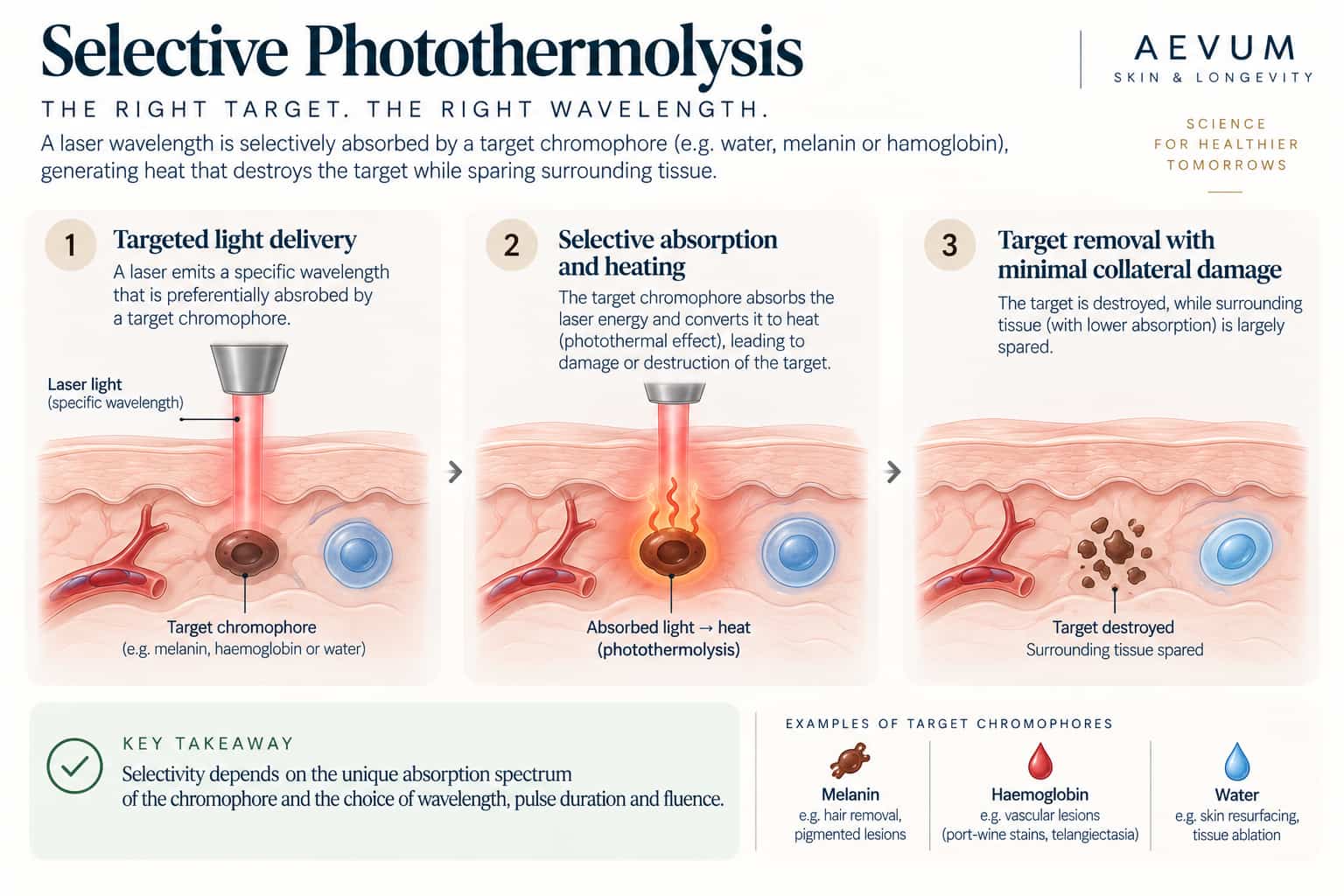
How it works: selective photothermolysis
Laser skin rejuvenation is built on a genuinely foundational piece of dermatology physics: selective photothermolysis, first described by Anderson and Parrish in a landmark 1983 paper. The principle rests on three specific conditions working together: a laser wavelength must be chosen to match the absorption characteristics of a specific target (called a chromophore) — water, melanin, or haemoglobin, depending on what's being treated; the pulse duration must be short enough (at or below the target's thermal relaxation time) to concentrate damage in the target before heat has time to spread to surrounding tissue; and the energy level (fluence) must be high enough to damage the target while staying below the damage threshold of everything around it. When all three conditions are met, a laser can destroy or alter a specific, microscopic target with real precision — this is the same underlying physics whether the goal is resurfacing skin texture, treating visible blood vessels, or removing unwanted pigmentation.
Ablative versus non-ablative is the most important practical distinction. Ablative lasers (CO2 and Erbium:YAG being the most common) target water directly, and use enough energy to actually vaporise and remove the outer epidermal and superficial dermal layers — producing dramatic, often single-treatment results, at the cost of a genuine wound requiring days to weeks of recovery. Non-ablative lasers also typically target water, but use energy levels calibrated to heat and coagulate tissue without removing it — triggering a collagen-remodelling response similar in spirit to the wound-healing cascade covered in our Microneedling article, but through a thermal rather than mechanical injury, with considerably less downtime.
Fractional technology changed the risk-benefit calculation substantially. Rather than treating the entire skin surface at once, fractional lasers deliver energy in a precise grid of microscopic treatment zones, leaving the surrounding, untreated tissue intact to support faster healing — while still triggering a genuine collagen response across the treated area. This innovation, applicable to both ablative and non-ablative lasers, is a major part of why modern laser resurfacing carries meaningfully less downtime and risk than earlier, fully-ablative approaches, while still delivering real, measurable results.
What to expect
- →Ablative laser resurfacing typically involves days to weeks of visible healing (redness, peeling, swelling), but can produce dramatic improvement in texture and wrinkling, sometimes in a single treatment
- →Non-ablative and fractional treatments generally involve roughly 1-3 days of downtime, but typically require 3 or more sessions to achieve comparable, meaningful results
- →Cost generally sits at the higher end of non-surgical procedures covered in this series, particularly for ablative treatments or multi-session fractional protocols
- →Different laser types target different chromophores for different purposes — pulsed dye lasers targeting haemoglobin for vascular concerns and redness, Q-switched or picosecond lasers targeting melanin for pigmentation, and CO2 or Erbium:YAG lasers targeting water for general resurfacing and texture — meaning "laser treatment" isn't one single procedure, but a family of genuinely different tools matched to different goals
Skin type, safety, and the melasma question
Skin tone meaningfully affects both risk and laser selection. For patients with Fitzpatrick skin types IV-VI (medium to deep skin tones), Erbium:YAG is generally preferred over CO2 for ablative resurfacing, given a comparatively lower risk of dyspigmentation and scarring. More encouragingly, a dedicated evidence-based review found that non-ablative fractional lasers specifically are a favourable treatment option for a range of dermatological concerns across Fitzpatrick skin types IV-VI — genuinely useful, specific guidance rather than a blanket caution against laser treatment for darker skin tones.
As flagged in our Melasma article, heat and inflammation are known triggers for this condition — and laser treatment, particularly more aggressive or heat-generating approaches, carries a real risk of worsening it. At the same time, research exists on the other side too: some studies have investigated non-ablative fractional lasers combined with topical therapy as a treatment approach for melasma resistant to standard topical treatment alone, including a randomised controlled split-face study comparing fractional laser against topical triple-combination therapy directly. Separately, other research has documented cases of melasma worsening following fractional resurfacing. The honest, practical takeaway: laser treatment for melasma-prone skin is genuinely technique-, device-, and practitioner-dependent — this is not a procedure to approach without a practitioner specifically experienced in melasma management, and general laser resurfacing shouldn't be assumed safe by default for anyone with active or a history of melasma.
Other genuine risks worth knowing about ablative treatment specifically include prolonged wound healing, scarring in rare cases, and reactivation of the herpes simplex virus following perioral ablative treatment — a known, specific risk requiring pre-treatment precautions in susceptible patients.
Evidence strength
The underlying physics of selective photothermolysis has been foundational to dermatology since 1983, and the laser resurfacing field built on it has accumulated several decades of research, device refinement, and clinical evidence since. It's worth being precise, though: "laser treatment" isn't a single, monolithic intervention with one evidence level — efficacy and safety vary considerably by specific device, wavelength, pulse parameters, and practitioner skill, meaning the quality of available evidence (and the quality of likely outcomes) genuinely depends on which specific laser and protocol are being discussed, not a single blanket answer.
Recommendations by skin concern
- 1Anyone with lighter skin tones seeking dramatic textural improvement and able to accommodate real downtime
Ablative laser resurfacing remains a well-established, evidence-backed option, generally delivering more dramatic single-treatment results than non-ablative alternatives.
- 2Anyone wanting meaningful results with minimal downtime
Non-ablative fractional laser treatment is the better-suited option, understanding that multiple sessions (typically 3+) will be needed for comparable improvement.
- 3Anyone with medium-to-deep skin tones (Fitzpatrick IV-VI)
Non-ablative fractional lasers have specific evidence-based support for this population; if ablative treatment is being considered, Erbium:YAG is generally the safer choice over CO2, and practitioner experience with darker skin tones specifically is genuinely important to confirm beforehand.
- 4Anyone with active melasma or a significant melasma history, as covered in our Melasma article
This is a case requiring specialist-level expertise specifically — some laser approaches have been studied as adjunctive treatments under careful protocols, but the risk of triggering or worsening melasma is real and technique-dependent, making this an area to approach only with a practitioner specifically experienced in melasma management.
- 5General / longevity-focused
Laser skin rejuvenation is a good example of a category where the underlying science is genuinely elegant and well-established, but where real-world outcomes depend heavily on matching the right specific device and protocol to the right patient — generic "laser treatment" recommendations are less useful than understanding your own skin type and goals specifically.
Practical notes
- →Selective photothermolysis is a genuinely precise, well-established scientific principle, not a marketing term — three specific physical conditions must be met for safe, effective treatment
- →Ablative and non-ablative represent a genuine trade-off between dramatic results and downtime, not simply "stronger vs. weaker" versions of the same treatment
- →Fractional technology meaningfully reduced risk and downtime while preserving genuine collagen-remodelling benefit, applicable to both ablative and non-ablative approaches
- →Skin tone should directly inform laser selection, not just treatment caution — specific devices (Erbium:YAG, non-ablative fractional) have genuine evidence supporting their use in darker skin tones specifically
- →Melasma and laser treatment require real specialist judgement — this is not a condition where general laser guidance safely applies without individual, expert assessment
Laser skin rejuvenation rests on genuinely elegant, well-established physics, but "laser treatment" covers a wide family of devices and approaches with real differences in risk, downtime, and suitability depending on skin type and specific condition. For the pigmentation-specific risks this connects to, see our Melasma article, and for how this compares to the mechanical collagen-induction approach of microneedling, see our Microneedling article. If you'd like personalised guidance on whether laser treatment suits your specific skin type and goals, our Longevity Doctors offer a free consultation as a starting point.
How does your skin
score on your longevity assessment?
Take the free Aevum Protocol assessment to see how your skin & longevity and 6 other longevity domains are performing — and get a personalised 90-day plan.
Take the Free Assessment →