Skin & Longevity
Peptides in Skincare:
Science or Marketing?
Our Skin Barrier article established that skin's structure is specifically designed to keep larger molecules out, and our Collagen Loss article covered how fragmented collagen sends signals that suppress new collagen production. Peptides sit at an interesting intersection of both: several are specifically designed to mimic those exact collagen-fragment signals — a genuinely clever mechanism — but they also happen to be exactly the kind of larger molecule the barrier is built to block. This article gives peptides the honest, mixed verdict the evidence actually supports.
Quick Summary
- →Peptides are short chains of amino acids, and cosmetic peptides fall into four functional categories — signal peptides (which prompt fibroblasts to produce more collagen), carrier peptides (which deliver trace elements like copper), enzyme-inhibitor peptides, and neurotransmitter-inhibiting peptides (marketed as "topical Botox")
- →Matrixyl (palmitoyl pentapeptide-4) has the strongest human clinical evidence of any cosmetic peptide — anchored by a 2005 double-blind, placebo-controlled trial in 93 women, and a 2023 head-to-head trial finding it outperformed both placebo and a competing peptide
- →Argireline, the "topical Botox" peptide, has a genuinely well-documented mechanism in theory — but a 2025 peer-reviewed review directly states that how it actually works when applied topically "remains incompletely understood," and flags low skin penetration as a real limitation on its effectiveness.
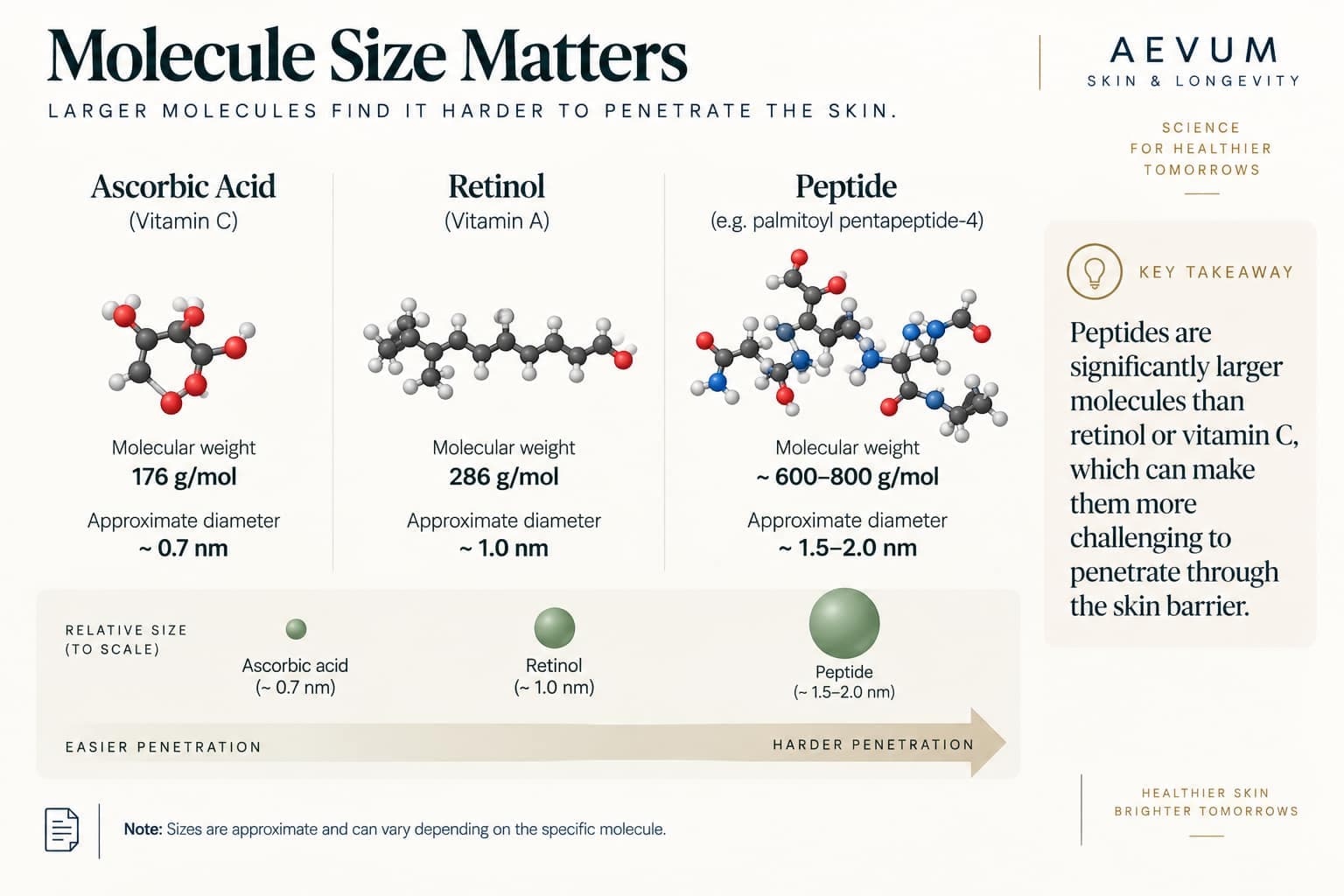
- →Penetration is the central, unresolved challenge for the entire peptide category — unlike the small, well-studied molecules covered in our Retinoids and Vitamin C articles, peptides are considerably larger and more water-loving, both properties that work against efficient penetration through the skin barrier
- →The honest verdict is genuinely mixed, not a blanket yes or no — some peptides (particularly signal peptides like Matrixyl) have real, replicated human evidence behind them, while others carry claims that outpace what's actually been demonstrated
Key numbers at a glance
| Measure | Figure |
|---|---|
| Participants in the foundational Matrixyl RCT (2005) | 93 women |
| Matrixyl vs. Argireline head-to-head trial (2023) | Matrixyl outperformed both Argireline and placebo |
| Claimed wrinkle depth reduction from 10% Argireline (30 days) | Up to ~30% |
| Peer-reviewed acknowledgment of Argireline's topical mechanism | "Incompletely understood" |
What peptides actually are, and the core challenge
Peptides are short chains of amino acids — smaller than full proteins, but larger than individual amino acids or the small molecules covered in our Retinoids and Vitamin C articles. Cosmetic peptides generally fall into four functional categories: signal peptides (such as Matrixyl), designed to mimic the fragments of broken-down collagen that naturally signal fibroblasts to produce more, connecting directly to the fragmentation cycle covered in our Collagen Loss article; carrier peptides (such as copper peptides, GHK-Cu), which deliver trace elements supporting various skin processes; enzyme-inhibitor peptides, designed to block collagen-degrading enzymes; and neurotransmitter-inhibiting peptides (such as Argireline), designed to reduce the muscle-signalling behind expression lines, in a topical echo of how botulinum toxin works, covered in more depth in our Botulinum Toxin article.
The challenge every one of these categories shares is penetration. As covered in our Skin Barrier article, the stratum corneum is specifically structured to block larger, water-loving molecules from passing through — and peptides are both larger and more hydrophilic than retinoids or even L-ascorbic acid. The most common engineering workaround, used in Matrixyl and several others, is palmitoylation — attaching a fatty acid chain to the peptide to make it more lipophilic and better able to cross the lipid-rich barrier. This is a genuine, sensible formulation strategy, but it doesn't fully eliminate the underlying size and penetration challenge, which remains the central variable determining whether any given peptide actually reaches the layers of skin where it would need to act.
Comparing the categories
| Signal Peptides (e.g., Matrixyl) | Carrier Peptides (e.g., Copper Peptides) | Neurotransmitter-Inhibitors (e.g., Argireline) | |
|---|---|---|---|
| Claimed mechanism | Mimics collagen fragments to stimulate new collagen production | Delivers copper to support enzymatic and wound-healing processes | Reduces muscle-signalling neurotransmitter release, similar in target to botulinum toxin |
| Human clinical evidence | Strongest in the category — multiple placebo-controlled RCTs | Moderate — decent mechanistic and wound-healing data, more limited cosmetic efficacy data | Limited, and mechanism when applied topically is disputed |
| Penetration | Improved via palmitoylation, still a limiting factor | Reasonable, given typically smaller carrier structures | A specifically flagged, unresolved limitation in recent review literature |
| Honest verdict | The most defensible peptide category based on current evidence | Plausible, reasonable, evidence still developing | Marketing claims currently outpace demonstrated topical mechanism |
What the research shows
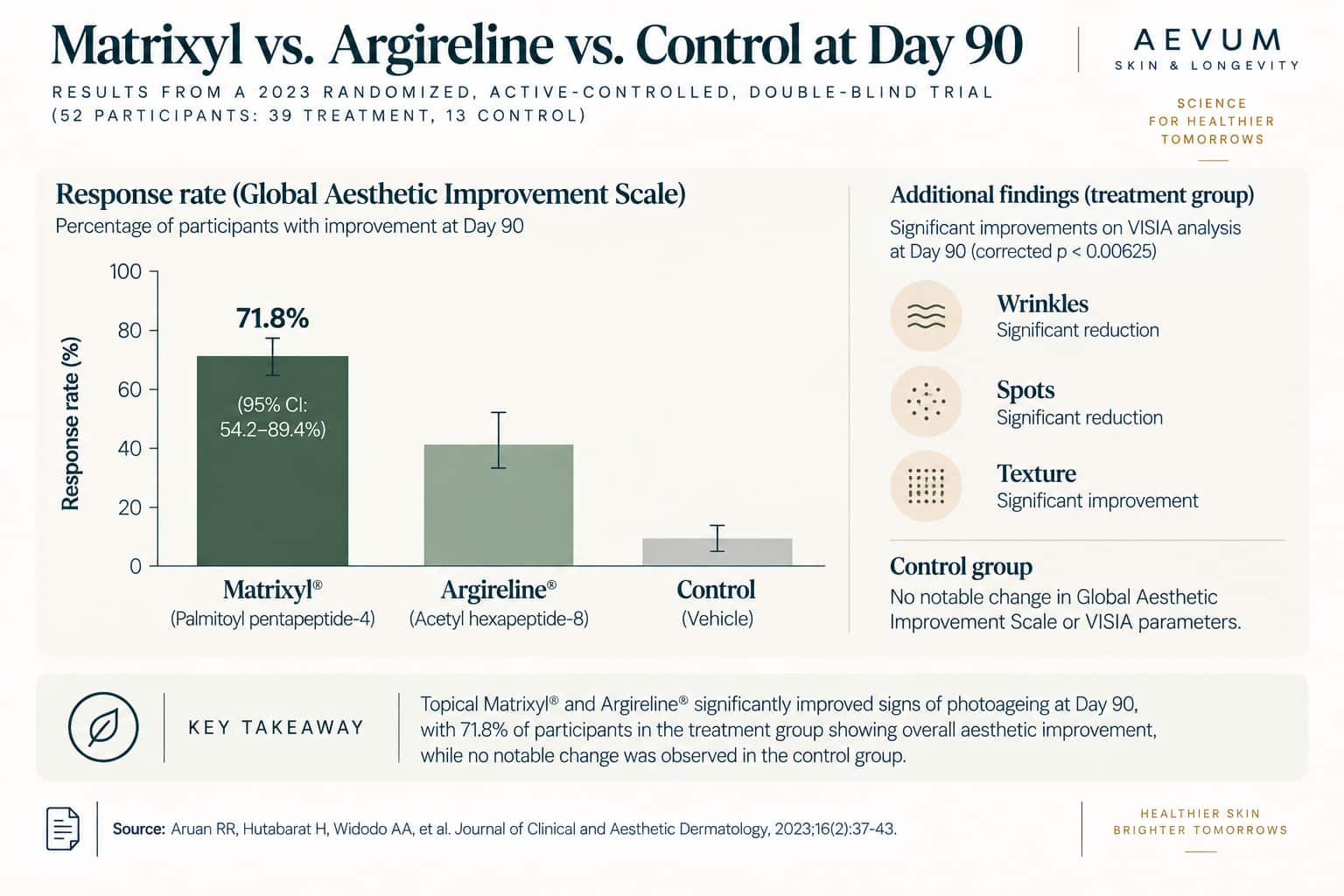
Matrixyl has genuinely solid, replicated human evidence. The foundational study, published in 2005, was a double-blind, placebo-controlled, split-face trial involving 93 women, and found measurable improvements in photoaged skin, including reduced wrinkle depth and improved texture. This isn't an isolated finding — a subsequent 2023 head-to-head trial directly compared palmitoyl pentapeptide-4 cream against acetylhexapeptide-3 (Argireline) cream and a placebo/control arm for crow's feet, and found Matrixyl outperformed both on standardised VISIA imaging and global aesthetic improvement scoring — 52 participants completed follow-up (39 in the treatment group, 13 in the control group), with a significant response rate of 71.8% in the treatment group. A separate trial testing a higher 7% concentration in 15 women found statistically significant reductions in crow's feet and under-eye wrinkles, alongside improved elasticity and barrier function. Taken together, this is a genuinely more substantial evidence base than most individual cosmetic peptides can claim, though it's worth noting plainly that industry funding is present in some of this research, as is common across cosmetic ingredient studies generally.
Argireline's "topical Botox" framing deserves real scrutiny — and recent peer-reviewed research provides it directly. Argireline (acetyl hexapeptide-8) is designed to target the same SNARE-protein mechanism involved in neurotransmitter release that botulinum toxin blocks via injection — a genuinely coherent, plausible mechanism on paper. Older formulation studies have claimed reductions in wrinkle depth of up to 30% over 30 days at 10% concentration. But a 2025 peer-reviewed review specifically examining Argireline's skin permeability and efficacy is notably direct about the gap between claim and evidence: it states that "the precise biological mechanisms underlying these effects — particularly the peptide's ability to inhibit muscle contraction when applied topically — remain incompletely understood," and explicitly identifies low skin penetration as a factor limiting its bioavailability and real-world therapeutic potential. This is a genuinely important, honest caveat from within the peer-reviewed literature itself, not external skepticism — the mechanism is plausible, but whether enough of the peptide actually reaches its intended target when applied topically remains a real, unresolved, acknowledged question.
Multi-peptide combination products complicate the evidence picture further. Several commercial studies test blends of multiple peptides together (one study combined Argireline, Matrixyl 3000, and a third peptide complex, finding measurable improvements in wrinkles, hydration, and elasticity over 28 days). While useful for evaluating a specific commercial product, this kind of combination research makes it genuinely difficult to isolate which individual peptide is actually responsible for any observed benefit — a real limitation worth keeping in mind when a product's marketing cites a study on a blend to support claims about one specific ingredient within it.
Recommendations by skin type or goal
- 1Anyone wanting the most evidence-backed peptide option available
Signal peptides like Matrixyl currently have the strongest, most replicated human clinical evidence in the category — a reasonable choice if the goal is genuinely evidence-based ingredient selection rather than following the newest trend.
- 2Anyone drawn to "topical Botox" marketing claims specifically
Worth understanding that the actual mechanism remains genuinely unresolved in the peer-reviewed literature, and that our Botulinum Toxin article covers the injectable version's considerably more robust, decades-long evidence base for comparison — expectations for a topical peptide alternative should be calibrated accordingly.
- 3Anyone evaluating a specific commercial peptide product
Check whether the supporting research tested the individual ingredient or a multi-peptide blend — this distinction genuinely matters for how much confidence to place in a claim about one specific peptide.
- 4Anyone building a routine already including retinoids and vitamin C, as covered in our previous two articles
Peptides are reasonably positioned as a complementary addition rather than a primary active — the evidence base, while real for some categories, isn't yet at the level of those two more established ingredient classes.
- 5General / longevity-focused
Peptides are a good example of a skincare category where the honest answer is genuinely "it depends which one" — broad statements either dismissing or endorsing "peptides" as a whole category miss the real, meaningful differences in evidence quality between specific types.
Practical notes
- →Peptides aren't one category with one answer — signal peptides like Matrixyl have real, replicated evidence; neurotransmitter-inhibiting peptides like Argireline have a plausible but unproven topical mechanism
- →Penetration remains the central unresolved challenge for the entire category — larger, more water-loving molecules than retinoids or vitamin C, even with formulation workarounds like palmitoylation
- →A peer-reviewed source itself acknowledges Argireline's topical mechanism is incompletely understood — this is a genuinely honest, current scientific position, not an overly skeptical one
- →Multi-peptide blend studies make it hard to credit any single ingredient — worth checking what was actually tested before trusting a specific ingredient claim
- →Matrixyl currently stands out as the more defensible choice within this ingredient category, based on the depth and consistency of its human trial evidence
Peptides in skincare deserve neither blanket dismissal nor blanket endorsement — the honest picture is a category with real mechanistic promise, genuinely strong evidence for some specific peptides, and claims that outpace the science for others. For the collagen biology signal peptides are designed to target, see our Collagen Loss article, and for the barrier challenge underlying their real-world effectiveness, see our Skin Barrier article. If you'd like personalised guidance on which actives are worth prioritising in your own routine, our Longevity Doctors offer a free consultation as a starting point.
How does your skin
score on your longevity assessment?
Take the free Aevum Protocol assessment to see how your skin & longevity and 6 other longevity domains are performing — and get a personalised 90-day plan.
Take the Free Assessment →