Skin & Longevity
How Hair Grows and Ages:
The Hair Cycle, Thinning and Greying
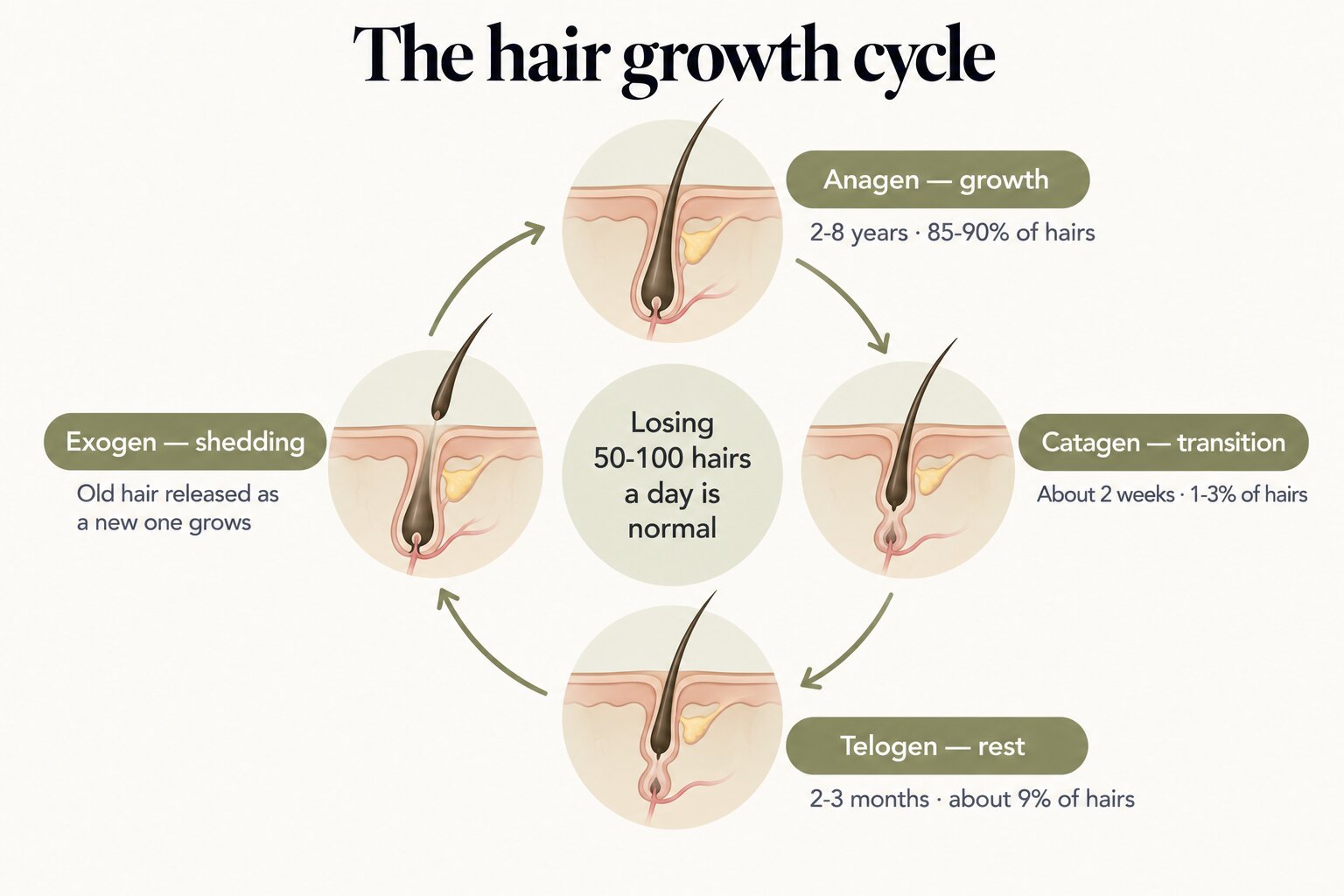
Every hair on your head grows from a follicle that goes through a repeating cycle of growth, rest and shedding. At any one time, about 85-90% of scalp hairs are in the growing phase (anagen), which lasts two to eight years; a few percent are in a short transition phase (catagen); and about 9% are resting (telogen) for two to three months before being shed. Losing 50 to 100 hairs a day is normal. With age, this cycle changes: growing phases get shorter, follicles produce thinner hairs, and hair density falls. In a study of 377 women, average hair density dropped from about 293 hairs per square centimetre at age 35 to about 211 at age 70. Pattern hair loss, driven mainly by genes and the hormone dihydrotestosterone (DHT), affects more than half of men over 50 and becomes increasingly common in women after menopause, reaching 38% of women aged 70 and over in the same study. Greying happens when the pigment stem cells in the follicle run out, but it's less universal than the old "50% of people are 50% grey by 50" rule suggests: a survey of 4,192 people found only 6-23% had reached that point. Stress can speed greying, and a 2021 study found that some stress-related grey hairs can regain their colour. Understanding the hair cycle explains why hair loss treatments take months to show results. This article, the first in our Hair & Scalp series, explains how hair grows and how it changes with age.
Key numbers
| Finding | Detail |
|---|---|
| Hairs in the growing phase (anagen) | About 85-90% at any time; phase lasts 2-8 years |
| Hairs in the resting phase (telogen) | About 9%; phase lasts 2-3 months |
| Normal daily shedding | 50 to 100 hairs |
| Hair density in women (377 women) | About 293 hairs/cm² at 35 vs 211 at 70 |
| Pattern hair loss | More than half of men over 50; 38% of women aged 70+ in one study |
| Grey hair by 50 (4,192 people) | Only 6-23% were at least 50% grey |
How hair grows
The follicle. Each hair grows from a follicle, a tiny organ in the skin. At its base, the hair bulb contains rapidly dividing cells that build the hair shaft, pigment cells (melanocytes) that give it colour, and a cluster of specialised cells called the dermal papilla that controls growth. Stem cells higher up the follicle allow it to regenerate in every cycle. The scalp has around 100,000 hair follicles.
The hair cycle. Each follicle cycles independently through four phases:
- 1. Anagen (growth): lasts two to eight years for scalp hair. About 85-90% of hairs are in this phase at any time. Scalp hair grows roughly a centimetre a month. The length of anagen determines how long your hair can grow.
- 2. Catagen (transition): lasts about two weeks. The follicle shrinks and detaches from its blood supply. Only 1-3% of hairs are in this phase.
- 3. Telogen (rest): lasts two to three months. About 9% of hairs are resting.
- 4. Exogen (shedding): the old hair is released, usually as a new hair begins to grow beneath it.
Because follicles cycle independently, we don't shed all our hair at once. Shedding 50 to 100 hairs a day is normal, and more may come out on days you wash or brush.
Why this matters for treatment. Because a hair cycle takes months, changes in hair growth take months to show. Shedding often appears two to three months after a trigger such as illness or childbirth, and most hair loss treatments need at least three to six months, often a year, to judge properly. Building a treatment plan around these timelines is covered in Building a Hair Loss Treatment Plan.
How hair changes with age
Thinner, fewer hairs. With age, the growth phase tends to get shorter and follicles produce finer hairs. In a 2001 study in the British Journal of Dermatology, Michael Birch and colleagues measured hair on the scalps of 377 women aged 18-99. Average density fell from about 293 hairs per square centimetre at age 35 to about 211 at age 70. Some thinning is a normal part of ageing in both sexes, sometimes called senescent thinning.
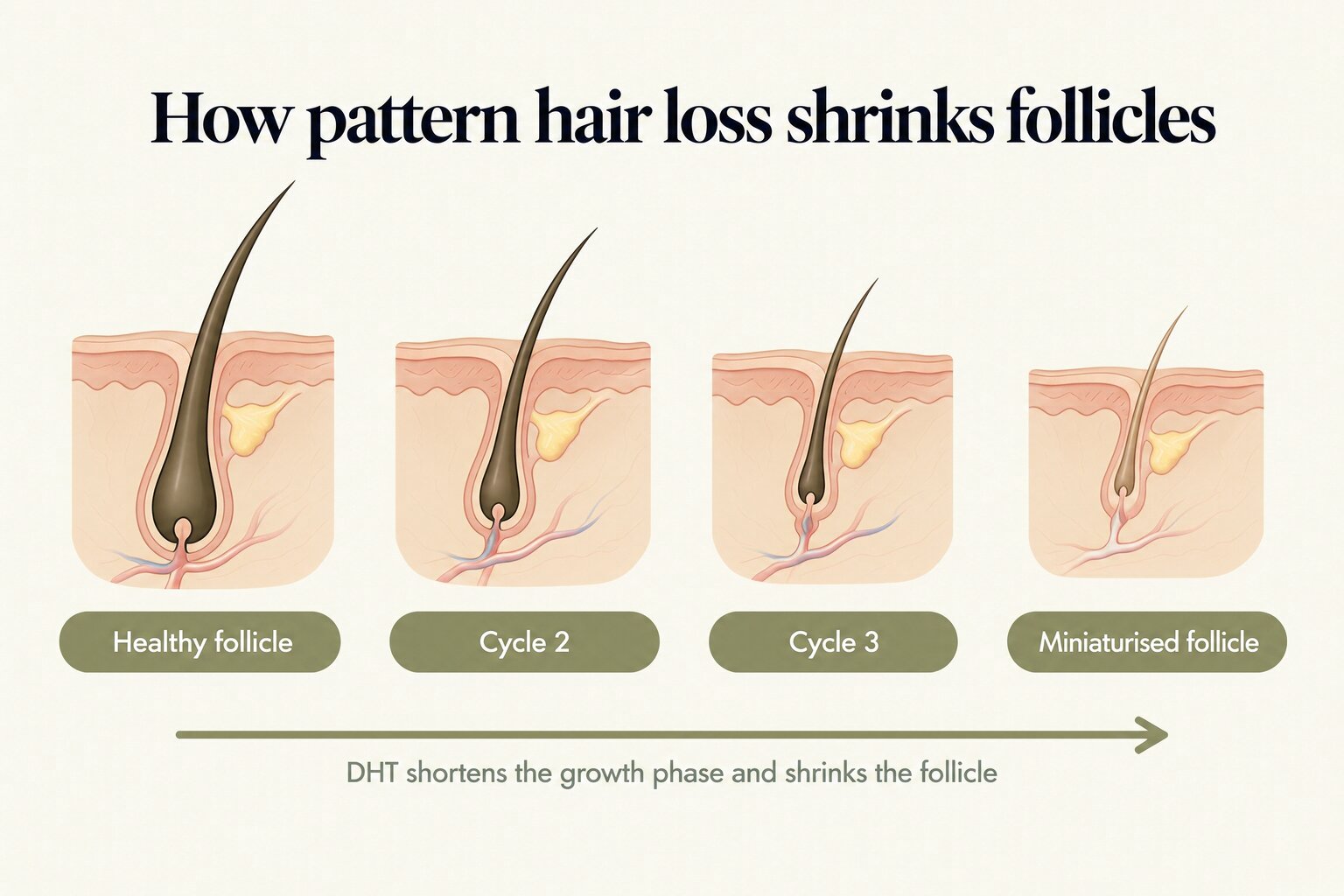
Pattern hair loss. The most common type of hair loss is androgenetic alopecia, or pattern hair loss. It's driven mainly by genes and by dihydrotestosterone (DHT), a potent form of testosterone. In genetically susceptible follicles, DHT gradually shortens the growth phase and shrinks the follicle, a process called miniaturisation, so that thick hairs are replaced over successive cycles by thinner, shorter, lighter ones.
- In men: hair typically recedes at the temples and thins at the crown. According to the US National Library of Medicine, more than half of men over 50 have some degree of hair loss.
- In women: hair thins over the top of the scalp and the parting widens, while the front hairline is usually preserved. In Birch's study, female pattern hair loss affected 6% of women under 50 but 38% of women aged 70 and over. It becomes more common after menopause, when the balance of oestrogen and androgens shifts (see Hormones and Skin).
Male and female pattern hair loss each have their own article: see Male Pattern Hair Loss and Female Pattern Hair Loss.
Why hair turns grey
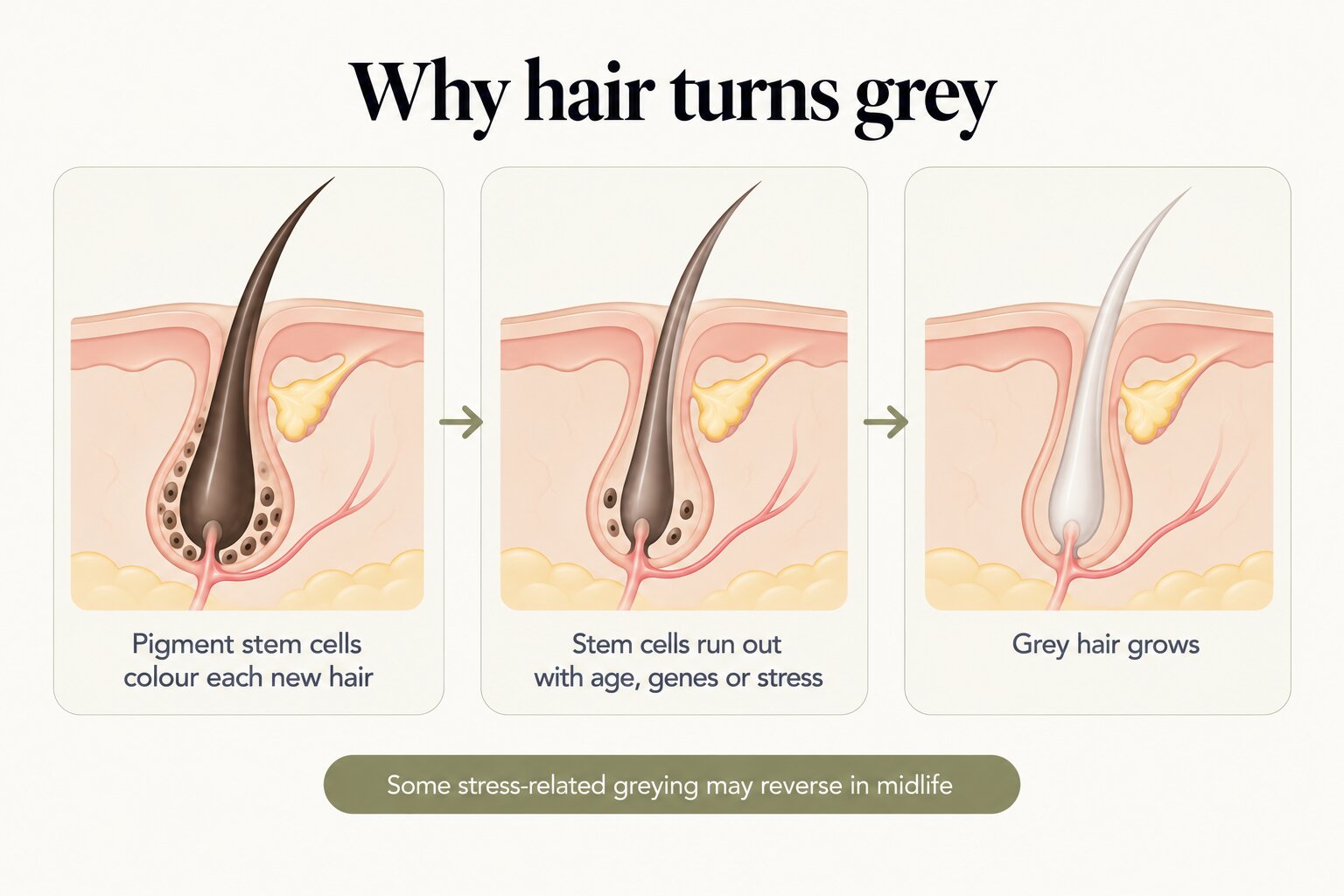
Hair colour comes from melanocytes in the hair bulb, which are replenished in each cycle from melanocyte stem cells. Greying occurs when these stem cells are depleted, so new hairs grow without pigment.
The "50-50-50 rule" isn't quite right. A popular rule of thumb says that half of people have half their hair grey by age 50. In a 2012 survey of 4,192 people worldwide, published in the British Journal of Dermatology, only 6-23% had at least half their hair grey by 50, depending on ethnicity and natural hair colour. People of Asian and African descent tended to grey later and more slowly than people of European descent. Genes are the main factor in when greying starts.
Stress and greying. In a 2020 study in Nature, Bing Zhang, Ya-Chieh Hsu and colleagues at Harvard showed that in mice, acute stress activates the sympathetic nerves that reach each hair follicle. These release noradrenaline, which causes the melanocyte stem cells to be used up rapidly. Within a few days the stem cells were gone, and the greying was permanent.
In humans, the picture may be more hopeful. In a 2021 study in eLife, Ayelet Rosenberg, Martin Picard and colleagues at Columbia University mapped pigment along individual hairs from 14 people, each slice representing about an hour of growth, and compared them with stress diaries. Some hairs turned grey during stressful periods and regained their colour when stress eased; in one person, five hairs darkened again during a holiday. The researchers think this is most likely in people whose hairs are close to a "greying threshold", typically in midlife, and don't expect stress reduction to darken hair that's been grey for years.
Other causes of early greying. Premature greying can sometimes be linked to smoking, thyroid disease, vitamin B12 deficiency or autoimmune conditions such as vitiligo. If greying starts very early or suddenly, it's worth checking with a doctor (see Thyroid Function and Ageing).
Why this matters for longevity
Hair changes are one of the most visible signs of ageing, and hair loss can affect confidence, wellbeing and quality of life. Most age-related hair changes are harmless, but hair can also reflect overall health: sudden shedding, patchy loss or early greying can point to stress, nutritional deficiencies, thyroid problems or autoimmune conditions. Knowing what's normal helps you recognise when to seek advice, and understanding the hair cycle helps set realistic expectations for treatment.
Recommendations
| Situation | What to consider |
|---|---|
| Shedding 50-100 hairs a day, no thinning | Normal; no action needed |
| Gradual thinning at the temples, crown or parting | Likely pattern hair loss; earlier treatment preserves more hair |
| Sudden heavy shedding | Look for a trigger 2-3 months earlier (illness, childbirth, stress, diet); see a doctor if it persists |
| Patchy bald spots | See a doctor; may be alopecia areata or another condition |
| Very early or sudden greying | Check thyroid, B12 and other causes with your doctor |
| Starting any hair treatment | Allow at least 3-6 months before judging results |
Practical notes
Some hair shedding every day is normal, and some thinning and greying with age are part of normal ageing. Take a photo of your parting or crown in the same light every few months to track real change rather than relying on hairs in the shower. If you notice faster thinning, sudden shedding or patches, see a doctor early: many causes are treatable, and pattern hair loss responds best when treated before follicles have fully miniaturised. Protect your general health too, with a balanced diet, enough protein and iron, good sleep, stress management and no smoking. Our Longevity Doctors can assess hair loss alongside skin, hormonal and nutritional health and recommend appropriate tests and treatments, starting with the free longevity assessment.
- Birch MP, Messenger JF, Messenger AG. Hair density, hair diameter and the prevalence of female pattern hair loss. British Journal of Dermatology, 2001;144(2):297-304.
- Panhard S, Lozano I, Loussouarn G. Greying of the human hair: a worldwide survey, revisiting the '50' rule of thumb. British Journal of Dermatology, 2012;167(4):865-873.
- Zhang B, et al. Hyperactivation of sympathetic nerves drives depletion of melanocyte stem cells. Nature, 2020;577(7792):676-681.
- Rosenberg AM, et al. Quantitative mapping of human hair greying and reversal in relation to life stress. eLife, 2021;10:e67437.
- MedlinePlus Genetics. Androgenetic alopecia. US National Library of Medicine.
- Natarelli N, et al. Integrative and mechanistic approach to the hair growth cycle and hair loss. Journal of Clinical Medicine, 2023;12(3):893.
Free longevity assessment
Noticing changes in
your hair?
Take the free Aevum Protocol assessment to see how your skin & longevity and 6 other longevity domains are performing — and get a personalised 90-day plan.
Take the free assessmentKeep reading