Skin & Longevity
Male Pattern Hair Loss:
Causes, Stages and What Works
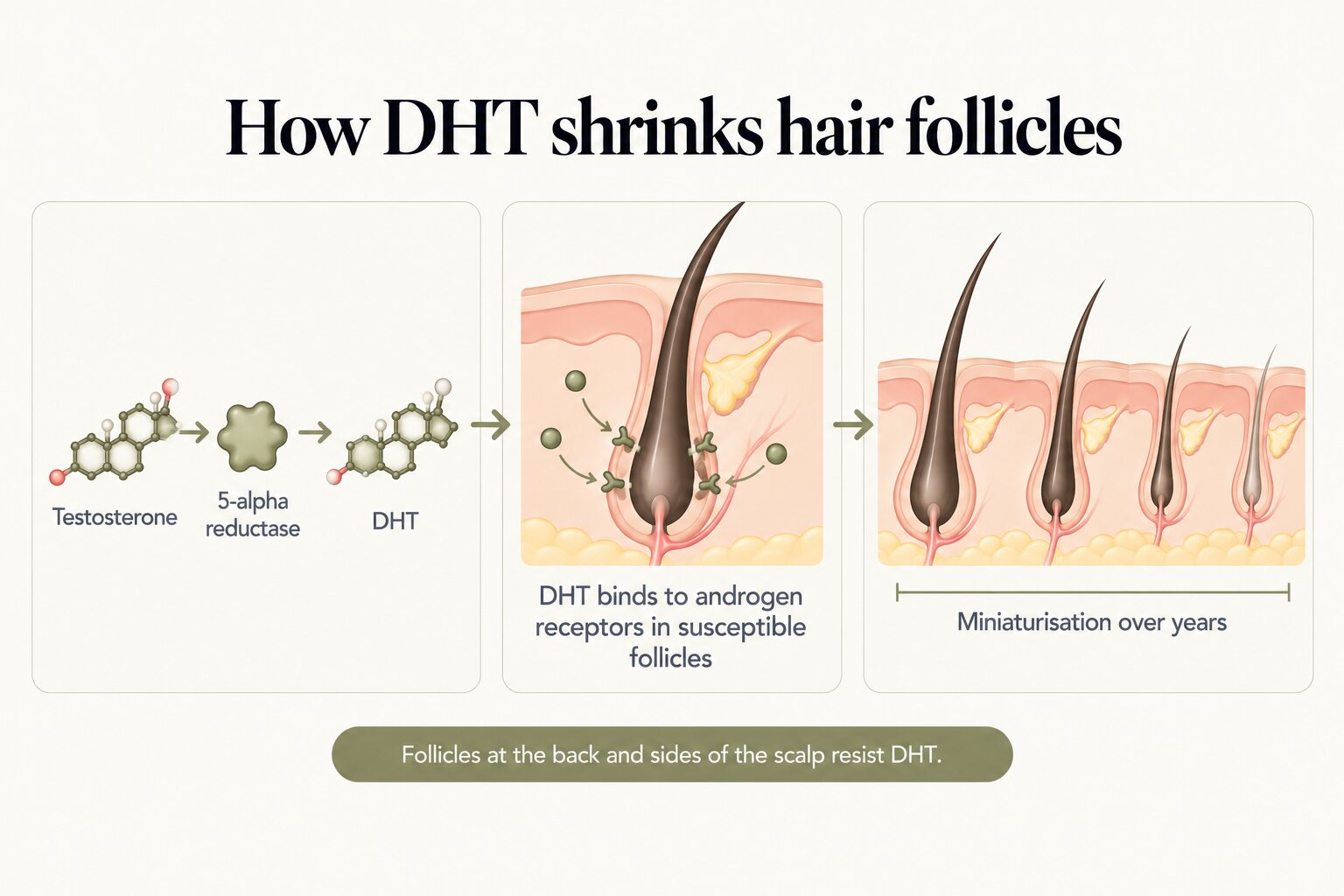
Male pattern hair loss (androgenetic alopecia) is the most common type of hair loss in men. It's caused by an inherited sensitivity of scalp follicles to dihydrotestosterone (DHT), a hormone made from testosterone. Over years, DHT shrinks affected follicles so they grow shorter, finer hairs, until some stop producing visible hair at all. It usually starts at the temples and crown and follows a predictable pattern, described by the Norwood scale. It affects roughly half of men by their 50s in European populations, and is common in South Asian men too, though often starting a little later than in white men. It isn't caused by helmets, caps or a lack of hair oil. Balding at the crown has been linked to a modestly higher risk of heart disease, so it's a reasonable prompt to check your heart health. Two treatments have the strongest evidence: finasteride, which lowers DHT, and minoxidil, which stimulates growth. Both work best when started early, because they protect follicles that are still alive much better than they revive ones that have gone. This article explains the causes, the stages, the health links and what works.
Key numbers
| Finding | Detail |
|---|---|
| White men with pattern hair loss | About 30% in their 30s, 40% in their 40s, 50% in their 50s |
| Indian men aged 30 to 50 (1,005 men, Bangalore) | 58% had pattern hair loss |
| Chinese men (six-city study) | 21% overall, rising from 3% at 18 to 29 to 41% at 70 and over |
| Genetic regions linked to baldness | 287, found in over 52,000 men |
| Crown balding and heart disease (6 studies, about 37,000 men) | Risk about 18% to 48% higher, rising with severity; frontal balding not linked |
| Finasteride at 5 years | 90% had no further visible loss vs 25% on placebo |
How it works
DHT and the follicle. Testosterone is converted into DHT by an enzyme called 5-alpha reductase, mainly the type 2 form found in hair follicles and the prostate. DHT binds to androgen receptors in the follicle. In genetically susceptible follicles on the top and front of the scalp, this gradually shortens the growing phase and shrinks the follicle, a process called miniaturisation. With each hair cycle, the hairs become thinner, shorter and lighter, until the follicle produces only fine, almost invisible hair (see How Hair Grows and Ages).
Follicles at the back and sides of the scalp are naturally resistant to DHT. That's why even men with extensive balding keep a horseshoe of hair, and why hair transplants work: follicles moved from the back keep their resistance.
Androgens are essential to the process. In classic observations from the 1940s, the American anatomist James Hamilton noted that men castrated before puberty didn't develop pattern baldness. Most balding men have normal testosterone levels; the difference lies in how sensitive their follicles are, not how much hormone they make.
Genes. Pattern hair loss is strongly inherited. A 2017 study of over 52,000 men in the UK Biobank identified 287 genetic regions linked to baldness, many of them on the X chromosome, which men inherit from their mothers. That includes the androgen receptor gene. But many other genes are involved too, from both parents, so the old idea that baldness comes only from your mother's father is an oversimplification. Genetic tests can't yet reliably predict an individual man's hair loss.
Other influences.
- Age: the most important factor after genes.
- Smoking: in a study of 740 Taiwanese men aged 40 to 91, smoking, especially 20 or more cigarettes a day, was linked to more severe pattern hair loss after accounting for age and family history.
- Testosterone therapy and anabolic steroids: these can speed up hair loss in susceptible men by raising the hormone available for conversion to DHT (see Testosterone Therapy).
- Not causes: wearing helmets or caps, washing your hair often, or not oiling your hair. These don't cause pattern hair loss.
How it progresses: the Norwood scale
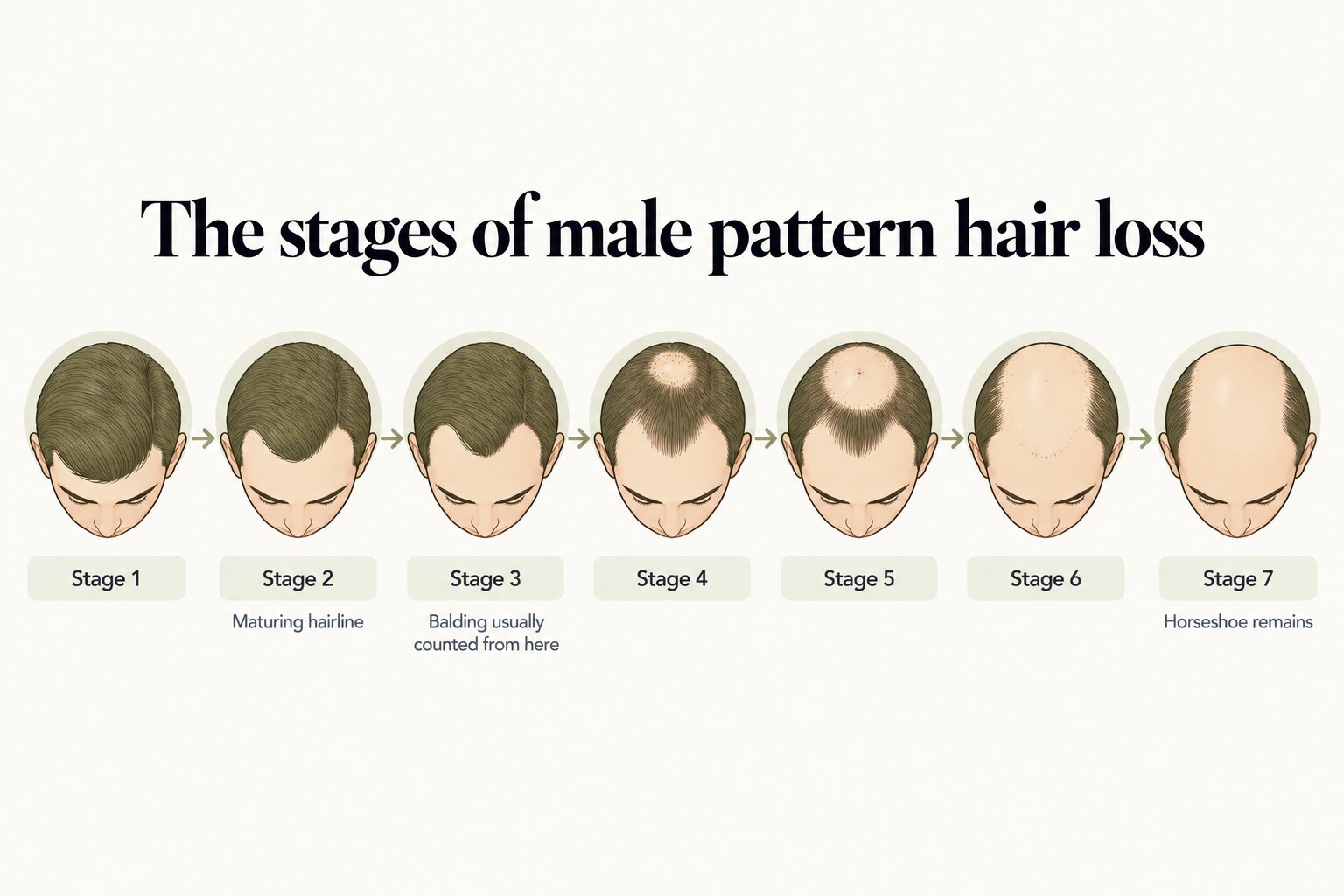
Doctors usually grade male pattern hair loss with the Hamilton-Norwood scale:
- Stage 1: no significant hair loss.
- Stage 2: slight recession at the temples. Many men have this as a normal "mature hairline" without going on to bald.
- Stage 3: deeper recession at the temples, forming an M shape. The earliest stage usually counted as balding. A variant (3 vertex) adds thinning at the crown.
- Stage 4: further loss at the front and a larger bald patch at the crown, still separated by a band of hair.
- Stage 5: the band between the front and crown becomes thinner.
- Stage 6: the front and crown merge into one bald area.
- Stage 7: only a horseshoe of hair remains around the sides and back.
Progression varies widely. Some men stay at stage 2 or 3 for life, while others move through several stages within a decade, particularly when hair loss starts in their teens or 20s.
Pattern hair loss develops gradually and leaves the scalp looking normal. Sudden shedding, round bald patches, or a sore, red or scaly scalp point to a different cause (see Types of Hair Loss).
What the research shows
How common it is. In white men, about 30% have pattern hair loss in their 30s, 40% in their 40s and 50% in their 50s. A US study found moderate to extensive loss in 16% of men aged 18 to 29, rising to 53% by 40 to 49. Rates are generally lower in East Asian men: a study across six Chinese cities found pattern hair loss in 21% of men overall, rising from about 3% at 18 to 29 to 41% at 70 and over. South Asian men aren't spared. A population study of 1,005 men in Bangalore, India, found pattern hair loss in 58% of those aged 30 to 50, though most had milder grades. There's no published Sri Lankan prevalence study, but the Indian figures are likely to be the closest guide.
Links with heart health. A 2013 meta-analysis in BMJ Open pooled six studies of about 37,000 men. Balding at the crown was linked to a higher risk of coronary heart disease, by about 18% for mild, 36% for moderate and 48% for severe crown balding. A receding hairline on its own wasn't significantly linked. The association was also seen in younger men. These studies show a link, not cause and effect: shared factors such as insulin resistance, inflammation or hormones may explain it. But the authors suggested that men with crown balding, especially younger men, should have their cardiovascular risk factors checked. This is particularly relevant for South Asian men, who develop heart disease earlier (see South Asian Cardiovascular Risk).
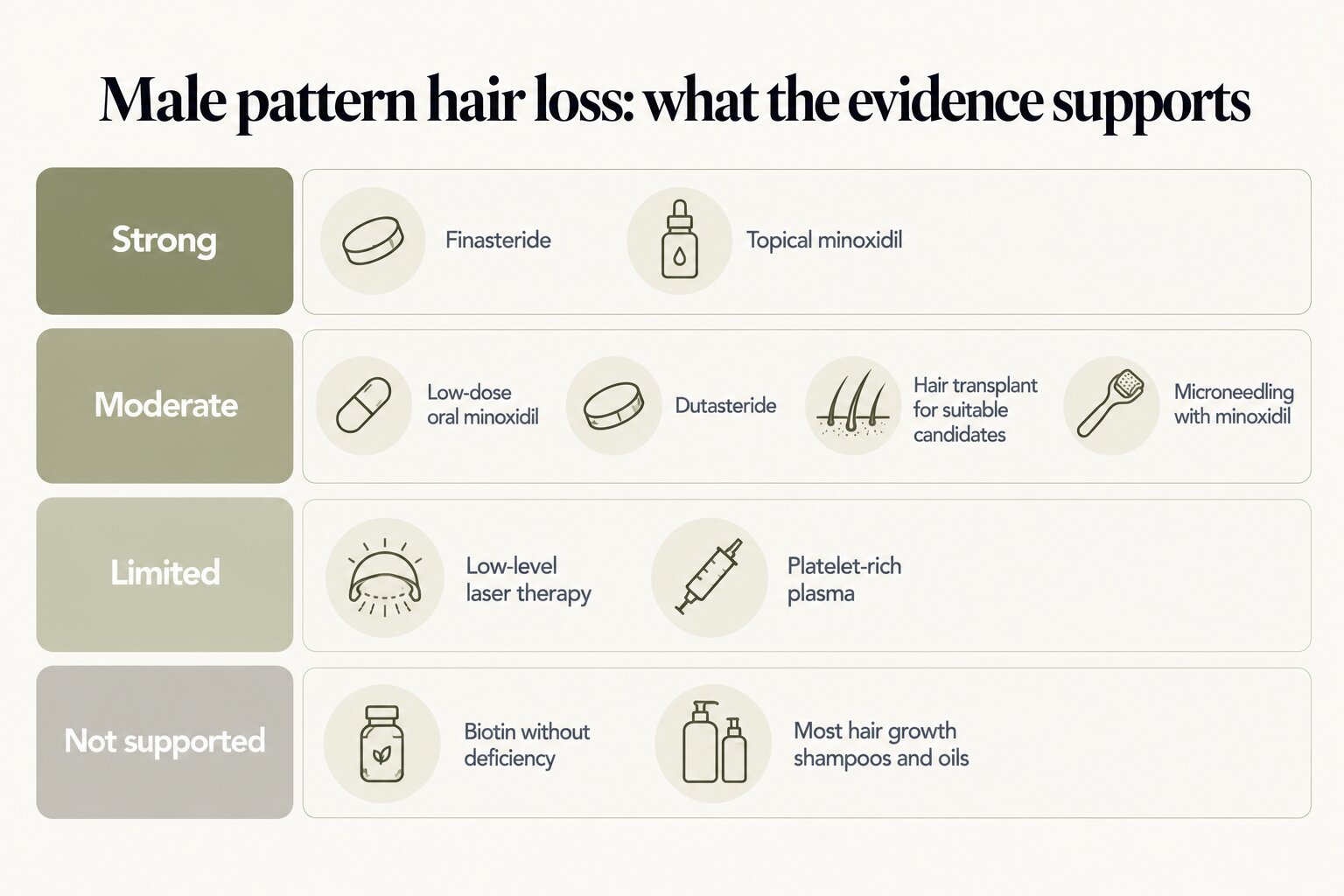
What works. Two treatments have strong evidence from large randomised trials:
- Finasteride: a daily tablet that blocks 5-alpha reductase type 2 and lowers DHT. In the original trials, 66% of men on finasteride had increased hair growth on photographs at 2 years, compared with 7% on placebo. At 5 years, 90% of men on finasteride had no further visible loss, compared with 25% on placebo, of whom 75% had lost more hair. Hair counts stayed above baseline throughout.
- Minoxidil: applied to the scalp as a 5% solution or foam, or taken as a low-dose tablet. It prolongs the growing phase and enlarges follicles. In a 2024 Brazilian trial of 90 men, a 5 mg daily tablet worked about as well as the 5% solution over 24 weeks, with a slight advantage at the crown. The tablet caused more unwanted body and facial hair growth (49% vs 25%) and headache (14% vs 2%); the solution caused more scalp irritation.
Using both together is common practice and generally works better than either alone. Other options include dutasteride (a stronger DHT blocker), hair transplant surgery, low-level laser therapy, microneedling and platelet-rich plasma (PRP), with evidence ranging from moderate to limited. Each is covered in detail in this series: see Minoxidil, Finasteride and Dutasteride, Low-Level Laser Therapy and Microneedling for Hair Loss, PRP for Hair Loss and Hair Transplant Surgery.
Side effects of finasteride. In the 12-month trials of finasteride 1 mg, sexual side effects were uncommon and only slightly more frequent than with placebo: reduced libido in 1.8% vs 1.3%, erectile difficulty in 1.3% vs 0.7%, and ejaculation changes in 1.2% vs 0.7%. Most resolved after stopping, and many resolved even while continuing. However, there are reports of sexual side effects persisting after stopping, and of mood changes. In 2025, the European Medicines Agency confirmed suicidal thoughts as a possible side effect of finasteride tablets, with unknown frequency. It concluded the benefits still outweigh the risks, but now advises anyone who notices mood changes to stop the medicine and seek medical advice. Finasteride is a prescription medicine and should be started after discussing these risks with a doctor.
Why this matters for longevity
Pattern hair loss isn't a disease, and many men are entirely comfortable with it. But for others it affects confidence, mood and quality of life, and those concerns deserve to be taken seriously. Crown balding may also be a visible marker of higher cardiovascular risk, so it's a good reason to check blood pressure, cholesterol and blood sugar (see Cardiovascular Risk Scores and Heart Age). And because treatment is far better at keeping hair than regrowing it, the timing of a decision matters: follicles that have fully miniaturised for years are much harder to recover.
Recommendations
By stage.
- Stage 2, a slightly maturing hairline: often normal. Monitor with photos every 6 to 12 months in the same lighting.
- Stages 3 to 5, noticeable thinning: the best time to start treatment if you want to keep your hair. Finasteride and minoxidil are first-line.
- Stages 6 and 7, extensive balding: medicines can help stabilise remaining hair, but meaningful regrowth is unlikely. A hair transplant may be an option if enough donor hair remains, or accepting the change is a perfectly healthy choice.
By situation.
- Young men with early or rapid loss: see a doctor early, as progression tends to be faster.
- Men with crown balding: check your cardiovascular risk factors.
- Men trying for a baby: discuss finasteride with your doctor first, as it has been linked to reduced semen quality in some men (see Male Fertility and Sperm Health).
- Men having PSA tests: finasteride and dutasteride lower PSA levels, roughly halving them, so tell your doctor if you're taking either (see PSA Screening for Prostate Cancer).
- Men on testosterone therapy or using anabolic steroids: expect possible faster hair loss if you're genetically prone.
Practical notes
Take clear photos of your hairline and crown every 6 months in the same light, as gradual change is hard to judge in the mirror. If you notice thinning and want to keep your hair, see a doctor sooner rather than later; treatment works best while follicles are still producing hair. Give any treatment at least 6 to 12 months before judging it, and expect a temporary increase in shedding in the first few weeks of minoxidil, which is a sign it's working. Treatment needs to continue for the benefit to last: if you stop, the hair gained over the following months is usually lost. Buy medicines from a registered pharmacy with a prescription rather than online sellers. Hair oils, special shampoos and biotin supplements won't stop pattern hair loss. If you smoke, stopping helps your hair as well as your heart. Our Longevity Doctors can confirm the type of hair loss, check for other causes, review your cardiovascular risk and help you choose a treatment plan, starting with the free longevity assessment.
- Krupa Shankar DS, et al. Male androgenetic alopecia: population-based study in 1,005 subjects. International Journal of Trichology, 2009;1(2):131-133.
- Wang TL, et al. Prevalence of androgenetic alopecia in China: a community-based study in six cities. British Journal of Dermatology, 2010;162(4):843-847.
- Rhodes T, et al. Prevalence of male pattern hair loss in 18-49 year old men. Dermatologic Surgery, 1998;24(12):1330-1332.
- Hagenaars SP, et al. Genetic prediction of male pattern baldness. PLOS Genetics, 2017;13(2):e1006594.
- Yamada T, et al. Male pattern baldness and its association with coronary heart disease: a meta-analysis. BMJ Open, 2013;3(4):e002537.
- Su LH, Chen TH. Association of androgenetic alopecia with smoking and its prevalence among Asian men. Archives of Dermatology, 2007;143(11):1401-1406.
- Hamilton JB. Male hormone stimulation is prerequisite and an incitant in common baldness. American Journal of Anatomy, 1942;71(3):451-480.
- Propecia (finasteride 1 mg) prescribing information: clinical studies and adverse reactions.
- Penha MA, et al. Oral minoxidil vs topical minoxidil for male androgenetic alopecia: a randomized clinical trial. JAMA Dermatology, 2024;160(6):600-605.
- European Medicines Agency. PRAC meeting highlights, 5–8 May 2025: finasteride and dutasteride and suicidal ideation.
- Indian Journal of Dermatology, Venereology and Leprology. Androgenetic alopecia: an update.
Free longevity assessment
Noticing your hairline
or crown thinning?
Take the free Aevum Protocol assessment to see how your skin & longevity and 6 other longevity domains are performing — and get a personalised 90-day plan.
Take the free assessmentKeep reading
Related articles
Skin & Longevity
Types of Hair Loss: How to Tell Pattern Loss, Shedding, Patchy and Scarring Hair Loss Apart
Skin & Longevity
How Hair Grows and Ages: The Hair Cycle, Thinning and Greying
Cardiovascular & Metabolic Health