Skin & Longevity
Types of Hair Loss:
How to Tell Pattern Loss, Shedding, Patchy and Scarring Hair Loss Apart
Hair loss has many causes, and the right treatment depends on finding the right one. Doctors split hair loss into two main groups. In non-scarring hair loss, the follicles are still alive, so the hair can usually regrow or be kept with treatment. This group includes pattern hair loss (the slow thinning that comes with age and genetics), telogen effluvium (sudden heavy shedding a few months after an illness, childbirth, crash diet or major stress), alopecia areata (round bald patches caused by the immune system), traction alopecia (from tight hairstyles), hair pulling, scalp fungal infection and hair loss from chemotherapy. In scarring hair loss, inflammation destroys the follicles and replaces them with scar tissue, so the loss is permanent. This group is less common but needs prompt assessment, because early treatment can save the follicles that remain. Three questions tell most types apart: where the hair is being lost, how fast, and what the scalp looks like. This article walks through each type, the clues that separate them and when to see a doctor.
Key numbers
| Finding | Detail |
|---|---|
| Normal daily shedding | About 50 to 100 hairs |
| Telogen effluvium timing | Shedding starts 2 to 4 months after the trigger; usually settles over 6 to 9 months |
| Alopecia areata lifetime risk | About 2% (2.1% in a US population study) |
| Traction alopecia (about 2,000 South Africans) | About 1 in 3 women and 1 in 7 schoolgirls |
| Chemotherapy hair loss | Starts within 2 to 4 weeks; regrows within about 3 to 6 months of stopping |
| Hair-pulling disorder | About 1 to 2% of adults and adolescents |
How hair loss is classified
Every follicle cycles through a growing phase (anagen), a short transition (catagen) and a resting phase (telogen), after which the old hair falls out and a new one starts (see How Hair Grows and Ages). Most types of hair loss disrupt this cycle in a particular way:
- Shortened growing phase and shrinking follicles: pattern hair loss.
- Too many follicles pushed into the resting phase at once: telogen effluvium.
- Growing follicles attacked or poisoned: alopecia areata and chemotherapy.
- Hair physically pulled or broken: traction alopecia, hair pulling and fungal infection.
- Follicle destroyed and replaced by scar: scarring alopecia.
The most important distinction for outcome is scarring vs non-scarring. A non-scarring scalp still has visible follicle openings (tiny pores where hairs emerge). In scarring alopecia these openings disappear and the skin looks smooth, shiny or pale.
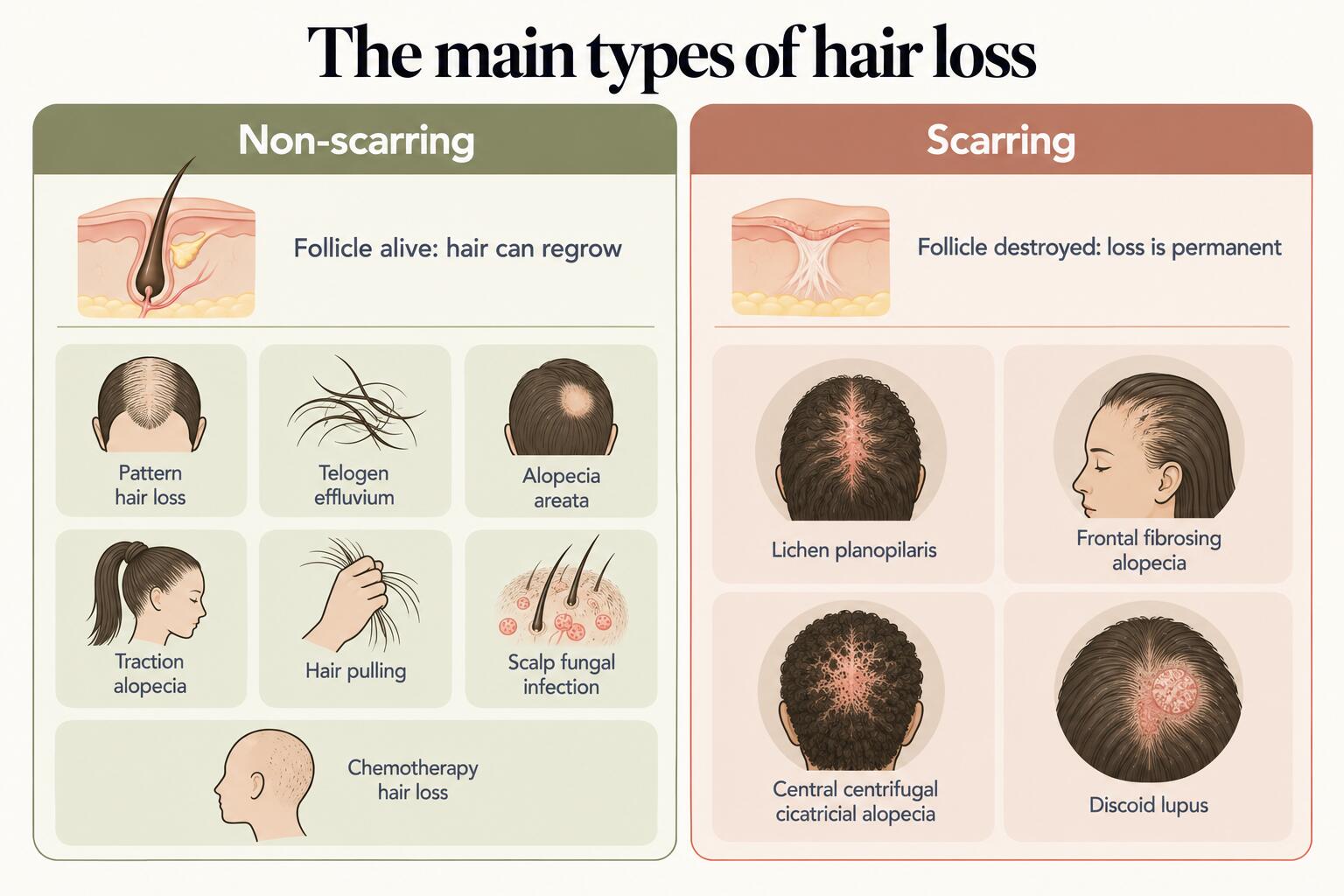
Non-scarring hair loss
Pattern hair loss (androgenetic alopecia). The most common type in both sexes. Under the influence of genes and dihydrotestosterone (DHT), follicles gradually shrink and produce finer, shorter hairs. In men it usually starts with a receding hairline at the temples and thinning at the crown. In women the front hairline is usually kept, and thinning appears over the top of the scalp with a widening parting. It develops slowly over years, the scalp looks normal, and there's often a family history. Pattern hair loss is covered in detail in Male Pattern Hair Loss and Female Pattern Hair Loss.
Telogen effluvium (sudden shedding). A shock to the body pushes many growing hairs into the resting phase at the same time. About 2 to 4 months later they fall out together, often in handfuls in the shower or on the pillow. The whole scalp thins evenly rather than in a pattern. Common triggers include:
- Childbirth (postpartum shedding).
- High fever or serious illness, including COVID-19 and dengue. In a Taiwanese report of 14 patients after a dengue outbreak, shedding began on average about 2 months after the infection and lasted about 3 months.
- Surgery, accidents or major psychological stress.
- Crash dieting, rapid weight loss or iron deficiency.
- Starting or stopping some medicines, including hormonal contraception.
Most acute telogen effluvium settles on its own over 6 to 9 months once the trigger has passed. If shedding continues beyond about 6 months, it's called chronic telogen effluvium, and it's worth checking for an ongoing cause. Repeated episodes can sometimes unmask pattern hair loss. Telogen effluvium is covered in its own article (see Telogen Effluvium).
Alopecia areata (patchy hair loss). An autoimmune condition in which the immune system attacks growing follicles. It typically causes round or oval, completely smooth bald patches, often appearing over a few weeks. Short broken hairs that taper towards the scalp ("exclamation mark" hairs) may be seen at the edges. It can also affect the beard, eyebrows or eyelashes, and in a minority it spreads to the whole scalp or body. About 2% of people develop it at some point in their lives, and it can start at any age. The follicles stay alive, so regrowth is possible, and new tablet treatments (JAK inhibitors) have changed the outlook for severe cases. It's covered in its own article (see Alopecia Areata).
Traction alopecia (from hairstyles). Long-term pulling from tight ponytails, buns, braids, cornrows, extensions, weaves or turbans gradually damages follicles, usually along the front hairline and temples. A South African study of about 2,000 people found it in about 1 in 3 women and 1 in 7 schoolgirls, with braids, extensions or weaves on chemically relaxed hair carrying the highest risk. Early traction alopecia is reversible if the tension stops. After years of pulling, the follicles can scar and the loss becomes permanent, so it's worth changing hairstyles at the first sign of a receding hairline or small bumps around the follicles.
Hair pulling (trichotillomania). Some people repeatedly pull out their own hair, often without being fully aware of it, in response to stress, boredom or tension. It affects about 1 to 2% of adults and adolescents, more often women. The patches have irregular shapes, and the hairs are broken at different lengths. It's a recognised condition, not a habit to be ashamed of, and behavioural therapy helps (see Therapy and Counselling).
Scalp fungal infection (tinea capitis). Mostly seen in children, but it can occur at any age. It causes scaly, itchy patches with broken hairs, sometimes seen as black dots at the scalp surface. A severe form, called a kerion, is a painful, swollen, pus-filled lump. It needs oral antifungal medicine, not just shampoo, because untreated infection, especially a kerion, can leave scarring.
Chemotherapy and other drugs (anagen effluvium). Chemotherapy damages rapidly dividing cells, including growing hair follicles. Hair loss usually begins within 2 to 4 weeks of treatment and can be extensive. It's almost always temporary, with regrowth usually within 3 to 6 months of stopping, though the new hair may differ in texture or colour at first. Scalp radiotherapy can cause permanent loss in the treated area.
Scarring hair loss (cicatricial alopecia)
In scarring alopecia, inflammation destroys the follicles and replaces them with scar tissue. Lost hair can't regrow, so the goal of treatment is to stop the inflammation and protect the follicles that remain. Some forms progress quietly with few symptoms, so it's easy to mistake them for ordinary thinning. The main types are:
- Lichen planopilaris: patches of hair loss with redness and scaling around individual follicles, often itchy, burning or tender.
- Frontal fibrosing alopecia: a band of hairline recession at the front and sides of the scalp, often with loss of the outer eyebrows. It mainly affects postmenopausal women, though men and younger women can be affected. First described in 1994, it has become much more common over the past two decades for reasons that aren't yet clear.
- Central centrifugal cicatricial alopecia: hair loss that starts at the crown and spreads outwards, seen mainly in women of African descent.
- Discoid lupus: red, scaly patches that leave scarred, sometimes discoloured bald areas.
Scarring can also follow burns, radiotherapy, severe infection or long-standing traction alopecia.
How to tell them apart
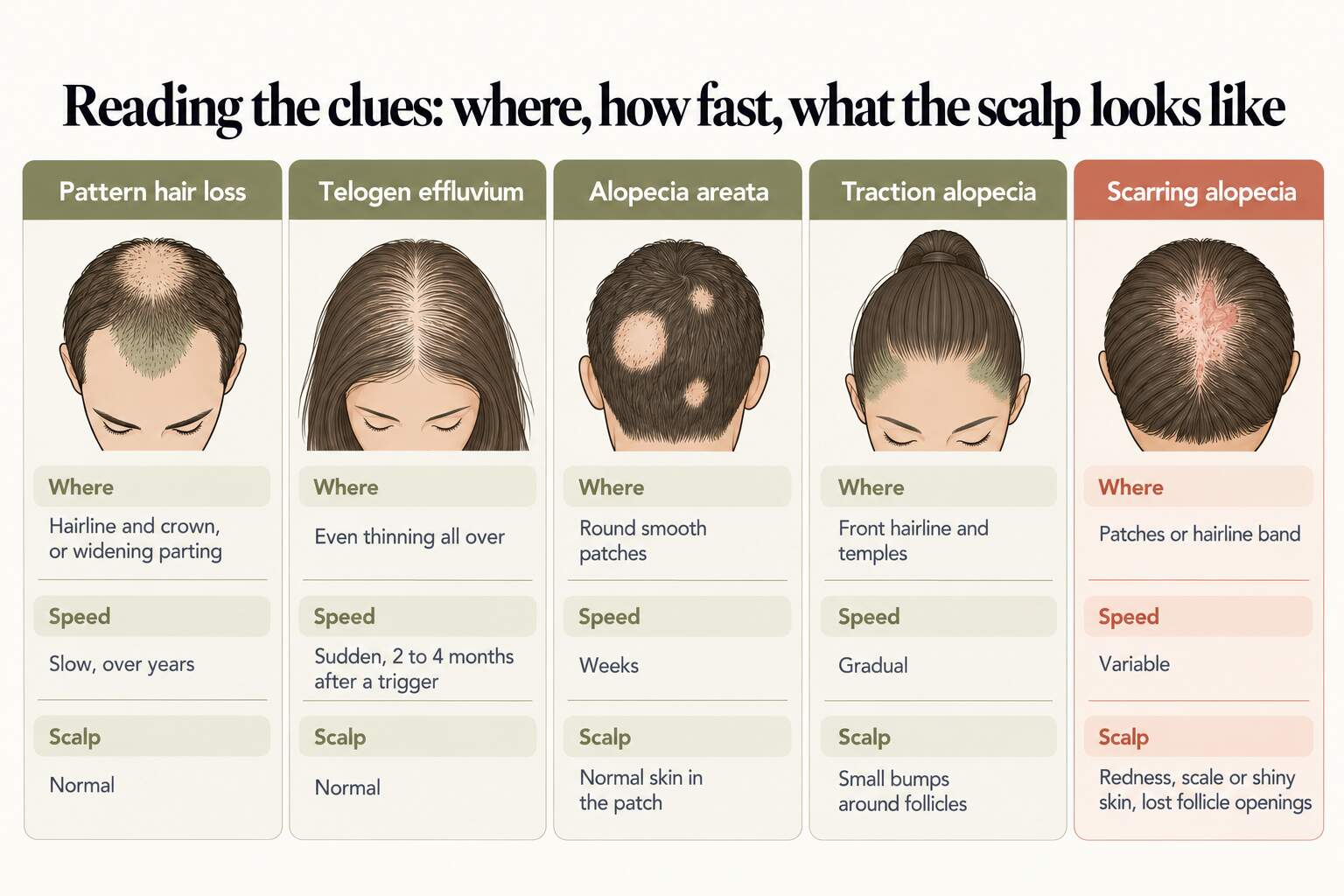
Three questions narrow down most cases:
- 1. Where is the hair being lost? A receding hairline or thinning crown suggests pattern loss in men. A widening parting suggests pattern loss in women. Even thinning all over suggests telogen effluvium. Round smooth patches suggest alopecia areata. Loss along the hairline in someone who wears tight styles suggests traction. A band of hairline loss with eyebrow loss suggests frontal fibrosing alopecia.
- 2. How fast? Pattern loss develops over years. Telogen effluvium and alopecia areata develop over weeks to months. Chemotherapy loss develops within weeks.
- 3. What does the scalp look like? A normal scalp points to pattern loss or telogen effluvium. Scaling with broken hairs suggests fungal infection. Redness, scale around follicles, pain, burning or smooth shiny skin with no follicle openings suggests scarring alopecia.
More than one type can occur together. For example, telogen effluvium after illness often reveals underlying pattern thinning, especially in women.
How doctors diagnose hair loss
- History: when it started, how fast, family history, recent illness, childbirth, diet or weight change, stress, medicines, hairstyles and hair treatments, and periods or menopause in women.
- Examination: the pattern of loss, the scalp skin, eyebrows, eyelashes, nails and body hair.
- Pull test: the doctor gently pulls a small bunch of hairs. If more come out than expected, the hair is actively shedding, as in telogen effluvium or active alopecia areata.
- Trichoscopy: a magnified look at the scalp with a dermatoscope. It shows shrinking hairs in pattern loss, exclamation mark hairs in alopecia areata, broken hairs in fungal infection and lost follicle openings in scarring alopecia.
- Blood tests: usually a full blood count, ferritin (iron stores), thyroid function and vitamin D, and in women with irregular periods, acne or excess facial hair, hormone tests for conditions such as PCOS (see Nutrient Blood Tests, Thyroid Function and Ageing and Living Well with PCOS). Blood tests and nutrition for hair loss are covered in more detail in Hair Loss, Blood Tests and Nutrition.
- Scalp sample: skin scrapings and plucked hairs for suspected fungal infection, and a small scalp biopsy when scarring alopecia is suspected or the diagnosis is unclear.
Why this matters for longevity
Hair loss is rarely dangerous in itself, but it can be a visible signal of something going on inside the body: iron deficiency, a thyroid problem, a hormonal condition such as PCOS, an autoimmune process or the after-effects of a serious illness. Finding and treating these improves overall health, not just hair. Hair loss also affects confidence and quality of life, which matter for wellbeing at every age. And because scarring alopecia is permanent, recognising it early is the difference between keeping and losing hair for life.
Recommendations: when to see a doctor
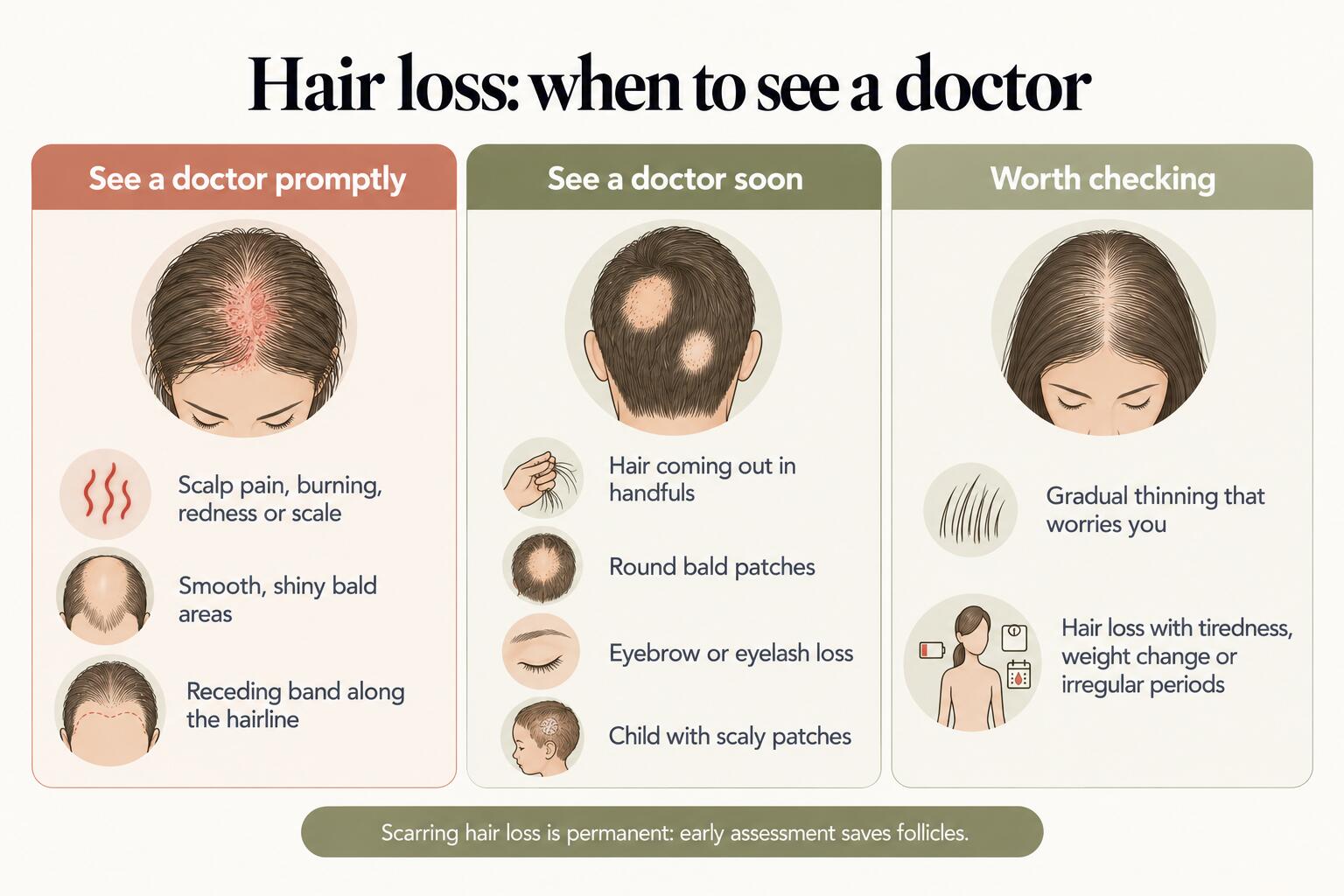
See a doctor or dermatologist promptly if you have:
- Sudden or rapid hair loss, or hair coming out in handfuls.
- Round bald patches, or loss of eyebrows, eyelashes or beard hair.
- A sore, itchy, burning, red or scaly scalp, or bald areas that look smooth and shiny.
- A receding band along the hairline, especially with eyebrow thinning.
- Hair loss with other symptoms, such as tiredness, weight change, irregular periods, acne or excess facial or body hair.
- A child with scaly patches and broken hairs.
- Thinning that's worrying you, at any stage. Treatments for pattern loss work best when started early.
Practical notes
Normal daily shedding is about 50 to 100 hairs, so finding hairs on your brush isn't a cause for alarm. If you notice more shedding than usual, think back 2 to 4 months for a trigger such as a fever, childbirth, a crash diet or a stressful event. In Sri Lanka, dengue and other high fevers are common triggers, and the shedding usually settles on its own within months. Iron deficiency is common, especially in women, and is worth checking. Wear your hair loosely where you can, alternate hairstyles, and avoid tight buns, braids and extensions for long periods. Don't rely on oils, shampoos or supplements until you know the cause. If your scalp is sore, red or scaly, or bald areas look smooth and shiny, see a doctor promptly, because scarring hair loss is permanent once it develops. Our Longevity Doctors can assess your hair and scalp, arrange the right blood tests and look for underlying causes, starting with the free longevity assessment.
- Mirzoyev SA, et al. Lifetime incidence risk of alopecia areata estimated at 2.1% by Rochester Epidemiology Project, 1990–2009. Journal of Investigative Dermatology, 2014;134(4):1141-1142.
- Khumalo NP, et al. Hairdressing and the prevalence of scalp disease in African adults. British Journal of Dermatology, 2007;157(5):981-988; and Hairdressing is associated with scalp disease in African schoolchildren. British Journal of Dermatology, 2007;157(1):106-110.
- Chu CB, Yang CC. Dengue-associated telogen effluvium: a report of 14 patients. Dermatologica Sinica, 2017;35(3):124-127.
- Kossard S. Postmenopausal frontal fibrosing alopecia: scarring alopecia in a pattern distribution. Archives of Dermatology, 1994;130(6):770-774.
- DermNet. Telogen effluvium; Anagen effluvium. dermnetnz.org.
- Primary Care Dermatology Society. Tinea capitis (scalp). pcds.org.uk.
- American Hair Loss Council. Scarring alopecia. americanhairloss.org.
- American Psychiatric Association. Diagnostic and Statistical Manual of Mental Disorders, 5th edition (DSM-5): trichotillomania (hair-pulling disorder).
Free longevity assessment
Worried about the hair
you're losing?
Take the free Aevum Protocol assessment to see how your skin & longevity and 6 other longevity domains are performing — and get a personalised 90-day plan.
Take the free assessment