Skin & Longevity
Alopecia Areata:
Patchy Hair Loss, Autoimmunity and New JAK Inhibitor Treatments
Alopecia areata is an autoimmune condition in which the immune system attacks growing hair follicles, causing smooth, round bald patches that can appear within weeks. It affects about 2% of people at some point in their lives, at any age, in both sexes and in all ethnic groups, most often starting in the teens, 20s or 30s. It isn't contagious and isn't caused by stress alone, although stress may act as a trigger in some people. Because the follicles aren't destroyed, hair can regrow, and over half of people diagnosed recover within a year, often without treatment. But the course is unpredictable: relapses are common, and in about 5 to 10% the hair loss spreads to the whole scalp (alopecia totalis) or the whole body (alopecia universalis). For limited patches, steroid injections or creams are the usual treatments. For severe disease, a new class of tablets called JAK inhibitors has transformed the outlook: in trials, roughly a quarter to two-fifths of people with at least half their scalp hair lost regrew most of it. The trade-offs are that these medicines need ongoing use, monitoring and careful consideration of side effects. Alopecia areata can also take a heavy emotional toll, and support matters as much as treatment. This article explains the condition, its course and the treatment options.
Key numbers
| Finding | Detail |
|---|---|
| Lifetime risk | About 2% |
| Recovery within 1 year | Over half of people diagnosed |
| Progression to total scalp or body hair loss | About 5 to 10% |
| Nail changes (pitting, ridging) | About 10 to 40% |
| Baricitinib 4 mg (about 1,200 adults, 36 weeks) | 36% to 39% regrew at least 80% of scalp hair vs 3% to 6% on placebo |
| Ritlecitinib 50 mg (718 people aged 12 and over, 24 weeks) | 23% regrew at least 80% vs 1.6% on placebo |
| Stopping baricitinib after response | 80% lost the benefit over time vs 7% who continued |
| Depressive and anxiety symptoms | Found in about 37% and 34% of people with alopecia areata |
How it works
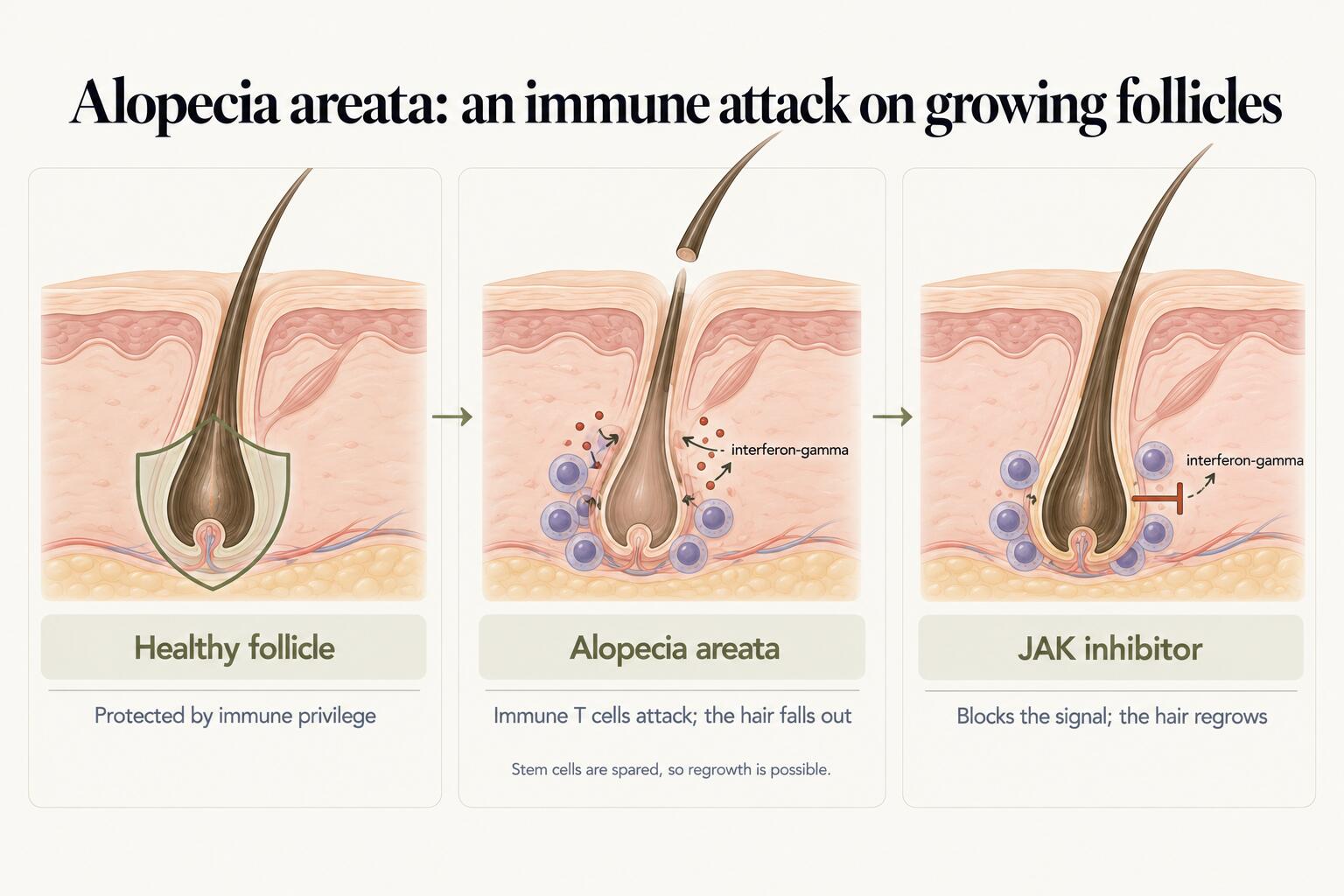
Losing immune privilege. Growing hair follicles normally have "immune privilege": they hide from the immune system by displaying few of the markers that immune cells use to recognise targets. In alopecia areata, this protection breaks down. Immune cells called CD8 T cells gather around the base of growing follicles and release signals, especially interferon-gamma, which push the follicle out of its growing phase. The hair falls out, but the stem cells higher up in the follicle are spared, which is why regrowth remains possible, even after years (see How Hair Grows and Ages).
The signals that drive this attack pass through an enzyme pathway inside cells called JAK-STAT. JAK inhibitors block this pathway, quieting the immune attack and allowing follicles to resume growth.
Genes and associated conditions. Alopecia areata runs in families, and at least 16 genetic risk regions have been identified, many shared with other autoimmune diseases. It's more common in people with:
- Atopic conditions (eczema, asthma, hay fever).
- Autoimmune thyroid disease (see Thyroid Function and Ageing).
- Vitiligo.
- Down syndrome.
- A family history of alopecia areata.
Stress, illness or infection are often reported before an episode, but they're thought to act as triggers in people already predisposed, rather than as the root cause.
Types and signs
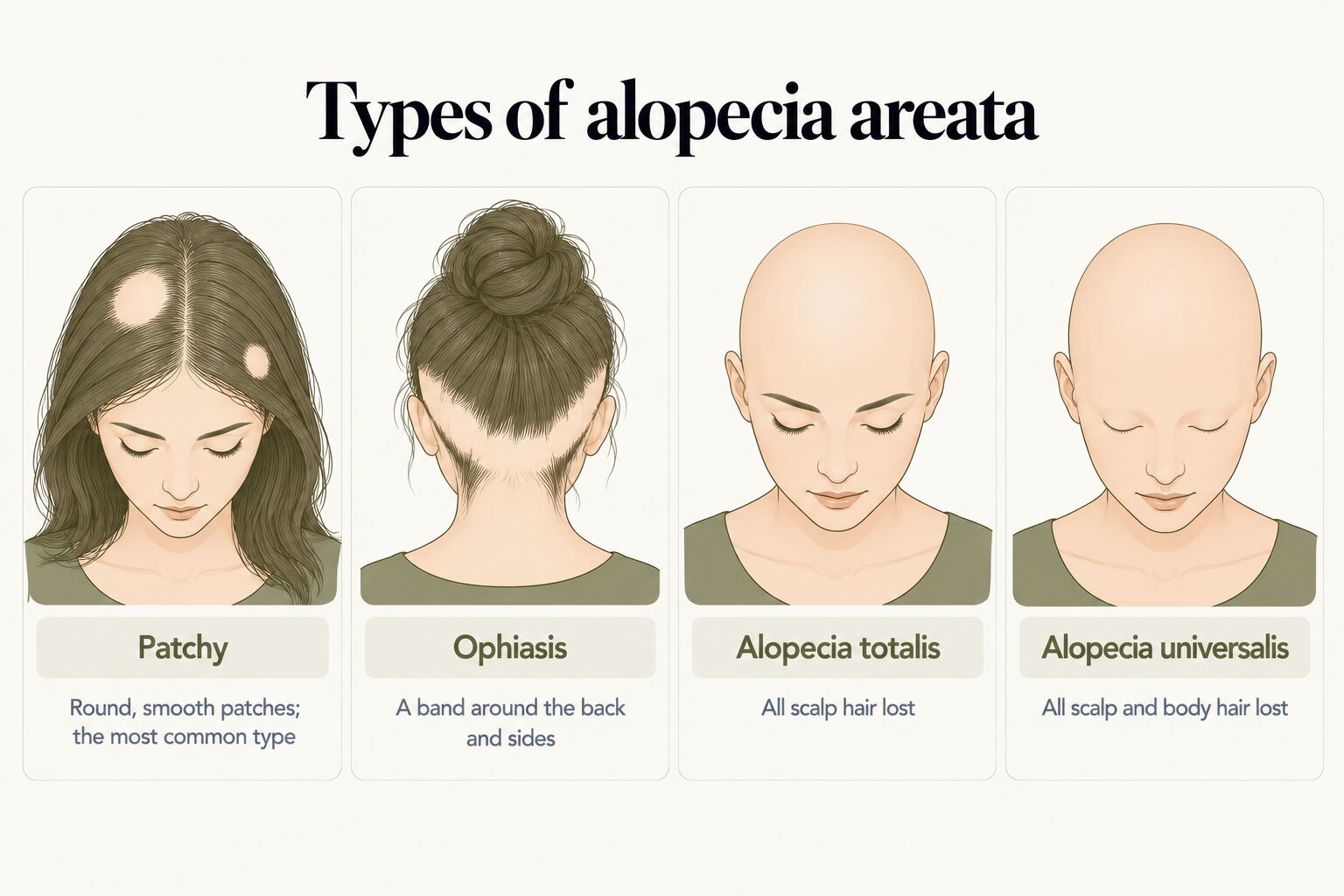
- Patchy alopecia areata: the most common form, with one or more round or oval, completely smooth patches on the scalp or beard. The skin looks normal, without scaling or scarring.
- Ophiasis: a band of hair loss around the back and sides of the scalp, which tends to be harder to treat.
- Alopecia totalis: loss of all scalp hair.
- Alopecia universalis: loss of all scalp and body hair, including eyebrows and eyelashes.
- Diffuse alopecia areata: rapid thinning over the whole scalp, which can be mistaken for telogen effluvium (see Telogen Effluvium).
Doctors look for "exclamation mark" hairs at the edges of patches: short broken hairs that are thicker at the tip and narrower near the scalp. Pitting or ridging of the nails occurs in about 10 to 40% of people and is linked to more severe disease. Regrowing hair is often fine and white at first, then gradually thickens and regains its colour. Alopecia areata can also explain the folk idea of hair "turning white overnight": the pigmented hairs fall out, leaving existing grey hairs behind.
What the research shows
The natural course. Over half of people diagnosed with alopecia areata recover within a year, often without treatment, but relapses are common over a lifetime. The outlook is less favourable with:
- Onset in childhood.
- Extensive hair loss or the ophiasis pattern.
- Hair loss lasting more than a year.
- Nail changes.
- Atopy, other autoimmune diseases or a family history.
About 5 to 10% progress to total scalp or body hair loss, and recovery from these forms is less likely without treatment.
JAK inhibitors. Three JAK inhibitors have been approved by the US FDA for severe alopecia areata:
- Baricitinib (2022, adults): in two trials of about 1,200 adults who had lost at least half their scalp hair for over six months, 36% to 39% on 4 mg daily had regrown at least 80% of their scalp hair at 36 weeks, compared with 3% to 6% on placebo. Lower 2 mg doses worked in about 19% to 23%.
- Ritlecitinib (2023, ages 12 and over): in a trial of 718 people, 23% on 50 mg daily had regrown at least 80% of their scalp hair at 24 weeks, compared with 1.6% on placebo. It's also approved in the UK.
- Deuruxolitinib (2024, adults): in two trials of over 1,200 adults, over 30% on 8 mg twice daily regrew at least 80% of their scalp hair at 24 weeks.
Responses often continue to improve beyond the first 6 to 12 months. But the benefit depends on continuing treatment. In a 2024 study, people who had responded well to baricitinib and were switched to placebo began losing hair within about 8 weeks; by three years, 80% had lost the benefit, compared with 7% of those who continued. Most regained their response when baricitinib was restarted.
Side effects and safety. JAK inhibitors carry warnings about serious infections (including tuberculosis and shingles), blood clots, heart attacks and strokes, and certain cancers. These risks were seen mainly with another JAK inhibitor in older people with rheumatoid arthritis and heart risk factors, and appear lower in the younger, healthier people typically treated for alopecia areata, but long-term data are still limited. More common side effects include headache, acne, raised cholesterol and minor infections. Treatment requires screening for tuberculosis and hepatitis beforehand, and regular blood tests. These medicines are also expensive and may not be widely available.
Emotional impact. A 2023 meta-analysis in JAMA Dermatology of 37 studies found depressive symptoms in about 37% and anxiety symptoms in about 34% of people with alopecia areata, with diagnosed depression and anxiety disorders more common than in people without it. Sudden loss of hair, eyebrows or eyelashes can affect identity, confidence, work and relationships, particularly in teenagers and young adults.
Treatment options
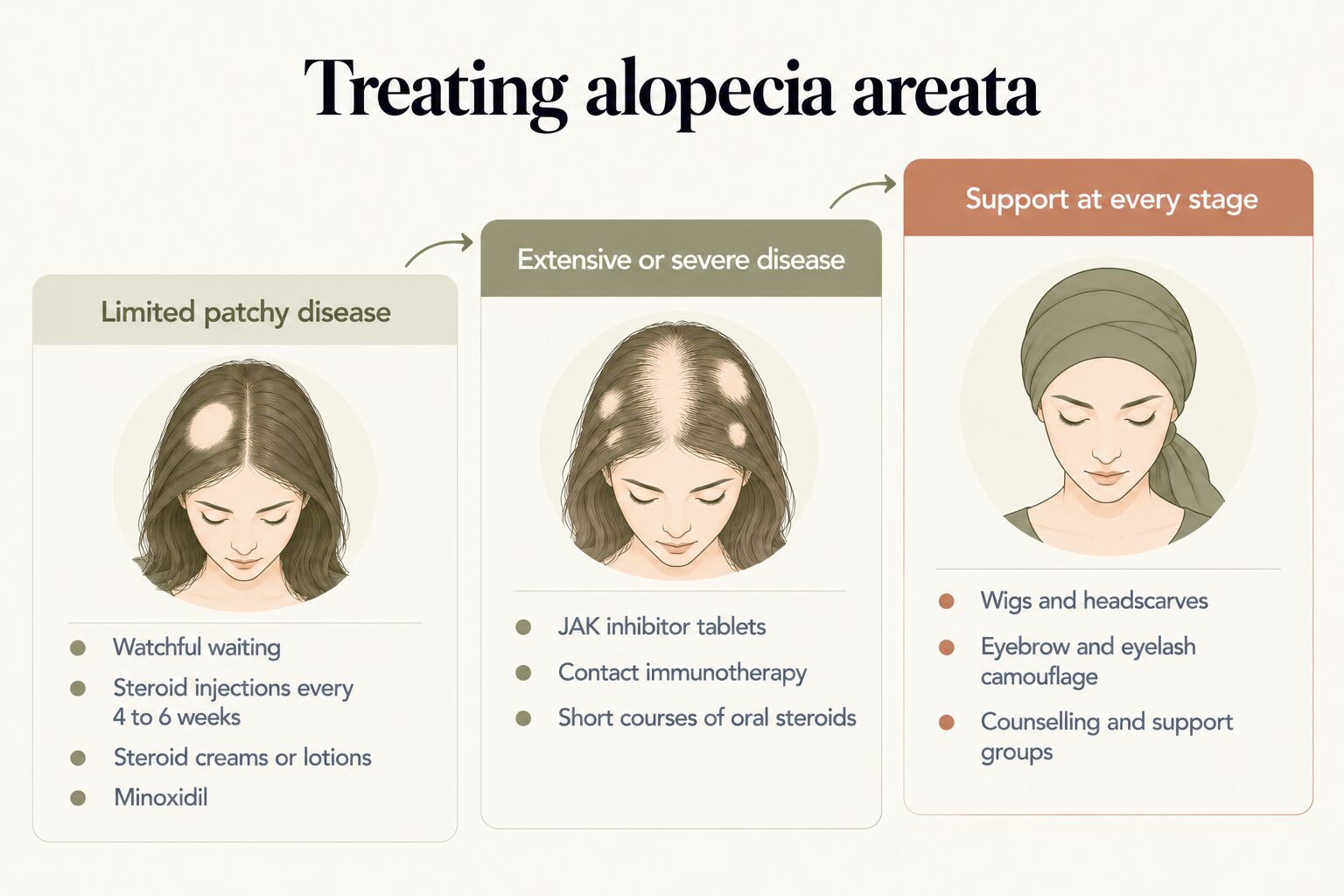
Limited patchy disease.
- Watchful waiting: reasonable for a small, recent patch, as many regrow on their own.
- Steroid injections into the patches: the usual first-line treatment for adults, repeated every 4 to 6 weeks until regrowth. Side effects include temporary skin thinning at the injection site.
- Strong steroid creams, lotions or foams: often used in children or for patches that are hard to inject.
- Topical minoxidil: sometimes added to support regrowth.
Extensive or severe disease.
- JAK inhibitors: now the most effective option for severe disease.
- Contact immunotherapy: a chemical applied weekly to the scalp to create a mild allergic reaction that redirects the immune response. It can help some people, but causes itching and dermatitis and isn't widely available.
- Short courses of oral steroids: occasionally used for rapidly spreading disease, but hair loss often returns when they're stopped, and long-term use has significant side effects.
Support and camouflage. Wigs, hairpieces, headscarves, eyebrow pencils or microblading, and false eyelashes can make a large difference to daily life. Support groups and counselling help many people cope with the uncertainty (see Therapy and Counselling).
Why this matters for longevity
Alopecia areata isn't physically dangerous, but it can affect wellbeing as much as many chronic diseases, and people with it are more likely to have autoimmune thyroid disease, eczema and other immune-related conditions. Recognising it as an autoimmune disease, not a cosmetic issue or a sign of personal stress, helps people get proper care. JAK inhibitors have turned a condition with few effective options into one where many people with severe disease can regrow their hair, but they need long-term treatment and careful monitoring, so the decision to use them should be shared between patient and doctor.
Recommendations
By situation.
- A new small patch: see a doctor to confirm the diagnosis, as fungal infection, hair pulling and scarring alopecia can look similar (see Types of Hair Loss). A thyroid check is often worthwhile.
- Several patches or rapid spread: see a dermatologist early, as early treatment may help prevent progression.
- Extensive loss, totalis or universalis: ask a dermatologist about JAK inhibitors, including the expected benefit, side effects, monitoring and long-term cost.
- Children: most treatments are gentler topical options; ritlecitinib is approved from age 12 for severe disease.
- Eyebrow and eyelash loss: camouflage options can help while waiting for regrowth.
Looking after your mental health.
- Hair loss from alopecia areata is not your fault and not caused by "too much worrying".
- Talk to people you trust, and consider a support group or counselling.
- If you feel persistently low, anxious or hopeless, speak to a doctor (see Mental Health Warning Signs and Getting Help in Sri Lanka). In Sri Lanka, you can call the National Mental Health Helpline on 1926 or CCCline on 1333, and in an emergency, Suwa Seriya on 1990.
Practical notes
If you notice a smooth, round bald patch, see a doctor rather than trying oils or home remedies, and don't panic: many patches regrow within months. Take photos to track changes. Regrowing hair often comes in white or fine at first, which is a good sign. Steroid injections every 4 to 6 weeks work well for limited patches in adults. If hair loss is extensive, ask about JAK inhibitors, and go in with realistic expectations: a good response takes months, and stopping treatment usually means hair loss returns. Look after your overall health too, as alopecia areata is linked to thyroid disease and other immune conditions. Our Longevity Doctors can confirm the diagnosis, check for associated conditions such as thyroid disease, discuss treatment options and refer you to a dermatologist when needed, starting with the free longevity assessment.
- DermNet. Alopecia areata. dermnetnz.org.
- Mirzoyev SA, et al. Lifetime incidence risk of alopecia areata estimated at 2.1% by Rochester Epidemiology Project, 1990–2009. Journal of Investigative Dermatology, 2014;134(4):1141-1142.
- King B, et al. Two phase 3 trials of baricitinib for alopecia areata (BRAVE-AA1 and BRAVE-AA2). New England Journal of Medicine, 2022;386:1687-1699.
- King B, et al. Efficacy and safety of ritlecitinib in adults and adolescents with alopecia areata (ALLEGRO phase 2b/3). The Lancet, 2023;401:1518-1529.
- Sun Pharmaceutical Industries. FDA approval of deuruxolitinib for severe alopecia areata (THRIVE-AA1 and THRIVE-AA2), July 2024.
- King B, et al. Randomized withdrawal of baricitinib in severe alopecia areata (BRAVE-AA1). JAMA Dermatology, 2024.
- Lauron S, et al. Prevalence and odds of depressive and anxiety disorders and symptoms in children and adults with alopecia areata: a systematic review and meta-analysis. JAMA Dermatology, 2023.
- University of Utah Health Dermatology. Alopecia areata.
Free longevity assessment
Noticed a smooth, round
bald patch?
Take the free Aevum Protocol assessment to see how your skin & longevity and 6 other longevity domains are performing — and get a personalised 90-day plan.
Take the free assessmentKeep reading
Related articles
Skin & Longevity
Types of Hair Loss: How to Tell Pattern Loss, Shedding, Patchy and Scarring Hair Loss Apart
Skin & Longevity
Telogen Effluvium: Sudden Shedding After Stress, Illness, Childbirth or Dieting
Hormones & Reproductive Health