Stress & Mental Wellbeing
Mental Health Warning Signs
and Getting Help in Sri Lanka
Mental health problems are common, treatable and nothing to be ashamed of, yet many people wait months or years before seeking help, often because of stigma or not knowing where to turn. Worldwide, about 322 million people have depression and 470 million have an anxiety disorder, and in high-income countries only about one in three people with depression receive treatment. Recognising the warning signs early, in yourself or someone you care about, makes a real difference: treatment works better when started sooner. Warning signs include persistent low mood or worry, loss of interest, changes in sleep or appetite, withdrawing from people, difficulty coping with daily life, and increased use of alcohol or drugs. Some signs need urgent attention, such as talking about wanting to die or feeling like a burden. It's a common fear that asking someone about suicide might "put the idea in their head", but a review of 13 studies found no evidence that asking increases suicidal thoughts, and talking openly may reduce them. Prevention works: Sri Lanka's suicide rate fell by about 70% between 1995 and 2015, saving an estimated 93,000 lives, largely through public health action. Sri Lanka has free and confidential support, including the National Institute of Mental Health helpline (1926), CCCline (1333, available 24 hours a day in Sinhala, Tamil and English) and Sri Lanka Sumithrayo. This guide explains the warning signs, how to help someone who's struggling, and where to get help.
Key numbers
| Finding | Detail |
|---|---|
| Depression worldwide (WHO) | About 322 million people |
| Anxiety disorders worldwide (WHO, 2023) | About 470 million people |
| Treatment gap (WHO) | Only about 1 in 3 people with depression in high-income countries get treatment |
| Asking about suicide (13 studies) | No evidence it increases suicidal thoughts; may reduce them |
| Sri Lanka's suicide rate | Fell by about 70% from its 1995 peak; an estimated 93,000 lives saved by 2015 |
| Emergency help in Sri Lanka | Suwa Seriya ambulance 1990; National Mental Health Helpline 1926; CCCline 1333 |
Why early help matters
Mental health conditions such as depression and anxiety tend to improve faster, and are less likely to return, when treated early. Left untreated, they can affect work, relationships, sleep and physical health, including raising the risk of heart disease, diabetes and dementia (see Depression and Physical Health and Anxiety and Physical Health). Seeking help early is a sign of strength and good sense, just like seeing a doctor for chest pain.
Warning signs to watch for
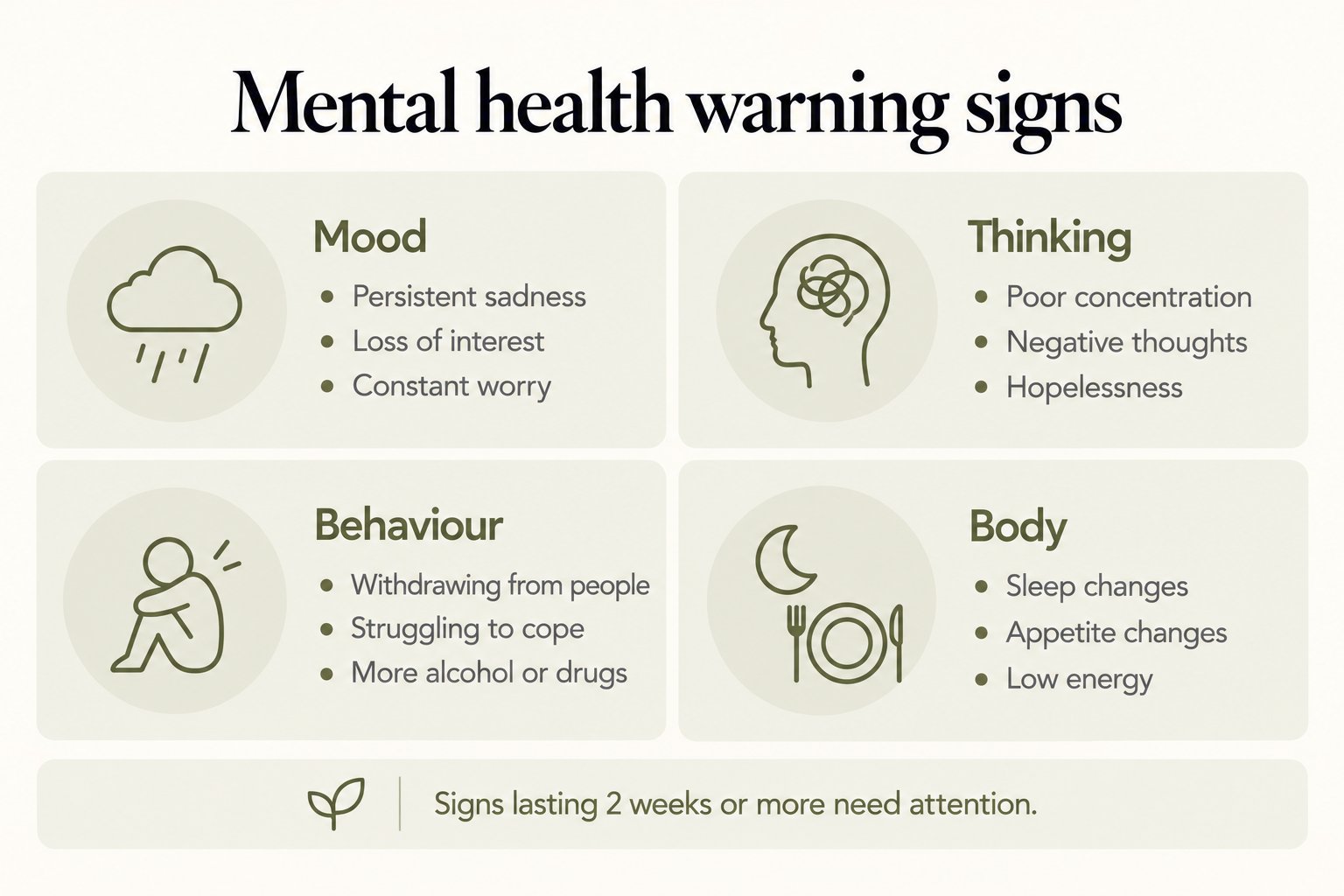
Everyone has bad days. Warning signs are changes that last two weeks or more, or that affect your ability to cope with daily life.
Mood and emotions
- Feeling sad, empty, hopeless or irritable most of the day
- Losing interest or pleasure in things you used to enjoy
- Constant worry, fear or panic
- Feeling numb, guilty or worthless
Thinking
- Difficulty concentrating, remembering or making decisions
- Persistent negative thoughts about yourself or the future
- Racing thoughts, or unusual beliefs or experiences that others don't share
Behaviour
- Withdrawing from family, friends and activities
- Struggling to manage work, study or household tasks
- Drinking more alcohol or using drugs to cope
- Neglecting appearance, hygiene or responsibilities
Body
- Sleeping much more or much less than usual
- Changes in appetite or weight
- Constant tiredness or low energy
- Unexplained aches, pains or stomach problems
In older adults, mental health problems often appear as tiredness, poor sleep, physical complaints, memory problems or loss of interest, rather than obvious sadness.
Urgent warning signs. Seek help immediately if you or someone else:
- Talks about wanting to die or not wanting to be alive
- Talks about feeling hopeless, trapped or a burden to others
- Is giving away possessions or saying goodbye
- Shows sudden calmness after a period of severe distress
- Has hurt themselves or is at risk of doing so
- Is confused, hearing voices or behaving very differently from usual
In these situations, don't leave the person alone if they're at immediate risk. Call 1990 for an ambulance, go to the nearest hospital emergency department, or call 1926 or 1333 for urgent guidance.
How to help someone who's struggling
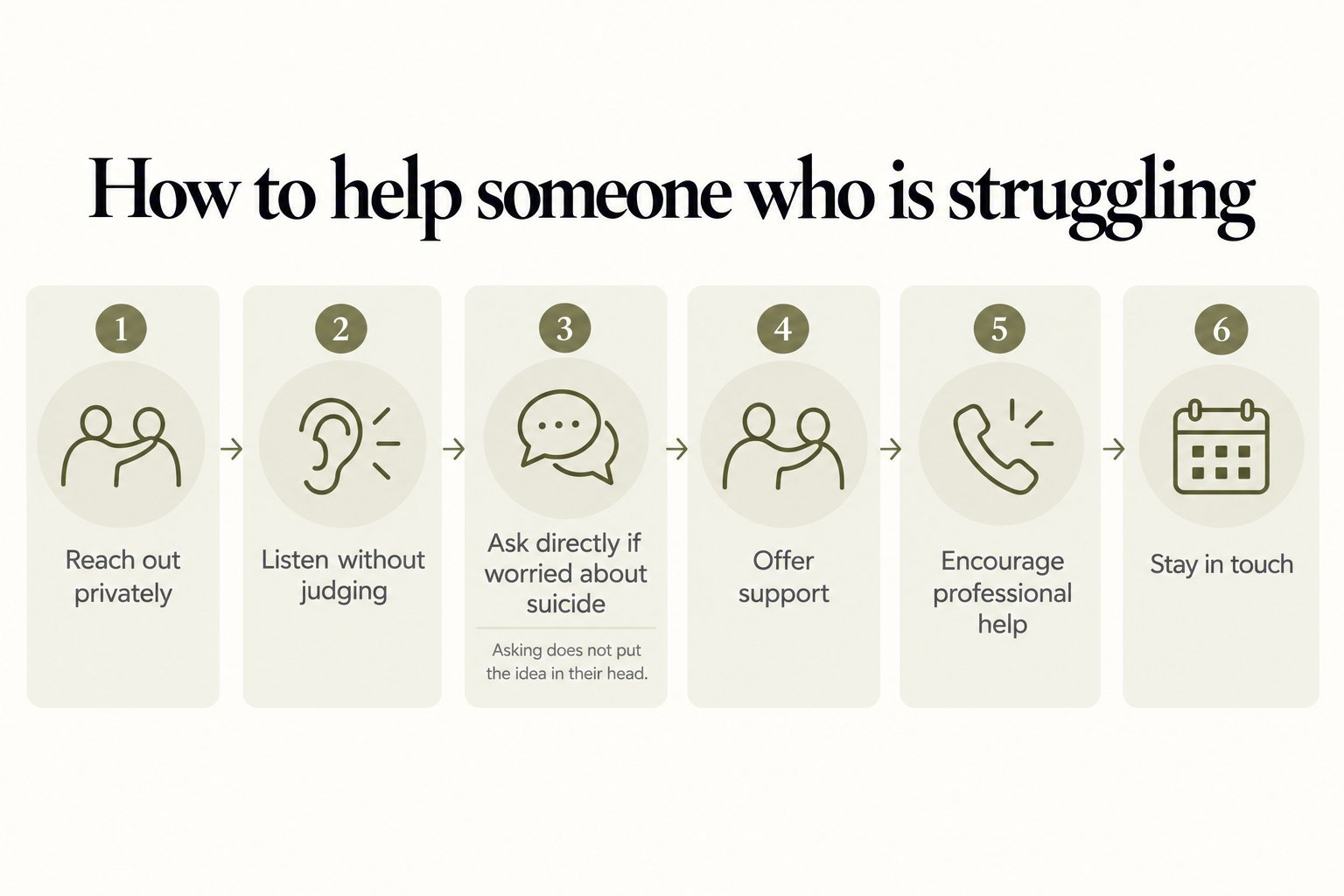
You don't need to be an expert to make a difference. A simple approach:
- 1. Reach out. Choose a quiet, private moment and say what you've noticed: "You haven't seemed yourself lately. How are you really doing?"
- 2. Listen without judging. Let them talk. Avoid rushing to give advice or saying "just think positive".
- 3. Ask directly about suicide if you're worried. For example: "Sometimes when people feel this bad, they think about ending their life. Have you had thoughts like that?" A 2014 review of 13 studies found no evidence that asking about suicide increases suicidal thoughts, and the authors suggested that talking about it openly may reduce them.
- 4. Offer support and information. Reassure them that these problems are common and treatable.
- 5. Encourage professional help. Offer to help them make an appointment, call a helpline together, or go with them.
- 6. Stay in touch. Check in regularly. Recovery takes time.
- 7. Look after yourself. Supporting someone can be draining; seek support for yourself too.
If someone is at risk, help keep them safe: stay with them, remove access to anything they could use to harm themselves, such as stored medicines and agricultural chemicals, and get urgent help.
Where to get help in Sri Lanka
Start with a doctor. Your family doctor or any government hospital outpatient department can assess you, check for physical causes, start treatment and refer you to a psychiatrist, psychologist or counsellor. Many government hospitals have psychiatry clinics, and government health services are free (see Therapy and Counselling).
Helplines and support services
| Service | Number | What it offers |
|---|---|---|
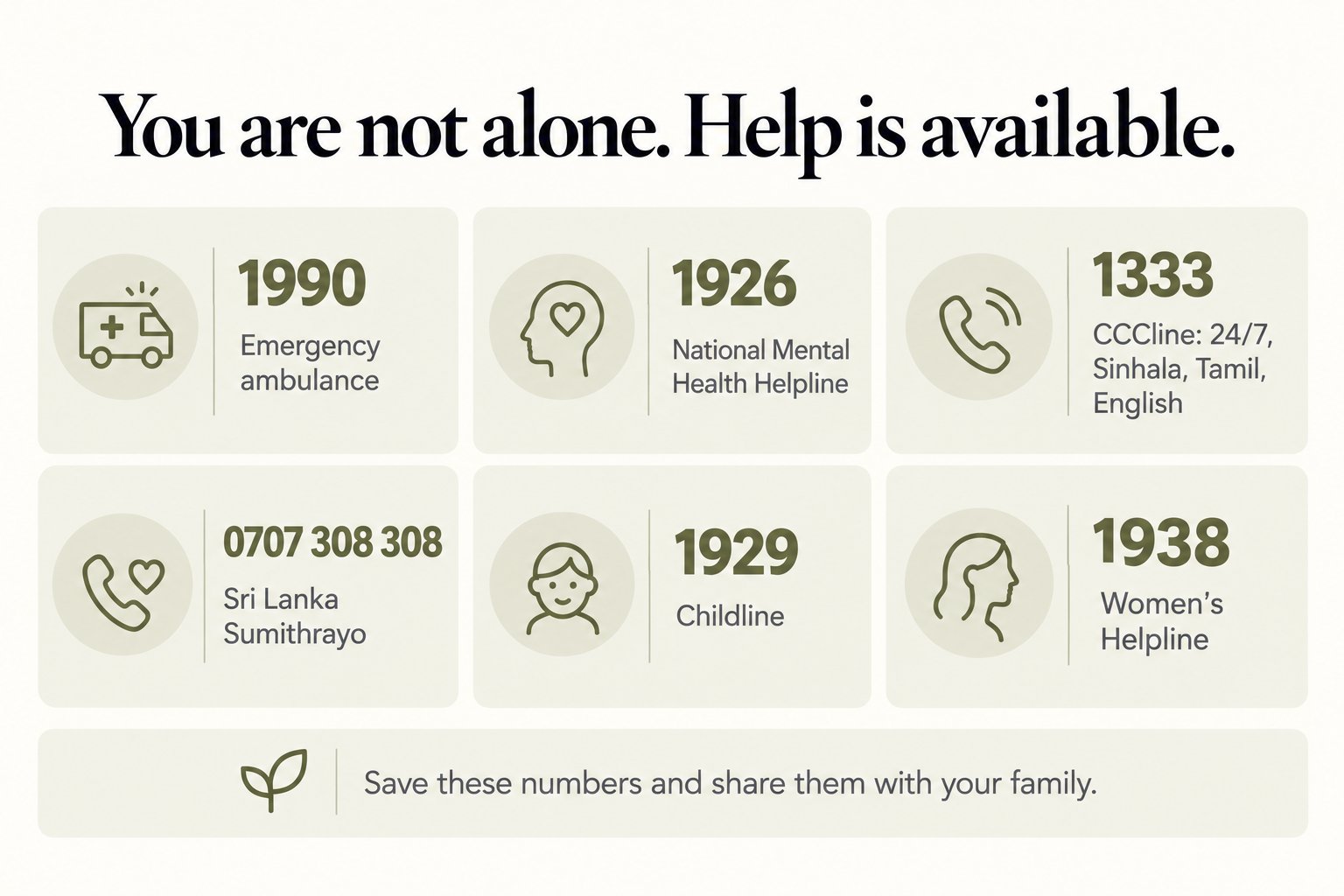
| Suwa Seriya ambulance | 1990 | Free, 24/7 emergency ambulance |
| Police emergency | 119 | Emergencies involving immediate danger |
| National Mental Health Helpline (National Institute of Mental Health) | 1926 | Mental health guidance; connects callers to services, including urgent support |
| CCCline (CCC Foundation) | 1333 | Free, 24/7 counselling in Sinhala, Tamil and English |
| Sri Lanka Sumithrayo (national line) | 0707 308 308 | Free, confidential emotional support; WhatsApp 0767 520 620 |
| Sri Lanka Sumithrayo, Panadura branch | 038 2235291 | Emotional support, daily 9 am to 2 pm |
| Childline (National Child Protection Authority) | 1929 | For children and young people, or adults calling on their behalf |
| Women's Helpline | 1938 | Support for women, including those facing violence |
| Shanthi Maargam (Colombo) | 0717 639 898 | Emotional wellness support for children and young people |
| National Council for Mental Health (Sahanaya) | 011 2685960 | Counselling and rehabilitation |
| Mel Medura (Colombo) | 011 2693460 | Support for alcohol and drug problems |
Numbers and hours can change; check the organisation's website if a line doesn't connect. Sumithrayo also has branches across the country, including Colombo, Kandy, Galle, Jaffna, Kurunegala, Negombo and others.
Prevention works. Sri Lanka has one of the world's most striking examples of suicide prevention. The suicide rate peaked at 57 per 100,000 people in 1995 and fell by about 70% to around 17 per 100,000, saving an estimated 93,000 lives between 1995 and 2015. Researchers attribute much of this to national restrictions on highly toxic pesticides, along with improvements in medical care. It's a powerful reminder that suicide is preventable, both through public policy and through individual care and connection.
Recommendations by scenario
| Scenario | What to do |
|---|---|
| Feeling low or anxious for more than two weeks | See your doctor, or call 1926 or 1333 for guidance |
| Worried about a friend or family member | Reach out, listen, and encourage them to get help |
| Someone talks about wanting to die | Ask directly, stay with them, remove access to means of harm, call 1926 or 1333 |
| Someone is in immediate danger | Call 1990 or go to the nearest hospital emergency department |
| Young person struggling | Talk to them, involve a trusted adult or school counsellor; Childline 1929 |
| Alcohol or drug problems | See a doctor or contact an addiction support service |
| Worried about memory or confusion in an older relative | See a doctor; ask about a memory assessment |
| Already in treatment but not improving | Go back to your doctor; treatment can be adjusted |
Practical notes
Save the key numbers in your phone now: 1990, 1926 and 1333, and share them with family members. If you notice warning signs in yourself, talk to someone you trust and see a doctor; you don't need to wait until things are severe. If you're worried about someone else, reaching out with a simple "Are you okay?" can be the first step to them getting help. Our Longevity Doctors include mental wellbeing in every assessment, can screen for depression and anxiety, and can help you access the right care, starting with the free longevity assessment.
- World Health Organization. Depression: fact sheet; Anxiety disorders: fact sheet; Suicide: fact sheet. Geneva: WHO.
- Dazzi T, et al. Does asking about suicide and related behaviours induce suicidal ideation? What is the evidence? Psychological Medicine, 2014;44(16):3361-3363.
- Knipe DW, Gunnell D, Eddleston M. Preventing deaths from pesticide self-poisoning: learning from Sri Lanka's success. Lancet Global Health, 2017;5(7):e651-e652.
- Therapy Route. Suicide hotlines and crisis lines in Sri Lanka. Accessed October 2026.
- Sri Lanka Medical Association. Mental health services available in Sri Lanka.
- YAMU. Reliable mental health resources in Colombo.
Free longevity assessment
Worried about yourself
or someone close?
Take the free Aevum Protocol assessment to see how your stress & mental wellbeing and 6 other longevity domains are performing — and get a personalised 90-day plan.
Take the free assessment