Skin & Longevity
Telogen Effluvium:
Sudden Shedding After Stress, Illness, Childbirth or Dieting
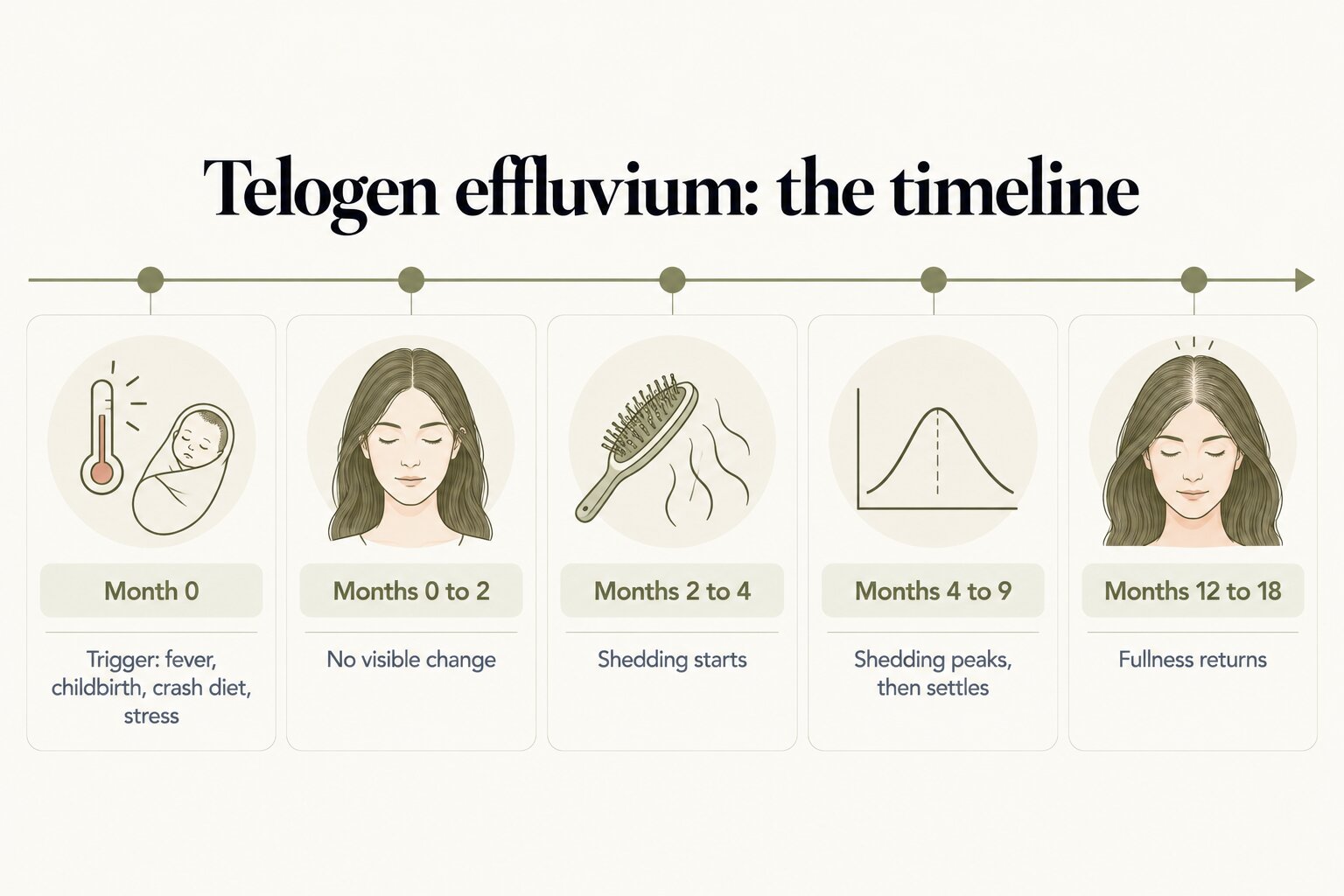
Telogen effluvium is the medical name for sudden, heavy hair shedding a few months after a shock to the body. A high fever, childbirth, surgery, a crash diet, rapid weight loss, iron deficiency, a new medicine or severe stress can push a large number of growing hairs into the resting phase at the same time. About 2 to 4 months later, those hairs fall out together, often in alarming handfuls in the shower or on the pillow. The whole scalp thins evenly rather than in patches. The good news is that the follicles aren't damaged, so the hair grows back: shedding usually settles within 6 to 9 months, and the hair looks full again within about a year to 18 months. The key is finding and fixing the trigger, especially if it's ongoing, such as iron deficiency, a thyroid problem or a medicine. When shedding lasts more than 6 months, it's called chronic telogen effluvium, which is common in women aged 30 to 60 and usually doesn't lead to baldness. Heavy shedding can also reveal underlying pattern hair loss, so it's worth seeing a doctor if your hair doesn't recover. This article explains the triggers, the timeline and what helps.
Key numbers
| Finding | Detail |
|---|---|
| Normal daily shedding | About 50 to 100 hairs |
| Time from trigger to shedding | Usually 2 to 4 months |
| Shedding settles | Usually within 6 to 9 months |
| Cosmetic recovery | About 12 to 18 months |
| Women with hair loss after childbirth | 68% to 92% in two studies; onset about 3 months, stops about 8 months |
| Hair loss after COVID-19 (58 cases) | Onset about 2 months after infection; recovery in about 5 months for 95% |
| Chronic telogen effluvium | Shedding lasting over 6 months, typically in women aged 30 to 60 |
How it works
Most scalp hairs, about 85 to 90%, are in the growing phase at any time, while about 10% are resting before they fall out (see How Hair Grows and Ages). A shock to the body signals many growing follicles to stop and enter the resting phase early. The resting phase lasts around 2 to 3 months, which is why the shedding appears long after the trigger has passed, and often after you've forgotten about it.
Under a microscope, the shed hairs have a small white bulb at the root. This is normal for a resting hair and shows the follicle has completed its cycle, not that it's been damaged. As each follicle sheds its old hair, it starts growing a new one. That's why you'll often see short new hairs along the hairline a few months later.
In mice, stress hormones have been shown to keep follicle stem cells in a prolonged resting state, which helps explain how severe stress can disrupt hair growth. How closely this applies to people is still being studied.
Common triggers
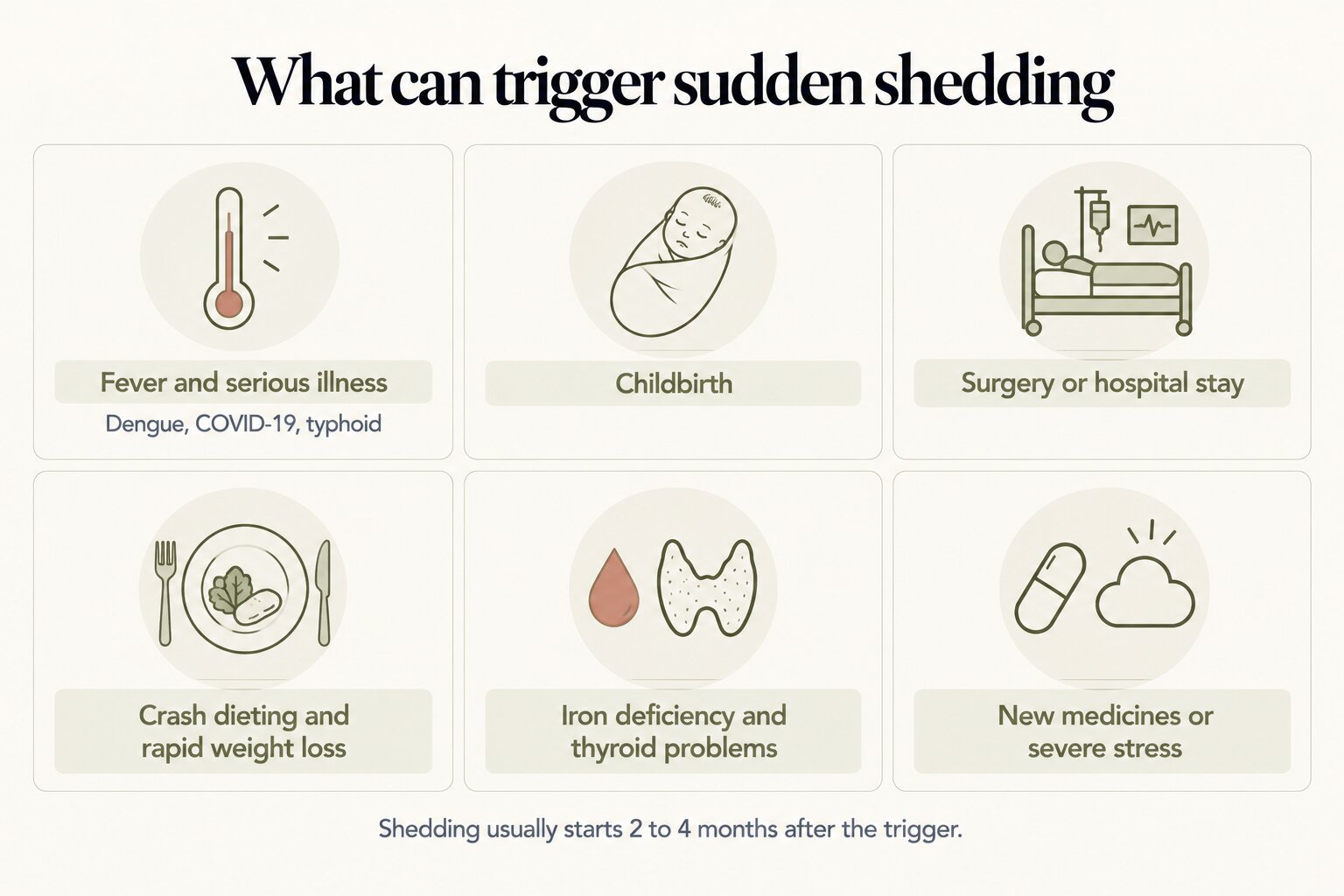
- Fever and serious illness: dengue, COVID-19, typhoid, pneumonia, or any illness with high fever. In a report of 14 patients after a dengue outbreak in Taiwan, shedding started on average about 2 months after the infection and lasted about 3 months.
- Childbirth: hair often feels thicker during pregnancy because more hairs stay in the growing phase. After delivery, they shift into the resting phase together. In a questionnaire study of women after childbirth, shedding started about 3 months after birth, peaked at about 5 months and stopped at about 8 months on average.
- Surgery, accidents and hospital stays.
- Crash dieting, rapid weight loss and low protein intake: hair is a low priority for the body when energy or protein is scarce. This includes weight loss from bariatric surgery and from weight-loss medicines such as semaglutide, where hair loss was reported by 3 to 4% of people in the long-term trials and is thought to relate mainly to rapid weight loss (see GLP-1 Medications).
- Iron deficiency: a common contributor, particularly in women with heavy periods, recent pregnancy or a mainly vegetarian diet.
- Thyroid problems: both an underactive and overactive thyroid can cause shedding (see Thyroid Function and Ageing).
- Medicines: including blood thinners (heparin, warfarin), some blood pressure medicines (beta-blockers, ACE inhibitors), retinoids, some anticonvulsants (valproate) and mood stabilisers (lithium), antithyroid drugs, and starting, stopping or switching hormonal contraception or hormone therapy.
- Severe psychological stress: such as bereavement, a relationship breakdown or job loss (see How the Stress Response Works).
What the research shows
After childbirth. Hair loss after childbirth is very common. A clinic-based study found it in about 68% of women within six months of delivery, and a questionnaire study reported it in about 92%, though that figure may be inflated by who chose to respond. It usually resolves within the first year. Some experts argue that persistent postpartum shedding often reflects pattern hair loss that the shedding has unmasked.
After COVID-19. A 2022 review of 58 published cases found that hair loss after COVID-19 began about 2 months after infection, and 95% of cases with reported outcomes recovered, at a median of 5 months. Over 80% of cases were in women, and severity of infection didn't clearly predict how much hair was lost.
Chronic telogen effluvium. In a 1996 study, the American dermatologist David Whiting described 355 patients with chronic telogen effluvium: increased shedding lasting more than 6 months, typically in women aged 30 to 60, often starting suddenly with or without an obvious trigger, and following a long, fluctuating course. Scalp biopsies showed a normal number of follicles and normal-sized hairs, unlike pattern hair loss, where follicles shrink. Women with chronic telogen effluvium often have thick hair to begin with and notice the loss more in volume, particularly at the temples, than in visible scalp. It rarely leads to baldness.
Treatment. There are no large trials of treatments for telogen effluvium, because acute cases recover on their own. Management focuses on finding and removing the trigger. Topical or low-dose oral minoxidil is sometimes used in chronic cases or when pattern hair loss is also present, mainly based on clinical experience rather than trials.
How to tell it apart from other hair loss
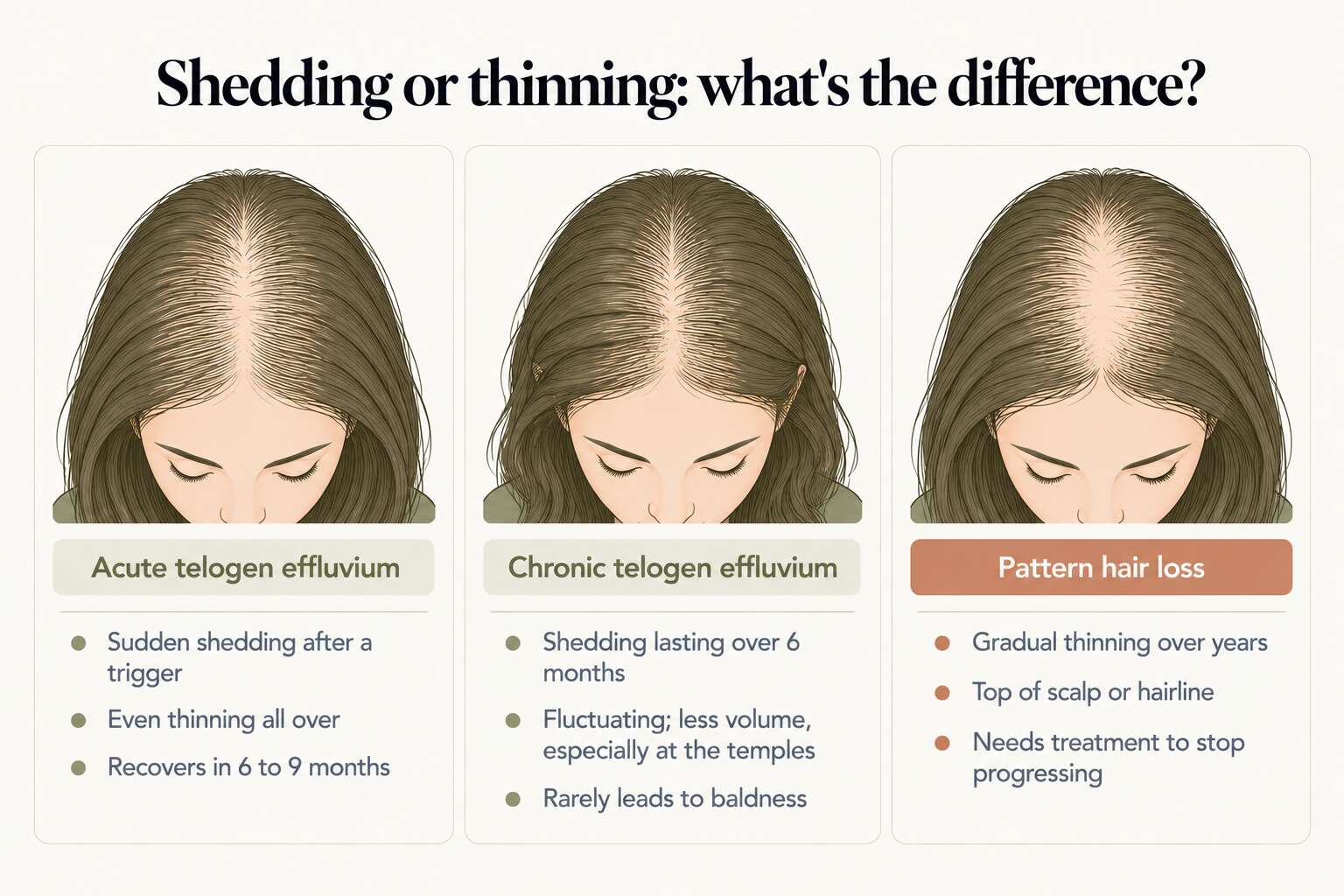
- Telogen effluvium: sudden increase in shedding, even thinning over the whole scalp, normal-looking scalp, often with a trigger 2 to 4 months earlier. The shed hairs have a white bulb at the root.
- Pattern hair loss: gradual thinning over years, concentrated on the top of the scalp or hairline, with finer, shorter hairs (see Female Pattern Hair Loss and Male Pattern Hair Loss).
- Alopecia areata: round, smooth bald patches. A diffuse form can mimic telogen effluvium, so a doctor's examination helps.
- Hair breakage: hairs snapped along their length without a root, from heat styling, chemical treatments or rough handling.
The two most common causes often overlap. A bout of telogen effluvium can reveal pattern hair loss, especially in women. If your hair hasn't returned to its previous fullness within a year, see a doctor (see Types of Hair Loss).
How doctors diagnose it
- History: illness, fever, childbirth, surgery, diet or weight changes, stress and medicines in the 2 to 6 months before the shedding began.
- Pull test: the doctor gently pulls a small bunch of about 50 to 60 hairs. More than about 6 coming out suggests active shedding.
- Trichoscopy: checks for signs of pattern hair loss or alopecia areata.
- Blood tests: full blood count, ferritin, thyroid function, vitamin D and, where relevant, zinc or other tests based on diet and symptoms (see Nutrient Blood Tests). Blood tests and nutrition for hair loss are covered in more detail in Hair Loss, Blood Tests and Nutrition.
- Scalp biopsy: rarely needed, but useful when it's unclear whether chronic shedding or pattern hair loss is the main problem.
Why this matters for longevity
Telogen effluvium is a visible record of what your body went through a few months earlier. It's harmless to the follicles, but it can be a useful clue to an issue that matters for overall health: iron deficiency, thyroid disease, undereating, too little protein, rapid weight loss, a medicine side effect or prolonged severe stress. Addressing these protects far more than your hair. The shedding itself can also be very distressing, and knowing that it's temporary is often the most helpful part of treatment.
Recommendations
If you're shedding heavily.
- Think back 2 to 4 months: was there a fever, an illness, childbirth, surgery, a diet, rapid weight loss, a new medicine or a stressful event?
- Get blood tests: iron (ferritin), a full blood count and thyroid function at least.
- Eat enough: especially enough protein and overall energy. Avoid crash diets (see Protein in the Sri Lankan Diet).
- Don't stop a medicine yourself: if you suspect a medicine, discuss it with your doctor. Proving a medicine is the cause usually requires stopping it for at least three months.
- Be gentle with your hair: avoid tight hairstyles, harsh chemical treatments and excessive heat while it recovers. Washing your hair doesn't cause more loss; it just collects hairs that were already going to fall.
- Manage stress: shedding can itself cause anxiety, which adds to stress (see Stress-Reduction Techniques That Work).
See a doctor if.
- Shedding continues for more than 6 months.
- Your hair hasn't returned to its previous fullness within a year.
- You see bald patches, a widening parting or a receding hairline.
- Your scalp is itchy, sore, red or scaly.
- Shedding comes with tiredness, weight change, palpitations, irregular periods or other symptoms.
Practical notes
If you're losing more hair than usual, the trigger was most likely 2 to 4 months ago. In Sri Lanka, dengue and other high fevers, childbirth, iron deficiency and crash diets before weddings or other events are common triggers. Shedding usually stops within 6 to 9 months, and you should start seeing short new hairs along your hairline before that. Full recovery in length and volume takes longer, because hair only grows about a centimetre a month. Don't spend money on special shampoos, oils or supplements unless a blood test shows a deficiency. Do check iron and thyroid levels, eat enough protein, and give your hair time. If shedding lasts longer than 6 months, or your hair doesn't recover, see a doctor, as it may be revealing pattern hair loss, which responds best to early treatment. Our Longevity Doctors can identify the trigger, arrange the right blood tests and check for other types of hair loss, starting with the free longevity assessment.
- DermNet. Telogen effluvium. dermnetnz.org.
- DermNet. Alopecia from drugs. dermnetnz.org.
- Headington JT. Telogen effluvium: new concepts and review. Archives of Dermatology, 1993;129(3):356-363.
- Whiting DA. Chronic telogen effluvium: increased scalp hair shedding in middle-aged women. Journal of the American Academy of Dermatology, 1996;35(6):899-906.
- Hirose A, et al. Investigation of exacerbating factors for postpartum hair loss: a questionnaire-based cross-sectional study. 2023.
- Ebrahimzadeh-Ardakani M, et al. Prevalence and risk factors of postpartum hair loss: a cross-sectional study. 2021.
- Czech T, et al. Characteristics of hair loss after COVID-19: a systematic scoping review. Journal of Cosmetic Dermatology, 2022.
- Chu CB, Yang CC. Dengue-associated telogen effluvium: a report of 14 patients. Dermatologica Sinica, 2017;35(3):124-127.
- Wegovy (semaglutide) prescribing information: adverse reactions in long-term weight management trials.
Free longevity assessment
Losing more hair than
usual lately?
Take the free Aevum Protocol assessment to see how your skin & longevity and 6 other longevity domains are performing — and get a personalised 90-day plan.
Take the free assessment