Skin & Longevity
Minoxidil:
Topical vs Oral, How It Works and What to Expect
Minoxidil is the most widely used hair loss treatment in the world, and one of only two with strong evidence for pattern hair loss in both men and women. It was first developed as a blood pressure tablet in the 1970s, when doctors noticed it caused unwanted hair growth. Applied to the scalp as a solution or foam, it lengthens the growing phase of the hair cycle and enlarges shrinking follicles. In a trial of 393 men, the 5% solution produced 45% more regrowth than the 2% solution over 48 weeks. More recently, low-dose minoxidil tablets have become a popular alternative: trials in both men and women show results broadly similar to the topical form, without the daily mess, but with more unwanted body and facial hair and a small risk of effects on blood pressure and fluid balance. Minoxidil isn't a cure. It works best on thinning hair that is still present, takes 6 to 12 months to judge, often causes a temporary increase in shedding at the start, and must be continued: when it's stopped, the hair gained is lost within months. This article compares the forms, explains how to use them and what to expect.
Key numbers
| Finding | Detail |
|---|---|
| 5% vs 2% solution (393 men, 48 weeks) | 45% more regrowth with 5%, and faster response |
| Oral 5 mg vs topical 5% (90 men, 24 weeks) | Similar results; slight advantage for oral at the crown |
| Oral 1 mg vs topical 5% (52 women, 24 weeks) | Hair density up 12% vs 7%; difference not significant |
| Low-dose oral minoxidil safety (1,404 patients) | Side effects in 21%; mostly unwanted hair growth (15%) |
| Stopping oral minoxidil due to side effects | About 1.2% |
| Time to judge results | 6 to 12 months |
How it works
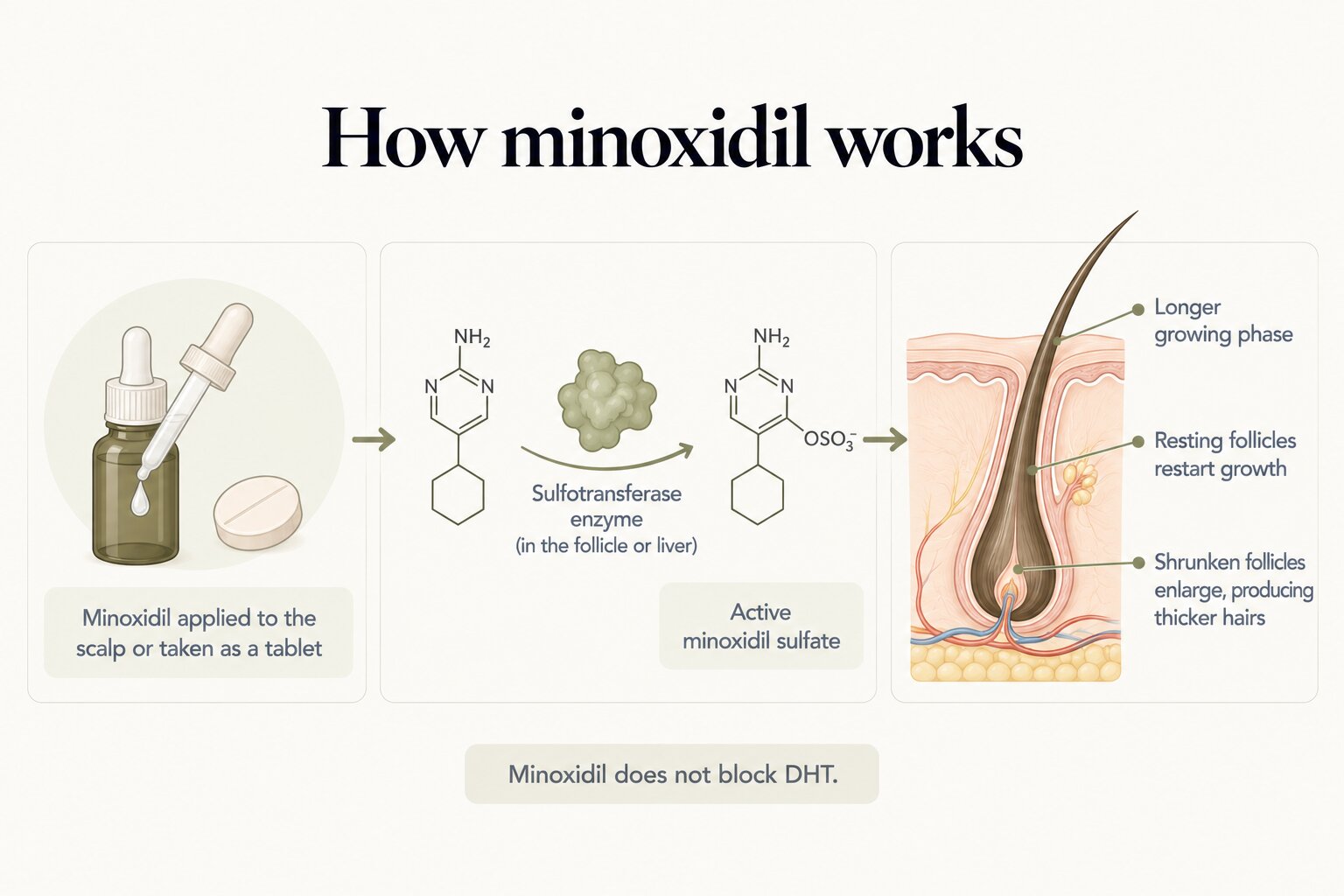
Minoxidil is a "prodrug": it has to be converted into its active form, minoxidil sulfate, by an enzyme called sulfotransferase. This enzyme is found in the outer root sheath of hair follicles and in the liver. Once activated, minoxidil:
- Lengthens the growing (anagen) phase of the hair cycle, so hairs grow longer (see How Hair Grows and Ages).
- Pushes resting follicles to start growing again, which is why it can cause a temporary shed at the start.
- Gradually enlarges shrunken follicles, producing thicker hairs.
- Opens potassium channels and widens small blood vessels, which may improve blood supply to the follicle.
The amount of sulfotransferase in scalp follicles varies from person to person, which may explain why some people respond well to topical minoxidil and others don't. In two small studies of 34 men and 21 women, an enzyme test on plucked hairs predicted who would respond to topical minoxidil, correctly classifying about 90% of the women. Because the liver has plenty of this enzyme, oral minoxidil may work for some people who don't respond to the topical form, though the evidence for this is mixed.
Minoxidil doesn't block DHT, the hormone that drives pattern hair loss. That's why it's often combined with a DHT blocker such as finasteride in men (see Finasteride and Dutasteride and Male Pattern Hair Loss).
The forms compared
| Form | How it's used | Main benefits | Main side effects | Prescription | Evidence |
|---|---|---|---|---|---|
| 2% solution | 1 mL to the scalp twice a day | Gentler; less facial hair in women | Scalp irritation, itch | No | Strong |
| 5% solution | 1 mL twice a day in men; often once a day in women | More effective than 2% | Itch, flaking, irritation from propylene glycol; facial hair | No | Strong |
| 5% foam | Half a capful twice a day in men; once a day in women | Less greasy and less irritating | Less irritation than solution; facial hair | No | Strong |
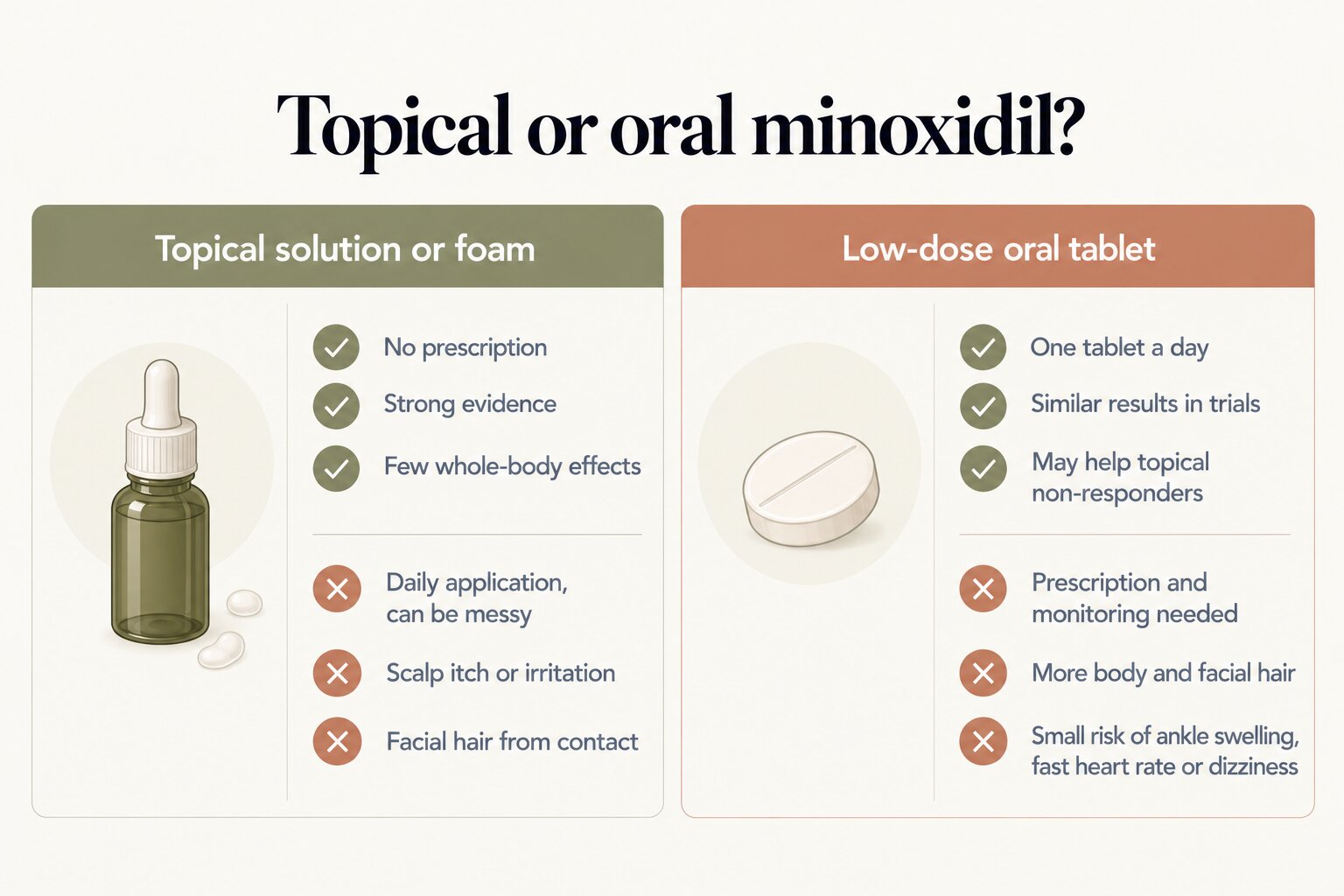
| Low-dose oral tablet | Usually 0.5 to 2.5 mg a day in women and 1.25 to 5 mg in men | No daily scalp application; may help topical non-responders | Body and facial hair, ankle swelling, fast heart rate, dizziness, headache | Yes | Moderate to strong |
| Sublingual tablet | Dissolved under the tongue | May need lower doses | Similar to oral | Yes | Limited |
What the research shows
Topical minoxidil. Topical minoxidil was approved by the US FDA in 1988, the first medicine proven to regrow hair. In a 48-week trial of 393 men aged 18 to 49, the 5% solution was significantly better than both the 2% solution and placebo, producing 45% more regrowth than 2% and a faster response. Itching and irritation were more common with the 5% solution, but both were well tolerated with no systemic effects. In women, a Cochrane review confirmed that topical minoxidil is effective for female pattern hair loss (see Female Pattern Hair Loss).
Oral minoxidil. Doctors began using low doses of oral minoxidil, a small fraction of the 10 to 40 mg once used for high blood pressure, to treat hair loss in the late 2010s. Two Brazilian randomised trials compared it directly with topical treatment:
- Men: in a 2024 trial in JAMA Dermatology, 90 men took 5 mg daily or applied 5% solution twice daily for 24 weeks. Both improved similarly overall, with a slight advantage for the tablet at the crown. Unwanted body and facial hair affected 49% on the tablet vs 25% on the solution, and headache 14% vs 2%; scalp eczema was more common with the solution.
- Women: in a 2020 trial, 52 women took 1 mg daily or applied 5% solution once daily for 24 weeks. Hair density rose 12% vs 7%, a difference that wasn't statistically significant. Unwanted hair affected 27% vs 4%, and 4% on the tablet developed mild ankle swelling.
The largest safety study, published in 2021, reviewed 1,404 patients treated with low-dose oral minoxidil across 10 centres in six countries, at an average dose of 1.6 mg. Side effects occurred in about 21%, mostly unwanted hair growth (15%). Lightheadedness affected 1.7%, fluid retention 1.3% and fast heart rate 0.9%, and only 1.2% stopped because of systemic side effects.
How to use it
Topical solution or foam.
- Apply to a dry scalp, directly onto the thinning areas, not to the hair itself. Part the hair to reach the skin.
- Dose: 1 mL of solution or half a capful of foam, twice a day for men. Women often use 5% once a day or 2% twice a day.
- Leave it on for at least 4 hours before washing, swimming or sweating heavily. Applying at night is fine.
- Wash your hands afterwards, and avoid touching your face to reduce unwanted facial hair.
- Using more doesn't work better, and increases side effects.
- If the solution irritates your scalp, try the foam, which doesn't contain propylene glycol.
Oral tablet.
- Only with a prescription and medical supervision. Your doctor should check your blood pressure, heart rate and medical history first, and review you regularly (see Home Blood Pressure Monitoring).
- Start low, typically about 0.5 mg a day in women and up to 2.5 mg in men, adjusted according to response and side effects.
- Watch for: ankle swelling, rapid weight gain, shortness of breath, palpitations, chest pain or dizziness, and report them promptly.
- Don't use if you have significant heart disease, low blood pressure or a phaeochromocytoma, and discuss with your doctor if you take blood pressure medicines.
What to expect over time.
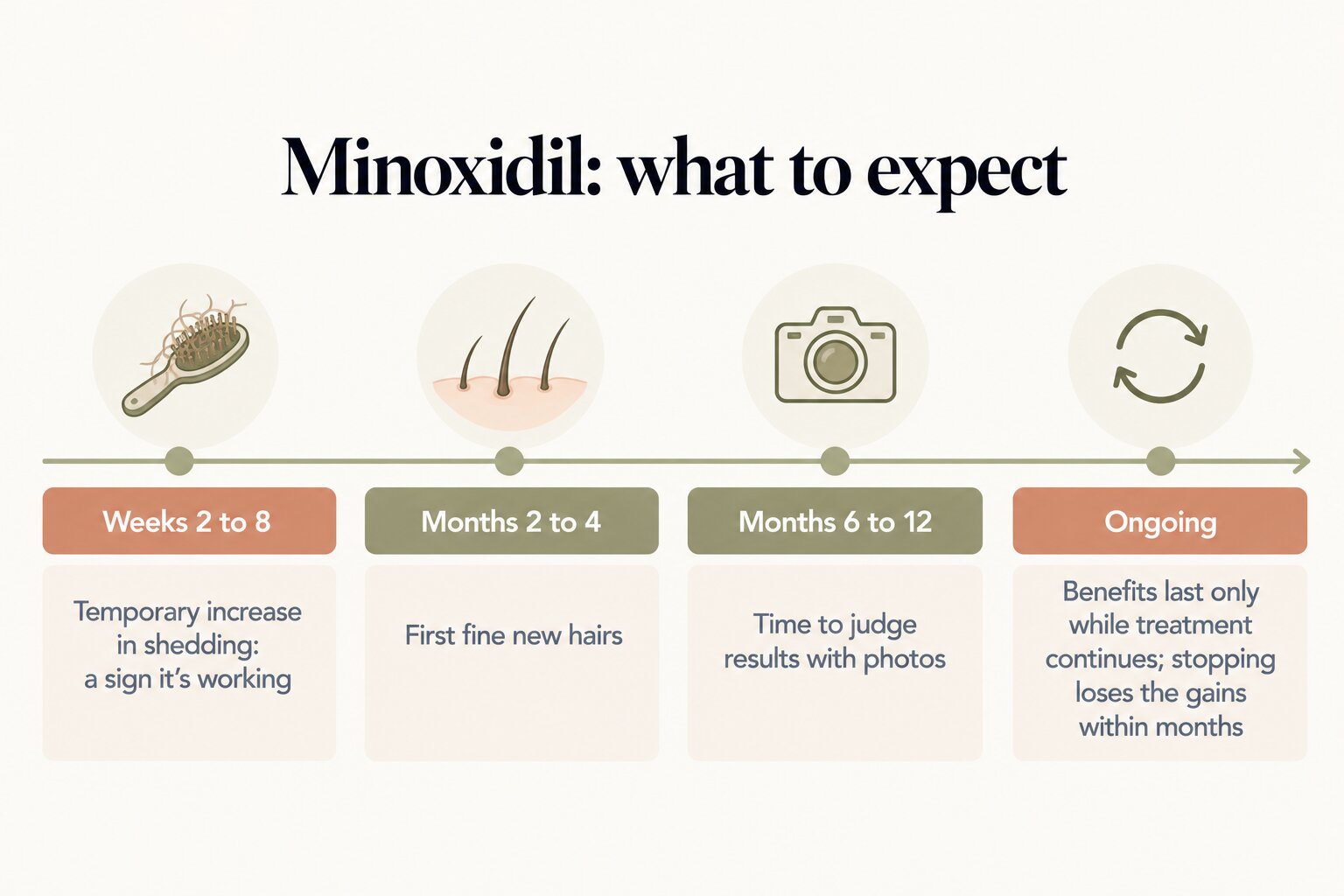
- Weeks 2 to 8: you may notice increased shedding. This means resting hairs are being pushed out by new growing hairs. It usually settles within a few weeks; don't stop treatment.
- Months 2 to 4: the first signs of new growth, often fine hairs.
- Months 6 to 12: the time to judge whether it's working. Take photos in the same light every few months to compare.
- Ongoing: benefits continue only while you use it. If you stop, the hair gained is usually lost within a few months, and hair loss continues as it would have done without treatment.
Safety: who should be careful
- Pregnancy and breastfeeding: avoid minoxidil in any form.
- Babies and young children: cases of excess body hair have been reported in babies after contact with a parent's topical minoxidil, usually resolving when exposure stopped. Since 2024, European product labels carry a warning. Wash your hands after applying it and avoid skin contact with infants until the product has dried.
- Pets, especially cats: minoxidil is highly toxic to cats. In a recent Canadian review of 68 exposed cats, about 15% died, often after licking a person's treated skin or bedding. Keep products away from pets, don't let them lick treated skin or your pillow, and wash your hands after use.
- Heart conditions and low blood pressure: speak to a doctor before using oral minoxidil.
- Scalp conditions: people with seborrhoeic dermatitis or psoriasis are more prone to irritation, so treat the scalp condition first.
Recommendations
By type of hair loss.
- Male pattern hair loss: topical 5% or low-dose oral minoxidil, often combined with finasteride for the best results.
- Female pattern hair loss: topical 5% foam once daily, 2% solution twice daily, or low-dose oral minoxidil, sometimes with spironolactone.
- Telogen effluvium: usually recovers on its own, but minoxidil is sometimes used in chronic cases (see Telogen Effluvium).
- Alopecia areata: sometimes used alongside steroid treatments, but it doesn't treat the immune cause (see Alopecia Areata).
Choosing topical or oral.
- Choose topical if you prefer an over-the-counter option, want to avoid systemic side effects, or have heart or blood pressure concerns.
- Consider oral if you find topical application impractical or irritating, have tried topical minoxidil consistently for 6 to 12 months without benefit, or want to treat a large area, after discussing the risks with a doctor.
Practical notes
Minoxidil works best on thinning hair, not on areas that have been bald for years, so start early. Use it consistently, ideally at the same time each day, and give it at least 6 months before judging. Expect a temporary shed in the first two months, and don't stop when it happens. Take photos every 3 months in the same lighting to track progress. Topical minoxidil is available without a prescription; low-dose oral tablets need one, and the small doses used for hair may require tablets to be split or specially prepared. Keep products away from children and pets, and wash your hands after use. If you're considering oral minoxidil, have your blood pressure and heart rate checked first. Our Longevity Doctors can confirm the type of hair loss, help you choose the right form and dose, and monitor safety and progress, starting with the free longevity assessment.
- Olsen EA, et al. A randomized clinical trial of 5% topical minoxidil versus 2% topical minoxidil and placebo in the treatment of androgenetic alopecia in men. Journal of the American Academy of Dermatology, 2002;47(3):377-385.
- Penha MA, et al. Oral minoxidil vs topical minoxidil for male androgenetic alopecia: a randomized clinical trial. JAMA Dermatology, 2024;160(6):600-605.
- Ramos PM, et al. Minoxidil 1 mg oral versus minoxidil 5% topical solution for the treatment of female-pattern hair loss: a randomized clinical trial. Journal of the American Academy of Dermatology, 2020;82(1):252-253.
- Vañó-Galván S, et al. Safety of low-dose oral minoxidil for hair loss: a multicenter study of 1404 patients. Journal of the American Academy of Dermatology, 2021;84(6):1644-1651.
- Goren A, et al.; Roberts J, et al. Sulfotransferase activity in plucked hair follicles predicts response to topical minoxidil, 2014.
- International Society of Hair Restoration Surgery. Minoxidil: formulation, dosage and side effects. ishrs.org.
- Navarra Pharmacovigilance Centre and EudraVigilance. Hypertrichosis in infants exposed to topical minoxidil, presented 2024.
- Canadian review of minoxidil exposures in cats, Journal of the American Academy of Dermatology; reported in The Limbic, January 2026.
- van Zuuren, E.J. et al. Interventions for female pattern hair loss. Cochrane Database of Systematic Reviews, 2012 (updated 2016).
Free longevity assessment
Thinking about starting
minoxidil?
Take the free Aevum Protocol assessment to see how your skin & longevity and 6 other longevity domains are performing — and get a personalised 90-day plan.
Take the free assessment