Skin & Longevity
Finasteride and Dutasteride:
How DHT Blockers Work, Results and Side Effects
Finasteride and dutasteride treat male pattern hair loss at its root, by lowering dihydrotestosterone (DHT), the hormone that shrinks susceptible hair follicles. Finasteride 1 mg a day is the most studied hair loss tablet in men: in the original five-year trials, 90% of men taking it had no further visible hair loss, compared with 25% on placebo. Dutasteride blocks DHT more completely and, in a head-to-head trial of 917 men, regrew more hair than finasteride over 24 weeks, though it's approved for hair loss only in some countries, such as South Korea and Japan. A topical finasteride spray, approved in several European countries, appears to work about as well as the tablet with much lower levels in the blood. These medicines aren't for everyone. Sexual side effects such as reduced libido or erectile difficulty affect a small minority, only slightly more often than placebo, and usually resolve. But persistent effects after stopping have been reported, and European regulators now list suicidal thoughts as a possible side effect of finasteride tablets. They can also harm a male baby during pregnancy, and they halve PSA test results. This article explains how they work, what to expect and how to decide whether they're right for you.
Key numbers
| Finding | Detail |
|---|---|
| Finasteride 1 mg at 5 years | 90% had no further visible loss vs 25% on placebo |
| Finasteride 1 mg at 2 years | 66% had increased hair growth vs 7% on placebo |
| Lowering of blood DHT | Finasteride about 70%; dutasteride over 90% |
| Dutasteride vs finasteride (917 men, 24 weeks) | Dutasteride 0.5 mg regrew significantly more hair |
| Topical vs oral finasteride (24 weeks) | Similar regrowth; blood DHT lowered 35% vs 56% |
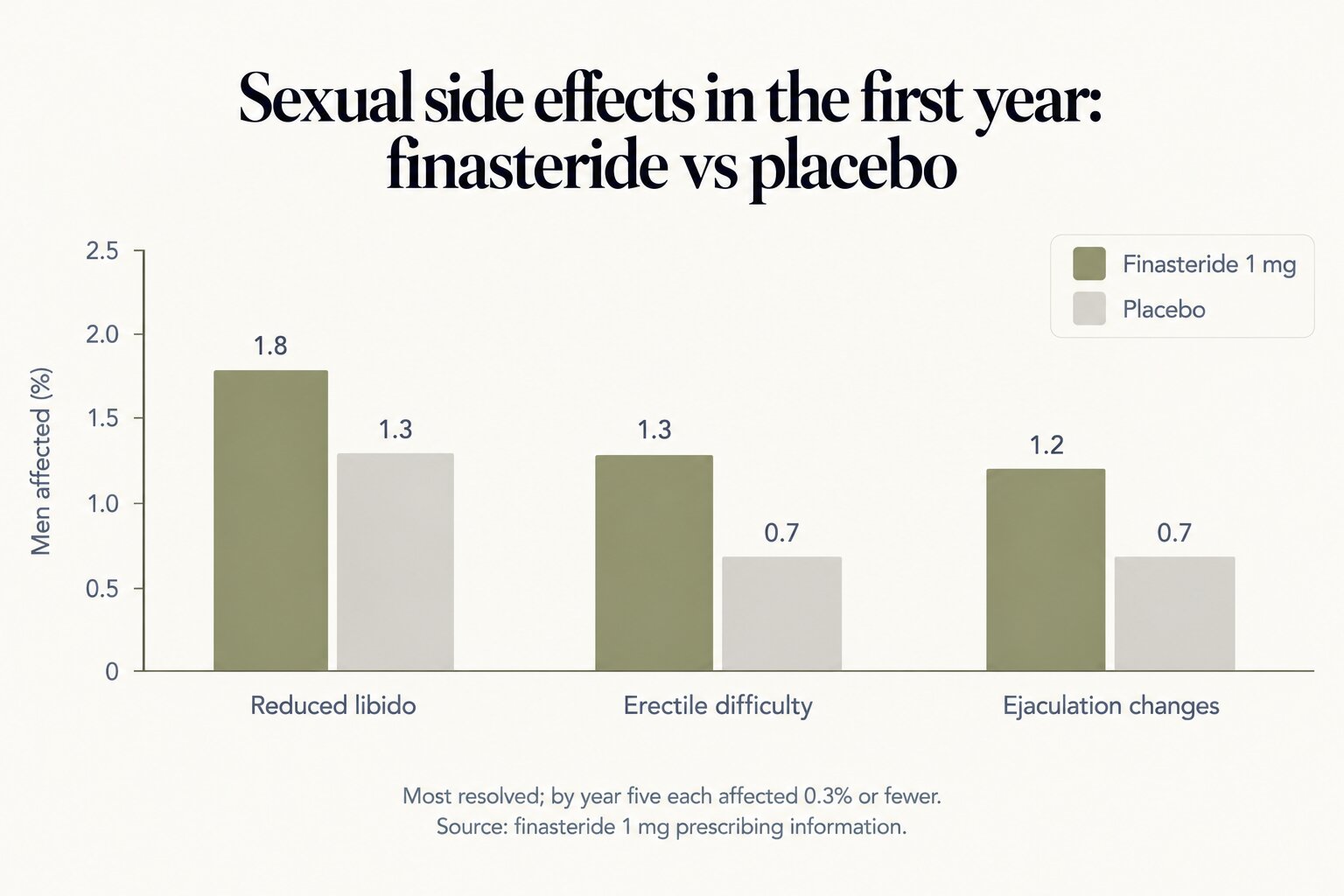
| Sexual side effects, finasteride vs placebo (first year) | Reduced libido 1.8% vs 1.3%; erectile difficulty 1.3% vs 0.7% |
| Effect on PSA test | Roughly halves the result |
How they work
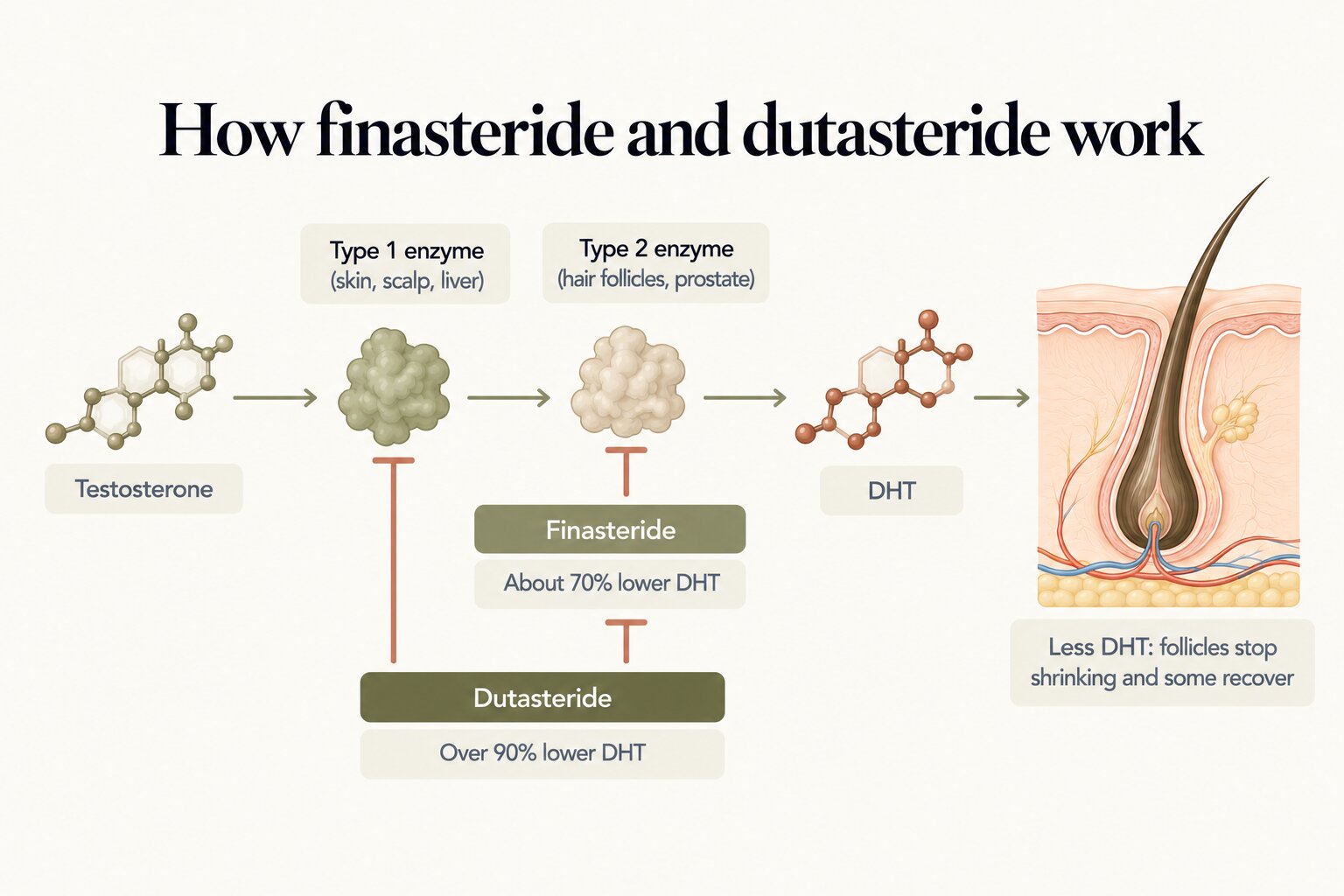
Testosterone is converted into DHT by an enzyme called 5-alpha reductase. There are two main types: type 2, found mainly in hair follicles and the prostate, and type 1, found mainly in the skin, scalp and liver. In men with a genetic tendency to pattern hair loss, DHT gradually shrinks follicles on the top and front of the scalp (see Male Pattern Hair Loss).
- Finasteride blocks mainly type 2, lowering blood DHT by about 70%.
- Dutasteride blocks both type 1 and type 2, lowering blood DHT by over 90%.
With less DHT, follicle shrinkage slows or stops, and some partly shrunken follicles recover and produce thicker hairs. Because these medicines tackle the cause, they're particularly good at preventing further loss, and they work well alongside minoxidil, which stimulates growth by a different route (see Minoxidil).
Finasteride has a half-life of 6 to 8 hours, but its effect on the enzyme lasts longer. Dutasteride's half-life is about 5 weeks, so it stays in the body for months after stopping.
The options compared
| Option | How it's taken | DHT lowering | Results | Main side effects | Approval | Evidence |
|---|---|---|---|---|---|---|
| Finasteride 1 mg tablet | One tablet a day | About 70% in the blood | Stops loss in most men; regrowth in many | Sexual side effects in a small minority; mood changes rare | Approved for men's hair loss in most countries | Strong |
| Topical finasteride spray | Sprayed on the scalp daily | About 35% in the blood | Similar to tablet at 24 weeks | Fewer whole-body effects; scalp irritation possible | Approved in several European countries | Moderate |
| Dutasteride 0.5 mg capsule | One capsule a day | Over 90% in the blood | More regrowth than finasteride in trials | Similar to finasteride, possibly slightly more | Approved for hair loss in South Korea and Japan; elsewhere used off-label | Moderate to strong |
| Dutasteride scalp injections | Injected into the scalp every few months | Local | Promising in small studies | Injection pain; whole-body effects possible | Not approved | Limited |
What the research shows
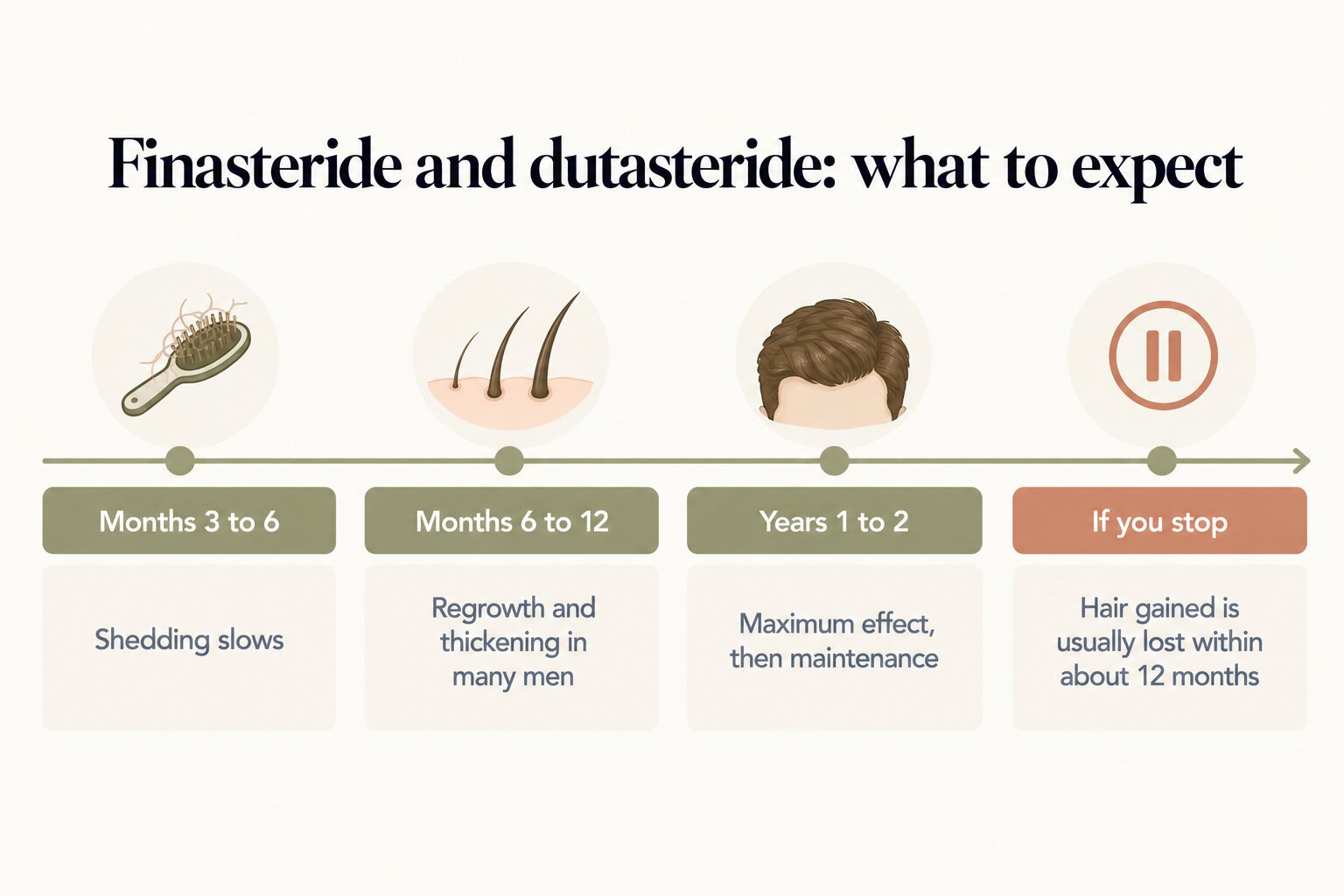
Finasteride tablets. Finasteride 1 mg was approved by the US FDA for male pattern hair loss in 1997, after large placebo-controlled trials. At two years, 66% of men taking it had increased hair growth on standardised photographs, compared with 7% on placebo. At five years, 90% had no further visible loss (42% unchanged and 48% improved), compared with 25% on placebo, while 75% of men on placebo had lost more hair. Hair counts stayed above baseline throughout five years. Benefits are typically seen from 3 to 6 months, with the full effect at 1 to 2 years.
Dutasteride. In a 2014 trial of 917 men aged 25 to 50, dutasteride 0.5 mg daily increased hair count and hair thickness significantly more than finasteride 1 mg or placebo over 24 weeks, with similar overall side effect rates across the groups. Dutasteride has been approved for hair loss in South Korea since 2009 and in Japan since 2015. Elsewhere, it's approved only for an enlarged prostate and used for hair loss off-label, often when finasteride hasn't worked well enough.
Topical finasteride. In a 2022 phase 3 trial, a 0.25% topical finasteride spray increased hair counts in a target area by about 20 hairs per square centimetre over 24 weeks, matching oral finasteride and outperforming placebo. Blood DHT fell by about 35% with the spray compared with 56% with the tablet, and finasteride levels in the blood were over 100 times lower. Sexual side effects were more associated with the tablet. The spray is approved in several European countries, including Italy and Germany. Some topical finasteride still reaches the bloodstream, so pregnancy precautions still apply.
Side effects in perspective. In the 12-month trials of finasteride 1 mg in about 1,900 men, sexual side effects were uncommon and close to placebo rates: reduced libido 1.8% vs 1.3%, erectile difficulty 1.3% vs 0.7%, and ejaculation changes 1.2% vs 0.7%. Most resolved after stopping, and many resolved while continuing; by the fifth year, each affected 0.3% or fewer.
Expectations matter too. In a study of men taking finasteride for an enlarged prostate, 44% of those told about possible sexual side effects reported them, compared with 15% of those who weren't told: a strong "nocebo" effect.
Persistent side effects and mood. Some men report sexual, mental and physical symptoms that persist for months or years after stopping finasteride, sometimes called post-finasteride syndrome. The evidence is of low quality: most studies are small or recruited men from online forums, blood hormone levels are typically normal, and a causal link hasn't been established. In one large retrospective study of 4,284 men, persistent sexual symptoms were found in 0.8%. In 2025, the European Medicines Agency confirmed suicidal thoughts as a side effect of finasteride tablets, with frequency unknown, concluded that benefits still outweigh risks, and added a patient card to packs. Anyone who notices mood changes should stop the medicine and seek medical advice.
Prostate cancer. At higher doses, finasteride (5 mg) and dutasteride are used for an enlarged prostate (see Prostate Enlargement (BPH)). In the Prostate Cancer Prevention Trial of 18,882 men, finasteride reduced the overall risk of prostate cancer. An early concern about more high-grade cancers wasn't borne out: after 18 years of follow-up, prostate cancer deaths were slightly lower with finasteride (0.45% vs 0.59%), a non-significant difference.
How to use it
Starting treatment.
- Talk to a doctor first, including about any history of depression, anxiety, sexual difficulties or fertility plans.
- Finasteride: 1 mg once a day, with or without food, at any time of day.
- Dutasteride: 0.5 mg once a day, usually considered when finasteride hasn't worked well enough.
- Topical finasteride: applied to the dry scalp once a day, following the product instructions.
- Combine with minoxidil for the best results in most men.
What to expect.
- Months 3 to 6: shedding slows; early improvement may be visible.
- Months 6 to 12: regrowth and thickening in many men. Take photos every 3 to 6 months.
- Years 1 to 2: maximum effect. After this, the goal is maintaining hair, not ongoing regrowth.
- Stopping: hair gained is usually lost within about 12 months, returning to where it would have been without treatment.
Important precautions.
- PSA tests: these medicines roughly halve PSA results. Tell your doctor, who will usually double the reading (see PSA Screening for Prostate Cancer).
- Pregnancy: women who are or may become pregnant shouldn't handle crushed or broken finasteride tablets or leaking dutasteride capsules, as they can be absorbed through the skin and affect a male baby's development.
- Fertility: reduced semen quality has been reported in some men. If you're trying for a baby and having difficulty, discuss stopping with your doctor (see Male Fertility and Sperm Health).
- Blood donation: wait at least one month after the last finasteride dose and six months after dutasteride.
- Mood: stop and seek advice if you notice low mood, anxiety or thoughts of self-harm (see Mental Health Warning Signs and Getting Help in Sri Lanka).
Who these medicines are for
- Men with early to moderate pattern hair loss who want to keep their hair: the best candidates.
- Men with extensive balding: may stabilise remaining hair but are unlikely to regrow the bald areas. Often used before and after hair transplants to protect existing hair.
- Women: not approved for women's hair loss. They're sometimes used in women after menopause or with reliable contraception, but never in pregnancy or when pregnancy is possible (see Female Pattern Hair Loss).
- Teenagers: generally not recommended under 18.
Recommendations
By goal.
- Stop further loss: finasteride 1 mg daily is the first choice for most men.
- Maximise regrowth: finasteride plus minoxidil, or dutasteride plus minoxidil under specialist care.
- Minimise whole-body exposure: topical finasteride where available, or low-dose regimens discussed with a doctor.
By situation.
- History of depression or sexual difficulties: discuss carefully, consider topical options, and monitor closely.
- Planning a family: discuss timing and semen testing with your doctor.
- Over 50 or with prostate symptoms: have a baseline PSA before starting, and remind your doctor at future tests.
Practical notes
Finasteride is one of the best-proven ways to stop male pattern hair loss, and most men take it without problems. The key is starting early, while follicles are still producing hair, and continuing long term, because benefits fade within about a year of stopping. Give it at least 6 to 12 months, and combine it with minoxidil for better results. Buy it from a registered pharmacy with a prescription. Be honest with your doctor about your mental health and sexual health, and stop and seek advice if you notice mood changes. Remind any doctor ordering a PSA test that you take it. If finasteride isn't enough, dutasteride is a stronger option under medical supervision. Our Longevity Doctors can confirm the diagnosis, discuss the benefits and risks for you, and monitor your treatment and PSA, starting with the free longevity assessment.
- Propecia (finasteride 1 mg) prescribing information: clinical studies and adverse reactions.
- Gubelin Harcha W, et al. A randomized, active- and placebo-controlled study of the efficacy and safety of different doses of dutasteride versus placebo and finasteride in the treatment of male subjects with androgenetic alopecia. Journal of the American Academy of Dermatology, 2014;70(3):489-498.
- Piraccini BM, et al. Efficacy and safety of topical finasteride spray solution for male androgenetic alopecia: a phase III, randomized, controlled clinical trial. Journal of the European Academy of Dermatology and Venereology, 2022;36(2):286-294.
- Mondaini N, et al. Finasteride 5 mg and sexual side effects: how many of these are related to a nocebo phenomenon? Journal of Sexual Medicine, 2007;4(6):1708-1712.
- Post-finasteride syndrome: a review. Anais Brasileiros de Dermatologia.
- European Medicines Agency. PRAC meeting highlights, 5–8 May 2025: finasteride and dutasteride and suicidal ideation.
- Goodman PJ, et al. Long-term effects of finasteride on prostate cancer mortality. New England Journal of Medicine, 2019;380:393-394.
- D'Amico AV, Roehrborn CG. Effect of 1 mg/day finasteride on concentrations of serum prostate-specific antigen in men with androgenic alopecia. The Lancet Oncology, 2007;8(1):21-25.
- Bernstein Medical. Dutasteride (Avodart) information sheet.
Free longevity assessment
Wondering whether a DHT blocker
is right for you?
Take the free Aevum Protocol assessment to see how your skin & longevity and 6 other longevity domains are performing — and get a personalised 90-day plan.
Take the free assessment