Skin & Longevity
Hair Transplant Surgery:
FUE vs FUT, Who's Suitable and What to Expect
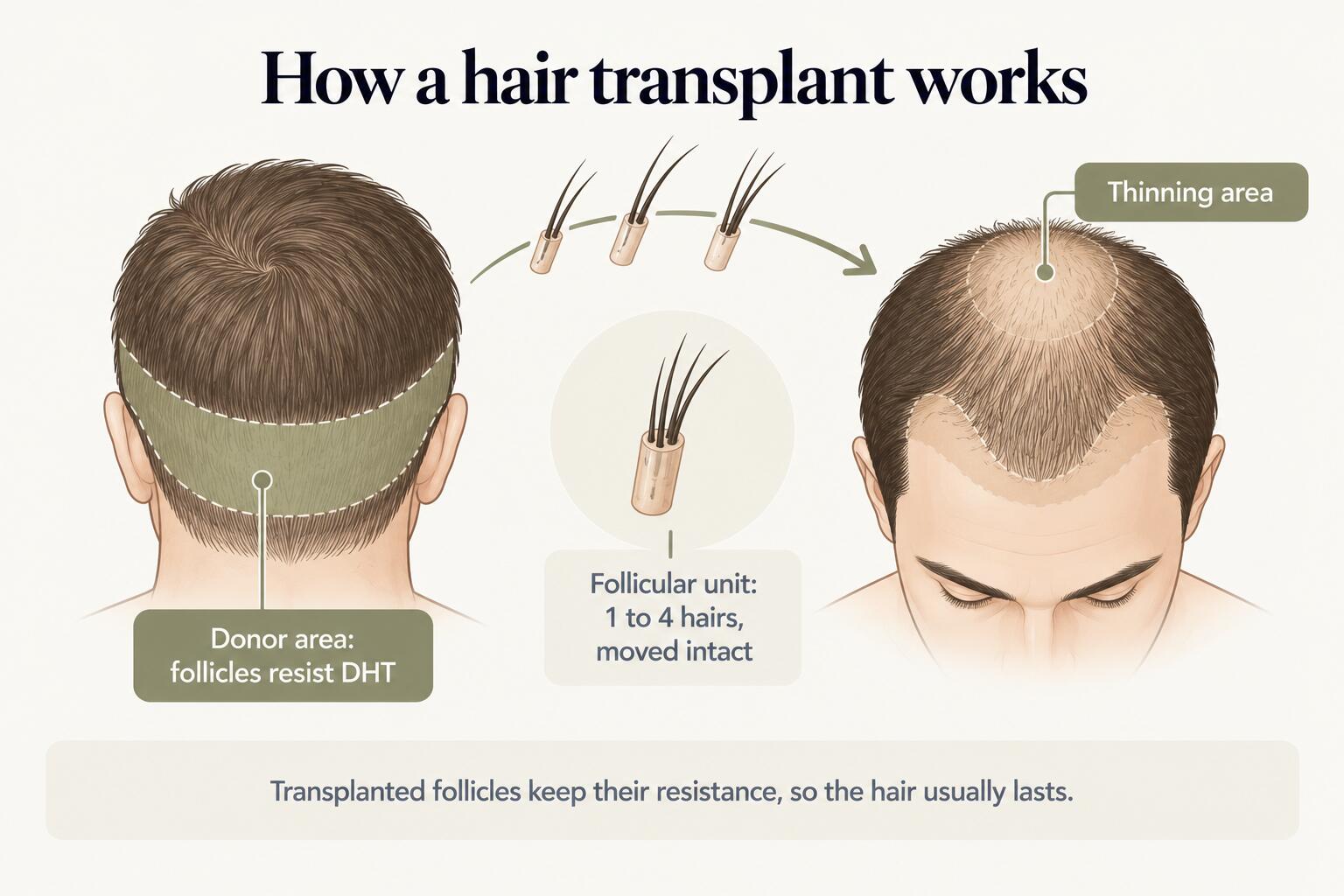
A hair transplant moves hair follicles from the back and sides of the scalp, where they resist the hormone DHT, to thinning or bald areas at the front and top. Because these follicles keep their resistance after moving, transplanted hair usually lasts for life. It's the only treatment that can restore hair to areas that are already bald. There are two main techniques. Follicular unit excision (FUE) removes follicles one by one, leaving tiny dot scars. Follicular unit transplantation (FUT) removes a thin strip of scalp, leaving a single fine linear scar but often allowing more grafts. In 2021, members of the International Society of Hair Restoration Surgery treated about 630,000 surgical patients, 87% of them men. A transplant isn't a cure: the donor supply is limited, the hair around the transplant keeps thinning without medical treatment, and the final result takes 12 to 18 months to appear. The biggest risk is choosing the wrong clinic. Unlicensed "black market" clinics, where technicians rather than doctors perform the surgery, are a growing problem worldwide. This article explains who's suitable, how the techniques compare, what to expect and how to choose a surgeon.
Key numbers
| Finding | Detail |
|---|---|
| Surgical hair restoration patients, ISHRS members (2021) | About 630,000; 87% men, 13% women |
| Patients aged 30 to 49 | About 57% of men and 55% of women |
| Members reporting black market clinics in their city | 51% |
| Patients seeking repair of previous surgery (2021) | 5.4%, up from 4.2% in 2019 |
| Shedding of transplanted hairs ("shock loss") | Usually starts 2 to 4 weeks after surgery |
| First new growth | About 3 to 4 months |
| Final result | 12 to 18 months |
How it works
In pattern hair loss, follicles on the top and front of the scalp gradually shrink under the influence of DHT, while follicles at the back and sides are genetically resistant (see Male Pattern Hair Loss). A transplant redistributes these resistant follicles. Hair grows naturally in small groups of one to four hairs called follicular units, and modern transplants move these units intact, which gives a natural-looking result.
The procedure has three main steps:
- 1. Harvesting follicles from the donor area by FUE or FUT.
- 2. Preparing the grafts, usually under a microscope, and keeping them cool and moist until placement.
- 3. Implanting the grafts into tiny incisions in the thinning area, angled and spaced to match natural hair growth, with careful design of the hairline.
FUE vs FUT compared
| Aspect | FUE (follicular unit excision) | FUT (strip method) |
|---|---|---|
| How grafts are taken | One by one with a tiny punch | A thin strip of scalp is removed and divided under a microscope |
| Donor scar | Many tiny dot scars | A single fine line, hidden by surrounding hair |
| Short hairstyles | Suitable; dots are less noticeable with very short hair | The line may show with very short hair |
| Number of grafts | Often fewer per session; uses a wider donor area | Often more per session from a smaller area |
| Procedure time | Longer for large sessions | Faster for large sessions |
| Donor recovery | Quick; little discomfort | Tighter and sorer for a few weeks; stitches or staples |
| Shaving | Donor area often shaved for large sessions | Usually no shaving needed |
| Best suited to | Short hairstyles, tight scalps, scar repair, body or beard hair | Large sessions, longer hairstyles, maximising lifetime graft supply |
Neither technique is better for everyone. Some surgeons combine both to maximise the total number of grafts available over a lifetime. Robotic systems can assist with FUE, and terms such as "sapphire FUE" or "DHI" describe particular instruments or implantation methods, not fundamentally different procedures.
Who is suitable
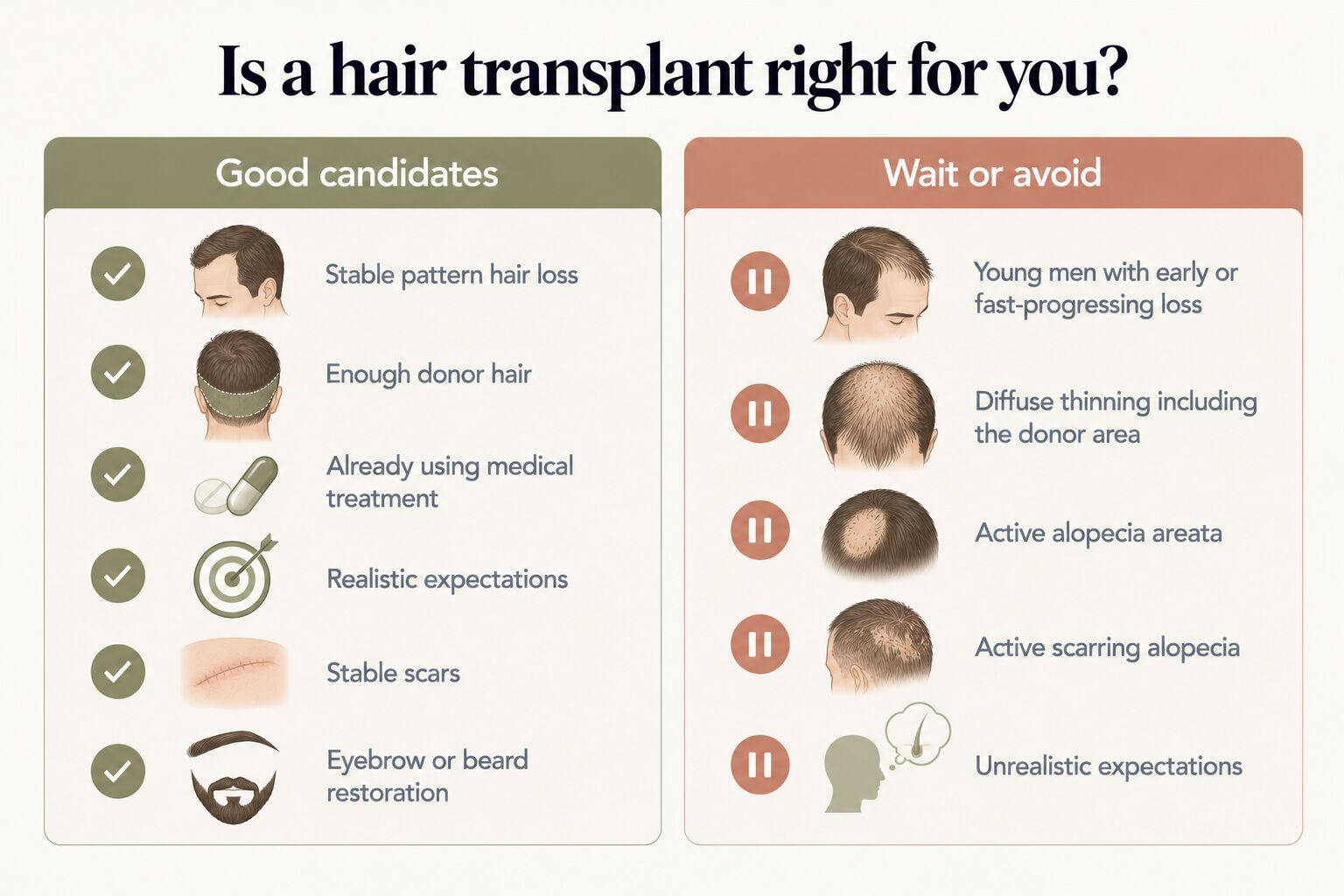
Good candidates.
- Men and women with stable pattern hair loss and enough donor hair to cover the area they want to restore.
- People already using medical treatment, such as minoxidil or finasteride, to protect their remaining hair (see Minoxidil and Finasteride and Dutasteride).
- People with realistic expectations: a transplant can restore a natural hairline and improve coverage, but it can't recreate the density of a full head of hair on a scalp with extensive loss.
- Some people with stable scarring: for example, from injury, surgery or burns, once the area has settled.
- Eyebrow, beard and moustache restoration: about 13% of procedures in men and 17% in women target areas other than the scalp.
Who should wait or avoid it.
- Young men with early or rapidly progressing loss: a transplant done too early may leave an unnatural island of hair as surrounding hair continues to recede. Stabilising loss with medicines first is often wiser.
- Women with diffuse thinning across the whole scalp, including the donor area: there may not be enough stable donor hair (see Female Pattern Hair Loss).
- Active alopecia areata: transplanted hair may be lost too (see Alopecia Areata).
- Active scarring alopecia, such as lichen planopilaris or frontal fibrosing alopecia: transplants often fail while inflammation continues, so the condition must be inactive for a prolonged period first.
- Unrealistic expectations or concerns about appearance that seem out of proportion to the hair loss.
- Medical conditions that increase surgical risk, such as bleeding disorders or uncontrolled diabetes, need assessment first.
What to expect
| Aspect | What to expect |
|---|---|
| Consultation | Diagnosis, scalp and donor assessment, hairline planning and a long-term plan |
| Anaesthesia | Local anaesthetic; most people are awake and comfortable |
| Procedure length | Typically a full day, sometimes two for large sessions |
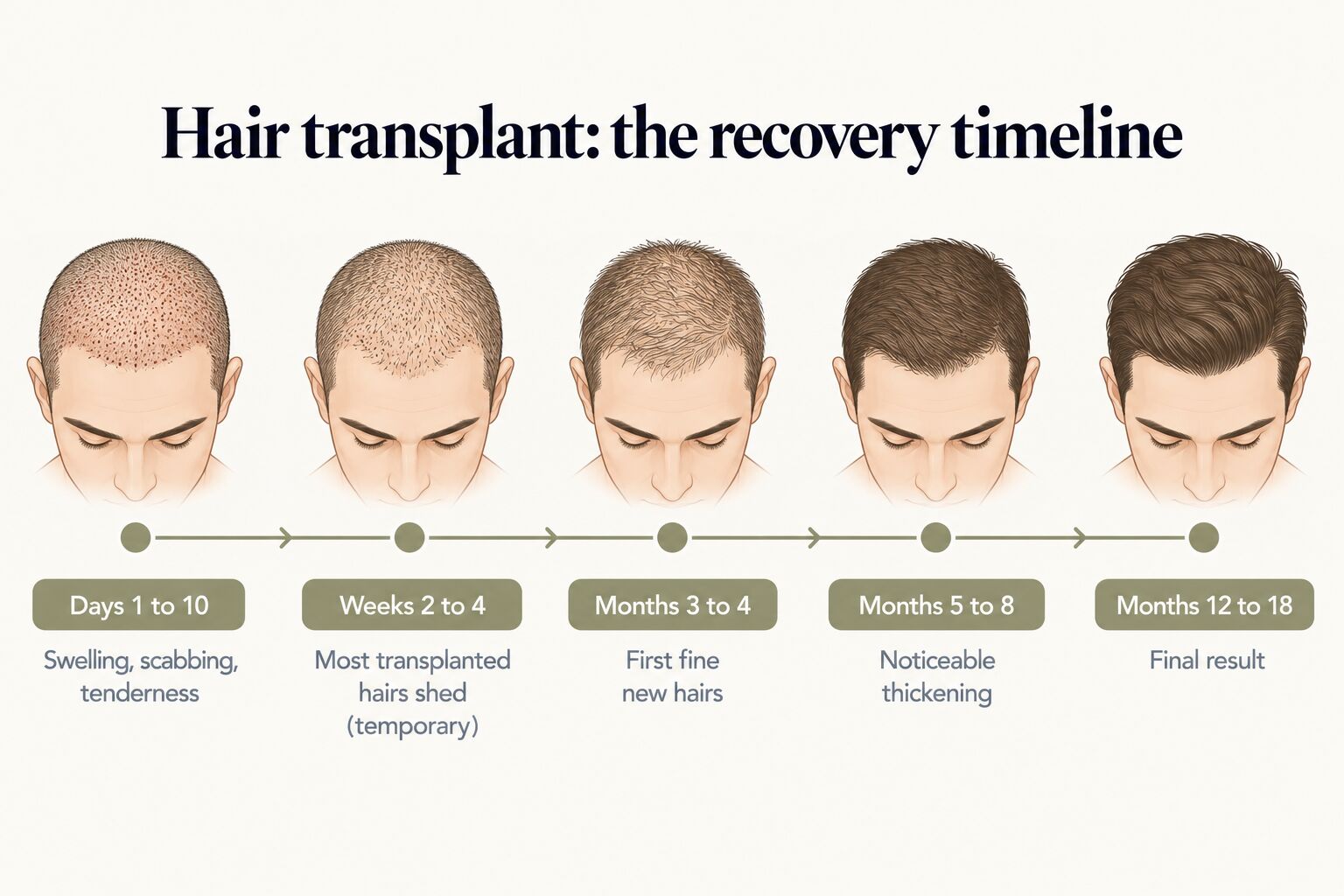
| First days | Swelling of the forehead, scabbing and tenderness; sleep slightly upright |
| Back to work | Often within a few days to a week, depending on work and visibility |
| Weeks 2 to 4 | Most transplanted hairs shed ("shock loss"); nearby native hairs may shed too |
| Months 3 to 4 | New hair starts to grow, often fine and patchy at first |
| Months 5 to 8 | Noticeable thickening |
| Months 12 to 18 | Final result |
| Cost | High; usually a one-off procedure, sometimes repeated |
Shock loss. Almost everyone sheds most of the transplanted hairs within the first few weeks. This is temporary: the follicles remain alive in the skin, rest, and start growing new hairs a few months later. Some native hair around the transplant may also shed temporarily. Continuing minoxidil or finasteride may help reduce this. Contact your surgeon if shedding comes with pain, pus, spreading redness or rash, or if there's no regrowth five or more months later.
Possible complications. Most are minor and temporary: swelling, bleeding, scabbing, itching, numbness of the scalp, small pimples or ingrown hairs (folliculitis), and temporary donor-area thinning. Less common problems include infection, cysts, a widened or visible donor scar, poor graft growth, an unnatural hairline, and over-harvesting of the donor area, which can leave the back of the head visibly thin. Many of the serious problems are linked to poorly trained operators and excessive harvesting.
Choosing a surgeon
The International Society of Hair Restoration Surgery warns that unlicensed clinics are a worldwide problem: in its 2022 census, 51% of members reported black market clinics in their city, and more patients were seeking repair of failed surgery. Many people travel abroad for a hair transplant, so careful checks matter wherever you have surgery, in Sri Lanka or overseas. The ISHRS's key advice is to "ask who performs each part of your surgery".
- A qualified doctor should diagnose your hair loss, plan treatment, design the hairline and perform the surgical steps: removing follicles and making the recipient incisions. Technicians can assist with graft preparation and placement under supervision.
- Red flags: no named surgeon, a sales pitch instead of a medical assessment, promises of "unlimited" grafts, branded technology presented as a breakthrough, cheap travel packages that don't say who operates, and decisions made mainly from social media.
- Good signs: a surgeon who explains the long-term plan, protects your donor supply, recommends medical treatment, and is willing to say if you're not a suitable candidate or should wait.
- Ask to see results from patients with similar hair loss, hair type and skin colour, ideally at 12 months or more.
Evidence strength
- Restoring hair to bald areas in stable pattern hair loss: strong; a well-established surgical procedure with long-lasting results.
- Transplanted hair lasting long term: strong, because donor follicles keep their resistance to DHT.
- Stopping ongoing hair loss: not supported; medical treatment is needed to protect non-transplanted hair.
- Use in active alopecia areata or active scarring alopecia: not supported.
- PRP and other add-ons to improve graft growth: limited evidence (see PRP for Hair Loss).
Why this matters for longevity
Hair loss can affect confidence and quality of life for decades, and for suitable people a transplant can offer a lasting, natural result. But it's a surgical procedure that uses a finite resource. Planning for the long term, combining surgery with medical treatment, and choosing a properly qualified surgeon protect both your results and your health. A good decision now avoids repair surgery later.
Recommendations
- Start with a diagnosis: confirm the type of hair loss and check for treatable causes first (see Types of Hair Loss).
- Stabilise first: use minoxidil and, for men, finasteride for 6 to 12 months before deciding, unless the loss is already stable.
- Plan for the future: ask how your hair loss is likely to progress and how the plan will look in 10 to 20 years.
- Choose the technique to suit you, not the clinic's marketing: FUE for short hairstyles or scar repair, FUT for large sessions and longer hair, or a combination.
- Keep up medical treatment afterwards to protect your native hair (see Building a Hair Loss Treatment Plan).
Practical notes
A hair transplant can be life-changing for the right person, but it isn't a quick fix or a cure. Make sure your hair loss is stable and your expectations are realistic, and use medical treatment before and after surgery to protect the hair you still have. Expect most transplanted hairs to shed in the first month, new growth to start at around 3 to 4 months, and the final result at 12 to 18 months. Choose a surgeon, not a package: find out who will perform each part of the procedure, and be wary of cheap offers, unlimited grafts and social media hype, whether in Sri Lanka or abroad. Our Longevity Doctors can confirm the type and stage of your hair loss, start and monitor medical treatment, and help you decide whether and when a transplant makes sense, starting with the free longevity assessment.
- International Society of Hair Restoration Surgery. 2022 Practice Census Results (2021 data). ishrs.org.
- International Society of Hair Restoration Surgery. Fight the FIGHT: hair transplant black market red flags. fightthefight.ishrs.org.
- Bernstein Medical. FUE vs FUT hair transplants: comparing techniques.
- Wimpole Clinic. Shock loss following a hair transplant.
Free longevity assessment
Wondering whether a hair
transplant is right for you?
Take the free Aevum Protocol assessment to see how your skin & longevity and 6 other longevity domains are performing — and get a personalised 90-day plan.
Take the free assessment