Skin & Longevity
Building a Hair Loss Treatment Plan:
Which Treatments to Use, Combine and When
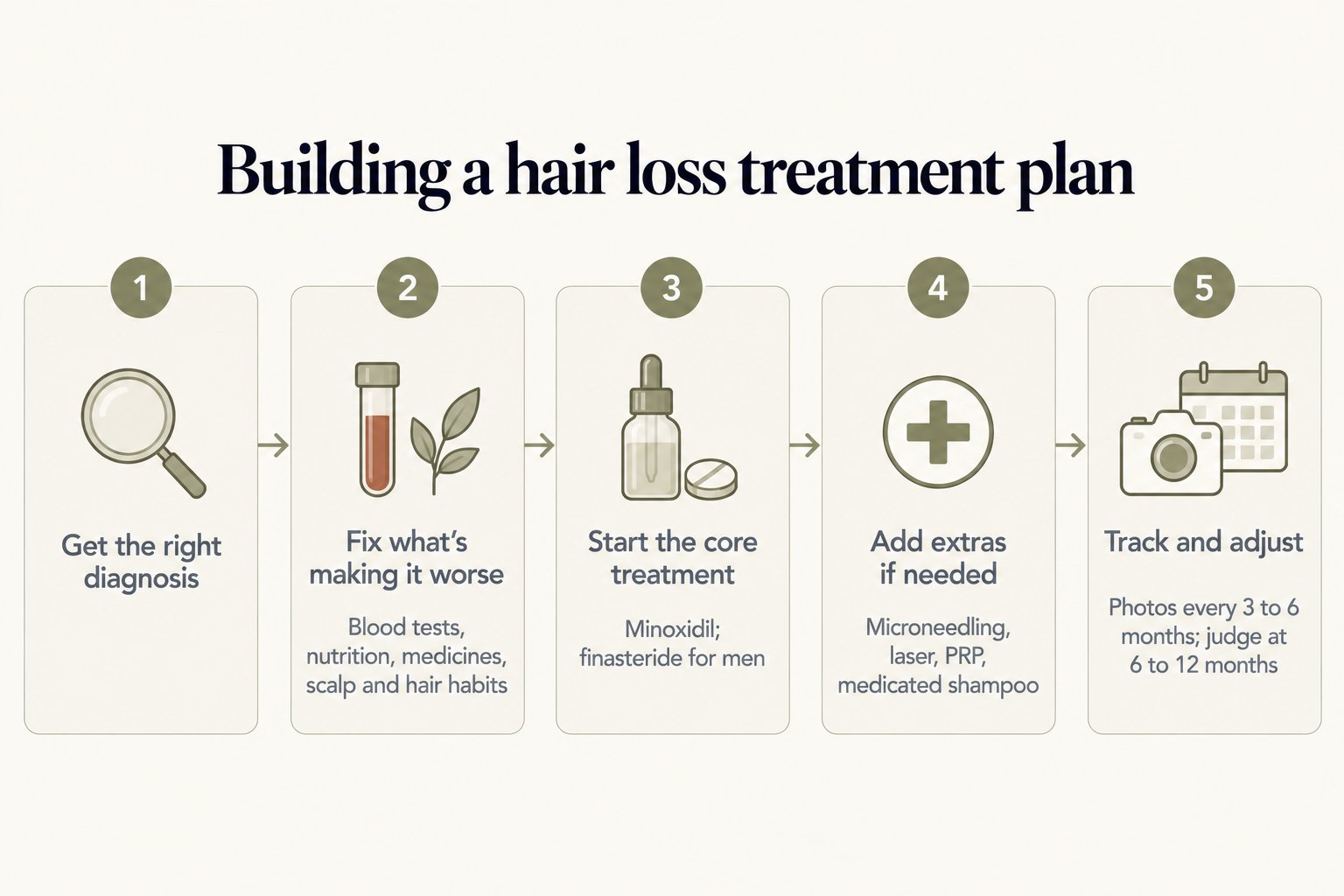
The most effective hair loss plans follow the same logic: get the right diagnosis, fix anything that's making it worse, start the treatments with the strongest evidence early, add extras only if needed, and track progress honestly. Different types of hair loss need very different approaches. Pattern hair loss responds to long-term medicines, telogen effluvium usually recovers once the trigger is removed, alopecia areata needs immune-targeted treatment, and scarring alopecia needs urgent specialist care. For pattern hair loss, European guidelines recommend topical minoxidil for men and women and oral finasteride for men as first-line treatments. Combining them works better than either alone: in a one-year study of 450 men, 94% improved with both, compared with 81% on finasteride and 59% on minoxidil alone. Procedures such as microneedling, low-level laser therapy and PRP can add modest benefit, and a hair transplant can restore bald areas once loss is stable. Whatever you choose, give it 6 to 12 months, take standardised photos, and remember that most treatments only work while you keep using them. This article brings the series together into a step-by-step plan, with example plans for common situations.
Key numbers
| Finding | Detail |
|---|---|
| Finasteride plus minoxidil (450 men, 1 year) | 94% improved vs 81% on finasteride and 59% on minoxidil |
| Finasteride 1 mg at 5 years | 90% had no further visible loss vs 25% on placebo |
| Time to judge any treatment | 6 to 12 months |
| Telogen effluvium | Usually settles within 6 to 9 months once the trigger is removed |
| Stopping pattern hair loss treatment | Gains usually lost within months to about a year |
| Normal daily shedding | About 50 to 100 hairs |
Step 1: Get the right diagnosis
Before choosing treatments, confirm what kind of hair loss you have (see Types of Hair Loss):
- Pattern hair loss: gradual thinning over years, at the temples and crown in men or with a widening parting in women (see Male Pattern Hair Loss and Female Pattern Hair Loss).
- Telogen effluvium: sudden heavy shedding 2 to 4 months after illness, childbirth, a crash diet or stress (see Telogen Effluvium).
- Alopecia areata: round, smooth bald patches (see Alopecia Areata).
- Scarring alopecia: loss with redness, scaling, pain or shiny skin, which needs prompt specialist assessment because it's permanent.
- Traction alopecia, hair breakage or hair pulling: need changes in hair care or behaviour more than medicines.
Many people have more than one type at the same time, especially telogen effluvium revealing underlying pattern loss.
Step 2: Fix what's making it worse
- Blood tests: a full blood count, ferritin, thyroid function and vitamin D for most people, plus hormone tests for women with irregular periods, acne or excess facial hair (see Hair Loss, Blood Tests and Nutrition).
- Correct deficiencies: treat low iron, vitamin D or B12 at the right dose, then recheck.
- Eat enough: particularly protein and overall energy, and avoid crash diets.
- Review medicines: some, such as certain blood thinners, mood stabilisers and retinoids, can cause shedding. Don't stop any without discussing it with your doctor.
- Treat the scalp: dandruff and inflammation can be managed with medicated shampoos.
- Change hair habits: avoid tight hairstyles, harsh chemical treatments and excessive heat.
- Stop smoking: it's linked to more severe pattern hair loss in men, as well as harming heart health.
Step 3: Start the core treatment
For pattern hair loss, start the treatments with the strongest evidence as early as possible. Medicines are much better at keeping hair than at regrowing hair that has been lost for years.
| Situation | First-line treatment | Other options |
|---|---|---|
| Men with pattern hair loss | Oral finasteride 1 mg plus topical or low-dose oral minoxidil | Dutasteride if finasteride isn't enough; topical finasteride where available |
| Premenopausal women with pattern hair loss | Topical minoxidil (5% foam once daily or 2% solution twice daily) | Low-dose oral minoxidil; spironolactone with reliable contraception, especially if androgens are raised |
| Postmenopausal women | Topical or low-dose oral minoxidil | Spironolactone; finasteride in selected cases |
| Telogen effluvium | Remove the trigger and correct deficiencies | Minoxidil sometimes used in chronic cases |
| Patchy alopecia areata | Steroid injections or strong steroid creams | Minoxidil as an add-on |
| Severe alopecia areata | JAK inhibitor tablets under specialist care | Contact immunotherapy |
| Scarring alopecia | Urgent dermatologist assessment | Treatment to stop inflammation |
The European evidence-based (S3) guideline recommends topical minoxidil for men and women and oral finasteride for men over 18, and suggests low-level laser therapy as an add-on. It makes no recommendation for or against PRP, saw palmetto or topical finasteride because the evidence was insufficient at the time (see Minoxidil and Finasteride and Dutasteride).
Step 4: Add extras if needed
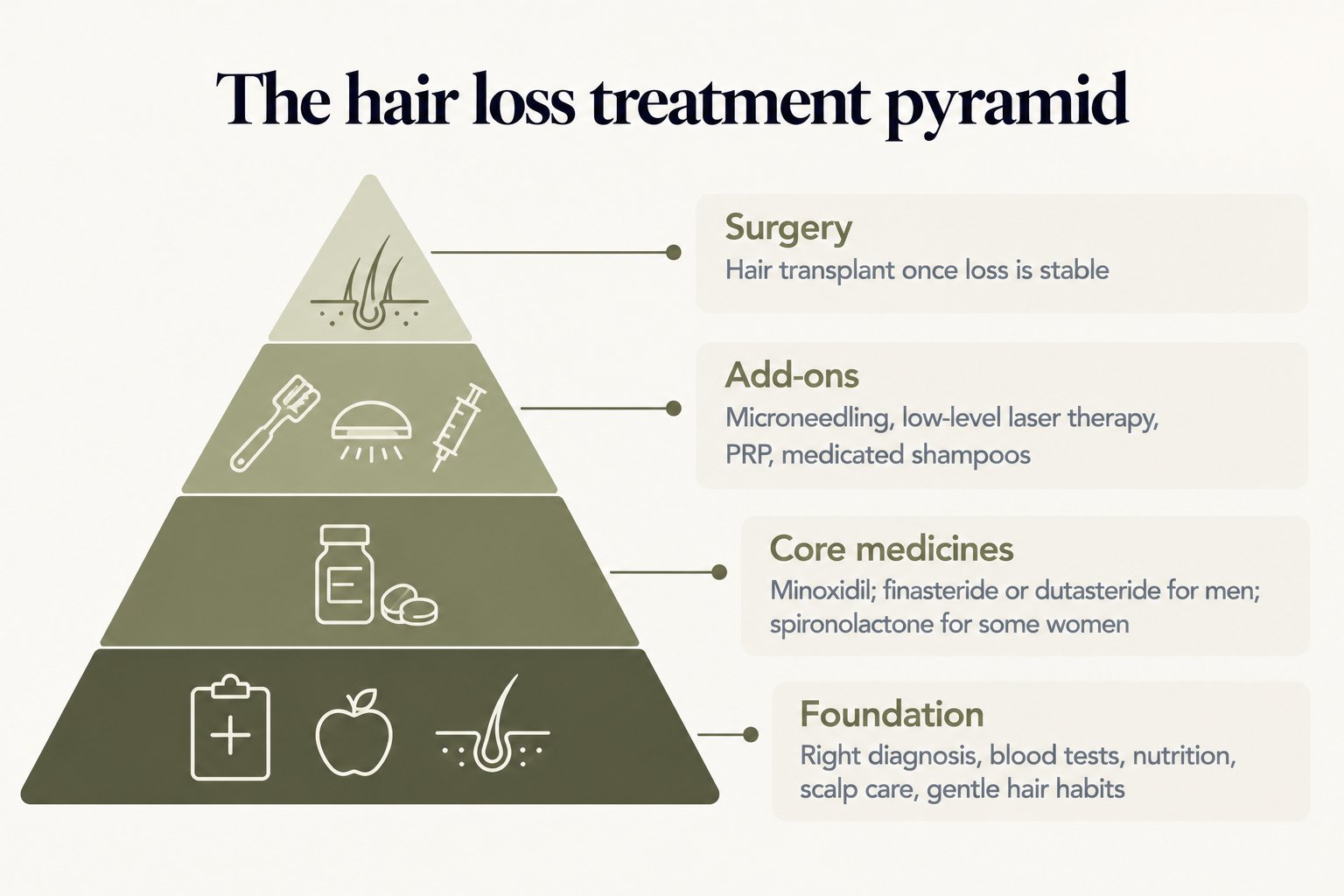
If you want to boost results, or can't use a core treatment, add options with reasonable evidence:
- Microneedling with minoxidil: the best-supported procedure add-on (see Low-Level Laser Therapy and Microneedling for Hair Loss).
- Low-level laser therapy: a modest benefit, mainly for early to moderate loss.
- PRP: may add some benefit, but evidence is low certainty and it requires ongoing sessions (see PRP for Hair Loss).
- Medicated shampoos: ketoconazole or zinc pyrithione two to three times a week (see Hair Supplements, Shampoos and Oils).
- Natural options: rosemary oil or pumpkin seed oil if you want to try them, with realistic expectations.
Avoid biotin and "hair vitamins" unless a blood test shows a deficiency.
When to consider surgery. A hair transplant is worth considering when pattern hair loss has stabilised on treatment, there's enough donor hair, and you want to restore areas that medicines can't regrow (see Hair Transplant Surgery). Continue medical treatment afterwards to protect the hair that wasn't transplanted.
Step 5: Track and adjust
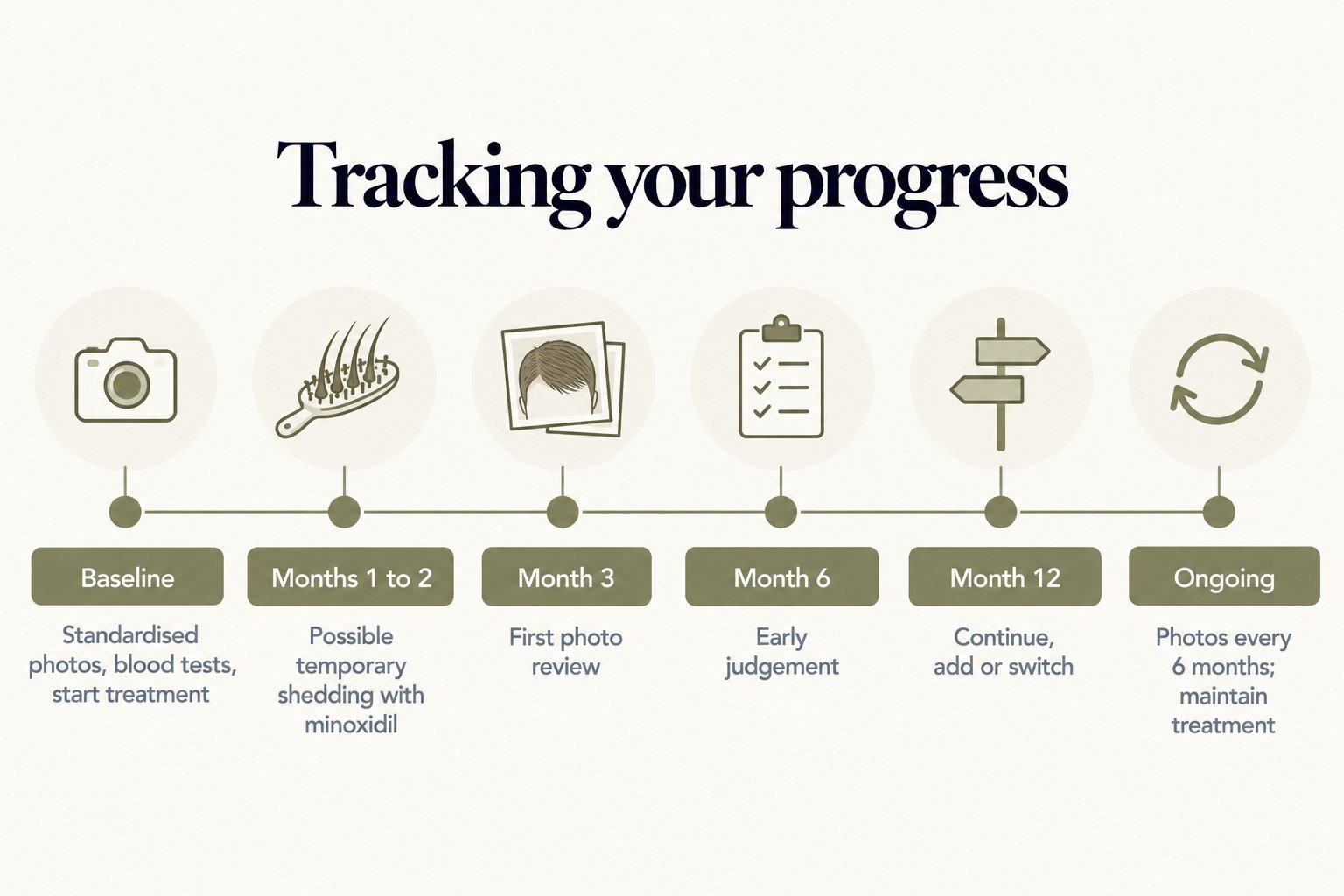
- Take baseline photos of your hairline, crown and parting in the same lighting, angle and hair length.
- Repeat every 3 to 6 months. Gradual change is very hard to judge in the mirror.
- Expect early shedding in the first two months of minoxidil; it's usually a sign the treatment is working.
- Judge at 6 to 12 months: if there's improvement or stabilisation, continue. If not, review the diagnosis, check adherence and consider adding or switching treatments.
- Review side effects at each visit, including mood, sexual function, blood pressure and swelling where relevant.
- Plan for the long term: most treatments for pattern hair loss need to continue indefinitely to keep their benefit.
Example plans
These are illustrations, not prescriptions. Your doctor will tailor them to you.
A man in his 20s with early temple recession.
- Confirm pattern hair loss; check smoking, diet and family history.
- Start oral finasteride 1 mg and topical 5% minoxidil.
- Add ketoconazole shampoo if there's dandruff.
- Photos every 3 to 6 months; consider microneedling if progress is slow at 12 months.
- Avoid a hair transplant until loss is stable.
A man in his 40s with crown thinning.
- Check cardiovascular risk factors as well: crown balding has been linked to heart disease.
- Finasteride plus topical or low-dose oral minoxidil.
- Consider dutasteride if finasteride isn't enough after 12 months.
- Consider a transplant assessment if the front is also bald and loss has stabilised.
A woman in her 30s with a widening parting and irregular periods.
- Blood tests for iron, thyroid, vitamin D and hormones; assess for PCOS.
- Treat any deficiency.
- Topical minoxidil, or low-dose oral minoxidil.
- Consider spironolactone with reliable contraception if androgens are raised or progress is slow.
A woman after menopause with diffuse thinning.
- Blood tests for iron, thyroid and vitamin D.
- Topical or low-dose oral minoxidil.
- Consider spironolactone, or finasteride in selected cases, after discussing risks.
- Check for frontal fibrosing alopecia if the hairline is receding or eyebrows are thinning.
Sudden shedding after dengue, childbirth or a crash diet.
- Identify the trigger and correct any deficiency, especially iron.
- Eat enough protein and energy.
- Wait: shedding usually settles within 6 to 9 months.
- See a doctor if it lasts beyond 6 months or your hair doesn't recover within a year, as pattern hair loss may be emerging.
Common mistakes
- Starting too late: waiting until hair is mostly gone limits what medicines can achieve.
- Stopping too early: most treatments take 6 to 12 months to show their full effect.
- Stopping when it works: benefits are usually lost within months to a year of stopping.
- Relying on supplements, oils or shampoos instead of proven treatments.
- Skipping the diagnosis: treating alopecia areata or scarring alopecia as pattern hair loss can lead to permanent loss.
- Choosing surgery first: a transplant without medical treatment often leaves an unnatural result as surrounding hair continues to thin.
- Choosing a clinic on price: especially for surgery, ask who performs each step.
Why this matters for longevity
Hair loss is common, and for many people it affects confidence and wellbeing for decades. A structured plan makes the most of treatments that work, avoids wasting time and money on those that don't, and uncovers treatable health problems such as iron deficiency, thyroid disease, PCOS and cardiovascular risk along the way. Like any long-term health habit, the best results come from starting early, staying consistent and reviewing progress with a doctor.
Recommendations
- See a doctor early if you notice thinning, sudden shedding, patches or scalp symptoms.
- Get a diagnosis and blood tests before spending money on treatments.
- Start evidence-based treatment early for pattern hair loss: minoxidil for everyone, finasteride for most men.
- Combine treatments for better results, and add procedures only if needed.
- Track progress with standardised photos and judge at 6 to 12 months.
- Plan for the long term, and review side effects and your goals at least once a year.
Practical notes
Start with a diagnosis, fix what's making your hair loss worse, then begin the treatments with the strongest evidence. For pattern hair loss, that's minoxidil, with finasteride for most men. Take photos before you start and every few months after, and give treatment at least 6 to 12 months. Add microneedling, laser or PRP only if you want extra benefit and can commit to them, and consider a transplant only once hair loss is stable. Be wary of products and clinics promising quick or dramatic results. Remember that sudden shedding after dengue, childbirth or a crash diet usually recovers on its own, while patches, scalp pain or shiny skin need prompt assessment. Our Longevity Doctors can diagnose the type of hair loss, arrange the right blood tests, build a personalised treatment plan, and monitor your progress and safety over time, starting with the free longevity assessment.
- Kanti V, et al. Evidence-based (S3) guideline for the treatment of androgenetic alopecia in women and in men: short version. Journal of the European Academy of Dermatology and Venereology, 2018;32(1):11-22.
- Hu R, et al. Combined treatment with oral finasteride and topical minoxidil in male androgenetic alopecia: a randomized and comparative study in Chinese patients. Dermatologic Therapy, 2015;28(5):303-308.
- Propecia (finasteride 1 mg) prescribing information: clinical studies.
- DermNet. Telogen effluvium; Female pattern hair loss; Alopecia areata. dermnetnz.org.
- Yamada T, et al. Male pattern baldness and its association with coronary heart disease: a meta-analysis. BMJ Open, 2013;3(4):e002537.
- International Society of Hair Restoration Surgery. 2022 Practice Census Results and Fight the FIGHT campaign.
Free longevity assessment
Want a personalised
hair loss treatment plan?
Take the free Aevum Protocol assessment to see how your skin & longevity and 6 other longevity domains are performing — and get a personalised 90-day plan.
Take the free assessmentKeep reading