Skin & Longevity
Hair Supplements, Shampoos and Oils:
Ketoconazole, Rosemary Oil, Saw Palmetto and More
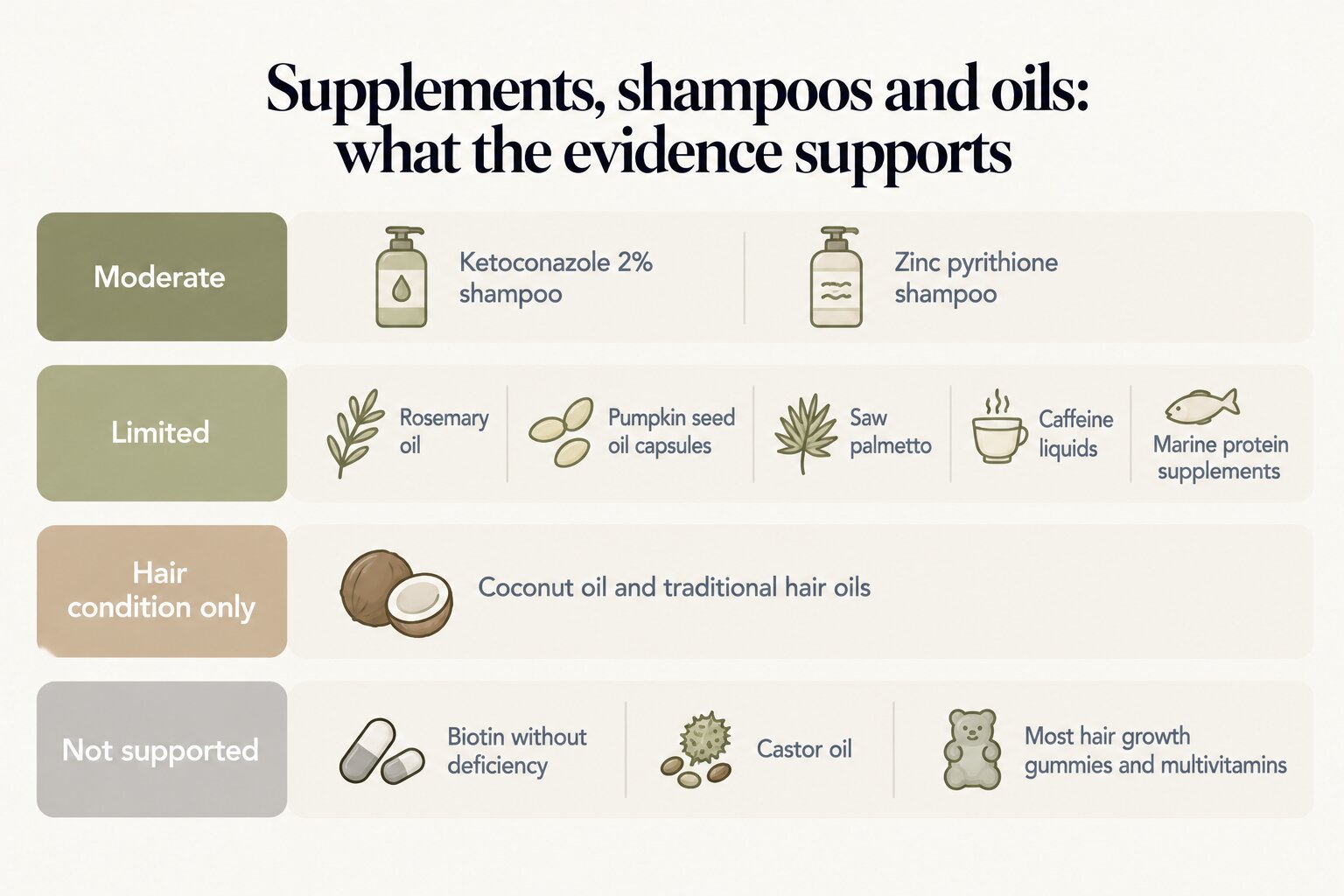
Hair supplements, shampoos and oils are a huge market, but most products promise far more than the evidence supports. A few have genuine, if modest, research behind them. Ketoconazole 2% shampoo, an anti-dandruff treatment, has small studies suggesting it may help pattern hair loss, and zinc pyrithione shampoo produced a modest increase in hair count in a trial of 200 men. Among natural options, rosemary oil matched a weak minoxidil solution in one trial of 100 men, and pumpkin seed oil capsules increased hair counts by about 40% vs 10% with placebo in a trial of 76 men. Saw palmetto, a plant extract that weakly blocks DHT, helped 38% of men in a two-year study, compared with 68% on finasteride. Caffeine liquids may support the growth phase of hair. But none of these comes close to the proven treatments, most studies are small, short, unrepeated or funded by manufacturers, and biotin and most "hair vitamins" don't help unless you're deficient. Coconut oil, widely used in Sri Lanka, protects the hair shaft from damage but doesn't affect hair growth. This article explains what each option can and can't do, and how to use them sensibly alongside proven treatments.
Key numbers
| Finding | Detail |
|---|---|
| Rosemary oil vs minoxidil solution (100 men, 6 months) | Similar increase in hair count; less scalp itch with rosemary |
| Pumpkin seed oil capsules (76 men, 24 weeks) | Hair count up about 40% vs 10% with placebo |
| Saw palmetto vs finasteride (100 men, 2 years) | 38% improved vs 68% |
| Zinc pyrithione shampoo (200 men, 26 weeks) | Increase a little under half that of 5% minoxidil |
| Caffeine liquid vs 5% minoxidil (210 men, 6 months) | Similar improvement in growing hairs (11% vs 12%); manufacturer-funded |
| Nutritional supplements review (30 studies, 20 interventions) | Promising but not definitive evidence; many studies small or industry-funded |
Where products act
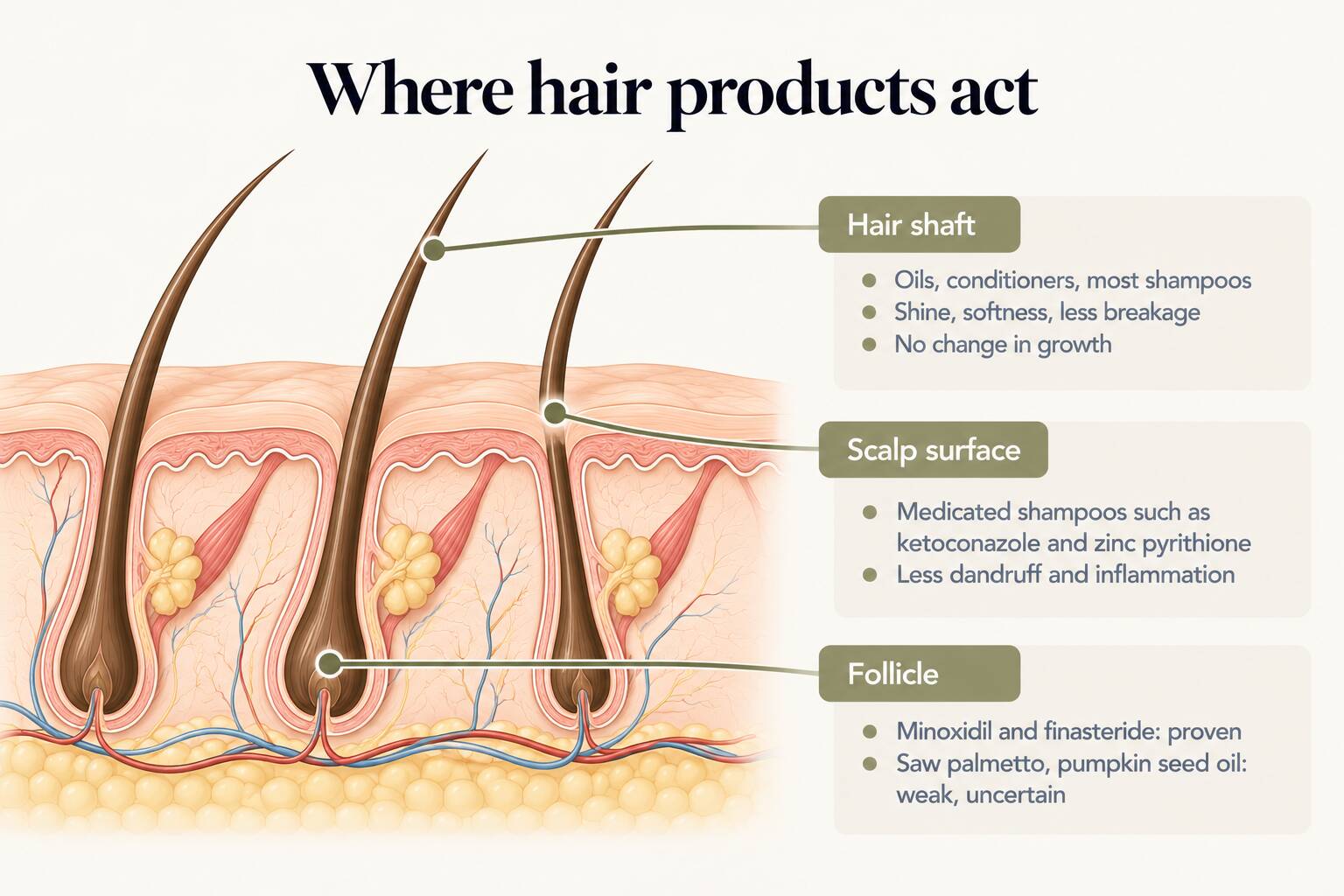
It helps to know which part of the hair each product targets:
- The hair shaft: the visible hair. Oils, conditioners and many shampoos act here, improving shine, softness and resistance to breakage. They can make hair look thicker but don't change how many hairs grow (see How Hair Grows and Ages).
- The scalp surface: medicated shampoos such as ketoconazole and zinc pyrithione reduce dandruff, yeast and inflammation, which may create a healthier environment for follicles.
- The follicle: proven treatments such as minoxidil and finasteride act here, changing the hair cycle or blocking DHT. A few natural products, such as saw palmetto and pumpkin seed oil, may have weak effects on this level.
The options compared
| Product | Claimed effect | Best evidence | Cautions | Verdict |
|---|---|---|---|---|
| Ketoconazole 2% shampoo | Anti-inflammatory; may weakly block androgens on the scalp | Small studies show improved density and hair thickness | Dryness; use 2 to 3 times a week | Reasonable add-on |
| Zinc pyrithione 1% shampoo | Anti-dandruff; may support growth | One trial of 200 men: modest increase in hair count | Few | Reasonable add-on |
| Caffeine liquid or shampoo | Supports the growth phase | One open, manufacturer-funded trial; shampoos have very short contact time | Few | Limited |
| Rosemary oil | Increases blood flow; may weakly block DHT | One trial of 100 men vs a weaker minoxidil solution; no placebo | Dilute before use; can irritate skin | Limited |
| Pumpkin seed oil capsules | May weakly block DHT | One trial of 76 men vs placebo | Mild stomach upset | Limited |
| Saw palmetto | Weak DHT blocker | One 2-year comparison: less effective than finasteride | Possible sexual side effects; avoid in pregnancy | Limited |
| Marine protein supplements | Provide nutrients for hair growth | Studies mostly small, manufacturer-funded and poorly controlled | Bloating; cost | Limited |
| Biotin and "hair vitamins" | Strengthen and grow hair | No benefit without deficiency | Distorts blood tests at high doses | Not supported |
| Coconut oil | Nourishes hair | Reduces protein loss from the hair shaft | Can worsen dandruff in some people | Good for hair condition, not growth |
| Onion juice | Stimulates regrowth | One small study in alopecia areata, not repeated | Smell, irritation | Very limited |
| Castor oil, other herbal oils | Thicker hair | No reliable human studies | Irritation or allergy | Not supported |
What the research shows
Medicated shampoos
Ketoconazole 2% is an antifungal shampoo used for dandruff and seborrhoeic dermatitis. In a 1998 study, 27 men using it two to four times a week for 21 months had increased hair density compared with an unmedicated shampoo, and a tiny comparison of 8 men found a similar 7% increase in hair thickness with ketoconazole and once-daily 2% minoxidil. The studies were small, and it's thought to work partly by reducing scalp inflammation and possibly by a weak anti-androgen effect.
Zinc pyrithione 1% shampoo was tested in a 2003 trial of 200 men. Used daily for 26 weeks, it produced a significant increase in visible hair count compared with placebo shampoo, a little under half the increase seen with 5% minoxidil, and adding it to minoxidil gave no extra benefit.
Caffeine. In an open-label trial of 210 men, a 0.2% caffeine liquid applied twice daily improved the proportion of growing hairs by about 11%, compared with about 12% with 5% minoxidil, meeting the researchers' test for non-inferiority. But the trial wasn't blinded, measured hair growth phase rather than hair count, and was funded by the product's manufacturer. Caffeine shampoos are rinsed off within minutes, so they're unlikely to have the same effect as leave-on liquids.
Rosemary oil. A 2015 trial randomised 100 men with pattern hair loss to rosemary oil or minoxidil solution for six months. Neither group improved at three months; both had a significant increase in hair count at six months, with no significant difference between them, and scalp itching was more common with minoxidil. But the comparison was the weaker strength of minoxidil, there was no placebo group, and the result hasn't been independently repeated. Rosemary oil is a reasonable option for people who want a natural add-on, but not a substitute for proven treatment.
Pumpkin seed oil. In a 2014 randomised, double-blind trial, 76 men with mild to moderate pattern hair loss took 400 mg of pumpkin seed oil daily or placebo for 24 weeks. Hair counts rose by about 40% with pumpkin seed oil, compared with about 10% with placebo, and side effects were no different. It's a single, small study, but one of the better-designed trials of a natural product.
Saw palmetto. Saw palmetto, a palm berry extract, weakly inhibits 5-alpha reductase. In a 2012 study of 100 men over two years, 320 mg daily improved hair in 38% of men, compared with 68% on finasteride 1 mg, and helped mainly at the crown. A 2023 systematic review in JAMA Dermatology concluded saw palmetto may stabilise hair loss but is likely less effective than finasteride, and noted it may also cause sexual side effects, though less often.
Marine protein and other supplements. The same review analysed 30 studies of 20 nutritional supplements. Several showed promising results, but most studies were small, included mixed types of hair loss or had inadequate controls. Marine protein supplements appeared to help, but the studies were manufacturer-funded and poorly controlled. The authors described the evidence as promising but not definitive. Biotin has no good evidence of benefit without deficiency and can distort blood tests (see Hair Loss, Blood Tests and Nutrition).
Coconut oil and traditional oils. In a 2003 laboratory study, coconut oil was the only one of three oils tested (with sunflower and mineral oil) that markedly reduced protein loss from hair, whether used before or after washing. Its main fat, lauric acid, is small and straight enough to penetrate the hair shaft. This makes coconut oil a good conditioner that helps prevent breakage, but there's no evidence it affects how hair grows. The same applies to most traditional and herbal hair oils: they can improve how hair looks and feels, but haven't been shown in reliable human trials to treat hair loss.
Onion juice. A 2002 study of 38 people with alopecia areata found regrowth in 87% of those who applied onion juice twice daily for two months, compared with 13% using tap water. It was small and hasn't been repeated, and alopecia areata often regrows on its own (see Alopecia Areata).
How to use them
If you want to add something.
- Ketoconazole 2% shampoo: use 2 to 3 times a week. Lather and leave on the scalp for 3 to 5 minutes before rinsing. Use a gentle shampoo and conditioner on other days, as it can be drying.
- Rosemary oil: always dilute essential oil in a carrier oil, such as a few drops in a tablespoon of coconut or jojoba oil. Test on a small patch of skin first. Massage into the scalp and leave on for a few hours or overnight, then wash out. Stop if it irritates.
- Pumpkin seed oil: the trial used 400 mg a day in capsules. Choose products from reputable manufacturers.
- Saw palmetto: typically 320 mg a day. Discuss with your doctor first if you take other medicines, are planning a pregnancy or have prostate problems, and avoid it if you're pregnant.
- Coconut oil: apply to the lengths of the hair before washing to reduce breakage. If you have dandruff, avoid applying heavy oils to the scalp.
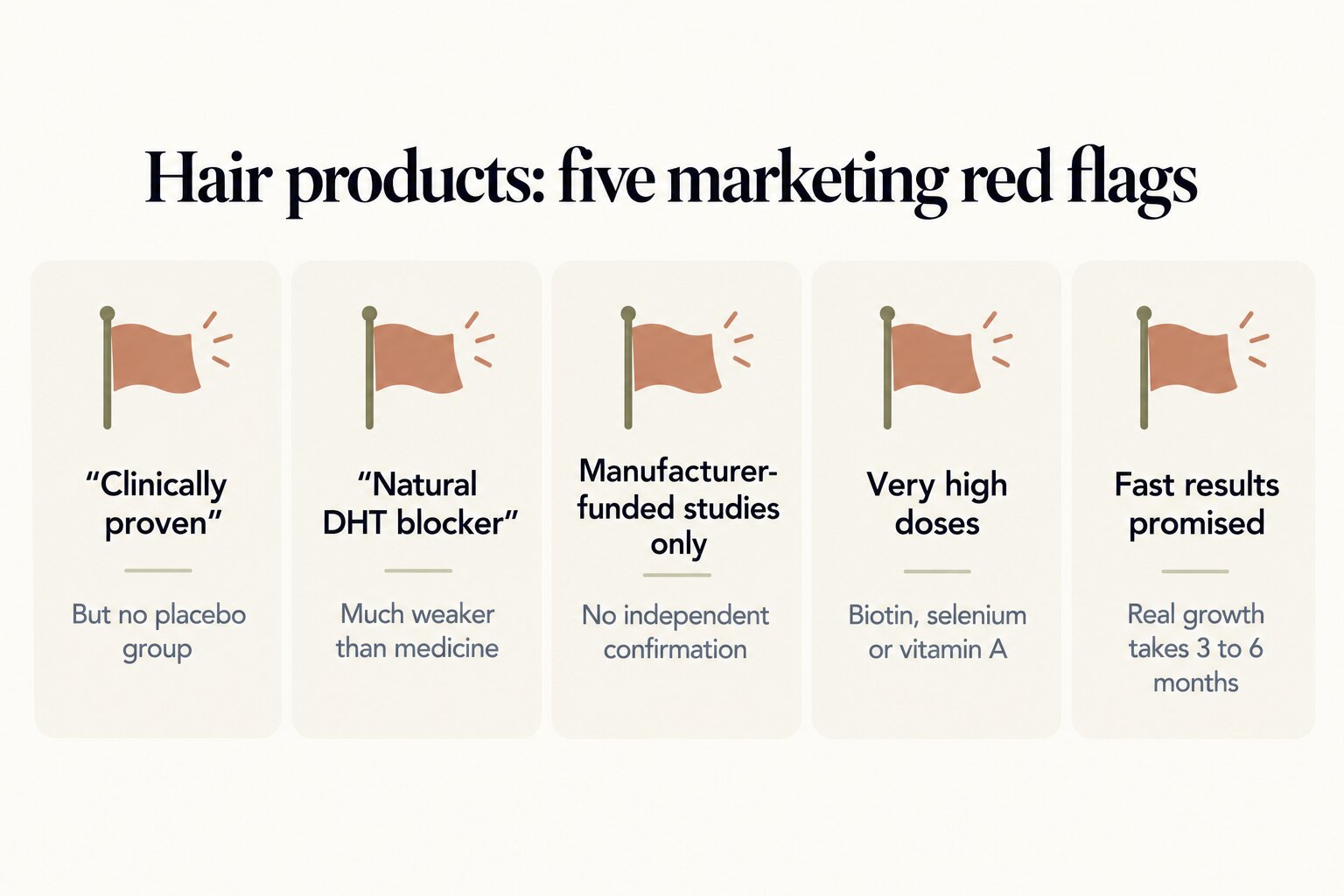
Spotting marketing tricks.
- "Clinically proven": ask what the study compared against. Many have no placebo group.
- "Natural DHT blocker": natural products are, at best, much weaker than finasteride.
- Manufacturer-funded studies with before-and-after photos but no independent confirmation.
- Very high doses of biotin, selenium or vitamin A, which can cause harm.
- Promises of fast results: genuine hair growth takes 3 to 6 months to appear.
Why this matters for longevity
Spending months on products that don't work delays effective treatment, and with pattern hair loss, time matters: follicles that have shrunk for years are much harder to recover. Some supplements can also cause harm, from misleading blood test results with biotin to toxicity with selenium or vitamin A. Choosing products based on evidence protects your hair, your health and your money.
Recommendations
By goal.
- Pattern hair loss: use proven treatments first: minoxidil and, for men, finasteride (see Minoxidil and Finasteride and Dutasteride). Ketoconazole shampoo is a reasonable add-on.
- Prefer to avoid medicines: rosemary oil or pumpkin seed oil are low-risk options, but expect smaller and less certain benefits, and review progress with photos after 6 months.
- Dandruff or an itchy scalp with thinning: ketoconazole or zinc pyrithione shampoo, as scalp inflammation can worsen shedding.
- Breakage and dry hair: coconut oil, gentle conditioners and less heat styling.
- Considering supplements: test for deficiencies first, and correct those rather than taking general "hair vitamins" (see Hair Loss, Blood Tests and Nutrition).
Practical notes
Coconut oil and traditional herbal oils are part of hair care in many Sri Lankan homes. They're good for keeping hair soft and strong, but they won't stop pattern hair loss or regrow hair. If your hair is thinning, see a doctor before spending money on supplements and specialist shampoos, and use the evidence-based options first. A medicated shampoo such as ketoconazole two or three times a week is a sensible, low-cost addition. If you'd like to try rosemary oil, always dilute it and test it on a small area first. Be wary of products promising fast or dramatic results, and of high-dose biotin, selenium or vitamin A. Whatever you use, take photos every 3 to 6 months to see whether it's actually working. Our Longevity Doctors can identify the type of hair loss, check for deficiencies and help you build a plan that combines proven treatments with sensible add-ons, starting with the free longevity assessment.
- Panahi Y, et al. Rosemary oil vs minoxidil 2% for the treatment of androgenetic alopecia: a randomized comparative trial. SKINmed, 2015;13(1):15-21.
- Cho YH, et al. Effect of pumpkin seed oil on hair growth in men with androgenetic alopecia: a randomized, double-blind, placebo-controlled trial. Evidence-Based Complementary and Alternative Medicine, 2014;2014:549721.
- Rossi A, et al. Comparative effectiveness of finasteride vs Serenoa repens in male androgenetic alopecia: a two-year study. International Journal of Immunopathology and Pharmacology, 2012;25(4):1167-1173.
- Piérard-Franchimont C, et al. Ketoconazole shampoo: effect of long-term use in androgenic alopecia. Dermatology, 1998;196(4):474-477.
- Berger RS, et al. The effects of minoxidil, 1% pyrithione zinc and a combination of both on hair density: a randomized controlled trial. British Journal of Dermatology, 2003;149(2):354-362.
- Dhurat R, et al. An open-label randomized multicenter study assessing the noninferiority of a caffeine-based topical liquid 0.2% versus minoxidil 5% solution in male androgenetic alopecia. Skin Pharmacology and Physiology, 2017;30(6):298-305.
- Drake L, et al. Evaluation of the safety and effectiveness of nutritional supplements for treating hair loss: a systematic review. JAMA Dermatology, 2023;159(1):79-86.
- Rele AS, Mohile RB. Effect of mineral oil, sunflower oil, and coconut oil on prevention of hair damage. Journal of Cosmetic Science, 2003;54(2):175-192.
- Sharquie KE, Al-Obaidi HK. Onion juice (Allium cepa L.), a new topical treatment for alopecia areata. Journal of Dermatology, 2002;29(6):343-346.
Free longevity assessment
Not sure which hair products
are worth your money?
Take the free Aevum Protocol assessment to see how your skin & longevity and 6 other longevity domains are performing — and get a personalised 90-day plan.
Take the free assessment