Skin & Longevity
PRP for Hair Loss:
What Platelet-Rich Plasma Can and Can't Do
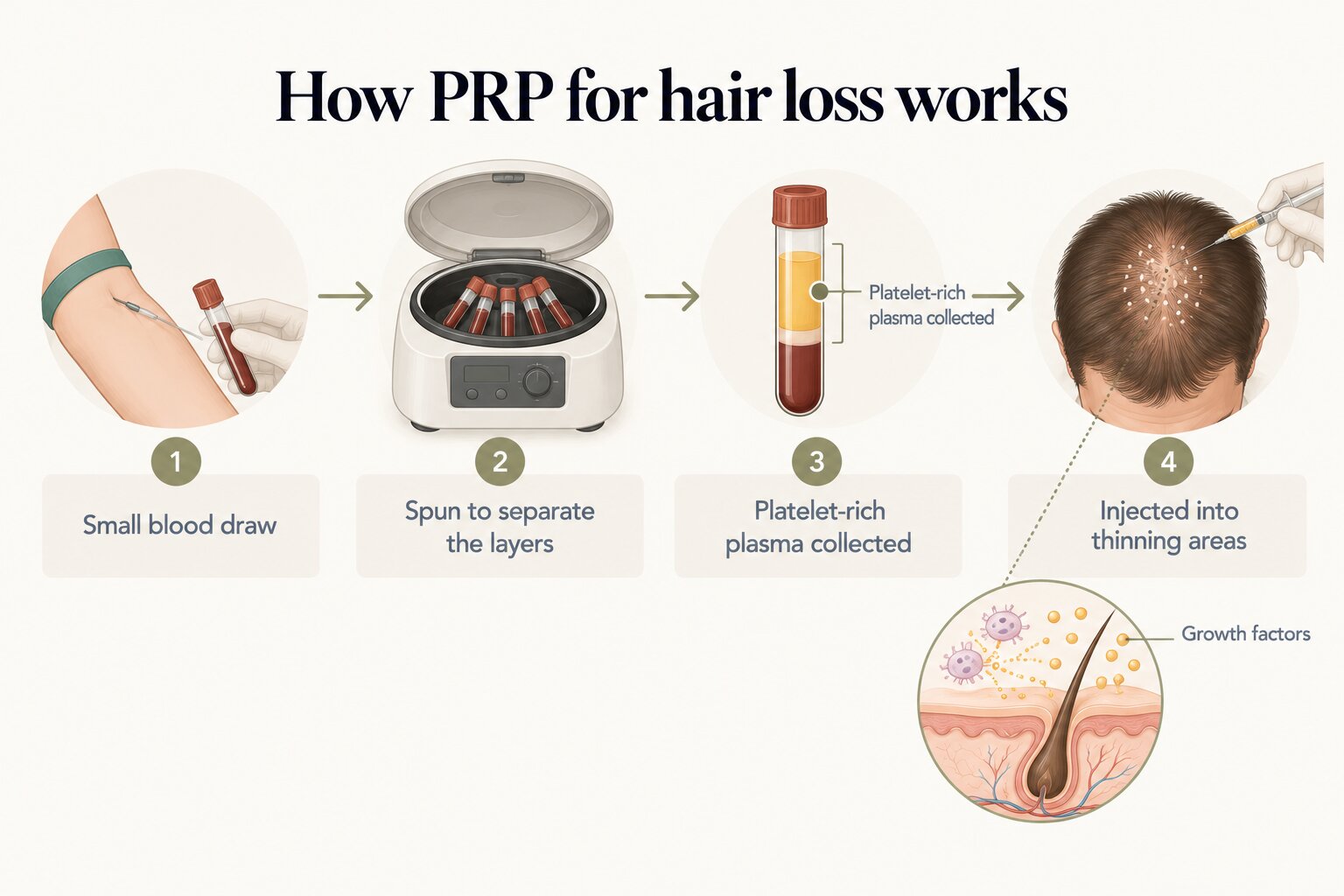
Platelet-rich plasma (PRP) is one of the most popular clinic treatments for thinning hair. A small amount of your own blood is drawn, spun in a centrifuge to concentrate the platelets, and injected into the scalp. Platelets release growth factors that may stimulate follicles, lengthen the growing phase of the hair cycle and improve blood supply. The evidence is encouraging but uncertain. A 2024 meta-analysis of 13 randomised trials found PRP increased hair density by about 28 hairs per square centimetre compared with controls, but rated the evidence as low certainty because the studies were small, varied widely in how PRP was prepared and showed very different results. Some well-designed trials found no clear difference from saline injections. PRP works best for early to moderate pattern hair loss, as an add-on to proven treatments such as minoxidil and finasteride, rather than on its own or for areas that are already bald. A typical course is three monthly sessions followed by maintenance every three to six months, and it isn't usually covered by insurance. This article explains how PRP works, what the research shows, what to expect and how to choose a clinic.
Key numbers
| Finding | Detail |
|---|---|
| PRP vs control (2024 meta-analysis, 13 trials) | About 28 more hairs per cm²; low-certainty evidence |
| PRP added to minoxidil (5 trials) | About 18 to 22 more hairs per cm² at 3 to 6 months; low to very low certainty |
| Split-scalp trial vs saline (35 people, 2020) | Both sides improved; difference not significant |
| Typical course | 3 monthly sessions, then every 3 to 6 months |
| Time to see results | Usually 3 to 6 months |
| Main side effects | Temporary pain, swelling, bruising, mild headache |
How it works
Making PRP.
- Blood draw: a small volume of blood is taken from your arm, as for a routine blood test. The amount depends on the kit used.
- Centrifuge: the blood is spun to separate red cells from the plasma. The layer richest in platelets is collected. Some methods spin once, others twice, and some add an "activator" such as calcium.
- Injection: the PRP is injected into the thinning areas of the scalp through many small injections, usually after numbing cream or other pain relief.
What it may do. Platelets contain growth factors, signalling proteins involved in healing and tissue repair. In the scalp, they're thought to:
- Stimulate follicle stem cells and support new hair growth.
- Prolong the growing phase of the hair cycle (see How Hair Grows and Ages).
- Help reverse follicle shrinkage in pattern hair loss.
- Improve blood supply around follicles.
PRP doesn't block DHT, the hormone that drives pattern hair loss, so it doesn't address the underlying cause in the way finasteride does (see Finasteride and Dutasteride).
What the research shows
Pattern hair loss. A 2024 meta-analysis in Anais Brasileiros de Dermatologia pooled 13 randomised trials and found that PRP increased hair density by an average of about 28 hairs per cm² compared with controls. But results varied enormously between studies, publication bias was likely, and the authors rated the certainty of evidence as low. A 2023 meta-analysis of 9 trials and 238 patients also found higher hair density with PRP at 3 and 6 months, with no serious side effects.
Not every good trial agrees. In a 2020 study in the Journal of the American Academy of Dermatology, 35 people received PRP on one side of the scalp and saline on the other, monthly for three months. Hair density rose by about 20 hairs per cm² on the PRP side, but also by about 16 on the saline side, and the difference wasn't significant.
Why the studies disagree.
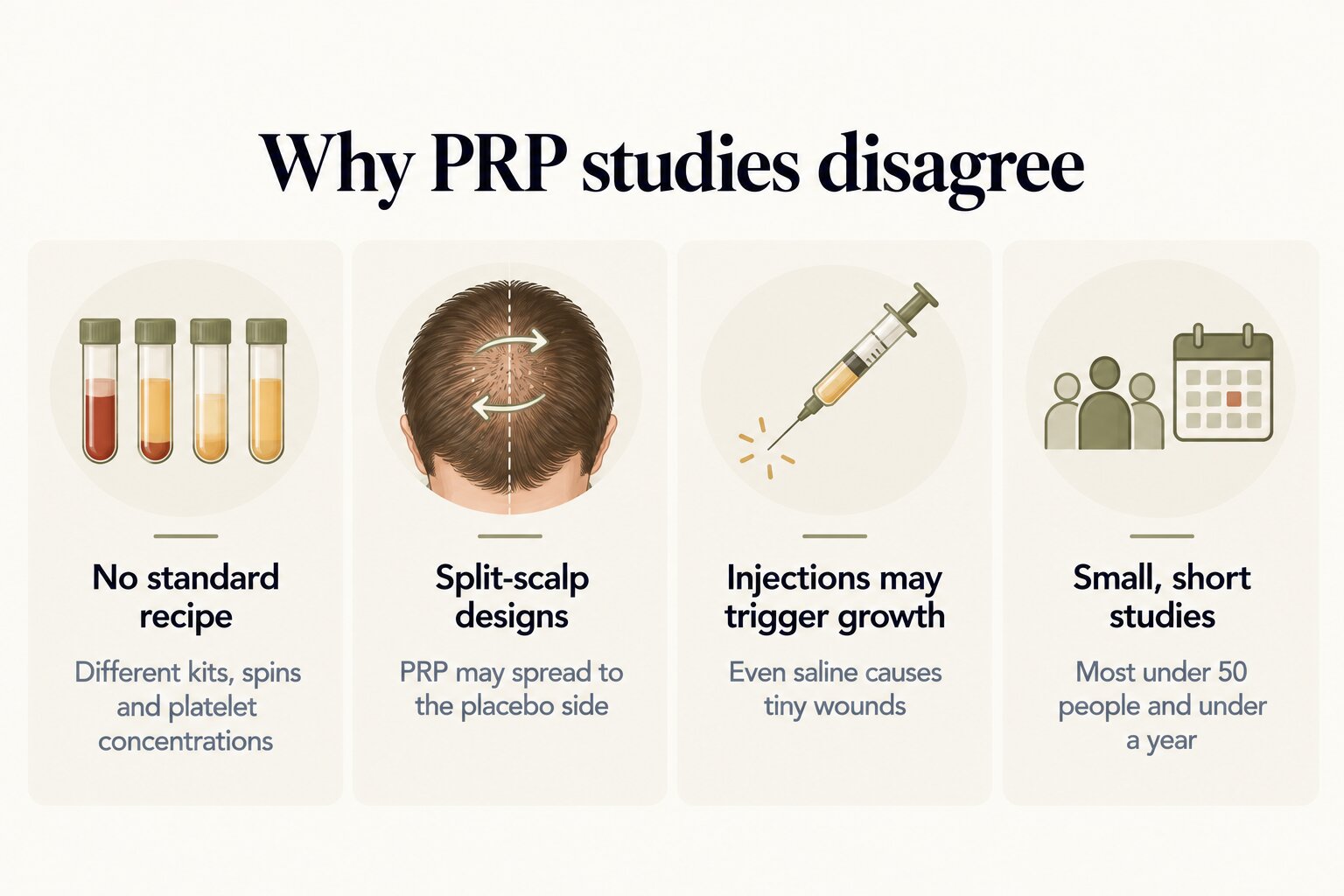
- No standard recipe: studies used different kits, spin speeds, platelet concentrations, activation methods, injection volumes and schedules.
- Split-scalp designs: in many trials, one side of the head receives PRP and the other a placebo. A 2022 analysis found that placebo sides in these trials gained about 37 more hairs per cm² than placebo groups in whole-head trials, suggesting PRP spreads across the scalp and makes the treatment look less effective.
- Injections themselves may stimulate growth: even saline injections cause tiny wounds, which may trigger some regrowth.
- Small numbers: most trials included fewer than 50 people and lasted under a year.
PRP with other treatments. A 2024 meta-analysis of 5 randomised trials found that adding PRP to topical minoxidil increased hair density more than minoxidil alone: by about 22 hairs per cm² at 3 months and 18 at 5 to 6 months, with similar side effects. The evidence was rated low to very low certainty, as most trials had a high risk of bias. PRP is also sometimes used around hair transplant surgery to support graft healing and growth, and alongside microneedling (see Low-Level Laser Therapy and Microneedling for Hair Loss).
Other types of hair loss. Small studies have explored PRP for alopecia areata and female pattern hair loss, with mixed results. It isn't an established treatment for alopecia areata, where steroid injections and JAK inhibitors have much stronger evidence (see Alopecia Areata). PRP doesn't help scarring alopecia, where the follicles have been destroyed.
Evidence strength
- Increasing hair density in early to moderate pattern hair loss: moderate benefit, low-certainty evidence.
- As an add-on to minoxidil: possible additional benefit, low to very low certainty.
- On its own as a replacement for minoxidil or finasteride: not supported.
- For bald areas, scarring alopecia or advanced hair loss: not supported.
- Safety: good; side effects are mostly minor and temporary.
What to expect
| Aspect | What to expect |
|---|---|
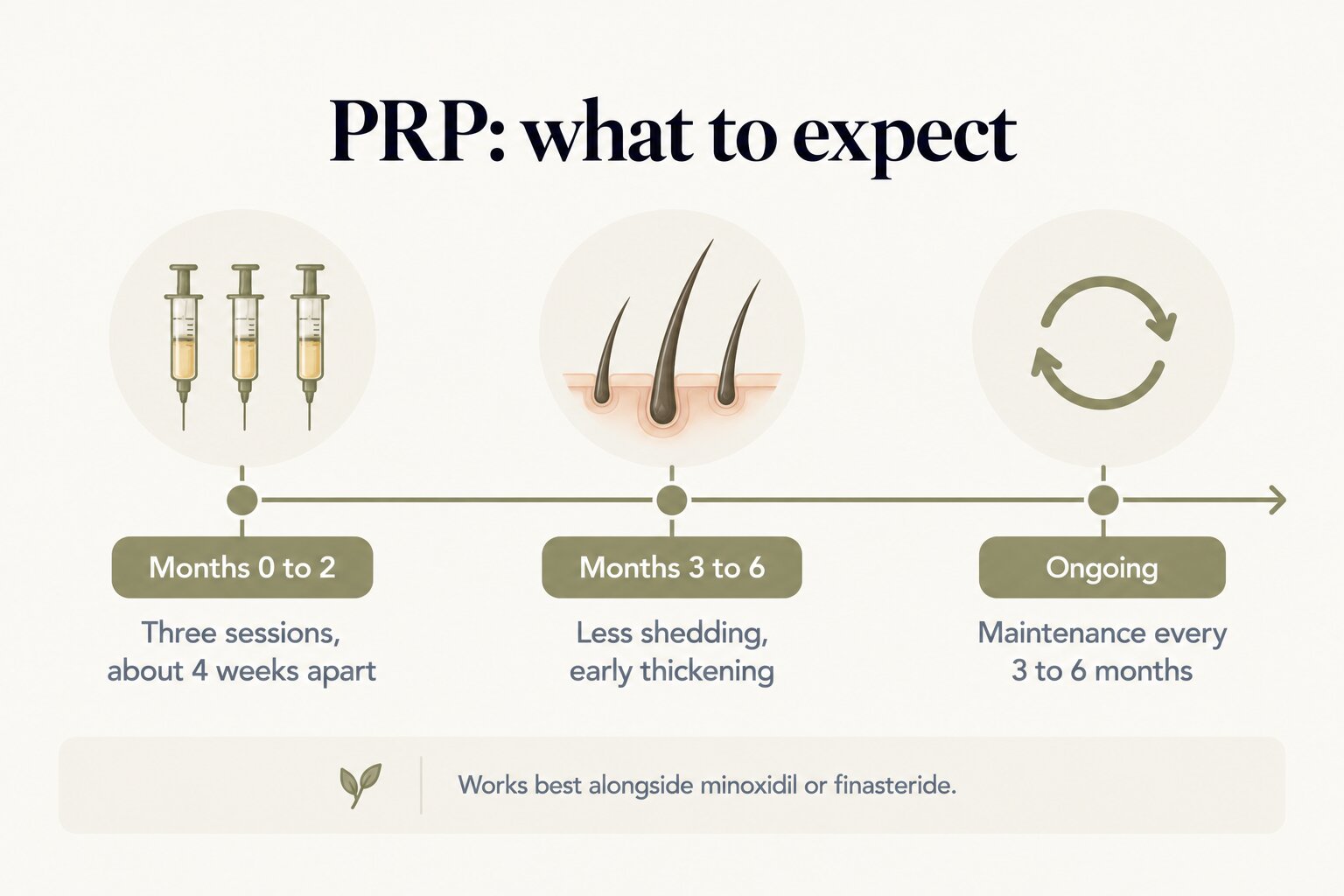
| Sessions | Usually 3 sessions, about 4 weeks apart |
| Each session | About 45 to 90 minutes, including blood draw and preparation |
| Pain | Moderate during injections; reduced with numbing cream, cooling or nerve blocks |
| Downtime | Little to none; mild swelling, tenderness or headache for 1 to 2 days |
| Results | Reduced shedding and early thickening at 3 to 6 months |
| Maintenance | Every 3 to 6 months to keep the benefit |
| Cost | Moderate to high per session, repeated long term; not usually covered by insurance |
Before and after a session.
- Don't take aspirin or anti-inflammatory painkillers such as ibuprofen for several days before and after, unless your doctor has prescribed them for a medical reason, as they may reduce platelet function. Paracetamol is usually fine.
- Arrive well hydrated and wash your hair on the day.
- Avoid washing your hair, swimming, saunas and strenuous exercise for about 24 hours afterwards.
- Continue your other hair loss treatments unless your doctor advises a short pause.
Who should avoid it.
- People with low platelets or platelet function disorders.
- People taking blood thinners.
- People with active scalp infection or skin disease at the injection sites.
- People with chronic liver disease or some systemic illnesses.
- People who are pregnant, or have active cancer, unless their specialist agrees.
How to choose a clinic
PRP is widely offered, including in Sri Lanka, but preparation methods and quality vary. Ask:
- Who performs it? A doctor experienced in hair loss should assess you first and confirm the diagnosis.
- How is the PRP prepared? A medical-grade kit and a centrifuge designed for PRP, with a sterile, single-use process.
- What's the plan? A clear number of sessions, how results will be measured (standardised photos, ideally hair counts) and when to stop if it isn't working.
- What else is recommended? A good clinic will combine PRP with proven treatments, not sell it as a stand-alone cure.
- Are the claims realistic? Be cautious of promises of dramatic regrowth or "growth factor" add-ons such as exosomes, which have even less evidence (see Exosomes, Growth Factors and Stem Cell Skincare).
Why this matters for longevity
PRP is a low-risk option that may help some people keep and thicken their hair. But because it requires repeated, costly sessions and the evidence is still uncertain, it's best used as part of a plan built on proven treatments, rather than in place of them. Choosing evidence-based care saves time and money, and makes it more likely that the follicles you still have will be protected.
Recommendations
- Early to moderate pattern hair loss, already on minoxidil or finasteride: PRP is a reasonable add-on if you want to try to boost results and can commit to maintenance.
- Can't use or tolerate medicines: PRP may help, but expect smaller and less predictable benefits.
- Before or after a hair transplant: discuss whether PRP is part of your surgeon's protocol (see Hair Transplant Surgery).
- Advanced baldness, scarring alopecia or untreated alopecia areata: PRP isn't the right treatment; see a dermatologist for alternatives.
- Judge it by results: take standardised photos before starting and after 6 months. If there's no improvement, stop.
Practical notes
PRP uses your own blood, so it's generally safe, but it's not a magic fix. It works best on thinning hair rather than bald areas, and alongside minoxidil and, for men, finasteride. Expect three monthly sessions, some discomfort during injections, results at 3 to 6 months and ongoing maintenance. Avoid aspirin and anti-inflammatory painkillers around treatment unless prescribed for a medical reason, and tell your doctor about any blood thinners or bleeding problems. Ask how the clinic prepares PRP and how it will measure your progress. Our Longevity Doctors can confirm the type of hair loss, check for underlying causes with blood tests and advise whether PRP is likely to be worthwhile for you, starting with the free longevity assessment.
- Kieling L, et al. Is autologous platelet-rich plasma capable of increasing hair density in patients with androgenic alopecia? A systematic review and meta-analysis of randomized clinical trials. Anais Brasileiros de Dermatologia, 2024;99(6):847-862.
- Zhang X, et al. Platelet-rich plasma for androgenetic alopecia: a systematic review and meta-analysis of randomized controlled trials. Journal of Cutaneous Medicine and Surgery, 2023.
- Shapiro J, et al. Evaluation of platelet-rich plasma as a treatment for androgenetic alopecia: a randomized controlled trial. Journal of the American Academy of Dermatology, 2020;83(5):1298-1303.
- Gupta AK, Bamimore MA. Analysis of placebo response in split-scalp vs whole-head trials of platelet-rich plasma for androgenetic alopecia. Journal of Cosmetic Dermatology, 2022.
- Yao J, et al. The additive value of platelet-rich plasma to topical minoxidil in the treatment of androgenetic alopecia: a systematic review and meta-analysis. PLOS ONE, 2024;19(8):e0308986.
- Shipp D. Can I use platelet-rich plasma to treat hair loss? Ohio State University Wexner Medical Center, 2024.
Free longevity assessment
Wondering whether PRP
is worth it for you?
Take the free Aevum Protocol assessment to see how your skin & longevity and 6 other longevity domains are performing — and get a personalised 90-day plan.
Take the free assessment