Skin & Longevity
Exosomes, Growth Factors
& Stem Cell Skincare: Separating Science From Hype
Our Peptides article covered a case where marketing claims outpaced the evidence for one specific ingredient. This article covers something more serious: a genuinely legitimate area of cell biology being sold commercially through products that, as of this writing, have essentially zero regulatory approval for the purposes they're marketed for — alongside a documented, growing record of safety concerns. This is the most important "read the fine print" article in this entire series.
Quick Summary
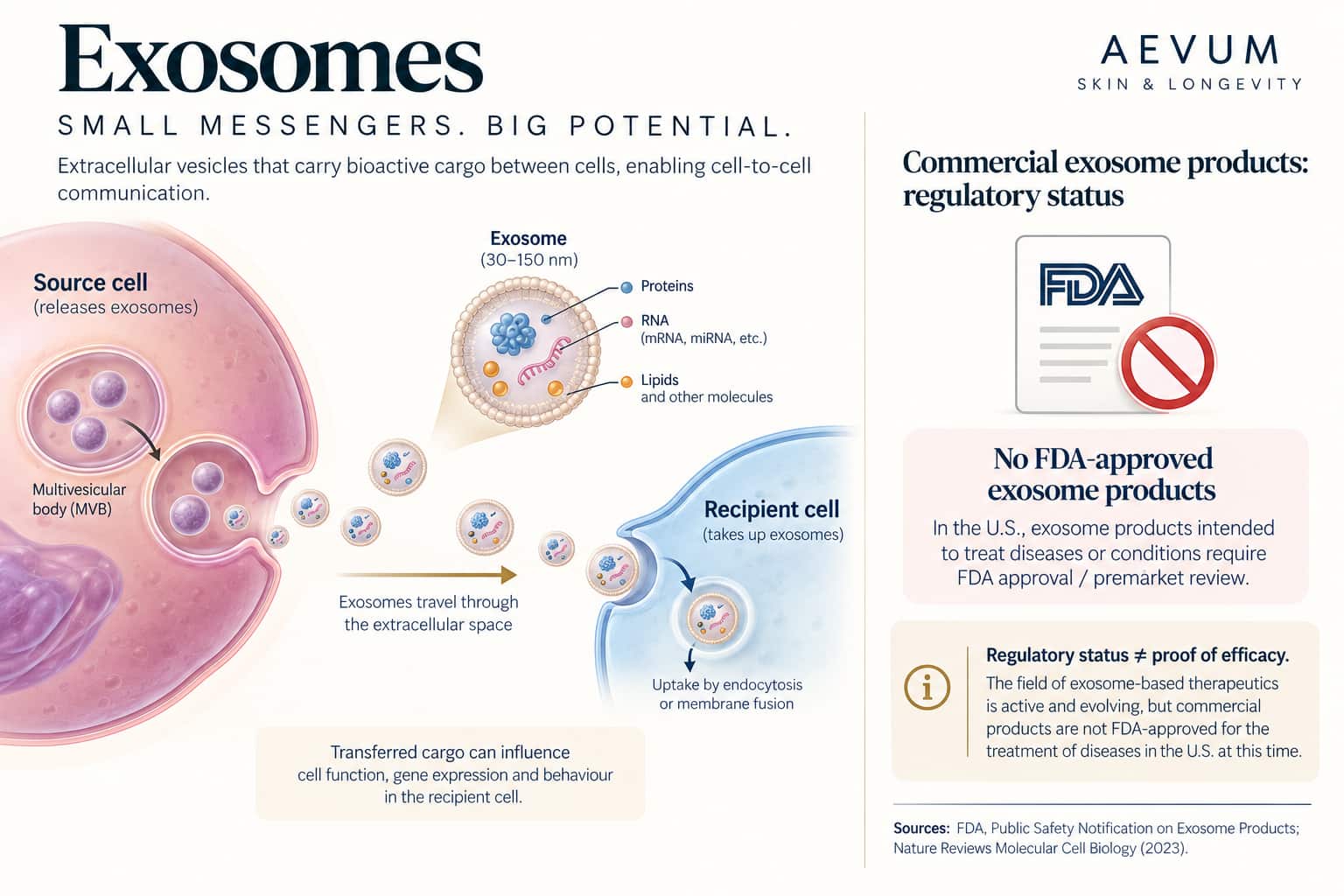
- →Exosomes are real, well-established extracellular vesicles (30-150 nanometres) that cells naturally use to communicate, carrying proteins, lipids, and genetic material to other cells — the underlying biology is genuinely legitimate, active scientific research
- →As of this writing, zero exosome products have received FDA approval for any therapeutic or cosmetic use, injectable or topical — this isn't a grey area or a matter of degree, but a direct, repeatedly confirmed regulatory fact
- →The FDA issued six public safety notifications and warning letters related to exosome products by October 2023 alone, following reports of serious adverse events including severe infections, allergic reactions, and tumour formation associated with unapproved products
- →A genuinely important, often-missed detail connects directly to our Skin Barrier and Microneedling articles: the FDA considers exosome application through skin compromised by microneedling to be systemic administration, not simple topical cosmetic use — meaning the "just apply it after microneedling" framing common in med-spas doesn't exempt it from drug regulation
- →Most "stem cell" skincare products don't actually contain living stem cells at all — topical formulations generally can't keep stem cells alive and functional in a jar, so these products typically contain stem cell-derived extracts or plant-derived compounds instead, a meaningful distinction the marketing language often obscures
Key numbers at a glance
| Measure | Figure |
|---|---|
| FDA-approved exosome products for cosmetic/therapeutic use | 0 |
| FDA public safety notifications/warning letters by October 2023 | 6 |
| Estimated annual exosome skincare market size | ~$251 million |
| Typical exosome size | 30-150 nanometres |
What these products actually are, and what's actually real
Exosomes are genuinely real, well-characterised biological structures. They're tiny extracellular vesicles released by cells, carrying proteins, lipids, and genetic material (including microRNA) that can influence signalling in the cells that receive them — a legitimate, actively-researched area of cell biology with real applications being studied in wound healing and tissue regeneration. The scientific premise behind marketing exosomes for skin rejuvenation isn't fabricated nonsense; it's built on genuine biology.
"Stem cell" skincare is a separate, frequently misleading category worth clarifying directly. Living stem cells cannot survive and remain functional inside a jar of skincare product — this is a basic, practical biological limitation. Products marketed with "stem cell" language typically contain stem cell-derived extracts (growth factors and signalling molecules harvested from stem cells during culture, without the cells themselves) or plant stem cell extracts, which are a genuinely different biological category from human stem cells entirely. This distinction matters — the marketing language often implies something the product doesn't actually contain.
Growth factor serums (EGF, TGF-β, and similar) sit in a related, adjacent category. Some small trials have found topical growth factor products associated with modest improvements in skin texture and fine lines, but — similar to the peptides covered in our previous article on that topic — the evidence base is considerably thinner than for retinoids or vitamin C, and genuine questions remain about how effectively these larger molecules penetrate skin at all.
The regulatory reality: what's actually approved
This is the section that matters most. As of this writing, no exosome product has received FDA approval for any therapeutic or cosmetic purpose — not for injection, not for topical application, not for any indication. This applies whether the product is marketed for anti-ageing, hair restoration, scar treatment, or any other use. The FDA has been explicit and repeated on this point across multiple public communications.
Given its direct connection to our Skin Barrier and Microneedling articles: many clinics apply exosome serums specifically after microneedling, reasoning that this is simply a topical cosmetic application. The FDA disagrees with this framing directly — because microneedling deliberately compromises the skin barrier (the same barrier permeability threshold covered in our Skin Barrier article), applying a biologic product onto that compromised skin is considered systemic administration, not topical cosmetic use, and is regulated accordingly as an unapproved drug or biologic. This is a genuinely important, frequently glossed-over regulatory reality, not a minor technicality.
Sourcing and manufacturing standards vary enormously, with little to no industry-wide consistency. Commercial exosome products are derived from a range of sources — umbilical cord tissue, amniotic fluid, placental tissue, Wharton's jelly, and plant sources among them — marketed for broadly similar purposes despite genuinely different origins, processing methods, and purity standards. Unlike pharmaceutical-grade products, many of these are not manufactured under the same rigorous, standardised conditions.
The documented safety concerns
This isn't a theoretical regulatory dispute — real, documented harm has followed from unapproved products in this category. By October 2023, the FDA had issued six separate public safety notifications and warning letters specifically related to exosome products, following reports of serious adverse events including severe infections, allergic reactions, and tumour formation. Enforcement has continued accelerating since — warning letters to multiple manufacturers and distributors between 2024 and 2026, alongside broader regulatory actions including product seizures, permanent debarment orders, and in some cases criminal prosecution. This reflects a genuine, ongoing pattern, not an isolated incident from several years ago.
Evidence strength: a genuine gap between legitimate science and commercial products
It's worth holding two things as true simultaneously here. The underlying cell biology of exosomes is real, legitimate, and an active area of serious scientific research — this isn't pseudoscience in the way some heavily-marketed ingredients turn out to be. But the specific commercial products currently being sold for cosmetic and aesthetic use exist in a genuine regulatory and evidence vacuum — unapproved, largely unstandardised, and associated with a documented, growing record of safety concerns. This is a meaningfully different, more serious situation than the evidence gaps covered for peptides or red light therapy elsewhere in this series, where the concern is primarily about efficacy claims outpacing evidence. Here, the concern extends directly to documented patient safety.
Recommendations
- 1Anyone considering an exosome treatment currently offered at a clinic or med-spa
Understand clearly that no such product currently has FDA approval for this purpose, regardless of how it's marketed or what claims are made — this is worth asking the provider about directly, including specific questions about product sourcing, manufacturing standards, and any adverse event data they can share.
- 2Anyone who has had exosomes applied following microneedling, assuming this was a simple cosmetic addition
Worth understanding this is regulated as systemic administration of an unapproved biologic, not a cosmetic topical step — genuinely relevant context for evaluating both the treatment received and any future recommendations.
- 3Anyone drawn to "stem cell" skincare products
Worth knowing these almost never contain living stem cells — understanding what's actually in the product (typically derived extracts or plant compounds) allows a more accurate evaluation of what benefit is plausible.
- 4Anyone genuinely interested in the legitimate science of cellular signalling and regenerative medicine
This remains real, serious, evolving research — the appropriate response is following it as it develops through proper clinical trials, not assuming current commercial products already reflect validated, safe, standardised science.
- 5General / longevity-focused
This article is a useful reminder that genuinely real, exciting underlying biology doesn't automatically mean the commercial products built around it are safe, effective, or properly regulated — a distinction worth applying carefully to any emerging trend in this space, not just this one.
Practical notes
- →Zero exosome products currently have FDA approval for cosmetic or therapeutic use — this is a clear, repeatedly confirmed fact, not a matter of interpretation
- →Real, documented safety incidents have occurred, including severe infections and tumour formation — this is a genuine patient safety concern, not just a regulatory technicality
- →Applying exosomes after microneedling is considered systemic administration by the FDA, not cosmetic use — directly connecting to the barrier compromise covered in our Skin Barrier and Microneedling articles
- →Most "stem cell" skincare doesn't contain living stem cells — understanding what's actually in these products is essential to evaluating them honestly
- →The underlying science is legitimate even where the commercial products aren't yet validated — this is a case for informed caution, not blanket dismissal of the biology itself
Exosomes and stem cell-derived skincare represent a genuine gap between real, promising underlying science and a commercial market that has, so far, significantly outpaced regulatory approval and safety validation — a distinction worth holding onto carefully rather than collapsing into either uncritical enthusiasm or dismissal of the biology itself. For the barrier compromise this connects to directly, see our Skin Barrier and Microneedling articles, and for a related evidence-quality discussion, see our Peptides article. If you'd like personalised, safety-first guidance on emerging treatments like this, our Longevity Doctors offer a free consultation as a starting point.
How does your skin
score on your longevity assessment?
Take the free Aevum Protocol assessment to see how your skin & longevity and 6 other longevity domains are performing — and get a personalised 90-day plan.
Take the Free Assessment →