Longevity 101
Longevity Myths:
Eight Common Beliefs About Ageing That the Evidence Doesn't Support
Longevity is full of confident claims: that your genes decide how long you'll live, that the right supplements will slow ageing, that a full-body scan will catch everything early, or that you can reverse your age in a few weeks. Many of these beliefs don't stand up to the evidence. Genes explain only about 7% or less of the variation in lifespan, and in a study of nearly 500,000 people, lifestyle and environment mattered far more than genetic predisposition. In nearly 400,000 healthy adults followed for more than 20 years, daily multivitamins didn't lower the risk of death, and a review of 78 trials found no benefit from antioxidant supplements. Full-body MRI scans in healthy people find something abnormal in about 95% of cases, usually harmless, leading to anxiety and further tests. Large trials of interventions that slow "biological age" have shown changes of months, not years. And longevity medicine isn't about looking younger; it's about staying healthy and independent for longer. Understanding what's myth and what's fact helps you spend your time, money and energy on what actually works. This article looks at eight common myths and what the evidence shows instead.
Key numbers
| Myth | What the evidence shows |
|---|---|
| "It's all in my genes" | Genes explain about 7% or less of variation in lifespan |
| "A daily multivitamin helps me live longer" | No lower risk of death in nearly 400,000 healthy adults over 20+ years |
| "Antioxidant pills slow ageing" | No benefit in 78 trials with 296,707 people; some may increase mortality |
| "A full-body scan is the best check-up" | About 95% of scans in healthy people find an abnormality, mostly harmless |
| "You can reverse your age in weeks" | Larger trials show slowing of months over years |
Why myths spread
Longevity myths often start with a grain of truth: a mouse study, a small trial or a striking story about a long-lived community. Marketing then turns early findings into confident promises. A few simple questions, such as whether the study was in humans, whether it was randomised and how big the effect was, help separate evidence from hype (see How to Read Longevity Research).
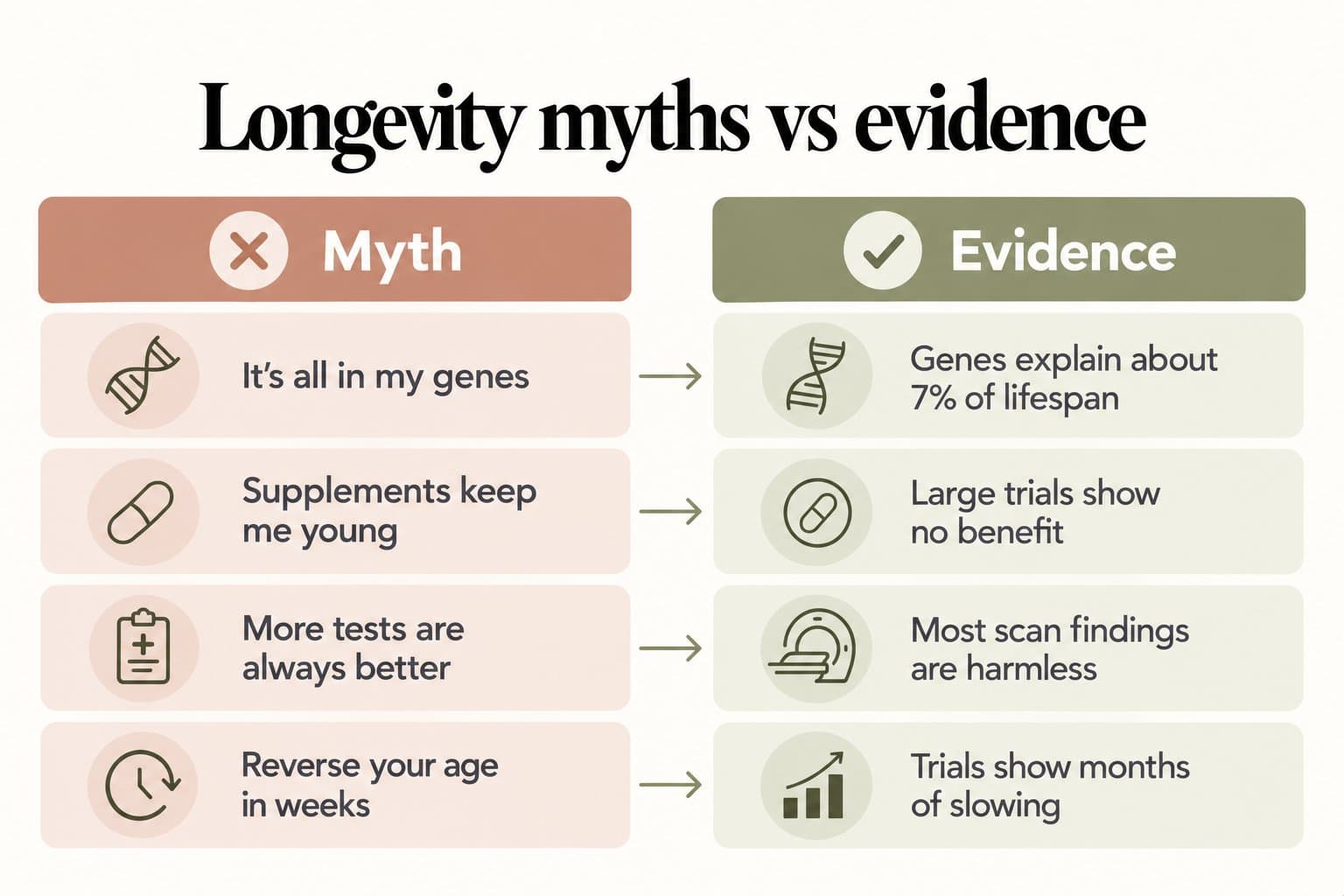
Evidence strength
Strong evidence against these myths.
Myth 1: "How long I live is mostly down to my genes." A study of family trees covering about 400 million people estimated that genes explain about 7% or less of the variation in lifespan, much lower than earlier estimates of 25-30%. In a 2025 study of nearly 500,000 people, environmental and lifestyle factors explained 17% of the variation in risk of death, compared with less than 2% for genetic predisposition (see The Genetics of Longevity).
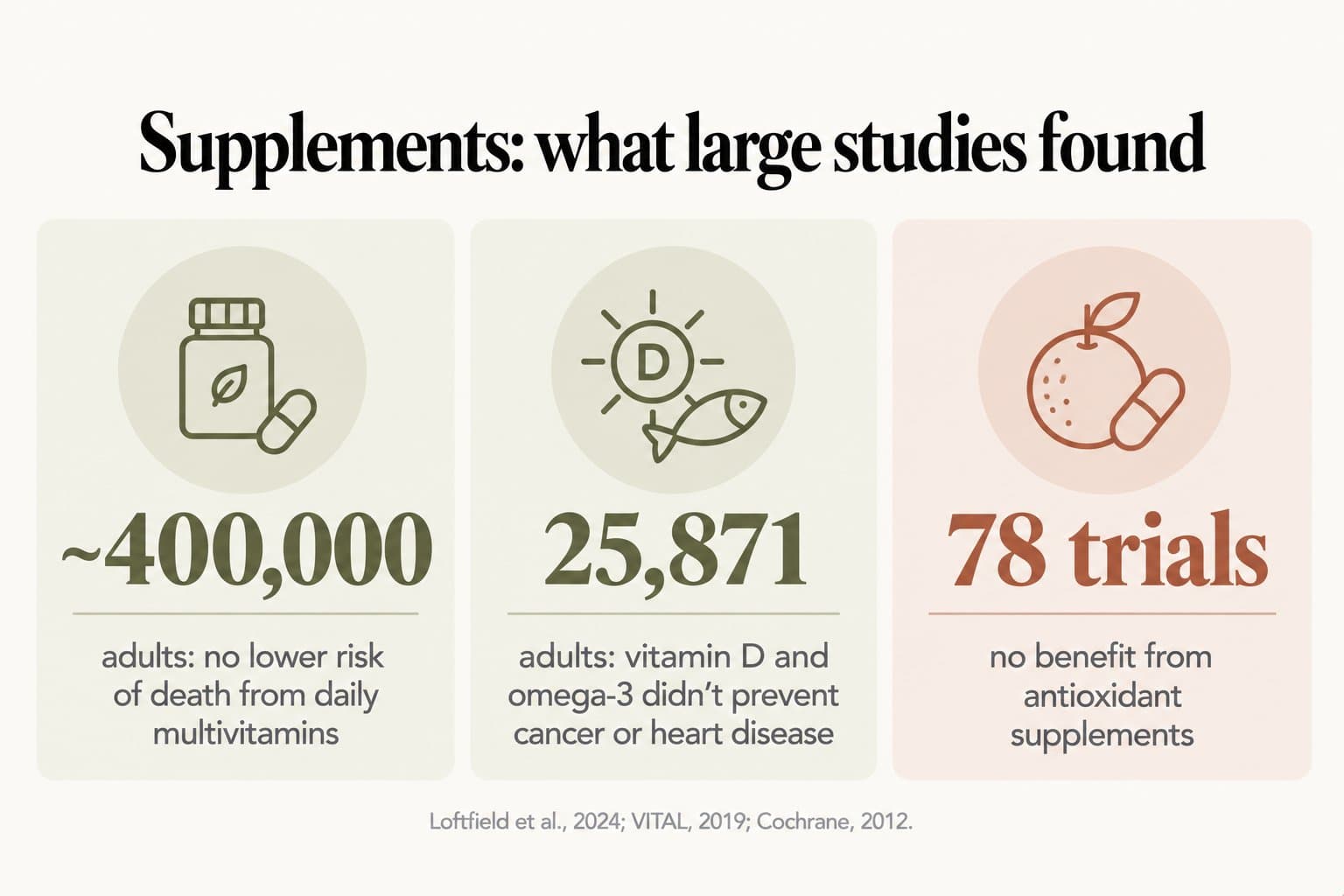
Myth 2: "Supplements will keep me young." In nearly 400,000 healthy US adults followed for more than 20 years, daily multivitamin use wasn't linked to a lower risk of death. In the VITAL trial of 25,871 adults, vitamin D and omega-3 supplements didn't reduce cancer or major cardiovascular events. A Cochrane review of 78 trials with 296,707 people found no benefit from antioxidant supplements, and beta-carotene, vitamin E and higher-dose vitamin A may slightly increase mortality. Supplements help when you have a genuine deficiency, not as an anti-ageing strategy (see Longevity Supplements).
Myth 3: "A little alcohol is good for my heart." A 2023 analysis of 107 studies with more than 4.8 million people found that low-volume drinking wasn't associated with lower risk of death compared with lifelong non-drinkers, once study design problems were accounted for (see Alcohol and Longevity).
Moderate evidence against these myths.
Myth 4: "More tests are always better." The American College of Radiology doesn't support full-body MRI in people without symptoms or risk factors. Reviews of screening scans have found abnormal findings in about 95% of people, with about 30% needing further evaluation and 91% of lesions benign. Simple, proven measures such as blood pressure, blood sugar, cholesterol and fitness are often more useful (see Longevity Testing and Your Key Longevity Numbers).
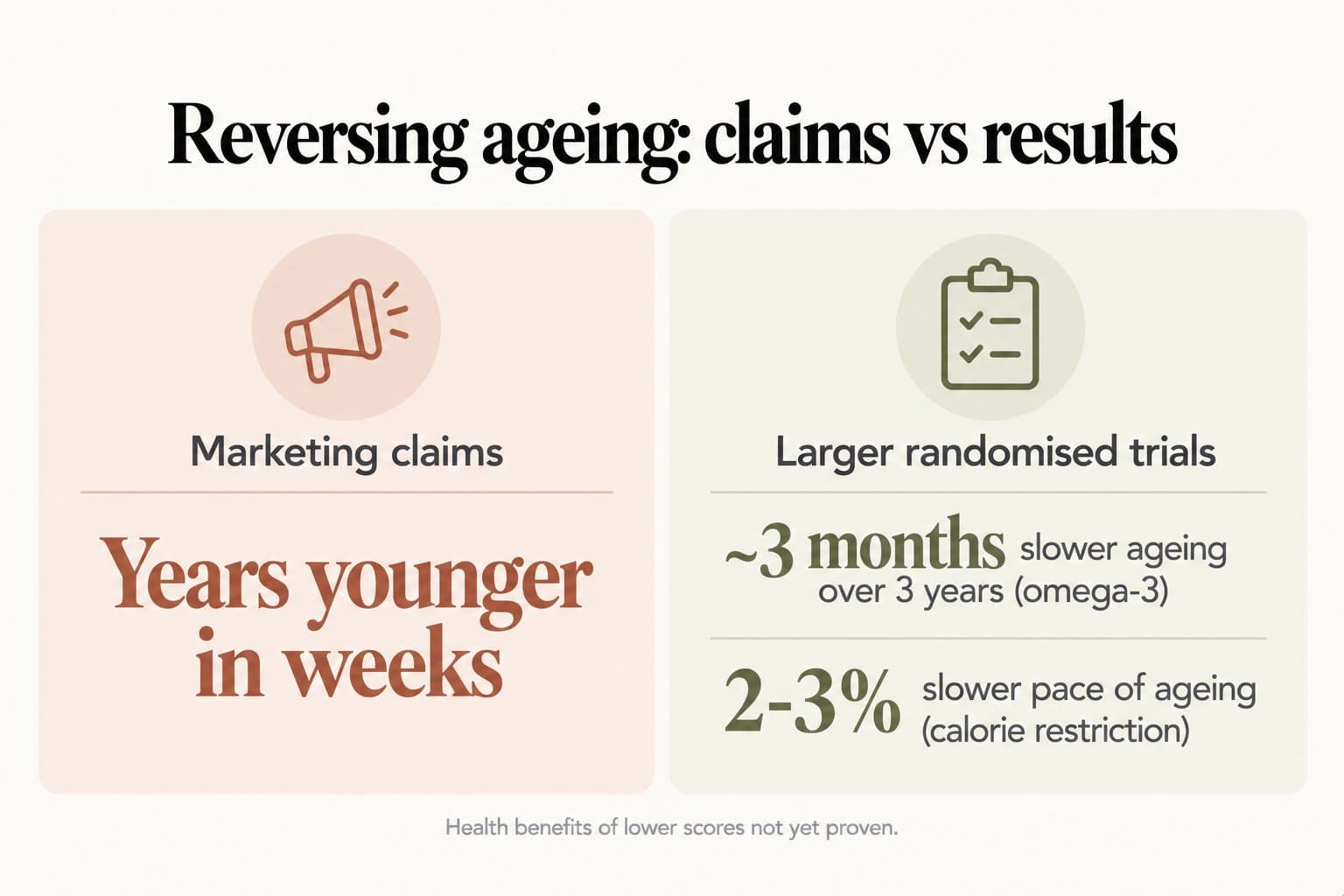
Myth 5: "You can reverse your biological age by years in a few weeks." Claims of large reversals come from small, short or uncontrolled studies. In larger randomised trials, daily omega-3 slowed epigenetic clocks by about three months over three years, and calorie restriction slowed the pace of ageing by 2-3%. Lower clock scores haven't yet been shown to extend life (see Can You Reverse Your Biological Age?).
Myth 6: "There's one magic diet or fasting schedule." In a one-year trial, alternate-day fasting produced similar weight loss to simply eating less every day (6.0% vs 5.3%), but more people dropped out. Healthy eating patterns share common features, such as plenty of vegetables, fruit, legumes, whole grains and nuts, rather than a single secret formula (see Eating Patterns for Longevity and Calorie Restriction and Fasting).
Limited evidence for these popular beliefs.
Myth 7: "Blue Zones prove there's a secret to living to 100." Claims about some long-lived communities have been questioned by researchers who found problems with birth records and pension fraud, although Blue Zone researchers dispute this. The broader lessons, such as plant-rich diets, daily movement and social connection, are well supported, but they're not a secret formula.
Myth 8: "Longevity medicine is just anti-ageing for looking younger." Longevity medicine focuses on how well your body works: preventing heart disease, diabetes, dementia and cancer, and preserving strength, fitness and independence. Skin health is one part of this, because it reflects both ageing and sun damage, but appearance is not the goal (see What Is Longevity Medicine?).
Important limitations.
- Science changes: some of today's facts may be refined by future research.
- Individual circumstances matter: some people do need supplements, extra tests or specific diets.
- Absence of proof isn't proof of harm: some unproven approaches may turn out to help, but they shouldn't replace proven ones.
Recommendations by situation
| Situation | What the evidence supports |
|---|---|
| Worried about family history | Know your risks, but focus on what you can change |
| Taking several supplements | Review them with your doctor; keep those that treat a proven deficiency |
| Considering a full-body scan | Discuss first; prioritise proven checks |
| Offered an age-reversal programme | Ask for independent randomised evidence |
| Choosing a diet | Choose a healthy pattern you can maintain, not a fad |
| Drink alcohol "for your heart" | There's no need to start, and less is better |
Practical notes
The most powerful longevity tools aren't secret or expensive: not smoking, regular exercise, a healthy diet, good sleep, healthy weight, managing stress, staying socially connected and keeping blood pressure, cholesterol and blood sugar in check. These are backed by decades of evidence and act on many aspects of ageing at once (see From Hallmarks to Habits). The idea that it's too late to start is another common myth, covered in It's Never Too Late. Our Longevity Doctors can help you separate evidence from hype for your own situation, starting with the free longevity assessment.
- Ruby JG, et al. Estimates of the heritability of human longevity are substantially inflated due to assortative mating. Genetics, 2018;210(3):1109-1124.
- Argentieri MA, et al. Integrating the environmental and genetic architectures of aging and mortality. Nature Medicine, 2025;31(4):1016-1025.
- Loftfield E, et al. Multivitamin use and mortality risk in 3 prospective US cohorts. JAMA Network Open, 2024;7(6):e2418729.
- Bjelakovic G, et al. Antioxidant supplements for prevention of mortality in healthy participants and patients with various diseases. Cochrane Database of Systematic Reviews, 2012;(3):CD007176.
- Zhao J, et al. Association between daily alcohol intake and risk of all-cause mortality: a systematic review and meta-analyses. JAMA Network Open, 2023;6(3):e236185.
- American College of Radiology. ACR statement on screening total body MRI. 2023.
- Bischoff-Ferrari HA, et al. Individual and additive effects of vitamin D, omega-3 and exercise on DNA methylation clocks of biological aging in older adults from the DO-HEALTH trial. Nature Aging, 2025;5(3):376-385.
- Trepanowski JF, et al. Effect of alternate-day fasting on weight loss, weight maintenance, and cardioprotection among metabolically healthy obese adults. JAMA Internal Medicine, 2017;177(7):930-938.
Free longevity assessment
Want to separate evidence
from hype?
Take the free Aevum Protocol assessment to see how your longevity 101 and 6 other longevity domains are performing — and get a personalised 90-day plan.
Take the free assessmentKeep reading
Related articles
Longevity Science
How to Read Longevity Research: Seven Questions to Ask Before You Believe a Headline
Nutrition & Metabolism
Longevity Supplements: NMN, Resveratrol, Metformin, Rapamycin and Multivitamins Under the Microscope
Longevity 101