Cardiovascular & Metabolic Health
Cardiometabolic Screening:
Which Tests You Need, When, and Why
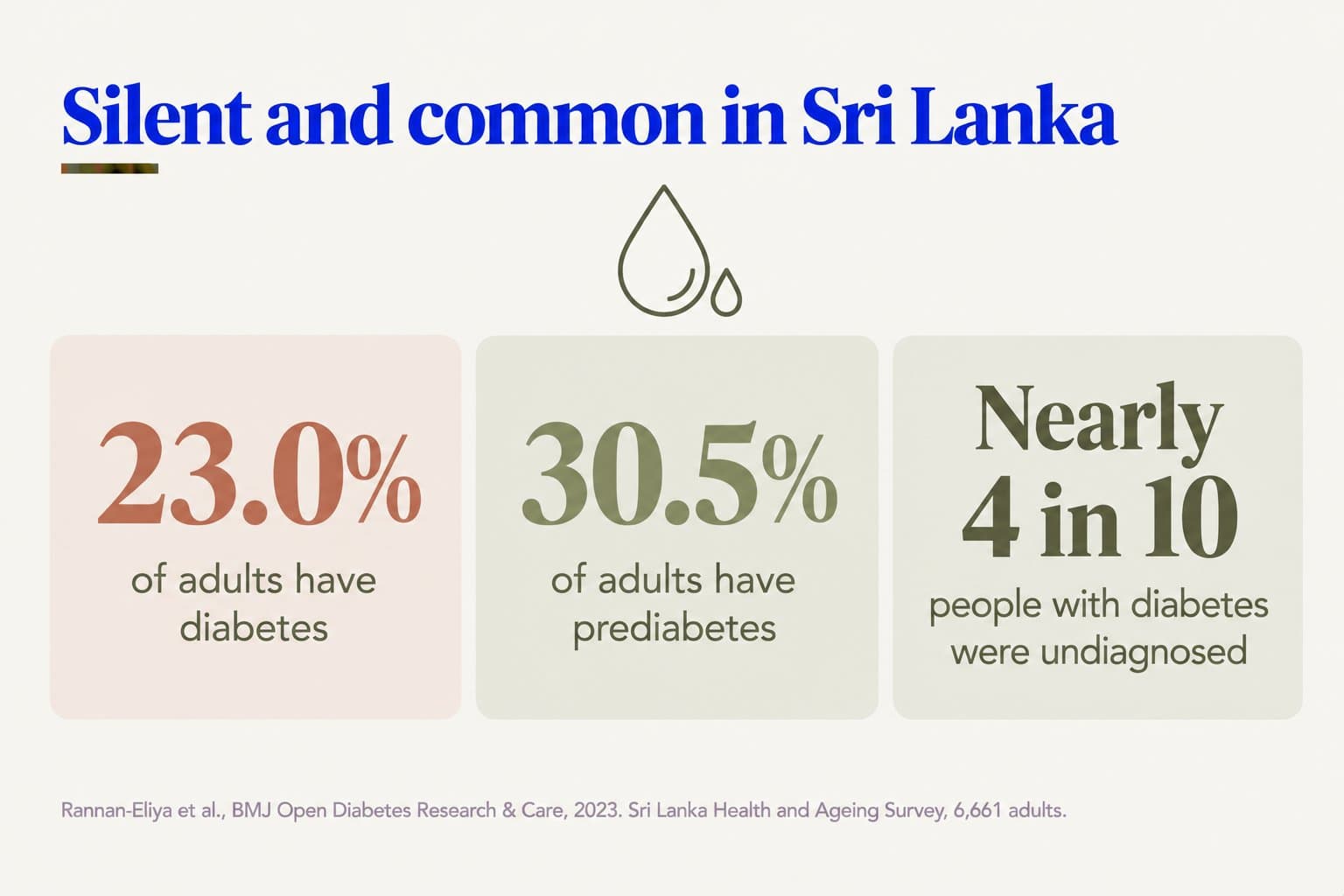
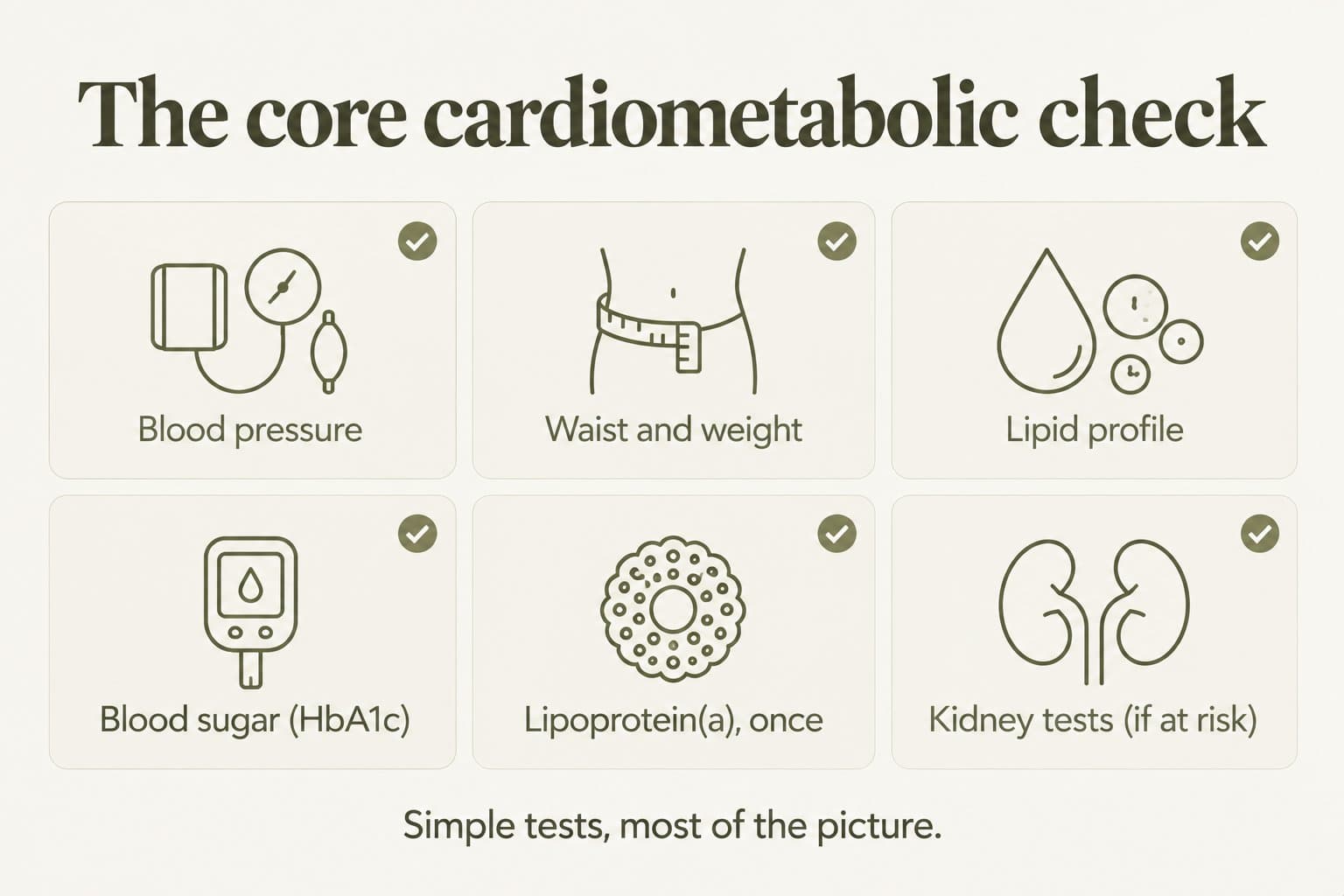
High blood pressure, high cholesterol, prediabetes, diabetes, fatty liver and early kidney disease usually cause no symptoms for years, yet together they drive most heart attacks and strokes. The only way to find them early is to test for them. In Sri Lanka, nearly 1 in 4 adults has diabetes and almost 1 in 3 has prediabetes, and in the national Health and Ageing Survey nearly 4 in 10 people with diabetes hadn't been diagnosed. A handful of simple, inexpensive tests (blood pressure, a lipid profile, a blood sugar test, weight and waist, and kidney tests for people at risk) cover most of what matters. Some people benefit from extra tests, such as a one-off lipoprotein(a) measurement or a coronary calcium scan. Because South Asians develop these conditions earlier and at lower body weights, screening should start earlier than many international guidelines suggest. This guide sets out which tests to have, when to start and how often to repeat them.
Key numbers
| Finding | Detail |
|---|---|
| Diabetes in Sri Lankan adults (national survey, 6,661 people) | 23.0% |
| Prediabetes in Sri Lankan adults (same survey) | 30.5% |
| Diabetes that was undiagnosed (same survey) | Nearly 4 in 10 cases (8.7% of adults undiagnosed vs 14.3% diagnosed) |
| US screening recommendation for diabetes and prediabetes (2021) | Adults aged 35-70 with overweight; a BMI of 23 or more may be appropriate for Asian Americans |
| US adults with chronic kidney disease who don't know it | As many as 9 in 10 |
Why screening matters
Cardiometabolic conditions develop silently over years. By the time symptoms appear, such as chest pain, breathlessness or a stroke, significant damage may already be done. Atherosclerosis begins decades earlier (see How Atherosclerosis Develops), and every year that blood pressure, LDL cholesterol or blood sugar is high adds to the damage. Finding these problems early allows lifestyle changes, and medicines where needed, to prevent most of the harm.
The core tests
| Test | What it tells you | When to start | How often |
|---|---|---|---|
| Blood pressure | High blood pressure, the biggest single risk factor | From 18 | At least every 3 years if normal; every year from 40 or if raised |
| Weight, BMI and waist | Excess and abdominal fat | From 18 | Every check-up |
| Lipid profile (total, LDL, HDL, triglycerides, non-HDL) | Cholesterol-related risk | From 20 | Every 4-6 years if normal; more often if raised or high risk |
| Fasting glucose or HbA1c | Prediabetes and diabetes | By 35, earlier if overweight or with risk factors | Every 3 years if normal; yearly if prediabetes |
| Lipoprotein(a) | Inherited cholesterol risk | Once in adulthood | Once is usually enough |
| 10-year risk score | Overall heart attack and stroke risk | From 40 | Every few years, or when risk factors change |
Additional tests for some people
- Kidney function (eGFR) and urine albumin-to-creatinine ratio: yearly for people with diabetes, high blood pressure or heart disease (see Kidney Health and Cardiometabolic Risk).
- ApoB: useful if you have high triglycerides, diabetes, insulin resistance or a large waist (see LDL, ApoB and Lipoprotein(a)).
- Liver tests and a fibrosis score (FIB-4), or an ultrasound: for people with diabetes, obesity or several metabolic risk factors (see Fatty Liver Disease (MASLD)).
- High-sensitivity CRP: can help refine borderline risk (see Inflammation and Heart Disease).
- Coronary artery calcium scan: for people aged 40-75 at intermediate risk who are unsure about starting a statin (see Coronary Calcium Scoring).
- Home blood pressure monitoring: to confirm a diagnosis and detect white-coat or masked hypertension (see Home Blood Pressure Monitoring).
- Pulse check or ECG: from about 65, or earlier with palpitations, to look for atrial fibrillation.
Timeline of cardiometabolic screening by age: 20s (blood pressure, weight and waist, lipid profile), 30s (add blood sugar by 35 or earlier, lipoprotein(a) once), 40s and beyond (10-year risk score, kidney tests if at risk, calcium scan if undecided); start earlier with South Asian ancestry or a family history of early heart disease
Understanding your results
Common thresholds for adults are:
- Blood pressure: under 120/70 mmHg is non-elevated, 120-139/70-89 is elevated, and 140/90 or higher is hypertension (European guidelines; see Blood Pressure Explained).
- Blood sugar: a fasting glucose of 100-125 mg/dL (5.6-6.9 mmol/L) or HbA1c of 5.7-6.4% suggests prediabetes; 126 mg/dL (7.0 mmol/L) or higher, or HbA1c of 6.5% or higher, suggests diabetes, usually confirmed with a repeat test.
- LDL cholesterol: your target depends on your overall risk, from under 116 mg/dL (3.0 mmol/L) at low risk to under 55 mg/dL (1.4 mmol/L) at very high risk.
- Lipoprotein(a): above 50 mg/dL (125 nmol/L) is high risk.
- Waist: for South Asians, aim for under 90 cm for men and under 80 cm for women.
Results are best interpreted together, using a risk score and your personal and family history (see Cardiovascular Risk Scores and Heart Age).
Recommendations by scenario
| Scenario | Suggested approach |
|---|---|
| Healthy adult in their 20s or 30s | Blood pressure, weight and waist regularly; lipid profile from 20; Lp(a) once |
| Aged 35 or over, or overweight at any age | Add fasting glucose or HbA1c, repeated every 3 years if normal |
| South Asian ancestry | Start blood sugar and lipid testing earlier, use lower BMI and waist cut-offs, and mention ancestry in risk assessment |
| Family history of early heart disease (father or brother before 55, mother or sister before 65) | Lipid profile and Lp(a) early; consider earlier risk assessment; test family members |
| Previous pre-eclampsia, gestational diabetes or early menopause | Regular blood pressure, blood sugar and lipid checks, even if you feel well |
| Diabetes or high blood pressure | Yearly kidney tests, lipids, and a full cardiovascular risk review |
| Aged 40-75, intermediate risk, undecided about a statin | Consider a coronary calcium scan and hsCRP |
| Already have heart disease | Regular monitoring of LDL, blood pressure, blood sugar and kidney function as part of treatment |
South Asian cardiovascular risk and women's heart risk are covered in more detail in South Asian Cardiovascular Risk and Women's Heart Disease.
Practical notes
The most important cardiometabolic conditions are silent, common and treatable, and simple tests can find them early. Every adult should know their blood pressure, cholesterol, blood sugar and waist size, and have lipoprotein(a) checked once. People with risk factors, and South Asians in particular, should start earlier and test more often, and targeted tests such as kidney tests, ApoB or a calcium scan add detail where needed. Screening only helps if the results lead to action, so review them with your doctor and act on what they show.
- Rannan-Eliya RP, et al. Prevalence of diabetes and pre-diabetes in Sri Lanka: a new global hotspot. Estimates from the Sri Lanka Health and Ageing Survey 2018/2019. BMJ Open Diabetes Research & Care, 2023;11(1):e003160.
- US Preventive Services Task Force. Screening for prediabetes and type 2 diabetes: US Preventive Services Task Force recommendation statement. JAMA, 2021;326(8):736-743.
- Centers for Disease Control and Prevention. Chronic Kidney Disease Basics.
- Kronenberg F, et al. Lipoprotein(a) in atherosclerotic cardiovascular disease and aortic stenosis: a European Atherosclerosis Society consensus statement. European Heart Journal, 2022;43(39):3925-3946.
- McEvoy JW, et al. 2024 ESC Guidelines for the management of elevated blood pressure and hypertension. European Heart Journal, 2024;45(38):3912-4018.
- American Diabetes Association. Diagnosis and classification of diabetes: Standards of Care in Diabetes. Diabetes Care.
Free longevity assessment
When did you last check your
blood pressure, lipids and blood sugar?
Take the free Aevum Protocol assessment to see how your cardiovascular & metabolic health and 6 other longevity domains are performing — and get a personalised 90-day plan.
Take the free assessmentKeep reading
Related articles
Cardiovascular & Metabolic Health
Cardiovascular Risk Scores and Heart Age: What Your Numbers Add Up To
Cardiovascular & Metabolic Health
South Asian Cardiovascular Risk: Why Heart Disease Strikes Earlier, and What You Can Do About It
Cardiovascular & Metabolic Health