Cardiovascular & Metabolic Health
How Atherosclerosis Develops:
The Decades-Long Process Behind Heart Attacks and Strokes
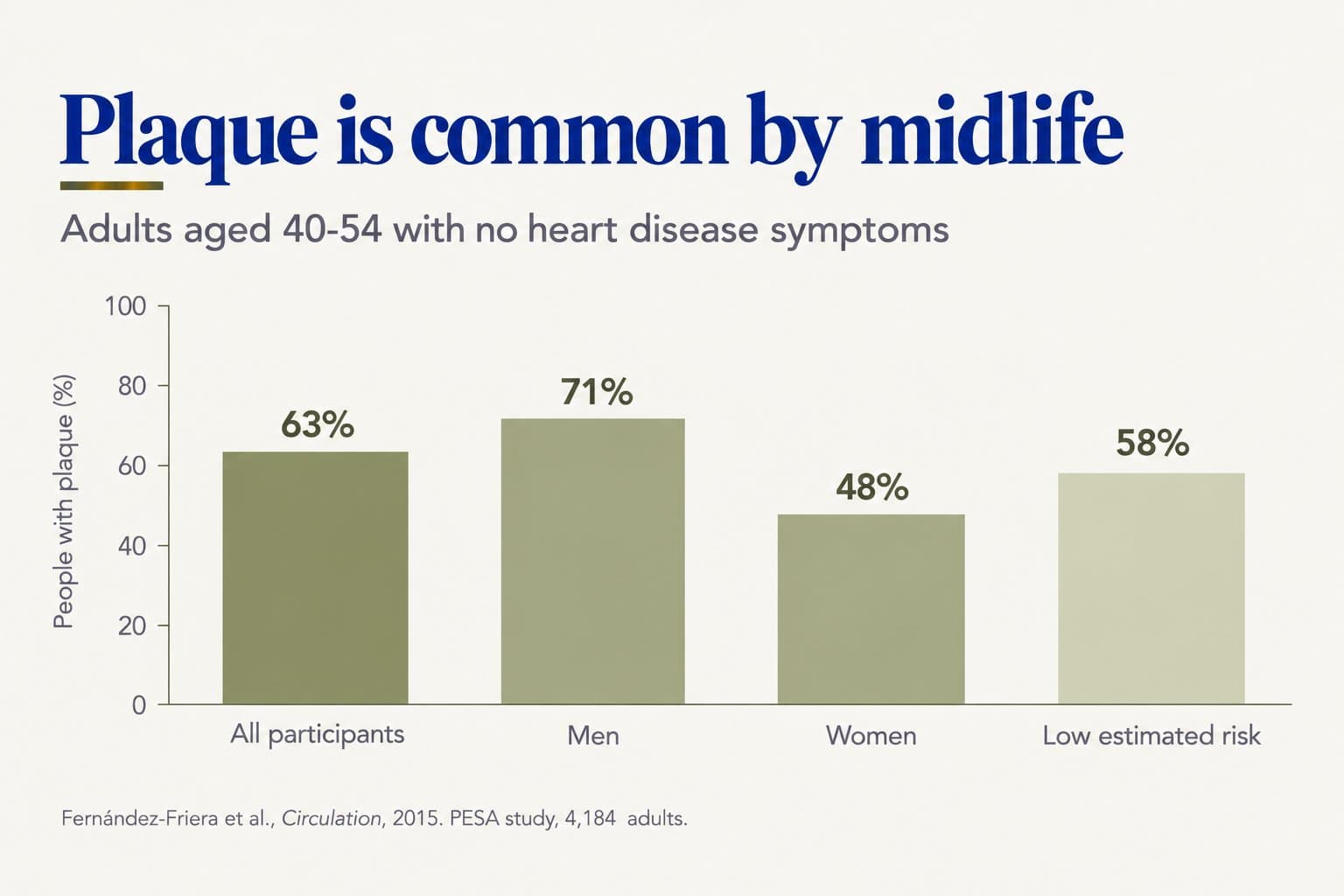
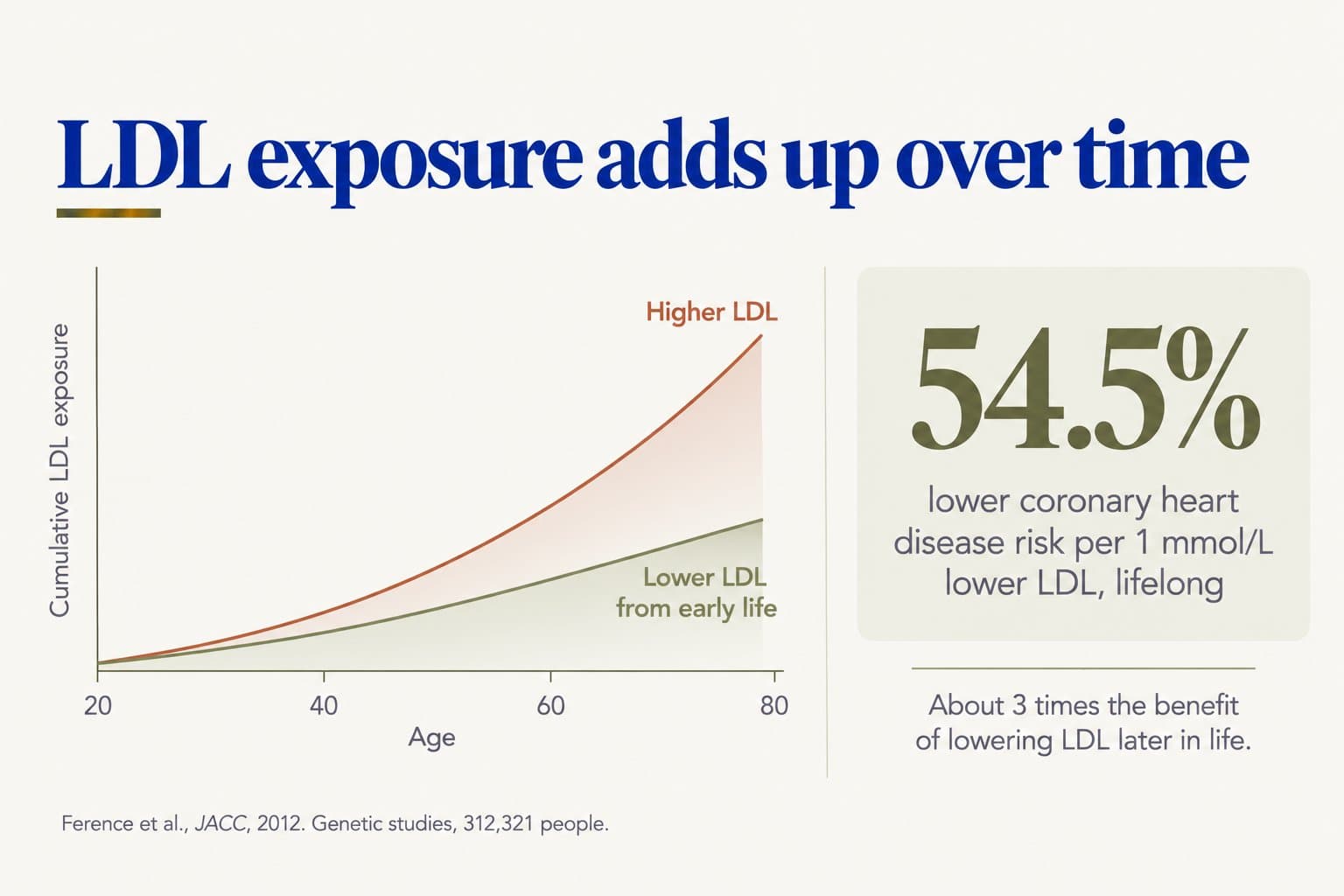
Most heart attacks and strokes are the end result of atherosclerosis, the slow build-up of fatty, inflamed plaque in the walls of the arteries. It isn't a disease of old age that appears suddenly. It starts in childhood and progresses silently for decades. In a World Health Organization study of 1,277 young people who died from accidents or other external causes, fatty streaks were already present in 87% of aortas and 30% of coronary arteries in children aged 5 to 14. By midlife it's common: in a Spanish study of 4,184 healthy-seeming adults aged 40 to 54, 63% already had plaques, including 58% of those classed as low risk. The main driver is LDL cholesterol, whose effect builds up with the number of years of exposure: people born with genetically lower LDL had about 55% less coronary heart disease for each 1 mmol/L lower LDL. This makes atherosclerosis a lifelong process that can be slowed at any age, and the earlier, the better.
Key numbers
| Finding | Detail |
|---|---|
| Fatty streaks in children aged 5-14 (WHO study, 1,277 young people who died from external causes) | Found in 87% of aortas and 30% of coronary arteries |
| Plaque in healthy-seeming middle-aged adults (PESA study, 4,184 people aged 40-54) | 63% had plaque (71% of men, 48% of women); 58% of those at low estimated risk |
| Coronary calcium in the same group | 18% |
| Evidence that LDL causes atherosclerosis (European Atherosclerosis Society review) | More than 200 studies, over 2 million people and more than 150,000 cardiovascular events |
| Lifelong lower LDL (genetic studies, 312,321 people) | 54.5% lower risk of coronary heart disease per 1 mmol/L lower LDL, about 3 times the benefit of statins started later in life |
What atherosclerosis is
Arteries are lined by a thin layer of cells called the endothelium, which keeps blood flowing smoothly and controls what passes into the artery wall. Atherosclerosis develops when cholesterol-carrying particles build up in the artery wall and trigger a long-running inflammatory response. Over time, this forms plaque: a mix of cholesterol, immune cells, scar tissue and, eventually, calcium.
Plaque can cause harm in two ways:
- Narrowing: large plaques can restrict blood flow, causing chest pain on exertion (angina) or leg pain on walking.
- Rupture or erosion: more dangerously, the surface of a plaque can crack or wear away, exposing its contents to the blood. A clot forms on top and can suddenly block the artery, causing a heart attack or stroke. Plaques don't need to be large to do this.
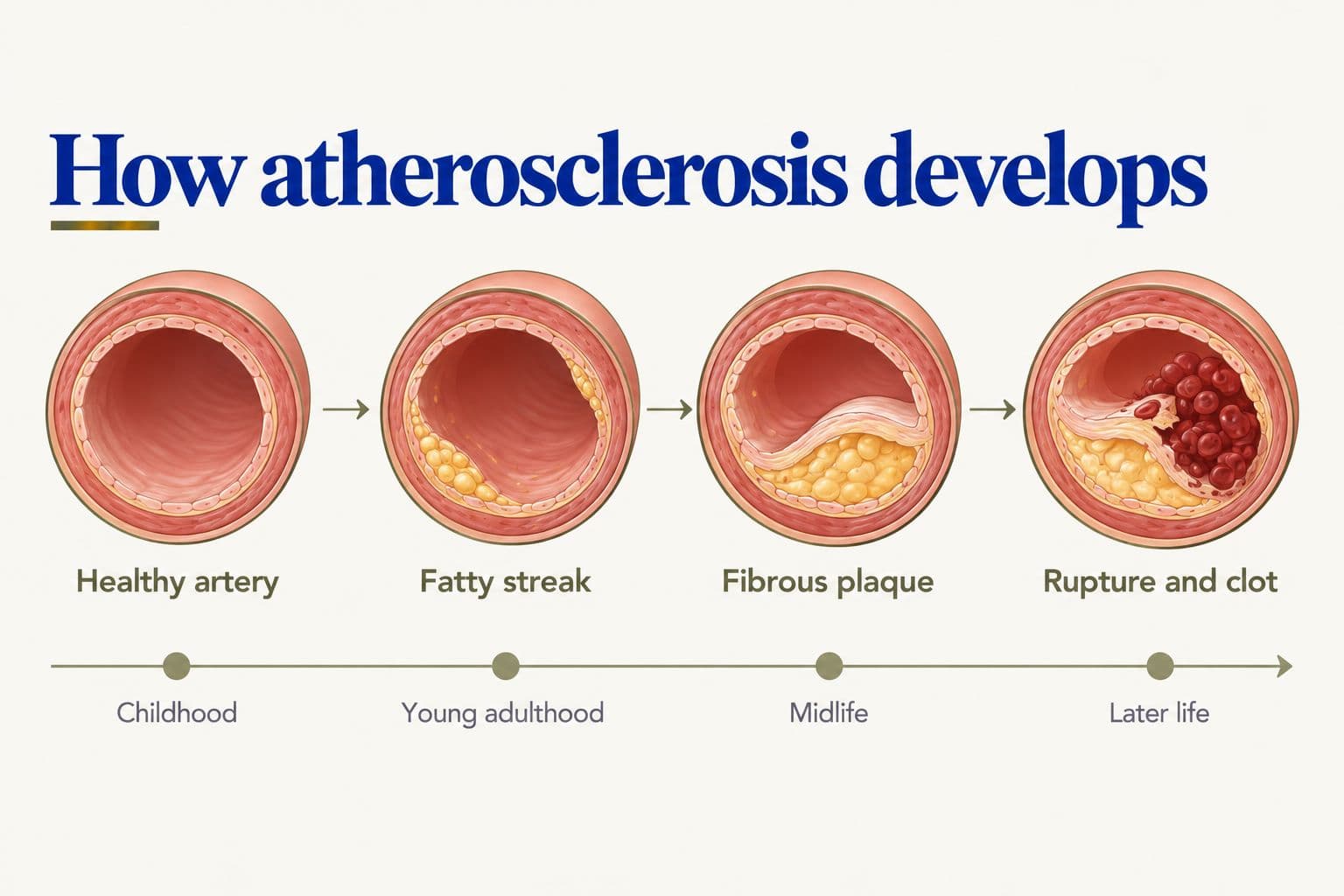
How it develops, stage by stage
1. Damage to the artery lining. The endothelium can be damaged or made "leaky" by high blood pressure, smoking, high blood sugar, inflammation and turbulent blood flow, especially where arteries branch.
2. LDL particles enter and get trapped. LDL and other particles that carry cholesterol (each containing one ApoB protein) cross into the artery wall. The more of these particles in the blood, and the longer they're there, the more get trapped. Once inside, they can become chemically modified (oxidised).
3. Immune cells move in: the fatty streak. The trapped, modified particles attract immune cells called macrophages, which engulf the cholesterol and become swollen "foam cells". Clusters of foam cells form fatty streaks, the earliest visible sign of atherosclerosis. These can appear in childhood.
4. Plaque grows and forms a cap. Over years, dying foam cells release fat and debris, forming a soft core. Muscle cells from the artery wall move in and build a fibrous cap over it. Calcium gradually deposits in the plaque, which is what a coronary calcium scan detects.
5. Rupture, clot and blockage. Plaques with a large soft core and a thin cap, full of inflammatory cells, are the most likely to rupture. When they do, a clot forms and can block the artery within minutes. This is why a heart attack can happen in someone who had no symptoms and a normal exercise test.
What the research shows
It starts in childhood. The World Health Organization and International Society and Federation of Cardiology study on the Pathobiological Determinants of Atherosclerosis in Youth examined the arteries of 1,277 people aged 5 to 34 who had died from accidents or other external causes, in 11 countries. Fatty streaks were already present in 87% of aortas and 30% of coronary arteries in the youngest group, aged 5 to 14. The extent of fatty streaks and more advanced raised lesions increased steadily with age.
By midlife, it's the norm, even in "low-risk" people. The PESA study in Spain used ultrasound and coronary calcium scans to look for plaque in 4,184 apparently healthy office workers aged 40 to 54. Plaque was present in 63% of them (71% of men and 48% of women), and 41% had plaque in several arteries. Even among people classed as low risk by a standard 10-year risk calculator, 58% had plaque. Plaque was most common in the leg (iliofemoral) arteries (44%), followed by the neck (carotid) arteries (31%) and the aorta (25%). Coronary calcium was found in 18%.
LDL is the root cause, and exposure adds up over time. In 2017, the European Atherosclerosis Society reviewed more than 200 studies involving over 2 million people and more than 150,000 cardiovascular events, including genetic studies and randomised trials. It concluded that LDL causes atherosclerotic cardiovascular disease, in a dose-dependent way, and that the benefit of lowering LDL depends on both how much it's lowered and for how long.
Genetic studies make the time effect clear. People born with gene variants that naturally lower LDL are effectively "randomised" to lower cholesterol from birth. A 2012 analysis of 312,321 people found that each 1 mmol/L (38.7 mg/dL) lower LDL from early life was linked to a 54.5% lower risk of coronary heart disease, about three times the benefit seen when statins lower LDL by the same amount later in life.
LDL and other cholesterol-carrying particles are covered in detail in LDL, ApoB and Lipoprotein(a).
Other drivers speed it up. LDL provides the raw material, but other factors damage the artery lining and accelerate plaque growth:
- High blood pressure
- Smoking
- Diabetes and insulin resistance (see Insulin Resistance)
- Lipoprotein(a), a genetically determined particle that raises risk
- Chronic inflammation, including from chronic stress (see Chronic Stress and Heart Disease)
- Age, male sex and family history
These factors multiply rather than simply add: a person with several moderately raised risk factors can be at higher risk than someone with one very high factor.
Why this matters for longevity
Because atherosclerosis builds up over decades, the most powerful time to act is early, well before symptoms. Every year of lower LDL, lower blood pressure and no smoking adds up. And because plaque can rupture without warning, feeling well isn't proof that the arteries are healthy. The same process also affects the brain's blood vessels, contributing to stroke and vascular dementia (see Vascular Health and the Brain).
The good news is that atherosclerosis can be slowed at any age. Lowering LDL and blood pressure, stopping smoking, controlling blood sugar and staying active reduce the risk of plaque growing and rupturing, and intensive LDL lowering can stabilise existing plaque.
Practical notes
- Know your numbers early: cholesterol, blood pressure and blood sugar, ideally from your 20s or 30s, and earlier if heart disease runs in your family.
- Think in decades, not years: modest improvements maintained over a lifetime matter more than short bursts of effort.
- Don't be reassured by feeling well: atherosclerosis is silent until it isn't.
- Consider your whole risk profile: blood pressure, blood sugar, smoking, family history and lipoprotein(a) all interact.
Blood pressure is covered in Blood Pressure Explained, cholesterol particles in LDL, ApoB and Lipoprotein(a), and risk scores in Cardiovascular Risk Scores and Heart Age.
- Mendis S, Nordet P, Fernandez-Britto JE, Sternby N, PBDAY Research Group. Atherosclerosis in children and young adults: an overview of the World Health Organization and International Society and Federation of Cardiology study on Pathobiological Determinants of Atherosclerosis in Youth study (1985-1995). Prevention and Control, 2005;1(1):3-15.
- Fernández-Friera L, et al. Prevalence, vascular distribution, and multiterritorial extent of subclinical atherosclerosis in a middle-aged cohort: the PESA (Progression of Early Subclinical Atherosclerosis) Study. Circulation, 2015;131(24):2104-2113.
- Ference BA, et al. Low-density lipoproteins cause atherosclerotic cardiovascular disease. 1. Evidence from genetic, epidemiologic, and clinical studies. A consensus statement from the European Atherosclerosis Society Consensus Panel. European Heart Journal, 2017;38(32):2459-2472.
- Ference BA, et al. Effect of long-term exposure to lower low-density lipoprotein cholesterol beginning early in life on the risk of coronary heart disease: a Mendelian randomization analysis. Journal of the American College of Cardiology, 2012;60(25):2631-2639.
Free longevity assessment
Do you know your LDL cholesterol
and how long it's been high?
Take the free Aevum Protocol assessment to see how your cardiovascular & metabolic health and 6 other longevity domains are performing — and get a personalised 90-day plan.
Take the free assessmentKeep reading
Related articles
Cardiovascular & Metabolic Health
LDL, ApoB and Lipoprotein(a): Understanding Cholesterol Beyond the Basic Test
Cardiovascular & Metabolic Health
Blood Pressure Explained: What the Numbers Mean and How to Measure It Properly
Cognitive Longevity