Cardiovascular & Metabolic Health
Coronary Calcium Scoring:
What a Heart Scan Can and Can't Tell You
A coronary artery calcium (CAC) scan is a quick, low-dose CT scan that detects calcium in the walls of the heart's arteries. Calcium is a marker of established atherosclerotic plaque, so the scan shows whether plaque is already present and roughly how much. Unlike a risk score, which estimates risk from factors such as cholesterol and blood pressure, a calcium scan looks at the arteries directly. In a large US study of 6,722 adults from four ethnic groups, people with a score above 300 had nearly 10 times the risk of a coronary event of those with a score of zero, and the scan improved prediction beyond standard risk factors in every group. Its main use is for people at intermediate risk who are unsure whether to start a statin: a score of zero can support delaying treatment, while a high score favours it. It has limits, though. A score of zero doesn't rule out soft, non-calcified plaque, especially in younger people, smokers and people with diabetes, and screening everyone hasn't yet been proven to save lives. This article explains what the scan shows and when it's useful.
Key numbers
| Finding | Detail |
|---|---|
| Calcium score and coronary events (MESA, 6,722 people in four ethnic groups) | Score 101-300: 7.7 times the risk; above 300: 9.7 times the risk, compared with a score of zero |
| Each doubling of the calcium score (same study) | 15-35% higher risk of a major coronary event |
| American guideline use (2018) | For adults 40-75 at intermediate risk (7.5-19.9% over 10 years) when the statin decision is uncertain |
| A score of zero in younger people with blocked arteries | Seen in 58% of those under 40, vs 14% of those over 40 |
| Screening trial in men aged 65-74 (DANCAVAS, 46,526 men, including a calcium scan) | Deaths 12.6% vs 13.1% over 5.6 years; not statistically significant |
What the scan measures
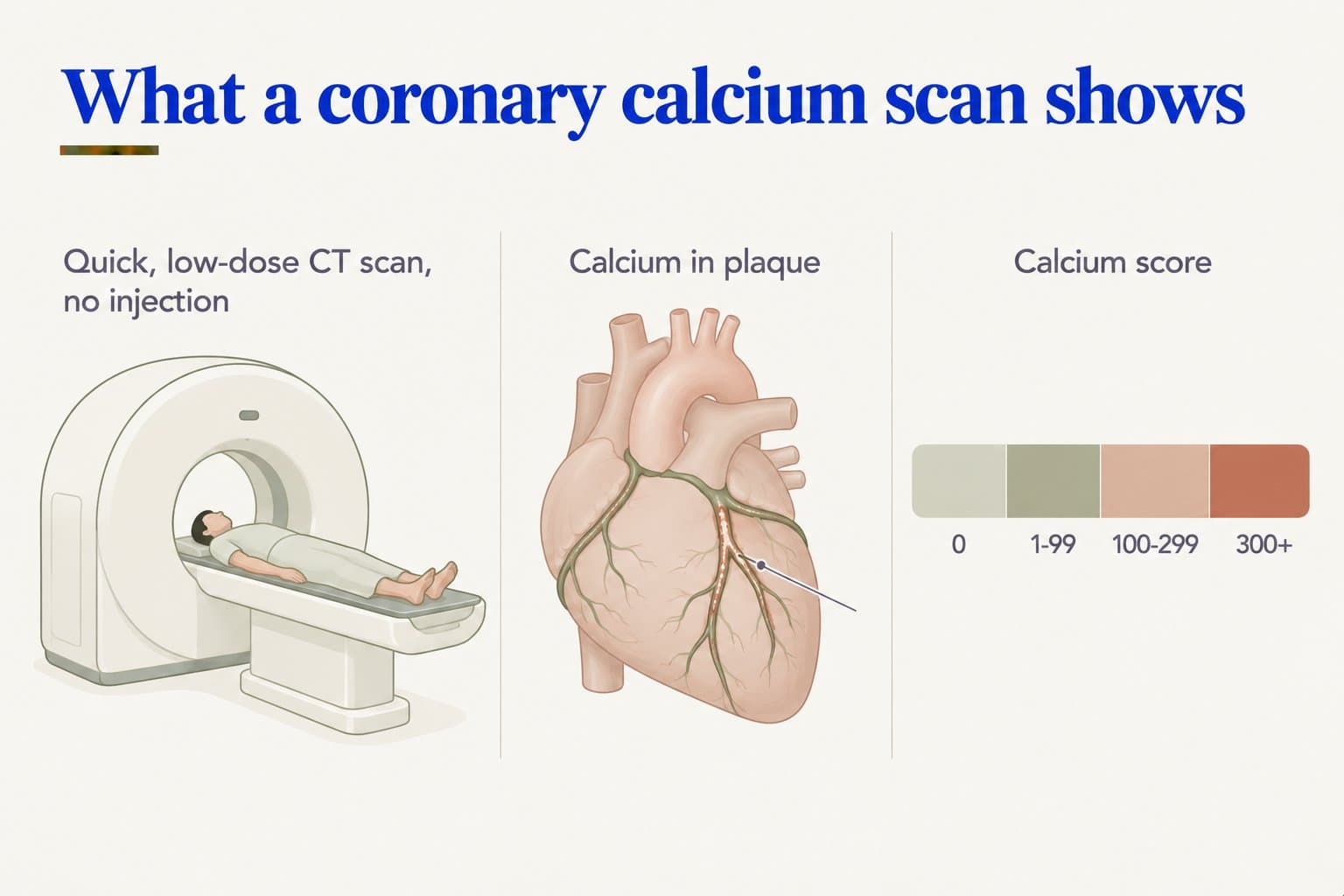
As atherosclerotic plaque matures, calcium is deposited within it (see How Atherosclerosis Develops). A CAC scan uses a quick CT scan, with no injection or dye and a low dose of radiation, to detect this calcium. The result is usually reported as an Agatston score, which reflects the area and density of calcium, often with a percentile comparing you with people of the same age, sex and ethnicity.
| Calcium score | What it suggests |
|---|---|
| 0 | No detectable calcified plaque; low short-term risk in most people |
| 1-99 | Mild plaque |
| 100-299 | Moderate plaque; clearly raised risk |
| 300 or more | Extensive plaque; high risk |
The score doesn't show whether arteries are narrowed; it shows how much plaque burden is present. Calcified plaque is actually the more stable type, but its amount is a marker of the total plaque in the arteries, including softer plaque that's more prone to rupture.
Evidence strength
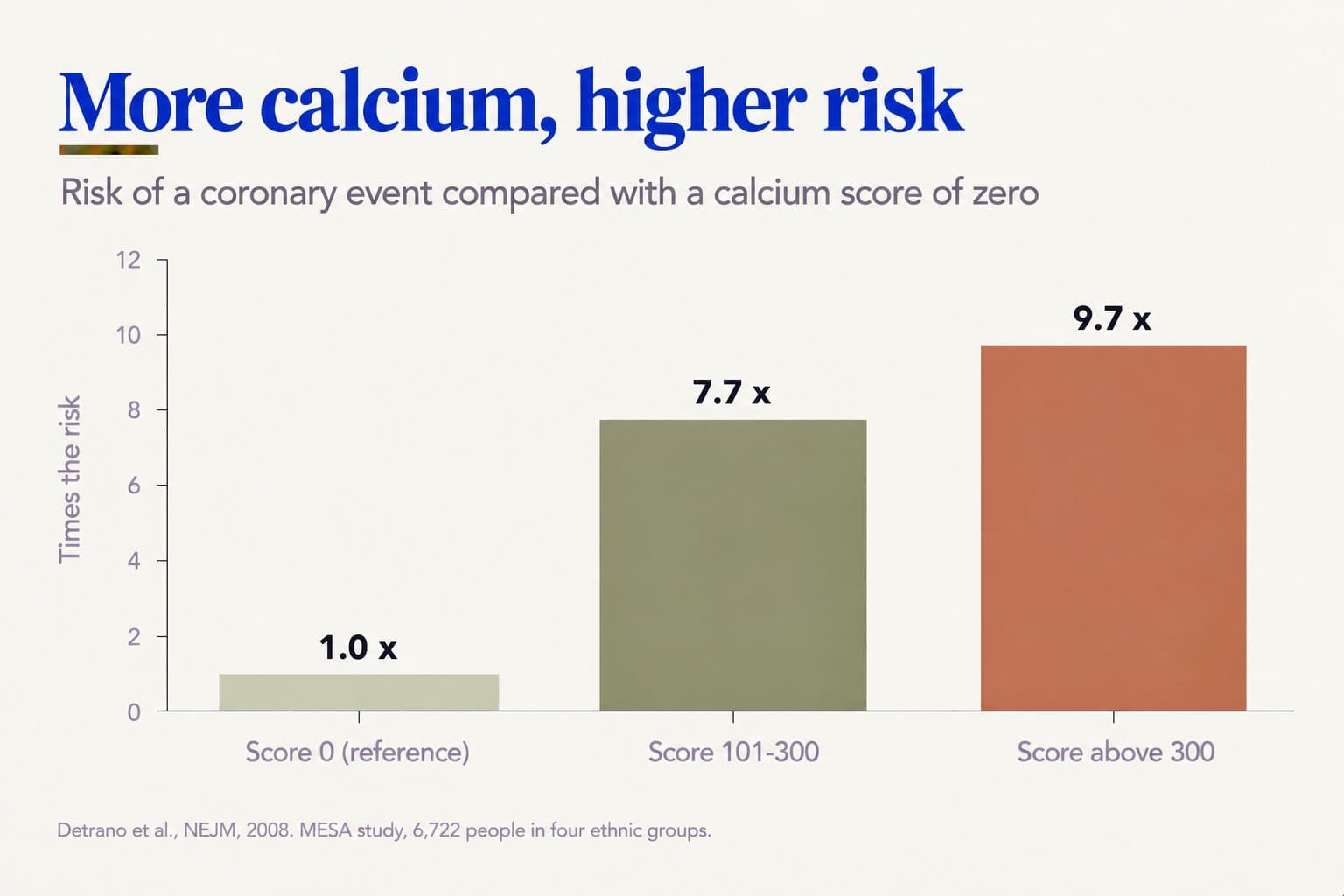
Strong: the calcium score predicts heart attacks beyond standard risk factors. The Multi-Ethnic Study of Atherosclerosis (MESA) scanned 6,722 adults without known heart disease, including white, Black, Hispanic and Chinese participants, and followed them for a median of 3.8 years. Compared with people with no calcium, those with scores of 101-300 had 7.73 times the risk of a coronary event, and those above 300 had 9.67 times the risk, after adjusting for standard risk factors. Each doubling of the score raised the risk of a major coronary event by 15-35%, and the scan improved risk prediction in all four ethnic groups.
Moderate: a score of zero indicates low short-term risk. A score of zero is one of the strongest indicators of low risk: in MESA, it was the most powerful "down-grading" marker among many tests. In early studies, people with a score of zero had very low annual rates of coronary events. For people at intermediate risk, a zero score can reasonably support delaying a statin and re-checking later.
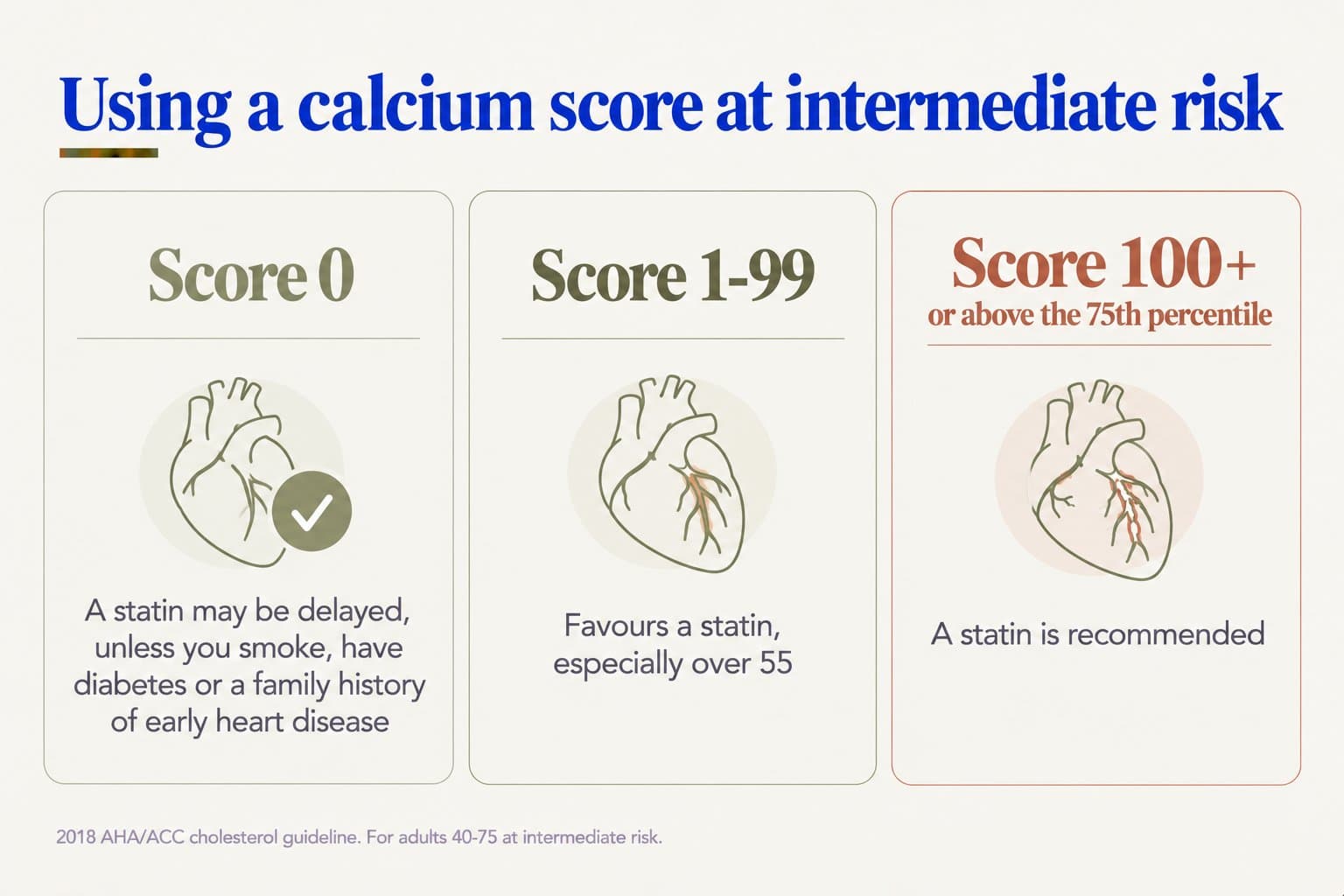
Moderate: using the score to guide statin decisions. American guidelines from 2018 recommend considering a calcium scan for adults aged 40-75 without diabetes, with an LDL of 70-189 mg/dL and a 10-year risk of 7.5-19.9%, when the decision about a statin is uncertain:
- Score 0: a statin may be withheld or delayed, except in smokers, people with diabetes, or those with a family history of early heart disease.
- Score 1-99: favours a statin, especially over 55.
- Score 100 or more, or above the 75th percentile for age and sex: a statin is indicated unless there's a good reason to defer.
This makes the scan especially useful for people whose risk scores may be unreliable, such as those of South Asian ancestry (see South Asian Cardiovascular Risk and Cardiovascular Risk Scores and Heart Age).
Limited: screening everyone improves survival. The Danish DANCAVAS trial invited 16,736 men aged 65-74 to comprehensive cardiovascular screening, including a calcium scan, and compared them with 29,790 men receiving usual care. Only 62.6% of those invited attended. After 5.6 years, 12.6% of the screening group had died compared with 13.1% of the control group, a 5% reduction that wasn't statistically significant. Screening did reduce strokes (HR 0.93), and there was a hint of benefit in men aged 65-69. So calcium scanning clearly improves risk prediction, but there's no proof yet that scanning everyone saves lives.
Important limitations.
- A zero score doesn't mean no plaque. Younger people tend to have soft, non-calcified plaque. In one analysis of people with significant blockages, 58% of those under 40 had a calcium score of zero, compared with 14% of those over 40.
- A zero score doesn't cancel other risk. Smokers, people with diabetes, very high LDL or a strong family history may still need treatment.
- Statins can increase the calcium score, because they stabilise plaque partly by calcifying it. A rising score on a statin isn't necessarily a bad sign, so repeat scans need careful interpretation.
- It's not a test for symptoms. Chest pain or breathlessness needs a different assessment, and a normal calcium score doesn't rule out a current heart problem.
- Incidental findings, such as small lung nodules, may lead to further tests.
Recommendations by situation
| Situation | What the evidence supports |
|---|---|
| Aged 40-75, intermediate 10-year risk, unsure about a statin | A calcium scan can help decide; discuss with your doctor |
| Borderline risk with risk-enhancing factors (South Asian ancestry, family history, high Lp(a)) | A scan can clarify whether plaque is already present |
| Low risk and under 40 | Usually not useful; a zero score is expected and doesn't rule out soft plaque |
| Already have heart disease, or clearly high risk | Not needed; treatment is recommended anyway |
| Smoker or diabetes with a score of zero | Don't take zero as reassurance to skip treatment; discuss overall risk |
| Chest pain, breathlessness or other symptoms | See a doctor; a calcium scan is not the right test |
| Score of zero at intermediate risk | Re-checking in about 5 years is commonly suggested |
Practical notes
A coronary calcium scan shows whether plaque is already present in the heart's arteries and predicts future heart attacks better than risk factors alone. It's most useful for people at intermediate risk deciding whether to start a statin: a zero score can support waiting, while a high score argues for treatment and more intensive prevention. But a zero score doesn't rule out soft plaque, particularly in younger people, smokers and people with diabetes, and scanning everyone hasn't been shown to save lives. Whatever the result, the foundations of prevention remain the same: controlling LDL cholesterol, blood pressure and blood sugar, and not smoking (see LDL, ApoB and Lipoprotein(a) and Statins: What the Evidence Shows About Benefits and Side Effects).
- Detrano R, et al. Coronary calcium as a predictor of coronary events in four racial or ethnic groups. New England Journal of Medicine, 2008;358(13):1336-1345.
- Grundy SM, et al. 2018 AHA/ACC/multisociety guideline on the management of blood cholesterol. Circulation, 2019;139(25):e1082-e1143.
- Lindholt JS, et al. Five-year outcomes of the Danish Cardiovascular Screening (DANCAVAS) trial. New England Journal of Medicine, 2022;387(15):1385-1394.
- Age and the power of zero CAC in cardiac risk assessment: overview of the literature and a cautionary case. British Journal of Cardiology, 2022.
Free longevity assessment
Would a calcium score help you
decide about prevention?
Take the free Aevum Protocol assessment to see how your cardiovascular & metabolic health and 6 other longevity domains are performing — and get a personalised 90-day plan.
Take the free assessmentKeep reading
Related articles
Cardiovascular & Metabolic Health
Cardiovascular Risk Scores and Heart Age: What Your Numbers Add Up To
Cardiovascular & Metabolic Health
Statins: What the Evidence Shows About Benefits and Side Effects
Cardiovascular & Metabolic Health