Stress & Mental Wellbeing
The Six Emotional Styles:
How Your Brain Shapes the Way You Handle Life
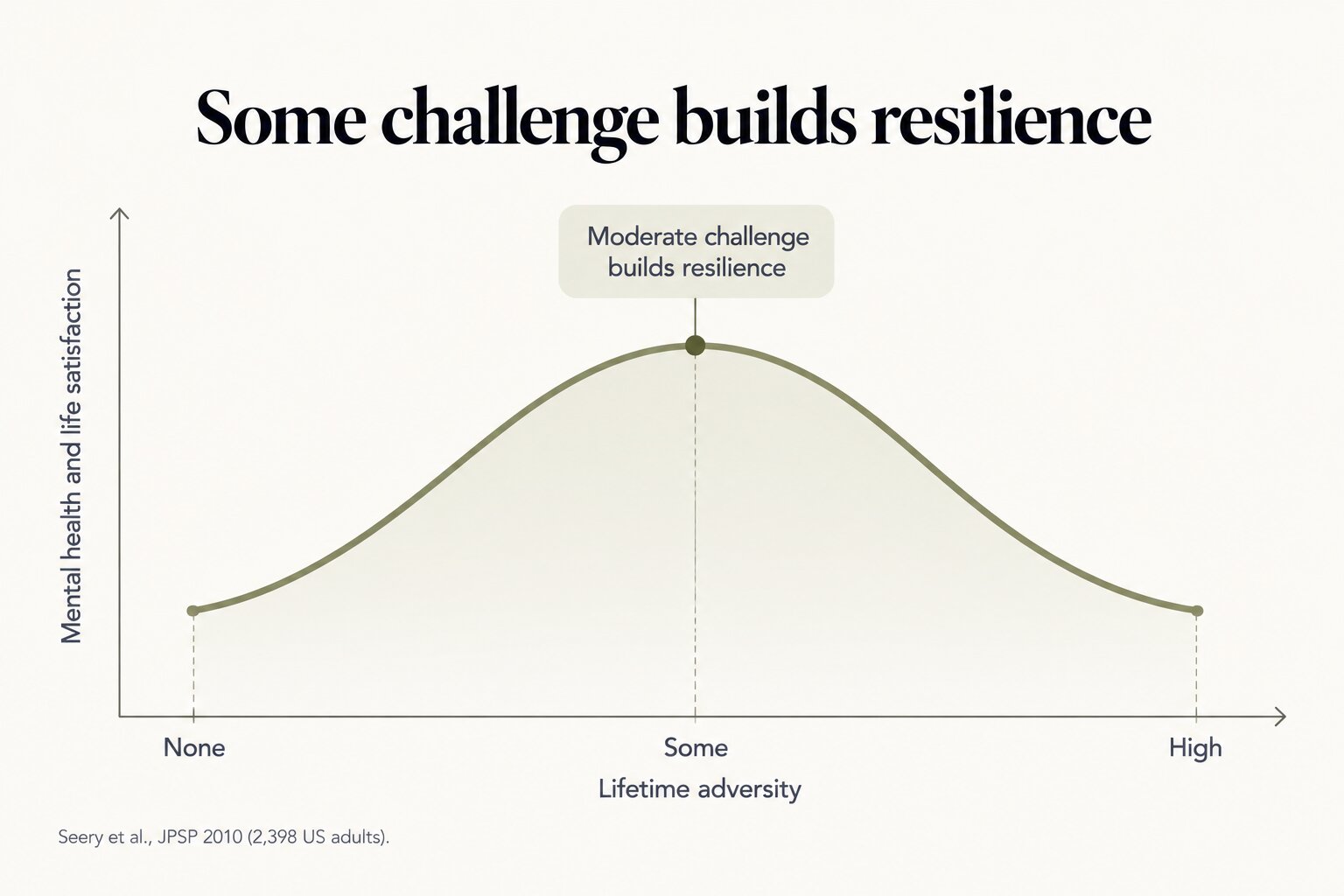
Why do some people bounce back quickly from setbacks while others dwell on them for days? Why do some people savour good moments, while others barely notice them? From decades of brain research, neuroscientist Richard Davidson of the University of Wisconsin-Madison proposed six "emotional styles" that describe how each of us tends to respond to life: resilience (how quickly you recover from adversity), outlook (how long positive feelings last), self-awareness (how well you read your own body and feelings), social intuition (how well you read other people), sensitivity to context (how well your emotions fit the situation) and attention (how well you can focus). Each is a spectrum, not a fixed type, and wellbeing comes from balance rather than being at one extreme. Importantly, these styles can change. Brain studies suggest, for example, that people whose emotional brain centres recover faster after something upsetting tend to have more stable moods, and people whose reward centres stay active longer tend to savour positive emotions for longer. Moderate challenge seems to build resilience: in a US study of 2,398 adults, people who'd faced some adversity in life had better mental health than those who'd faced none or a great deal. This article explains each style, how it affects wellbeing and simple ways to shift it.
Key numbers
| Finding | Detail |
|---|---|
| Emotional styles described by Davidson | Six, each a spectrum |
| Lifetime adversity (2,398 US adults) | Some adversity linked to better mental health than none or a lot |
| Mind-wandering (2,250 adults, ~250,000 moments) | Minds wandered 46.9% of the time; wandering predicted unhappiness |
| Brief early stress in young monkeys | Less anxiety, more curiosity and larger regulatory brain regions later in life |
| Sustained reward-centre activity (about 100 adults) | Linked to positive emotions lasting longer in daily life |
What emotional styles are
Davidson described the six emotional styles in his 2012 book The Emotional Life of Your Brain, written with science writer Sharon Begley. They summarise patterns he and others observed in how people's brains and behaviour respond to emotional events. The styles aren't diagnoses or personality "types". Everyone sits somewhere on each spectrum, and the combination is unique to each person.
Two key points:
- Balance matters more than extremes. Being very high on a style isn't always better. For example, someone extremely sensitive to other people's non-verbal cues can find social situations overwhelming.
- Styles can shift. They reflect brain circuits that change with experience and practice (see How Meditation Affects the Brain and Body).
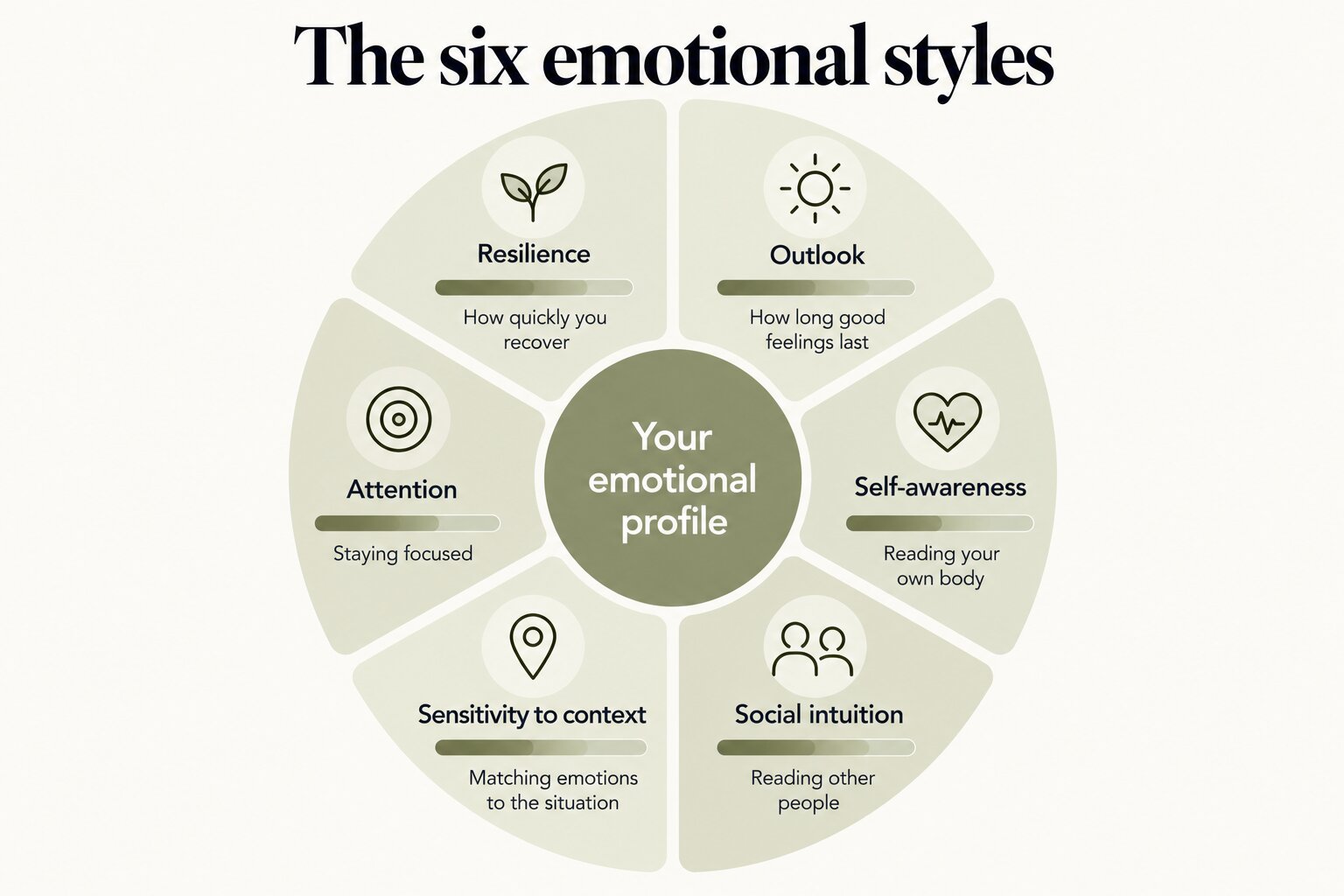
The six styles
1. Resilience: how quickly you recover. Resilience is how quickly you recover from setbacks such as an argument, a disappointment, an illness or a loss. In a study of healthy adults, Davidson's team found that people whose amygdala, a brain centre involved in threat and fear, took longer to settle after viewing upsetting images tended to score higher on neuroticism, a tendency towards negative emotions.
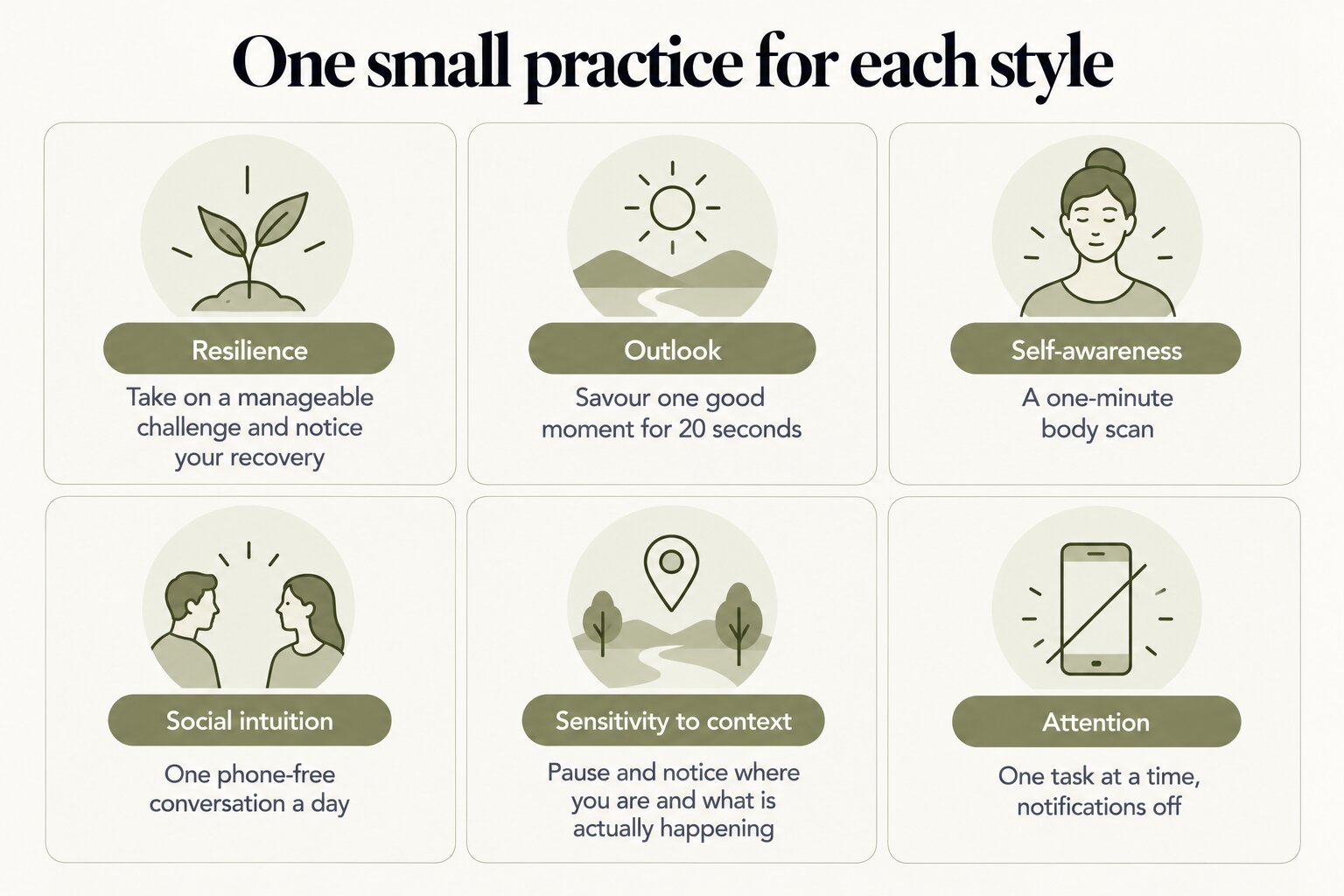
What helps: moderate, manageable challenges. In a 2010 study of 2,398 US adults followed from 2001 to 2004, Mark Seery and colleagues found that people who'd experienced some adversity in their lives had less distress and higher life satisfaction than those with no adversity or a great deal. Animal studies point the same way: young squirrel monkeys briefly separated from their group once a week for ten weeks were later less anxious, more curious and had larger regions of the prefrontal cortex involved in regulating emotion. Davidson suggests that hard physical training, used safely, may play a similar role, alongside awareness practices (see A Stress-Resilience Routine for Every Life Stage).
2. Outlook: how long good feelings last. Outlook is how long positive emotions last, and whether you tend to see what's right with people and situations rather than what's wrong. In a 2015 study of about 100 adults, Aaron Heller and colleagues in Davidson's group found that people whose ventral striatum, a reward centre, stayed active longer after a win in a lab game reported positive emotions lasting longer in their daily lives.
What helps: savouring good moments, gratitude practices and deliberately noticing what's going well (see Optimism and Healthy Ageing).
3. Self-awareness: reading your own body. Self-awareness is how well you notice your own thoughts, feelings and bodily signals. Scientists call the ability to sense internal signals, such as your heartbeat, breathing or a tight stomach, interoception. A brain region called the insula plays a central role. Better awareness of these signals gives earlier warning of stress and emotions.
What helps: body scans, mindful breathing and noticing sensations during exercise (see Contemplative Aerobics).
4. Social intuition: reading other people. Social intuition is how well you pick up non-verbal signals from others, such as facial expressions, tone of voice and body language. It helps in relationships, work and parenting. Some people, including some autistic people, find these cues harder to read, while others can be so focused on them that interactions become exhausting.
What helps: being fully present in conversations, putting your phone away and paying attention to faces and tone (see Building Social Connection).
5. Sensitivity to context: matching emotions to the situation. This style describes how well your emotional reactions fit the setting. Strong fear is useful in danger but not at a family dinner. Post-traumatic stress disorder is an example of low sensitivity to context: a war veteran may react to an ambulance siren at home as if back in a war zone. The hippocampus, which helps us process context, is involved.
What helps: noticing where you are and what's actually happening right now. If you experience flashbacks or reactions that feel out of proportion, trauma-focused therapy is effective (see Therapy and Counselling).
6. Attention: staying focused. Attention is your ability to focus and resist distraction. In a 2010 study in Science, Matthew Killingsworth and Daniel Gilbert used a smartphone app to sample the thoughts of 2,250 adults at random moments. Their minds were wandering 46.9% of the time, and people were less happy when their minds wandered, regardless of what they were doing. As the authors put it, "a wandering mind is an unhappy mind." Davidson argues that constant digital distraction is steadily weakening our ability to focus.
What helps: focused-attention meditation, doing one thing at a time and limiting notifications (see Digital Overload and Mental Wellbeing).
| Style | What it describes | If it's low, you might notice | What helps |
|---|---|---|---|
| Resilience | Speed of recovery from setbacks | Dwelling on problems for days | Awareness practice, manageable challenges |
| Outlook | How long positive feelings last | Good moments fade quickly | Savouring, gratitude |
| Self-awareness | Sensing your own body and feelings | Stress noticed only when it's severe | Body scans, mindful breathing |
| Social intuition | Reading others' non-verbal cues | Misreading others' moods | Full attention in conversations |
| Sensitivity to context | Fitting emotions to the setting | Reactions out of proportion to the situation | Noticing the present situation; therapy for trauma |
| Attention | Focus and resisting distraction | Constant distraction, unfinished tasks | Focused meditation, single-tasking |
Why children bounce back faster
Young children often recover quickly from upsets. Davidson suggests the main reason isn't that their brains are more adaptable, but that their prefrontal cortex, which allows us to plan for the future and reflect on the past, is still developing. This "mental time travel" is useful, but it's also what lets adults worry about tomorrow and ruminate about yesterday. Children spend more time in the present. Practices that bring adults back to the present moment may help recover some of that ease.
Can you change your emotional style?
Davidson's research suggests you can. Emotional styles reflect brain circuits that are constantly shaped by experience, whether we notice it or not. Regular practices that train awareness, attention, connection and insight can gradually shift them (see Flourishing Is a Skill). Change is usually gradual, takes consistent practice, and works best when it suits the individual. Some of the brain findings come from small studies, and the six-style model itself is a framework drawn from research rather than a clinical diagnosis.
Why this matters for longevity
How we handle stress and emotion affects the body: chronic stress, rumination and low mood are linked to higher blood pressure, inflammation, heart disease and depression, while resilience, optimism and focus are linked to healthier ageing (see Allostatic Load). Understanding your own emotional style is a practical starting point for choosing the habits that will help you most.
Practical notes
Read through the six styles and pick the one where you'd most like to change. Choose one small daily practice from the table and keep it up for a month. Notice gradual shifts, such as recovering from setbacks a little faster or savouring good moments a little longer. If emotional reactions are seriously affecting your life, such as persistent low mood, anxiety or trauma symptoms, speak to a doctor or therapist, or call the National Mental Health Helpline on 1926. Our Longevity Doctors include stress and emotional wellbeing in every assessment, starting with the free longevity assessment.
- Davidson RJ, Begley S. The Emotional Life of Your Brain. Hudson Street Press, 2012.
- Schuyler BS, et al. Temporal dynamics of emotional responding: amygdala recovery predicts emotional traits. Social Cognitive and Affective Neuroscience, 2014;9(2):176-181.
- Seery MD, Holman EA, Silver RC. Whatever does not kill us: cumulative lifetime adversity, vulnerability, and resilience. Journal of Personality and Social Psychology, 2010;99(6):1025-1041.
- Lyons DM, et al. Developmental cascades linking stress inoculation, arousal regulation, and resilience. Frontiers in Behavioral Neuroscience, 2009;3:32.
- Heller AS, et al. The neurodynamics of affect in the laboratory predicts persistence of real-world emotional responses. Journal of Neuroscience, 2015;35(29):10503-10509.
- Killingsworth MA, Gilbert DT. A wandering mind is an unhappy mind. Science, 2010;330(6006):932.
- Patrick R. FoundMyFitness podcast: interview with Dr. Richard Davidson on meditation, neuroplasticity and flourishing.
Free longevity assessment
Want to understand how you
handle stress and emotion?
Take the free Aevum Protocol assessment to see how your stress & mental wellbeing and 6 other longevity domains are performing — and get a personalised 90-day plan.
Take the free assessment