Stress & Mental Wellbeing
Optimism and Healthy Ageing:
What the Research Shows About a Hopeful Outlook
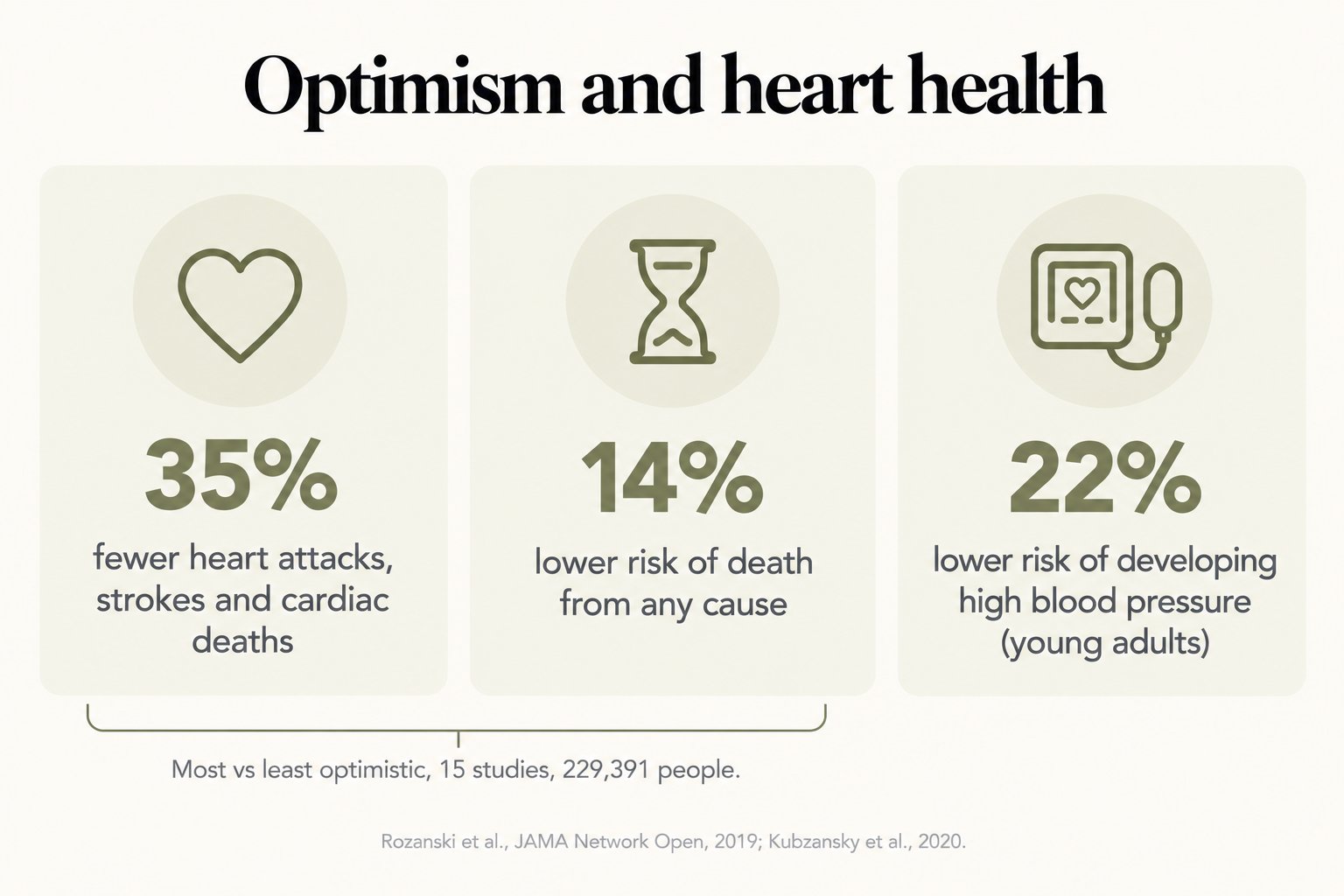
Optimism is the general expectation that good things will happen and that your efforts will pay off. It isn't the same as ignoring problems or "thinking positive" about everything; realistic optimists see difficulties clearly but believe they can be managed. Optimism has some of the strongest links to health of any psychological trait. A meta-analysis of 15 studies with 229,391 people followed for an average of 13.8 years found that the most optimistic people had 35% fewer heart attacks, strokes and cardiac deaths, and 14% lower mortality from any cause, than the least optimistic. In two large US studies, the most optimistic women and men lived 11-15% longer on average and had 50-70% greater odds of reaching 85. In 159,255 women from diverse racial and ethnic backgrounds, the most optimistic quarter lived 5.4% longer and were 10% more likely to live beyond 90. Optimists tend to exercise more, smoke less and manage stress better, but healthy habits explained less than a quarter of the link, suggesting other pathways too. Only about 25-30% of optimism is inherited, and trials show that simple exercises such as imagining your best possible future can increase it, although the effects tend to fade without practice. This article explains what optimism is, what the evidence shows, and how a hopeful but realistic outlook can be strengthened.
Key numbers
| Finding | Detail |
|---|---|
| Meta-analysis (15 studies, 229,391 people) | Most optimistic: 35% fewer cardiovascular events, 14% lower all-cause mortality |
| US women and men (Lee et al., 2019) | Most optimistic: 11-15% longer lifespan; 50-70% greater odds of reaching 85 |
| Women's Health Initiative (159,255 women, up to 26 years) | Most optimistic quarter: 5.4% longer lifespan; 10% more likely to live beyond 90 |
| Young US soldiers (about 3.5 years) | Most optimistic: 22% lower risk of developing high blood pressure |
| Heritability | About 25-30% of optimism is inherited |
What optimism is
Psychologists Michael Scheier and Charles Carver defined dispositional optimism as a general tendency to expect good outcomes in life. Optimists tend to expect things to work out and experience a more positive mix of emotions, while pessimists expect bad outcomes and are more prone to anxiety and sadness. It's usually measured with a short questionnaire called the Life Orientation Test-Revised, which asks how much you agree with statements such as "In uncertain times, I usually expect the best." Optimism exists on a spectrum, and it's fairly stable over time.
Optimism is often confused with other ideas, so it helps to be clear about what it isn't:
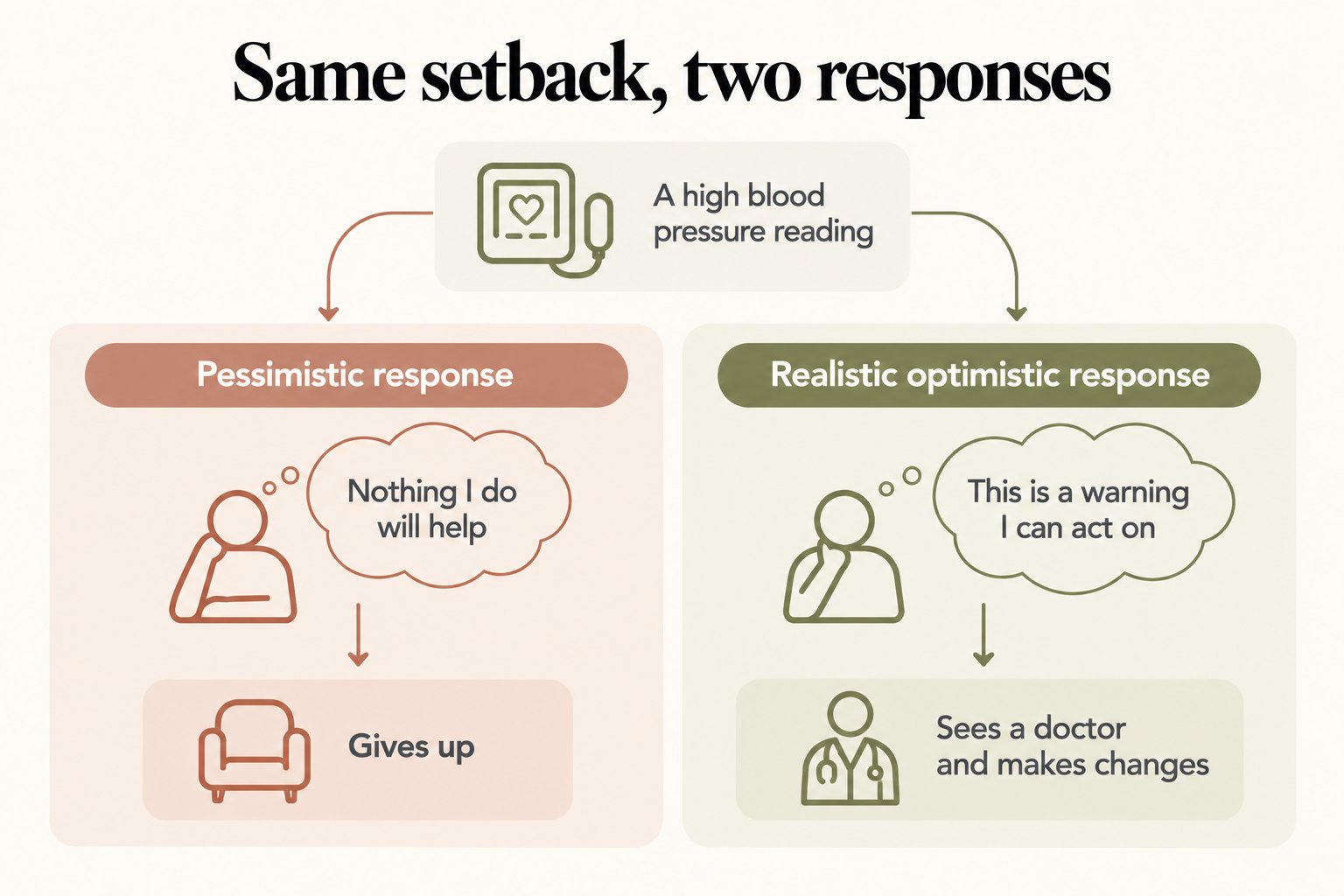
- It isn't denial. Realistic optimists acknowledge problems and risks, but believe they can be dealt with. That belief makes them more likely to take action, such as seeing a doctor or changing a habit.
- It isn't forced positivity. Pretending to feel happy, or being told to "stay positive" when facing real difficulties, can make people feel worse.
- It isn't unrealistic optimism. Believing that bad things happen only to other people ("I won't get diabetes, even though it runs in my family") can lead people to ignore genuine risks.
What the research shows
Optimism and the heart. In 2019, Alan Rozanski and colleagues at Mount Sinai combined 15 studies with 229,391 participants followed for an average of 13.8 years. Compared with the least optimistic people, the most optimistic had a 35% lower risk of cardiovascular events (heart attack, stroke or cardiac death) and a 14% lower risk of death from any cause. Optimism was linked to substantially lower cardiac risk in 9 of the 10 studies that examined it, and the researchers found that "the higher the level of optimism, the lower the risk for cardiac events or death."
Optimism may also help protect against high blood pressure. In a Harvard study of young, healthy US Army soldiers followed for about three and a half years, the most optimistic had a 22% lower risk of developing hypertension than the least optimistic, a result that held for men and women and across racial and ethnic groups (see Blood Pressure Explained).
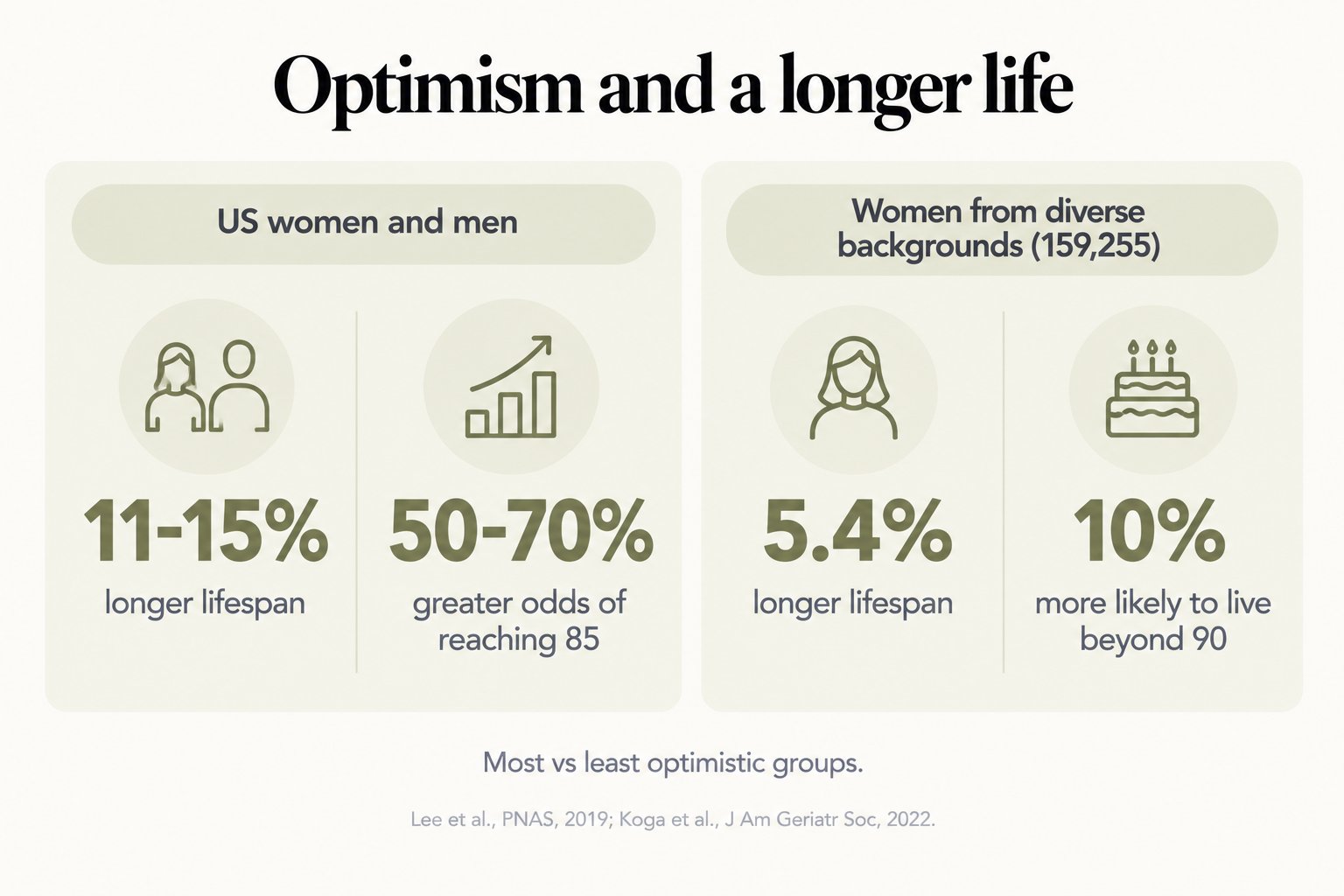
Optimism and exceptional longevity. In a 2019 study in the Proceedings of the National Academy of Sciences, Lewina Lee and colleagues analysed 69,744 women from the Nurses' Health Study, followed for 10 years, and 1,429 men from the Veterans Affairs Normative Aging Study, followed for 30 years. The most optimistic participants lived 11-15% longer on average than the least optimistic, and had 50-70% greater odds of reaching age 85. The link held after accounting for education, chronic diseases, depression and health behaviours such as exercise, diet, alcohol and doctor visits.
A 2022 study extended these findings to a more diverse group. Hayami Koga and colleagues followed 159,255 women aged 50-79 from the Women's Health Initiative for up to 26 years. The most optimistic quarter had a 5.4% longer lifespan and a 10% greater likelihood of living beyond 90 than the least optimistic quarter. The benefits were seen across racial and ethnic groups, and lifestyle factors such as exercise and diet explained less than a quarter of the link.
How optimism may protect health
Healthier habits. Optimists are less likely to smoke or misuse alcohol and more likely to be physically active. Because they expect their efforts to pay off, they're more likely to follow medical advice and keep making changes.
Better coping. Optimists tend to tackle problems directly, plan ahead and seek support, rather than avoiding difficulties. This may soften the effects of chronic stress (see Allostatic Load).
Biology. Researchers have found links between optimism and healthier biological markers in several studies, including lower inflammation, higher antioxidant levels and higher HDL ("good") cholesterol, although these pathways are still being studied.
More than habits. Because healthy behaviours explained less than a quarter of the link in the Women's Health Initiative, other pathways, such as stress biology and social support, probably also contribute.
Can optimism be learned?
Only about 25-30% of optimism is inherited, according to Harvard researchers, which leaves considerable room for change. Optimism also tends to rise with education and problem-solving skills, suggesting that environments where people feel able to tackle problems help foster it.
A meta-analysis of 29 randomised trials with more than 3,000 participants found that interventions designed to increase optimism had a small but significant effect overall. The most effective was the Best Possible Self exercise, which involves spending about half an hour imagining and writing about your life in the future, imagining that everything has gone as well as it reasonably could. This produced a medium-sized effect. Other approaches included cognitive behavioural therapy, mindfulness and self-compassion training. However, the benefits tended to fade over time, suggesting that optimism, like fitness, needs regular practice.
Important limitations
- Observational evidence: the studies on longevity show associations, not proof that optimism itself extends life.
- Health affects optimism: people who feel unwell may become less optimistic, although most studies adjusted for existing health conditions and depression.
- No trials of optimism and lifespan: interventions can raise optimism in the short term, but no trial has yet shown that raising optimism extends life.
- Pessimism isn't a character flaw: outlook is shaped by genes, upbringing, circumstances and hardship. People facing poverty, illness or loss have good reasons to feel less hopeful, and they deserve support, not blame.
Why this matters for longevity
Optimism is one of the most consistent psychological predictors of a longer, healthier life, linked to fewer heart attacks and strokes, lower blood pressure risk and greater chances of living into your late 80s and 90s. It works partly by helping people take better care of themselves and cope with stress. A hopeful, realistic outlook is not a substitute for medical care, but it may make healthy changes more likely to happen and to last.
Practical notes
Optimism can be practised. Try the Best Possible Self exercise: spend about 20-30 minutes writing about your life five or ten years from now, imagining that things have gone well, and include your health, relationships and goals. Repeat it every few weeks. When something goes wrong, notice whether you see it as permanent and all-encompassing ("I always fail") or temporary and specific ("this didn't work this time"), and practise the second view. Break big goals into small steps you can achieve, as each success builds confidence. Gratitude, meditation and spending time with hopeful people may also help (see Stress-Reduction Techniques That Work). Keep it realistic: the aim is to believe you can handle what comes, not to ignore risks. If pessimism comes with persistent low mood, hopelessness or loss of interest, speak to a doctor, as these can be signs of depression. Our Longevity Doctors can help you build a plan you feel confident about, starting with the free longevity assessment.
- Rozanski A, et al. Association of optimism with cardiovascular events and all-cause mortality: a systematic review and meta-analysis. JAMA Network Open, 2019;2(9):e1912200.
- Lee LO, et al. Optimism is associated with exceptional longevity in 2 epidemiologic cohorts of men and women. Proceedings of the National Academy of Sciences, 2019;116(37):18357-18362.
- Koga HK, et al. Optimism, lifestyle, and longevity in a racially diverse cohort of women. Journal of the American Geriatrics Society, 2022;70(10):2793-2804.
- Kubzansky LD, et al. Optimism and risk of incident hypertension: a target for primordial prevention. Epidemiology and Psychiatric Sciences, 2020;29:e157.
- Scheier MF, Carver CS, Bridges MW. Distinguishing optimism from neuroticism (and trait anxiety, self-mastery, and self-esteem): a reevaluation of the Life Orientation Test. Journal of Personality and Social Psychology, 1994;67(6):1063-1078.
- Malouff JM, Schutte NS. Can psychological interventions increase optimism? A meta-analysis. Journal of Positive Psychology, 2017;12(6):594-604.
Free longevity assessment
Ready to build a hopeful,
realistic plan?
Take the free Aevum Protocol assessment to see how your stress & mental wellbeing and 6 other longevity domains are performing — and get a personalised 90-day plan.
Take the free assessmentKeep reading
Related articles
Stress & Mental Wellbeing
Psychological Wellbeing and Longevity: Why Feeling Well and Living Well Matter for Health
Stress & Mental Wellbeing
Purpose in Life and Longevity: How Having a Reason to Get Up Protects Your Health
Cardiovascular & Metabolic Health