Stress & Mental Wellbeing
Digital Overload and Mental Wellbeing:
Screens, Social Media and the Mind
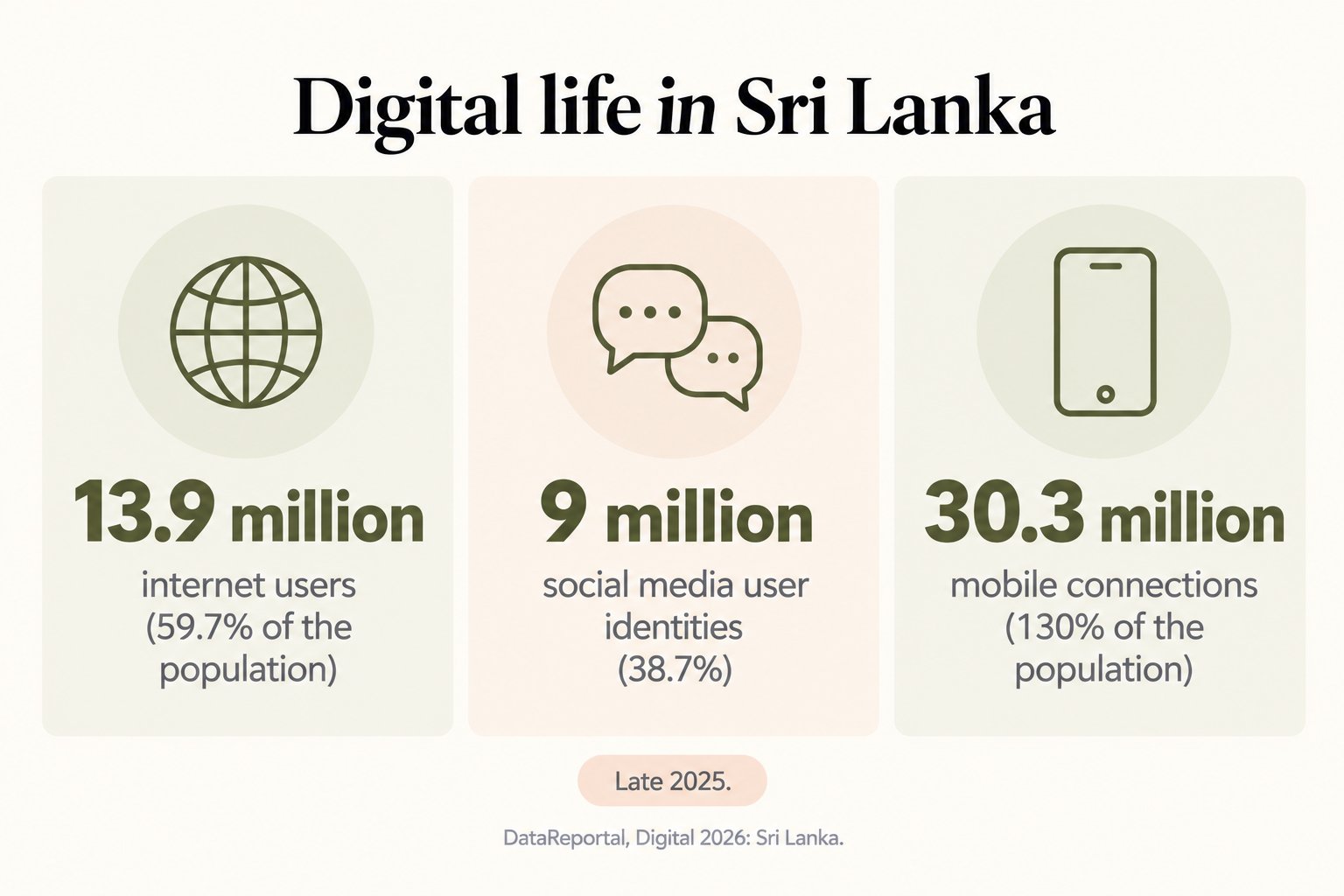
Smartphones and social media have transformed how we work, learn and stay in touch, including with family members living abroad. In Sri Lanka, 13.9 million people (59.7% of the population) used the internet in late 2025, and there were 9 million social media user identities. Digital technology brings real benefits, but it also competes for our attention, sleep and time with others. The research is more nuanced than headlines suggest. A large Oxford study of more than 300,000 adolescents found that, on average, screen use explained at most 0.4% of differences in wellbeing, about the same as regularly eating potatoes. But averages hide important patterns. The US Surgeon General's 2023 advisory warned that young people spending more than three hours a day on social media face double the risk of poor mental health outcomes, and a meta-analysis of 20 studies with 125,198 children found that using a device at bedtime more than doubled the odds of not getting enough sleep. In adults, experiments suggest cutting back helps: limiting social media to about 30 minutes a day for three weeks reduced loneliness and depressive symptoms in students, and deactivating Facebook for four weeks increased wellbeing in about 2,800 adults. The problem isn't technology itself, but how, when and how much we use it, and what it displaces: sleep, movement, focus and face-to-face connection. This article explains what the evidence shows and how to build a healthier relationship with your devices.
Key numbers
| Finding | Detail |
|---|---|
| Sri Lanka (late 2025) | 13.9 million internet users (59.7%); 9 million social media user identities |
| Average association in adolescents (more than 300,000) | Screen use linked to at most 0.4% of differences in wellbeing |
| Heavy social media use in youth (US Surgeon General, 2023) | More than 3 hours a day: double the risk of poor mental health outcomes |
| Bedtime device use (20 studies, 125,198 children) | 2.17 times the odds of inadequate sleep |
| Limiting social media to 30 minutes a day (143 students, 3 weeks) | Reduced loneliness and depressive symptoms |
| Deactivating Facebook for 4 weeks (about 2,800 adults) | Increased subjective wellbeing |
Is technology bad for mental health?
Not in itself. Digital tools help people stay connected with distant family, find information and support, learn, work flexibly and access health services, including mental health support. For many older adults with children abroad, video calls are a lifeline (see Loneliness and Social Isolation).
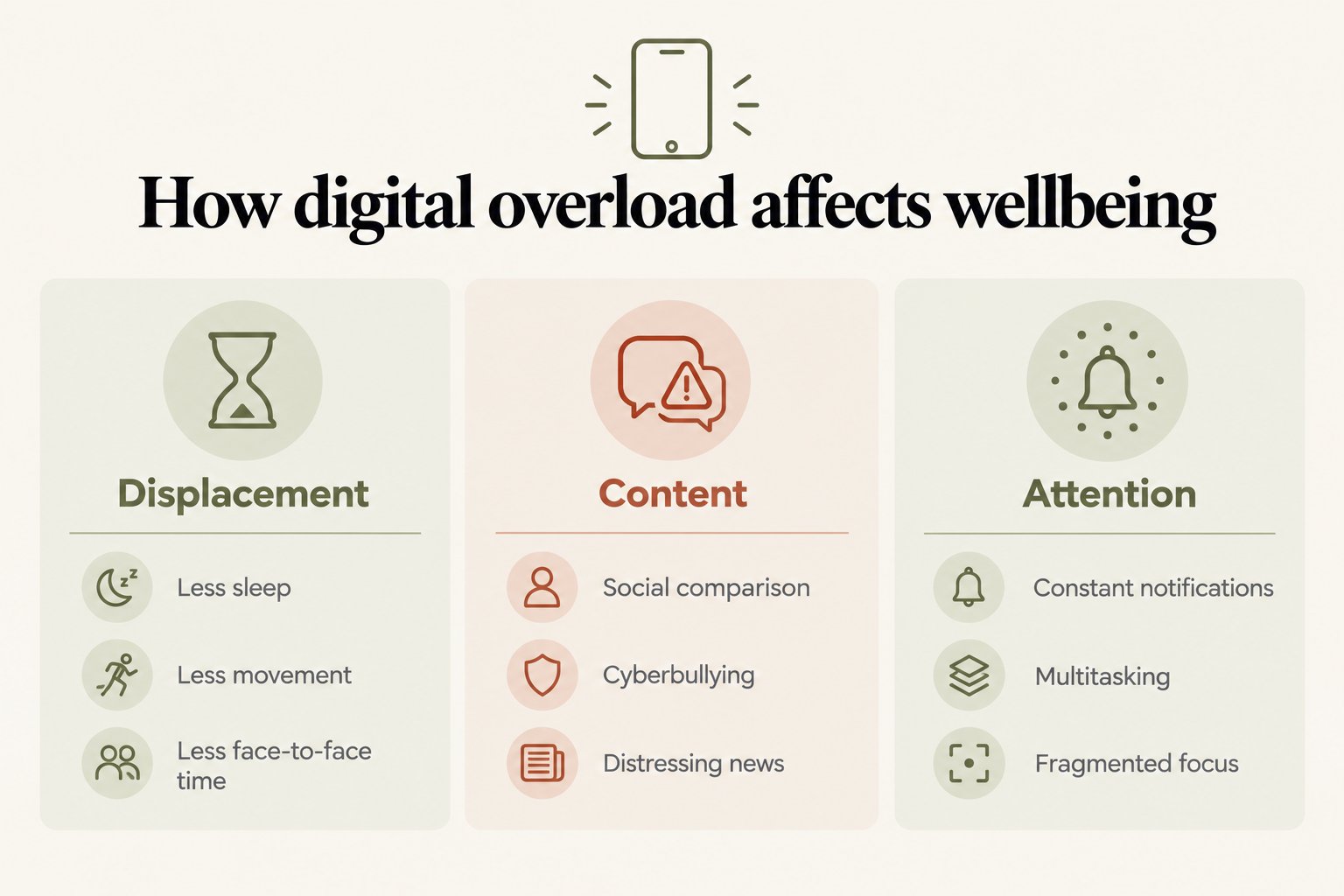
The concern is "digital overload": use that's excessive, compulsive or poorly timed, and that crowds out things we need for wellbeing. Researchers describe three broad ways screens can harm mental health:
- 1. Displacement: time on screens replaces sleep, physical activity, face-to-face time and quiet reflection.
- 2. Content: social comparison, cyberbullying, distressing news and harmful material can affect mood and self-esteem.
- 3. Attention: constant notifications and multitasking fragment attention and keep the mind in a state of low-level alertness.
What the research shows
The average effect is small. In 2019, Amy Orben and Andrew Przybylski at the University of Oxford analysed data from more than 300,000 adolescents and parents in the UK and US. They found that, on average, technology use explained at most 0.4% of differences in adolescent wellbeing. Eating potatoes regularly had a similar negative association, wearing glasses a slightly larger one, and bullying was about 4.3 times more strongly linked to poor wellbeing. Sleep and eating breakfast mattered far more than screen time. As Przybylski put it: "Our findings demonstrate that screen use itself has at most a tiny association with youth mental health."
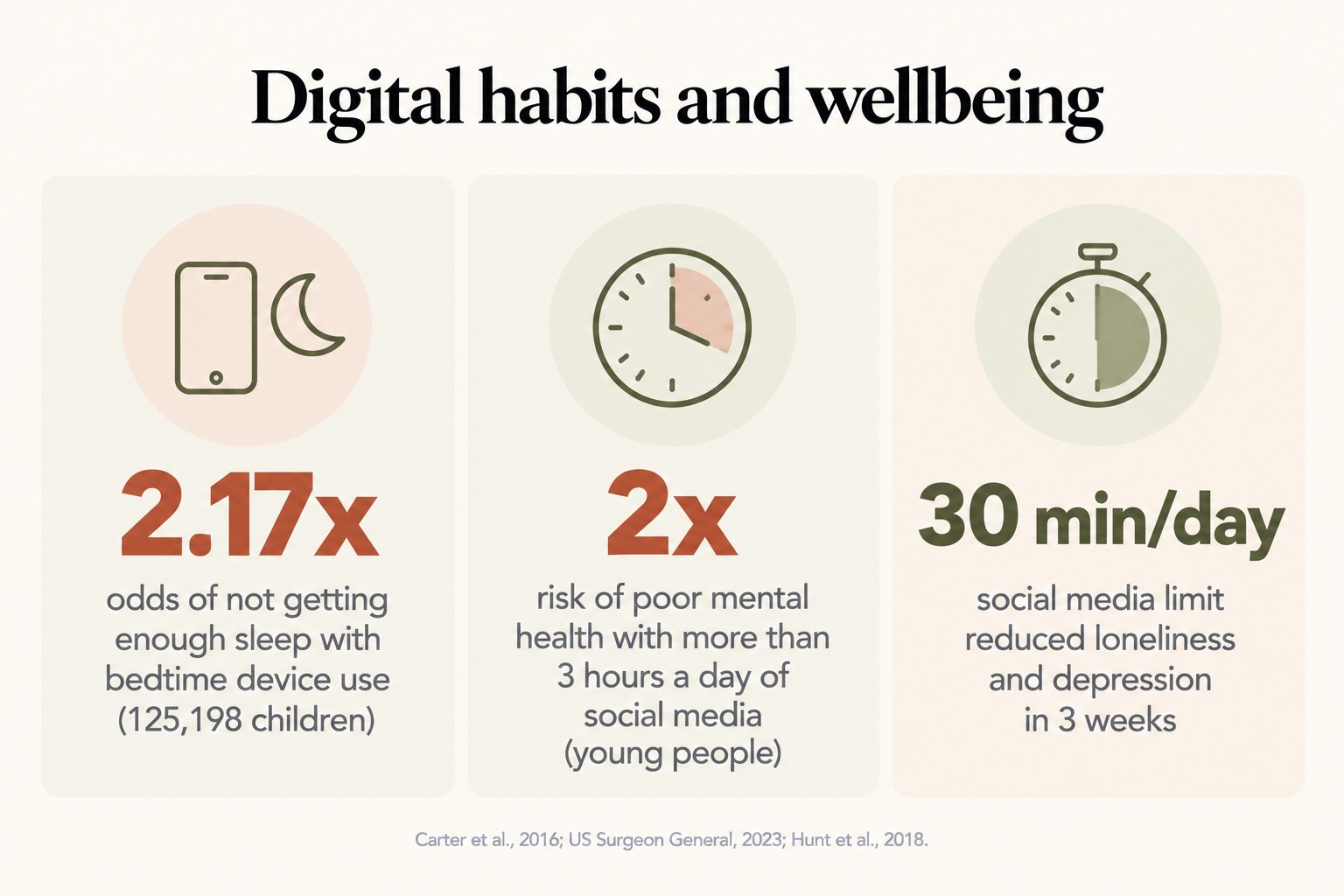
But heavy use and certain patterns matter. Averages can hide risks for particular groups and patterns of use. The US Surgeon General's 2023 advisory on social media and youth mental health reported that young people spend about 3.5 hours a day on social media, and that those using it for more than three hours a day face double the risk of poor mental health outcomes. The advisory also highlighted exposure to harmful content, cyberbullying and the effect on sleep.
Screens at bedtime harm sleep. In a 2016 meta-analysis of 20 studies with 125,198 children, Ben Carter and colleagues found that using a phone or tablet at bedtime was associated with 2.17 times the odds of inadequate sleep, 1.46 times the odds of poor sleep quality and 2.72 times the odds of excessive daytime sleepiness. Even having a device in the bedroom without using it was linked to poorer sleep. Because sleep is closely tied to mood, this may be one of the most important ways screens affect mental health (see Sleep Hygiene).
Cutting back can help adults too. Two experiments suggest that reducing social media use can improve wellbeing:
- Limiting use: in a 2018 study led by Melissa Hunt at the University of Pennsylvania, 143 students were randomly assigned to keep their usual habits or limit Facebook, Instagram and Snapchat to 10 minutes each per day (about 30 minutes in total) for three weeks. The limited group had significant reductions in loneliness and depressive symptoms. The authors concluded that "limiting social media use to approximately 30 minutes per day may lead to a significant improvement in wellbeing."
- Taking a break: in a study by economists Hunt Allcott, Matthew Gentzkow and colleagues, about 2,800 US Facebook users were randomly assigned to deactivate their accounts for four weeks or keep using them. Those who deactivated spent more time offline, including with family and friends, and reported higher subjective wellbeing. Many continued to use Facebook less after the experiment ended.
Digital life in Sri Lanka
Sri Lanka is rapidly going online. According to DataReportal, there were 13.9 million internet users in late 2025, 59.7% of the population, an increase of 1.5 million in a year, and 9 million social media user identities, equal to 38.7% of the population. Mobile connections exceeded the population at 30.3 million. Smartphones keep families connected across cities and countries, but they also bring the same challenges seen elsewhere: late-night scrolling, work messages outside working hours, online harassment, and growing concern about children's screen time.
Risk factors
| Risk factor | How it contributes | Who is most affected | What helps |
|---|---|---|---|
| Device use at bedtime | Delays sleep, reduces sleep quality | Teenagers, young adults, shift workers | Phone out of the bedroom, screen curfew |
| Heavy social media use | Comparison, displacement, exposure to harmful content | Teenagers, especially girls | Time limits, curated feeds |
| Constant notifications and work messages | Fragmented attention, no recovery time | Office workers, professionals | Notification settings, set offline hours |
| Doomscrolling news | Ongoing exposure to distressing events | Everyone during crises | Limit news checks to set times |
| Cyberbullying and harassment | Direct harm to mood and self-esteem | Young people, women | Blocking, reporting, telling someone |
| Online gambling and compulsive gaming | Addictive reward loops, financial stress | Young men | Blocking tools, specialist help |
| Long sedentary screen time | Less physical activity | All ages | Movement breaks, active hobbies |
What you can actually change
- 1. Make the bedroom a phone-free zone. Charge your phone outside the bedroom and stop screens 30-60 minutes before sleep. Use a simple alarm clock if needed.
- 2. Turn off non-essential notifications. Keep only calls and messages from people who matter; check email and social media at set times instead.
- 3. Set a daily limit. Use your phone's built-in screen-time tools. The Pennsylvania study suggests that around 30 minutes a day of social media is a useful target.
- 4. Curate what you see. Unfollow accounts that make you feel worse, and follow those that inform, inspire or connect you.
- 5. Use technology to connect, not just consume. A video call with a family member abroad is very different from an hour of scrolling.
- 6. Protect offline time. Set phone-free meals, family time and religious or reflective practices. A regular "digital sabbath" of a few hours or a day each week can reset habits.
- 7. Model healthy habits for children. Children copy what adults do. Keep devices out of children's bedrooms at night, agree family rules, and talk openly about online experiences and safety.
- 8. Notice compulsive patterns. If you can't cut down despite trying, feel anxious without your phone, or are gambling or gaming at the expense of sleep, work or relationships, seek help.
Why this matters for longevity
Digital technology isn't going away, and much of it supports health, from video calls with family to online health services. But overuse can quietly erode the foundations of wellbeing that matter most for healthy ageing: sleep, physical activity, face-to-face relationships and a calm, focused mind. Managing screen time is less about fear of technology and more about protecting the habits that keep us well (see Stress-Reduction Techniques That Work).
Practical notes
Check your phone's screen-time report for a week without changing anything, and notice when, where and how you use it. Then pick one or two changes, such as no phone in the bedroom and notifications switched off, and stick with them for three weeks. Pay attention to how you feel after using different apps: keep what leaves you connected and informed, and cut back on what leaves you anxious, envious or drained. If screen use is affecting your sleep, mood, work or relationships, or a family member's, and you can't change it alone, talk to a doctor. Our Longevity Doctors look at sleep, stress and daily habits as part of every assessment, starting with the free longevity assessment.
- Kemp, S. Digital 2026: Sri Lanka. DataReportal, 2026.
- Orben A, Przybylski AK. The association between adolescent well-being and digital technology use. Nature Human Behaviour, 2019;3(2):173-182.
- Office of the US Surgeon General. Social Media and Youth Mental Health: The U.S. Surgeon General's Advisory. 2023.
- Carter B, et al. Association between portable screen-based media device access or use and sleep outcomes: a systematic review and meta-analysis. JAMA Pediatrics, 2016;170(12):1202-1208.
- Hunt MG, et al. No more FOMO: limiting social media decreases loneliness and depression. Journal of Social and Clinical Psychology, 2018;37(10):751-768.
- Allcott H, et al. The welfare effects of social media. American Economic Review, 2020;110(3):629-676.
Free longevity assessment
Are your screen habits
affecting your health?
Take the free Aevum Protocol assessment to see how your stress & mental wellbeing and 6 other longevity domains are performing — and get a personalised 90-day plan.
Take the free assessment