Stress & Mental Wellbeing
Flourishing Is a Skill:
The Four Pillars of Wellbeing and the Five-Minute Habit
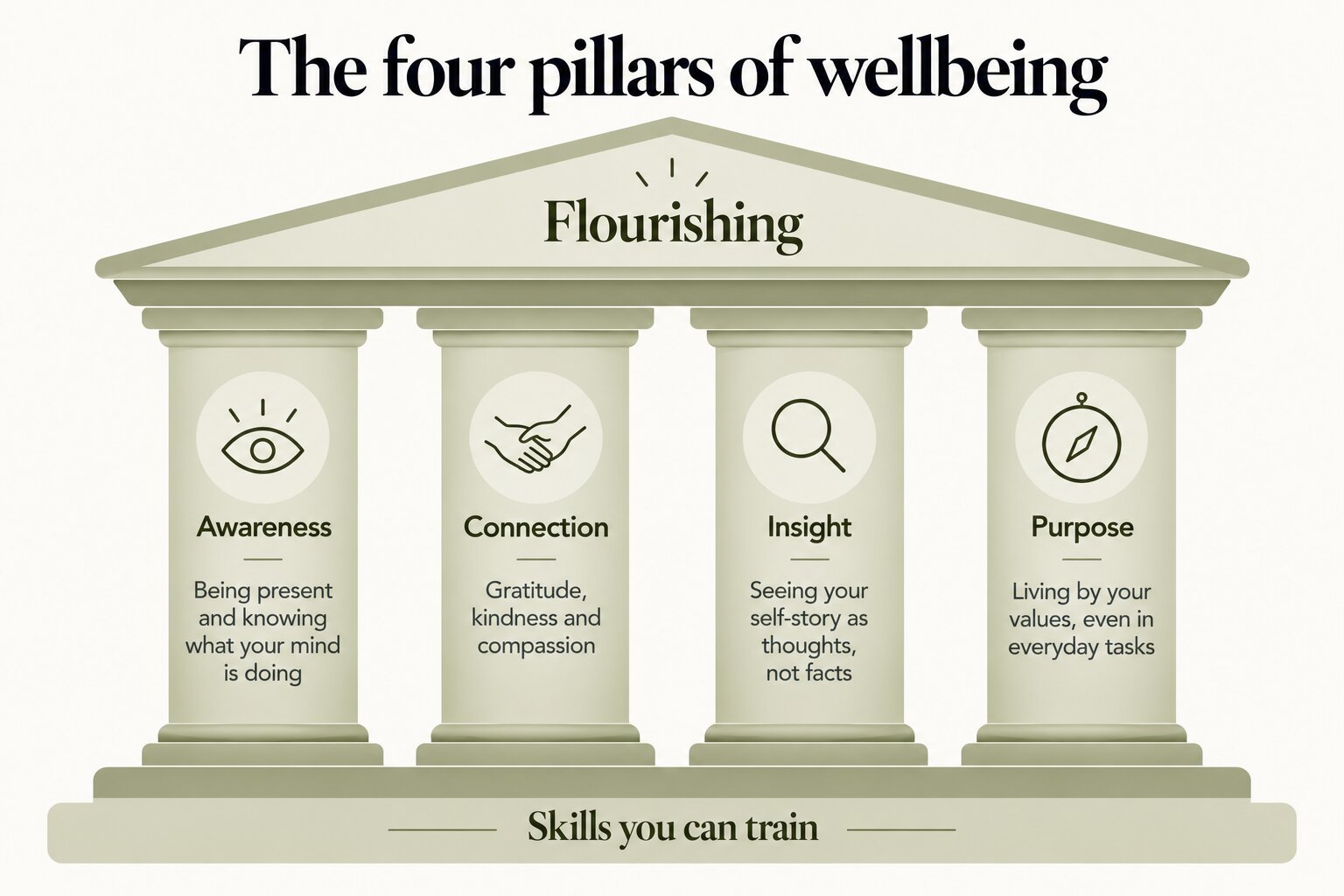
We often think of wellbeing as something that depends on personality, genes or luck. Neuroscientist Richard Davidson and colleagues at the University of Wisconsin-Madison's Center for Healthy Minds argue that it's better thought of as a set of trainable skills. In a 2020 paper they described four pillars: awareness (being present and knowing what your mind is doing), connection (gratitude, kindness and compassion), insight (seeing the story you tell about yourself as just thoughts) and purpose (living by your values, even in everyday tasks). In a trial of more than 660 school employees, four weeks of short daily practice with their free app reduced psychological distress for at least three months. Davidson reports that unpublished results suggest even five minutes a day may lower inflammation and change gut bacteria, but these await peer review. The skills can be practised while walking, eating or doing chores, and they seem to be contagious, especially to children. This article explains the four pillars, the evidence and a five-minute habit for each.
Key numbers
| Finding | Detail |
|---|---|
| Healthy Minds Program trial (660+ school employees, 4 weeks) | Less psychological distress, depression and anxiety; lasting at least 3 months |
| Spending on others (students given $5 or $20) | Spending on others made people happier than spending on themselves |
| Purpose in life (1,238 older adults, up to 5 years) | High purpose: about half the risk of death of low purpose |
| Loneliness (US Surgeon General, 2023) | Mortality risk comparable to smoking up to 15 cigarettes a day |
| Sitting alone with your thoughts (2014 study) | 67% of men and 25% of women chose a mild electric shock over doing nothing |
The four pillars
1. Awareness. Awareness means being present: noticing what's happening around you and within you, including body sensations, thoughts and feelings. A key part is meta-awareness, knowing what your mind is doing. Davidson gives the example of reading several pages of a book and suddenly realising you have no idea what you've read. That moment of noticing is meta-awareness, and it can be trained. Without it, we can't change our habits of mind.
2. Connection. Connection covers the qualities that support healthy relationships: appreciation, gratitude, kindness and compassion. What matters is the quality of your relationships, not how many people you know (see Building Social Connection). The US Surgeon General's 2023 advisory warned that social disconnection raises the risk of premature death to a level comparable to smoking up to 15 cigarettes a day (see Loneliness and Social Isolation).
3. Insight. We all carry a story about who we are, built from beliefs and expectations, and we filter the world through it. People with very negative self-stories are more prone to depression. Insight isn't so much about rewriting the story as changing your relationship to it: seeing your thoughts as thoughts, not facts.
4. Purpose. Purpose means knowing your values and what motivates you. It doesn't have to be grand. Davidson describes turning a daily chore, cleaning his cat's litter tray, into a small ritual by reflecting on how it helps the cat, his wife and anyone who enters the room. In a 2009 study of 1,238 older adults in Chicago, those with a strong sense of purpose were about half as likely to die over up to five years as those with low purpose, even after accounting for depression, disability and other illnesses (see Purpose in Life and Longevity).
What the evidence shows
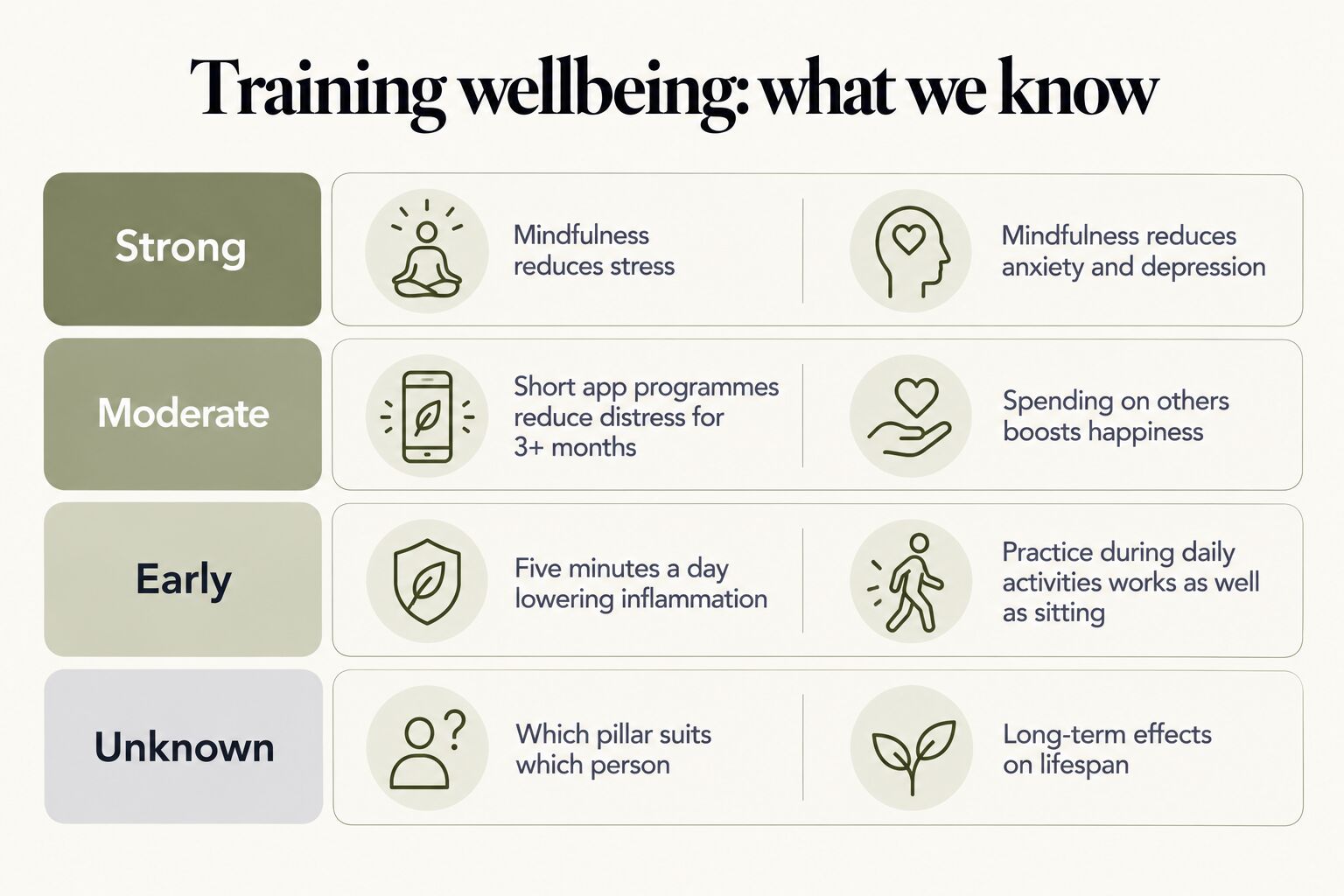
Short daily practice can help. The free Healthy Minds Program app teaches the four pillars through short guided practices, sitting or during daily activities. In a randomised trial led by Matthew Hirshberg, more than 660 school employees in Wisconsin used the app for four weeks during 2020. Compared with a control group, they had less psychological distress, fewer symptoms of depression and anxiety and greater wellbeing, with benefits lasting at least three months.
Mindset alone helps, but practice helps more. Davidson describes a large trial, now submitted for publication, comparing the full app with a "mindset-only" version that taught the ideas behind the four pillars with no meditation at all. Both helped compared with no training, with the full version working best.
Effects on the body: promising but early. In a 2003 study led by Davidson, people who completed an 8-week mindfulness course produced more antibodies in response to the flu vaccine than people who didn't. Davidson also reports that unpublished results from a trial of about 1,200 people with moderate depression, using about five minutes a day of the app for 28 days, found lower levels of IL-6, an inflammation marker, and changes in gut bacteria linked to butyrate, a compound that helps maintain the gut lining. These results haven't yet been peer-reviewed, so they should be treated as preliminary (see Meditation and Mindfulness).
You don't have to sit still. In a 2026 analysis in Mindfulness, Simon Goldberg and colleagues looked at more than 26,000 app users and 248 trial participants who could choose between sitting practices and "active" practices done while folding laundry, walking or doing other activities. About a third of practices were active, and active practice didn't appear to produce worse results. People chose their own style, so the authors called the findings preliminary.
Why it can feel harder at first
Many people find sitting with their own minds surprisingly uncomfortable. In a 2014 study in Science, Timothy Wilson and colleagues asked people to sit alone and think for 15 minutes, with the option of giving themselves a mild electric shock. 67% of men and 25% of women chose to shock themselves at least once rather than simply sit with their thoughts.
Davidson says people starting the Healthy Minds Program often feel more anxious in the first week, because they're noticing how busy their minds are for the first time. In his experience this usually settles after about a week, and anxiety then falls below where it started. If you feel this way, it doesn't mean you're doing it wrong. If practice brings up severe distress, take a break and speak to a doctor or therapist.
Five-minute habits for each pillar
You can practise all four pillars without extra time, by linking them to things you already do:
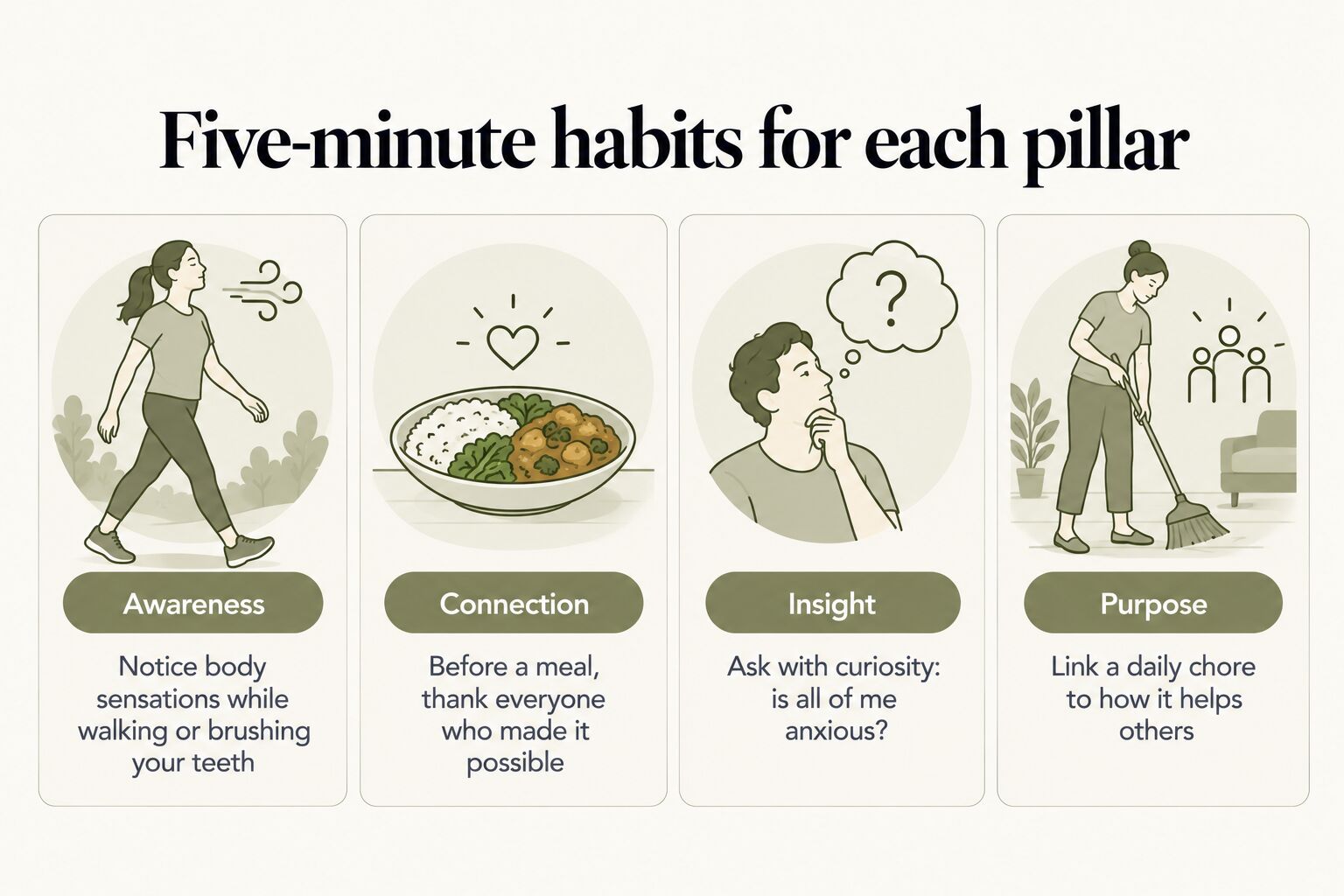
- Awareness: while brushing your teeth, walking or exercising, notice the sensations in your body. When your mind wanders, notice that it has, and come back (see Contemplative Aerobics).
- Connection: before a meal, pause to think of everyone who made it possible: farmers, transport workers, shopkeepers and the person who cooked it. Send one message of thanks or appreciation each day.
- Insight: when you notice a thought like "I'm anxious" or "I'm hopeless", ask with curiosity: "Is all of me anxious? Is there any part of me that isn't?" This loosens the grip of the story. The six emotional styles that shape how we react are explained in The Six Emotional Styles.
- Purpose: link one daily chore to a purpose beyond yourself, such as how cooking nourishes your family or how your work helps others. Spend a little money or time on someone else: in a 2008 study in Science, students given $5 or $20 were happier that evening if they spent it on others rather than themselves, whatever the amount.
Reminders help: use an app, a note on the fridge or a daily trigger such as mealtimes.
Flourishing is contagious
Davidson's advice to parents is that the most important thing isn't teaching children mindfulness, but practising it yourself: being calm, present and loving, and not constantly checking your phone around them. Children absorb their parents' emotional states, just as they absorb stress. Simple practices can also help children directly. In a 2015 trial, 4- and 5-year-olds who took part in the Center for Healthy Minds' 12-week "Kindness Curriculum" shared more and later scored higher on academic measures than a comparison group.
Why this matters for longevity
Purpose, connection and a calmer mind are linked to longer, healthier lives, and loneliness and chronic stress to higher risks of heart disease, dementia and early death. The four pillars framework suggests these aren't fixed traits but skills anyone can strengthen with a few minutes of practice a day, much like brushing your teeth.
Recommendations by situation
| Situation | What to try |
|---|---|
| Too busy to meditate | Build practices into daily activities: walking, eating, chores |
| Find sitting meditation hard | Try active practice; expect the first week to feel harder |
| Feeling lonely or disconnected | Daily gratitude at meals; one message of appreciation a day |
| Tend towards pessimism | Insight practice: question the story with curiosity |
| Retired or lacking direction | Link everyday tasks to helping others; volunteer |
| Parent of young children | Practise yourself first; try simple listening and kindness games |
| Persistent low mood or anxiety | Practices can help, but see a doctor if symptoms persist |
Practical notes
Pick one pillar this week and one five-minute habit to go with it, attached to something you already do every day. Consistency matters more than length. If you'd like guidance, the Healthy Minds Program app is free. If you or someone you know is struggling, contact the National Mental Health Helpline on 1926 or CCCline on 1333. Our Longevity Doctors include mental wellbeing in every assessment and can help you build daily habits that support it, starting with the free longevity assessment.
- Dahl CJ, Wilson-Mendenhall CD, Davidson RJ. The plasticity of well-being: a training-based framework for the cultivation of human flourishing. Proceedings of the National Academy of Sciences, 2020;117(51):32197-32206.
- Hirshberg MJ, et al. A randomized controlled trial of a smartphone-based well-being training in public school system employees during the COVID-19 pandemic. Journal of Educational Psychology, 2022;114(8):1895-1911.
- Goldberg SB, et al. Sitting and active meditation practice: utilization and associations with outcomes in naturalistic and clinical trial data. Mindfulness, 2026;17(4):1120-1137.
- Davidson RJ, et al. Alterations in brain and immune function produced by mindfulness meditation. Psychosomatic Medicine, 2003;65(4):564-570.
- Wilson TD, et al. Just think: the challenges of the disengaged mind. Science, 2014;345(6192):75-77.
- Dunn EW, Aknin LB, Norton MI. Spending money on others promotes happiness. Science, 2008;319(5870):1687-1688.
- Boyle PA, et al. Purpose in life is associated with mortality among community-dwelling older persons. Psychosomatic Medicine, 2009;71(5):574-579.
- Flook L, et al. Promoting prosocial behavior and self-regulatory skills in preschool children through a mindfulness-based kindness curriculum. Developmental Psychology, 2015;51(1):44-51.
- Office of the US Surgeon General. Our epidemic of loneliness and isolation. 2023.
- Patrick R. FoundMyFitness podcast: interview with Dr. Richard Davidson on meditation, neuroplasticity and flourishing.
Free longevity assessment
Want help building daily habits
that support your wellbeing?
Take the free Aevum Protocol assessment to see how your stress & mental wellbeing and 6 other longevity domains are performing — and get a personalised 90-day plan.
Take the free assessmentKeep reading