Stress & Mental Wellbeing
Contemplative Aerobics:
How to Train Your Mind While You Exercise
Many people ask whether they should spend their limited time meditating or exercising. Neuroscientist Richard Davidson, founder of the Center for Healthy Minds at the University of Wisconsin-Madison, argues that you don't have to choose. Exercise, especially aerobic exercise, is the best-proven way to boost neuroplasticity, the brain's ability to change and form new connections. In one trial, a year of brisk walking enlarged the hippocampus, a key memory region, by about 2%, while it shrank in a stretching group. But Davidson points out that neuroplasticity is neutral: it strengthens whatever the brain is doing at the time, positive or negative. His suggestion, which he calls "contemplative aerobics", is to pair exercise with a deliberate mental practice, such as awareness of your body or a moment of kindness or purpose, so that the brain changes exercise makes possible are steered in a healthy direction. Early research supports combining the two: in a small Rutgers study, eight weeks of 30 minutes of meditation followed by 30 minutes of aerobic exercise, twice a week, cut symptoms of depression by about 40%. The best way to combine them isn't yet known, but it takes no extra time and is easy to try. This article explains the idea, the evidence and how to practise it.
Key numbers
| Finding | Detail |
|---|---|
| Aerobic walking for a year (120 older adults) | Hippocampus grew about 2%; shrank about 1.4% with stretching |
| Meditation plus aerobic exercise (52 adults, 8 weeks) | About 40% fewer depressive symptoms in those with depression |
| Meditation or exercise training (149 adults aged 50+) | Fewer days of colds and flu than controls; meditation group missed 16 work days vs 67 |
| Extra time needed for contemplative aerobics | None: practised while preparing for and during exercise |
Why exercise and the mind belong together
Exercise grows the brain. Aerobic exercise raises levels of brain-derived neurotrophic factor (BDNF), a protein that supports the growth of new neurons and connections, especially in the hippocampus. In a 2011 trial in PNAS, Kirk Erickson and colleagues assigned 120 sedentary older adults to walk for 40 minutes three days a week or to do stretching and toning for a year. The walkers' hippocampus grew by about 2%, while the stretching group's shrank by about 1.4%, and the walkers' spatial memory improved. Larger gains were linked to higher BDNF levels (see Exercise and Brain Health).
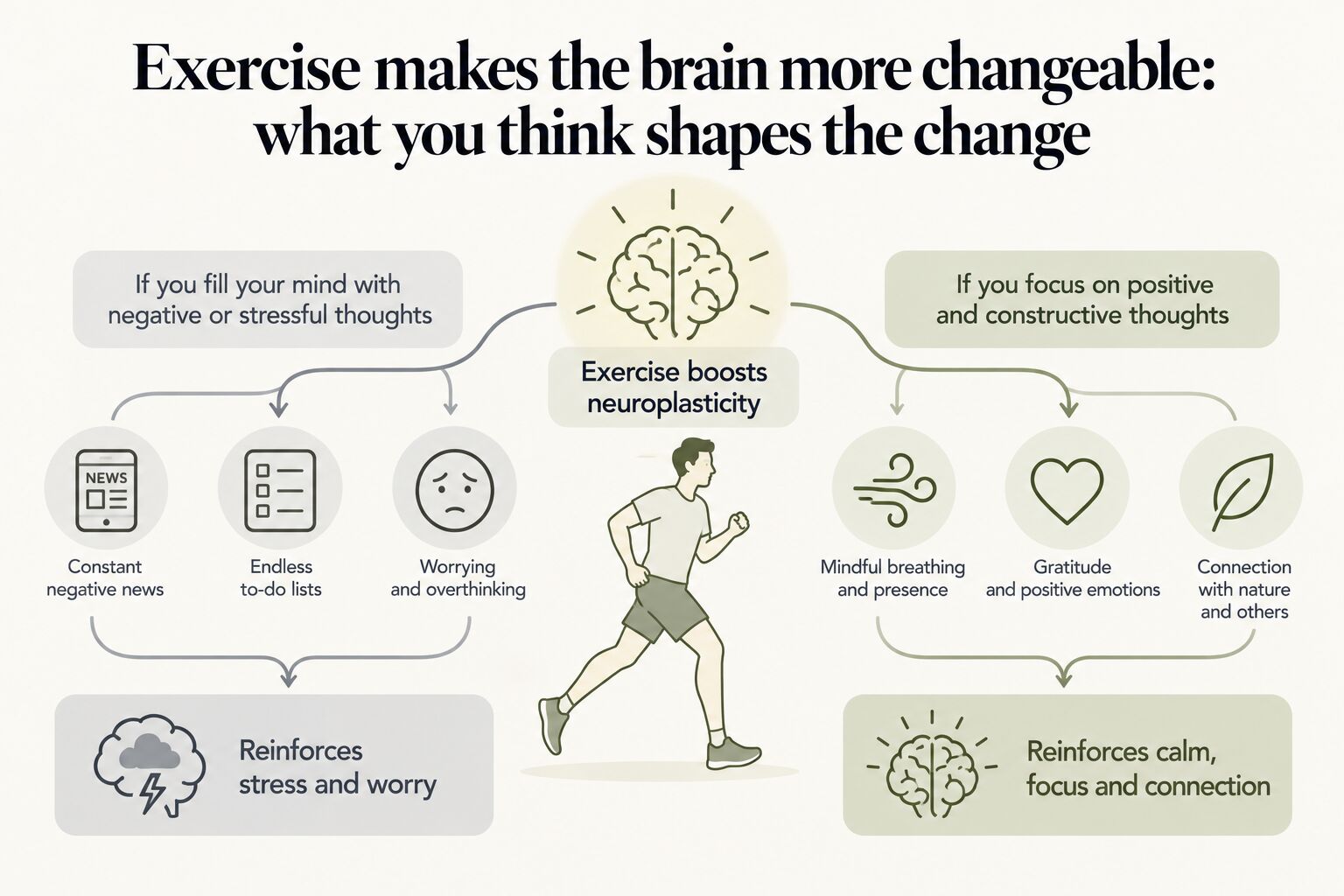
Neuroplasticity is neutral. Davidson's key point is that a brain primed to change will strengthen whatever it is repeatedly doing. If you exercise while ruminating about problems, scrolling stressful news or watching negative content on the gym television, he argues, you may be encoding those patterns more deeply. If you exercise while focusing your attention or cultivating positive states, you may be reinforcing those instead. This is Davidson's interpretation of how neuroplasticity works; it hasn't been tested directly in a trial comparing exercise with negative vs positive mental content.
What the evidence shows
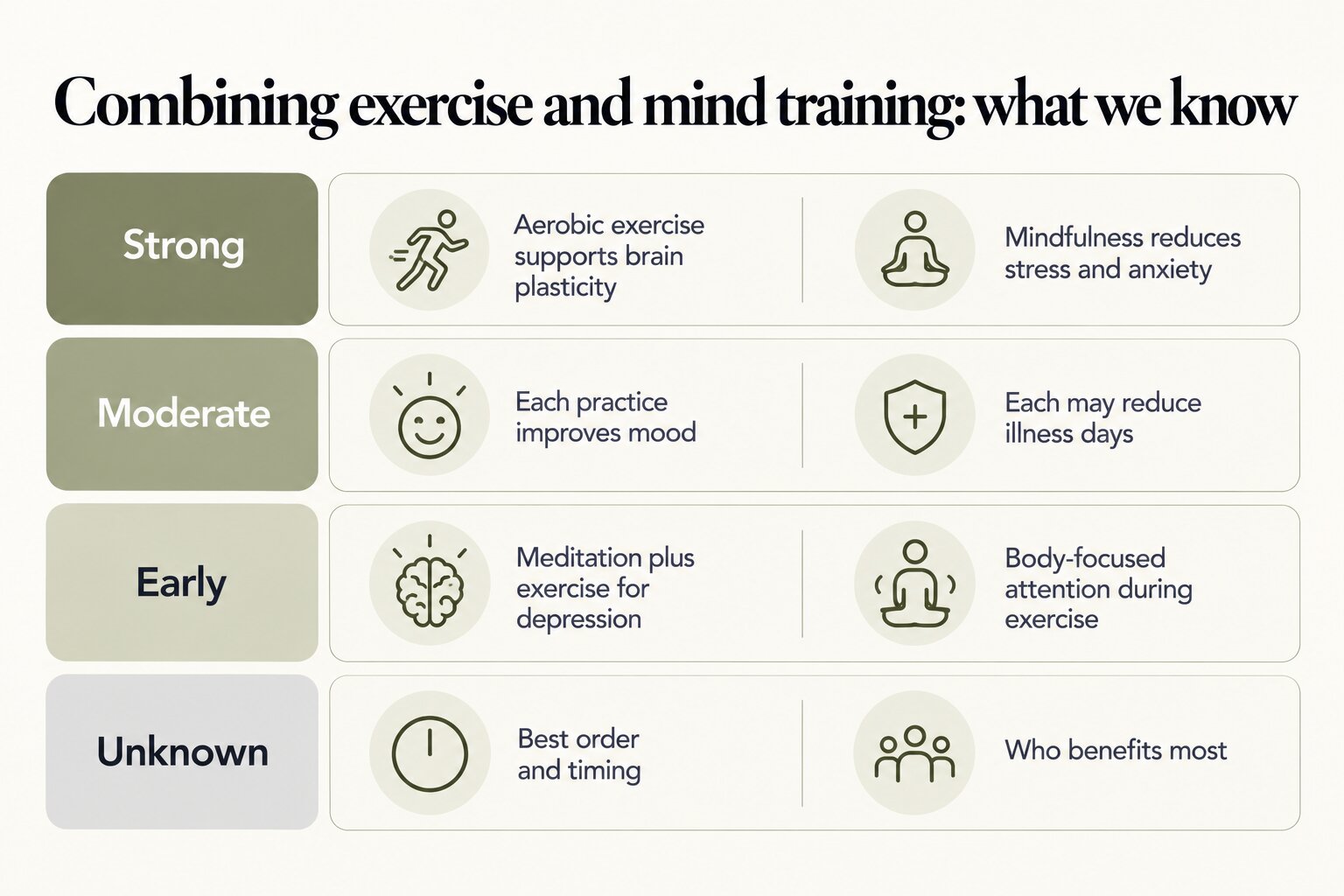
Combining meditation and exercise. In a 2016 study in Translational Psychiatry, Brandon Alderman and Tracey Shors at Rutgers University tested a programme they call MAP (mental and physical) training: 30 minutes of focused-attention meditation followed by 30 minutes of aerobic exercise, twice a week, for eight weeks. Among 52 participants, the 22 with depression reported about 40% fewer depressive symptoms, and those without depression reported less rumination and anxiety. The study was small and had no group doing exercise or meditation alone, so it can't show that the combination is better than either on its own. Davidson notes that only a few such studies exist and that "nothing has been resolved" about the ideal combination.
Each practice helps on its own. In a 2012 trial at the University of Wisconsin, 149 adults aged 50 and over were assigned to an 8-week mindfulness course, an 8-week moderate exercise programme, or no training. Over the winter, the control group had 453 days of colds and flu, compared with 257 in the meditation group and 241 in the exercise group, and missed 67 days of work, compared with 16 and 32. The study was small and some differences were borderline, but it suggests both mind and body training can affect health (see Meditation and Mindfulness).
What we don't know.
- Whether meditation should come before, during or after exercise.
- How much combined practice is needed.
- Whether some people benefit more than others. Davidson emphasises that "one size does not fit all".
How to practise contemplative aerobics
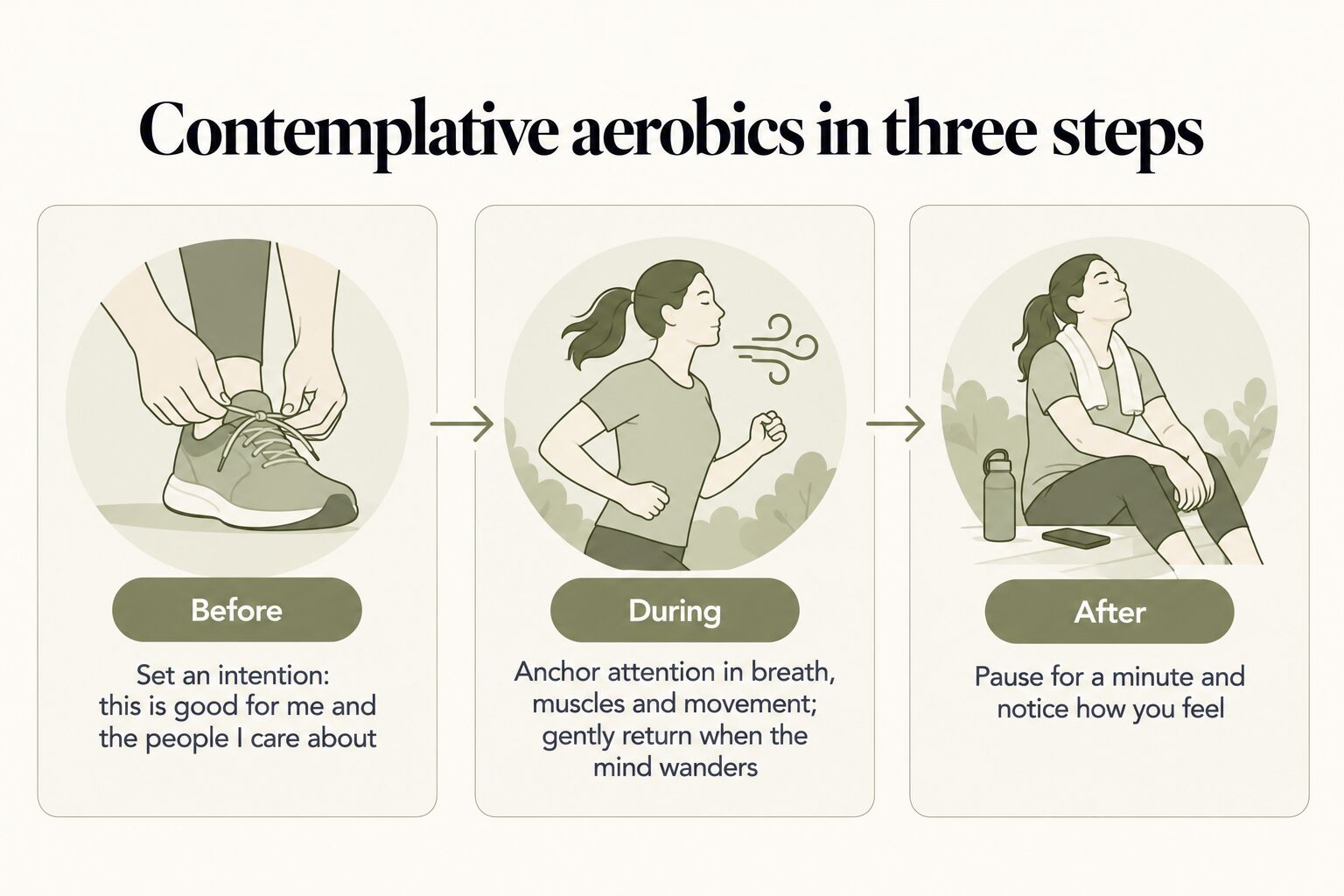
Before you start: set an intention. While putting on your shoes or warming up, take a few moments to reflect that exercising isn't only good for you, but for everyone you're connected to: your family, friends, colleagues and patients. Davidson describes caring for your own health as "a radical act of generosity". This shifts the focus from yourself to others, which is linked to better wellbeing (see Gratitude, Kindness and Positive Psychology).
During exercise: anchor your attention in your body.
- Walking or running: notice your breath, your feet touching the ground, the rhythm of your arms.
- Cycling or swimming: notice your breathing pattern and the feeling of your muscles working.
- Strength training: focus fully on the muscles you're using, your posture and your breath. Heavy lifting naturally demands this kind of attention, which is a form of mindfulness in itself.
- When your mind wanders to your to-do list or a worry, notice that it has wandered, and gently bring it back. That moment of noticing, which Davidson calls meta-awareness, is the skill being trained.
Reduce the negative inputs.
- Avoid stressful news, arguments on social media or emotionally draining content while exercising (see Digital Overload and Mental Wellbeing).
- If you like listening to something, choose music, calming audio or something uplifting.
- Exercising outdoors, or with friends, adds connection and nature.
After exercise: take one minute. Before going back to your phone or work, take a few breaths and notice how your body and mind feel. Many people find they're more focused after exercise, a good time for demanding work.
Who might benefit
- People who exercise but struggle to meditate: you can build mental skills without finding extra time.
- People who meditate but don't exercise: walking meditation is an easy way to add movement (see How to Start Meditating).
- People with stress, low mood or anxiety: both exercise and mindfulness help; combining them is a simple, low-risk option. If symptoms are severe or persistent, speak to a doctor.
- Older adults: brisk walking with attention to breath and surroundings supports both brain and body health.
Why this matters for longevity
Regular exercise and a healthy mind are both linked to longer, healthier lives, with lower risks of heart disease, dementia and depression. Contemplative aerobics is a way to get more from time you already spend exercising, by using the brain's heightened capacity for change to build attention, calm and connection rather than stress. The research is still early, but the approach is safe, free and takes no extra time.
Practical notes
Next time you exercise, try three things: set an intention while you get ready, keep your attention on your breath and body during the session, and pause for a minute afterwards before picking up your phone. Swap the news or social media for music or silence. Don't worry if your mind wanders; noticing and returning is the practice. Our Longevity Doctors consider both physical and mental wellbeing in every assessment and can help you build an exercise and mind-training routine that suits you, starting with the free longevity assessment.
- Erickson KI, et al. Exercise training increases size of hippocampus and improves memory. Proceedings of the National Academy of Sciences, 2011;108(7):3017-3022.
- Alderman BL, et al. MAP training: combining meditation and aerobic exercise reduces depression and rumination while enhancing synchronized brain activity. Translational Psychiatry, 2016;6:e726.
- Barrett B, et al. Meditation or exercise for preventing acute respiratory infection: a randomized controlled trial. Annals of Family Medicine, 2012;10(4):337-346.
- Patrick R. FoundMyFitness podcast: interview with Dr. Richard Davidson on meditation, neuroplasticity and flourishing.
Free longevity assessment
Want an exercise and mind-training
routine that suits you?
Take the free Aevum Protocol assessment to see how your stress & mental wellbeing and 6 other longevity domains are performing — and get a personalised 90-day plan.
Take the free assessment