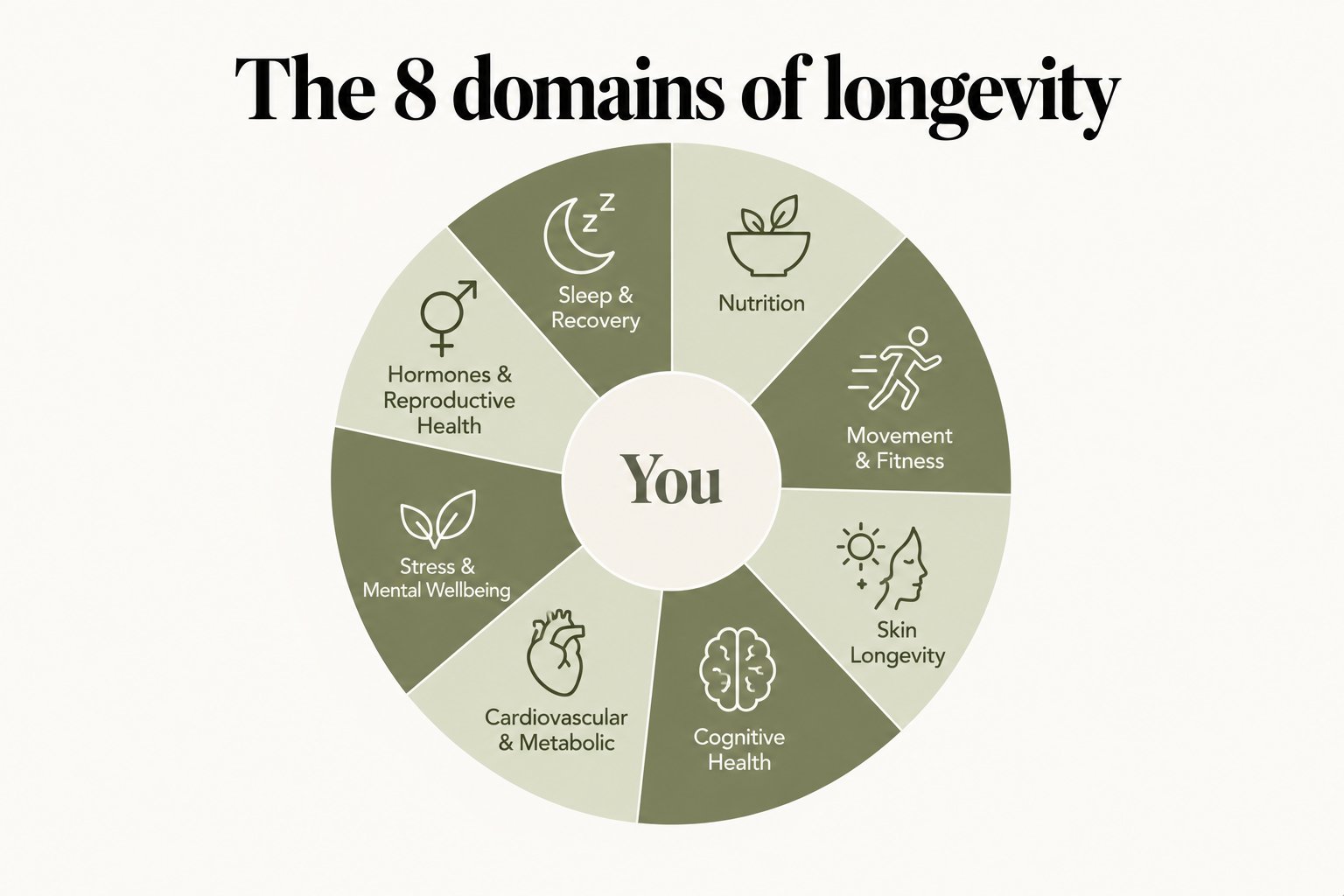
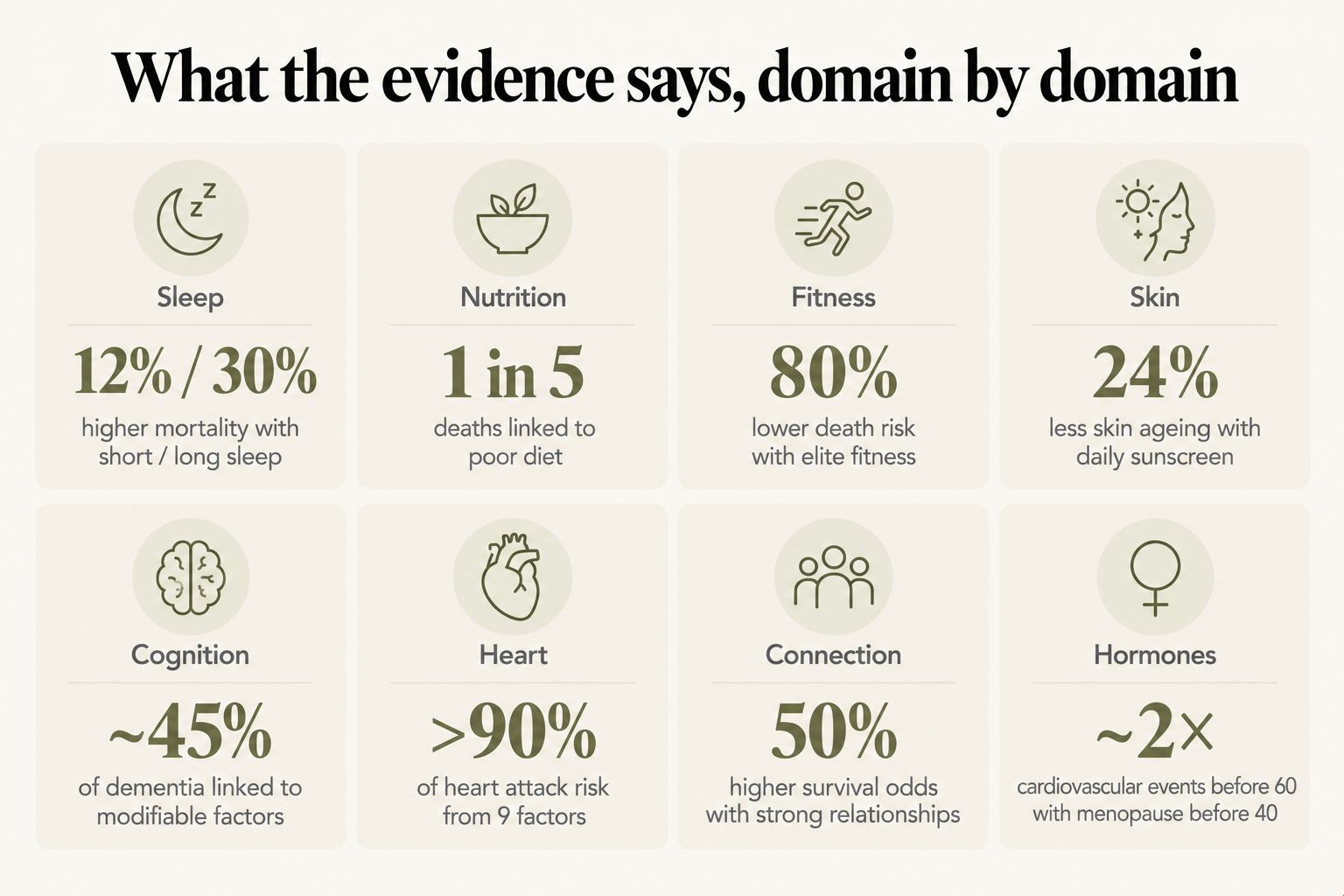
Healthy ageing doesn't depend on a single number, organ or habit. At Aevum Protocol, we assess longevity across eight connected domains: Sleep & Recovery, Nutrition, Movement & Fitness, Skin Longevity, Cognitive Health, Cardiovascular & Metabolic Health, Stress & Mental Wellbeing, and Hormones & Reproductive Health. Each is backed by strong evidence. Poor diet was linked to about 11 million deaths worldwide in 2017, one in five deaths. People with elite cardiorespiratory fitness had an 80% lower risk of death than those with low fitness. Nine modifiable risk factors explain more than 90% of heart attack risk. Strong social relationships were linked to 50% higher odds of survival. Sleeping too little or too long was associated with higher mortality. About 45% of dementia is linked to modifiable factors. Daily sunscreen led to 24% less skin ageing in a randomised trial. And women with menopause before 40 were nearly twice as likely to have a non-fatal cardiovascular event before 60. The domains also affect one another: poor sleep worsens appetite and stress; fitness supports brain health; hormones influence heart risk. That's why we assess them together, to find the areas where change will make the biggest difference for you. This article explains each domain and why it matters.
Key numbers
| Domain | One key finding |
|---|---|
| Sleep & Recovery | Short sleep linked to 12% and long sleep to 30% higher mortality (1.4 million people) |
| Nutrition | Poor diet linked to about 11 million deaths in 2017, 1 in 5 deaths worldwide |
| Movement & Fitness | Elite vs low fitness: 80% lower risk of death (122,007 people) |
| Skin Longevity | Daily sunscreen: 24% less skin ageing over 4.5 years |
| Cognitive Health | About 45% of dementia linked to 14 modifiable risk factors |
| Cardiovascular & Metabolic Health | Nine modifiable factors explain over 90% of heart attack risk |
| Stress & Mental Wellbeing | Strong social relationships: 50% higher odds of survival (148 studies) |
| Hormones & Reproductive Health | Menopause before 40: nearly twice the risk of a non-fatal cardiovascular event before 60 |
Why domains, not just numbers
A single blood test or biological age score can't capture how well you're ageing. Someone may have perfect cholesterol but sleep five hours a night, or be fit but chronically stressed. Looking at eight domains gives a fuller picture of where your risks and strengths lie (see What Is Longevity Medicine?).
The 8 domains
1. Sleep & Recovery. Sleep supports memory, metabolism, immunity and repair. A 2010 meta-analysis of 16 studies with more than 1.3 million people found that short sleep (usually under 7 hours) was linked to a 12% higher risk of death, and long sleep (usually over 8-9 hours) to 30% higher risk, although long sleep may partly reflect existing illness (see Sleep Duration and Longevity).
2. Nutrition. What you eat affects nearly every other domain. The Global Burden of Disease study estimated that poor diet was linked to about 11 million deaths in 2017, one in five deaths worldwide, more from eating too little healthy food, such as whole grains and fruit, than from eating too much unhealthy food (see Eating Patterns for Longevity).
3. Movement & Fitness. Fitness, strength and mobility are among the strongest predictors of long life. In a study of 122,007 people who had treadmill tests, those with elite cardiorespiratory fitness had an 80% lower risk of death over about 8 years than those with low fitness.
4. Skin Longevity. Skin is both a visible sign of ageing and an organ in its own right. In a randomised trial of 903 Australian adults under 55, those who applied sunscreen daily for 4.5 years showed 24% less skin ageing than those who used it at their own discretion.
5. Cognitive Health. Memory, thinking and brain health determine independence in later life. The 2024 Lancet Commission found that 14 modifiable risk factors, including hearing loss, high LDL cholesterol, physical inactivity, high blood pressure and social isolation, account for about 45% of dementia cases (see The MIND Diet and Brain Health).
6. Cardiovascular & Metabolic Health. Heart disease is the leading cause of death worldwide, and diabetes and insulin resistance drive many other conditions. In the INTERHEART study across 52 countries, nine modifiable risk factors explained more than 90% of the risk of a heart attack (see The Major Diseases of Ageing).
7. Stress & Mental Wellbeing. Chronic stress, low mood and isolation affect sleep, hormones, inflammation and behaviour. A meta-analysis of 148 studies found that people with stronger social relationships had 50% higher odds of survival over an average of 7.5 years, an effect comparable to that of smoking.
8. Hormones & Reproductive Health. Hormones influence energy, body composition, bone, heart and brain health at every stage of life. In a pooled analysis of more than 300,000 women, those who reached menopause before 40 were nearly twice as likely to have a non-fatal cardiovascular event before 60 as women with menopause at 50-51 (see Reproductive Health by Life Stage).
Why they're assessed together
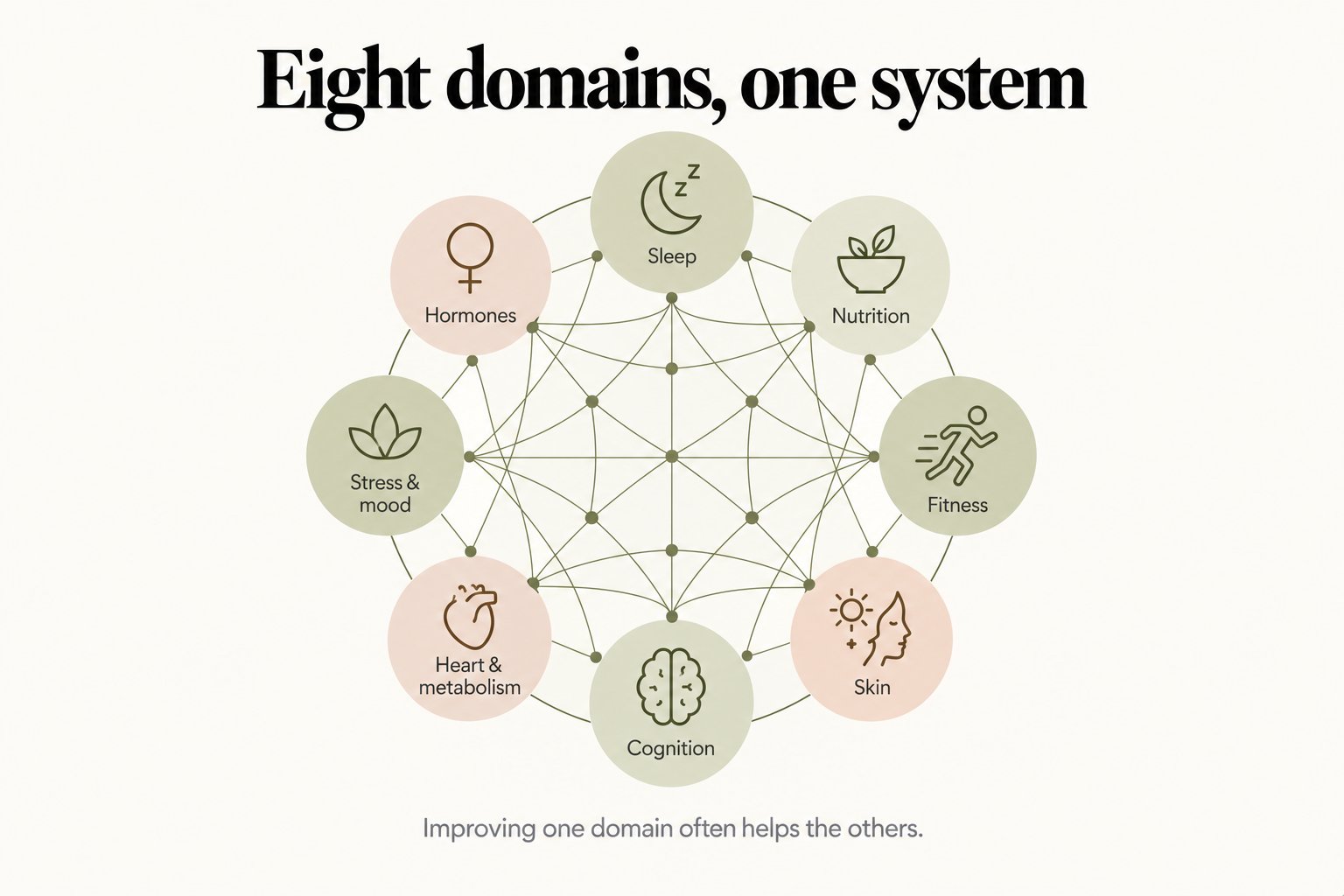
The domains are closely connected:
- Poor sleep affects appetite, blood sugar, mood and stress.
- Chronic stress disrupts sleep, raises blood pressure and can affect hormones.
- Fitness and diet influence heart, metabolic, brain and skin health.
- Hormonal changes, such as menopause or low testosterone, affect sleep, mood, body composition and cardiovascular risk.
Because of these links, improving one domain often helps others, and a problem in one domain can hold back progress in the rest. Assessing all eight together reveals your priorities: the two or three areas where change will make the biggest difference.
Why this matters for longevity
The same biology of ageing underlies all eight domains (see The Hallmarks of Ageing), and the same everyday habits improve them together (see From Hallmarks to Habits). A domain-based approach helps avoid two common mistakes: focusing on one impressive number while missing a bigger risk elsewhere, and trying to change everything at once.
Practical notes
Start by asking yourself which domain feels weakest: is it sleep, fitness, stress, diet or something else? Small changes in your weakest domain often bring the biggest gains, and they tend to improve other domains too. Each domain has its own section in our Learn library, with practical guides. Our free 40-question longevity assessment scores you across all eight domains and highlights your priorities, and our Longevity Doctors can turn those results into a personalised plan.
- Cappuccio FP, et al. Sleep duration and all-cause mortality: a systematic review and meta-analysis of prospective studies. Sleep, 2010;33(5):585-592.
- GBD 2017 Diet Collaborators. Health effects of dietary risks in 195 countries, 1990-2017. The Lancet, 2019;393(10184):1958-1972.
- Mandsager K, et al. Association of cardiorespiratory fitness with long-term mortality among adults undergoing exercise treadmill testing. JAMA Network Open, 2018;1(6):e183605.
- Hughes MCB, et al. Sunscreen and prevention of skin aging: a randomized trial. Annals of Internal Medicine, 2013;158(11):781-790.
- Livingston G, et al. Dementia prevention, intervention, and care: 2024 report of the Lancet standing Commission. The Lancet, 2024;404(10452):572-628.
- Yusuf S, et al. Effect of potentially modifiable risk factors associated with myocardial infarction in 52 countries (the INTERHEART study). The Lancet, 2004;364(9438):937-952.
- Holt-Lunstad J, et al. Social relationships and mortality risk: a meta-analytic review. PLOS Medicine, 2010;7(7):e1000316.
- Zhu D, et al. Age at natural menopause and risk of incident cardiovascular disease: a pooled analysis of individual patient data. The Lancet Public Health, 2019;4(11):e553-e564.
Free longevity assessment
See your own results
across all 8 domains
Take the free Aevum Protocol assessment to see how your longevity 101 and 6 other longevity domains are performing — and get a personalised 90-day plan.
Take the free assessment