Sleep & Recovery
Sleep Duration and Longevity: How
Many Hours Actually Matter
Our Sleep Architecture article covered what happens inside a night of sleep — the stages, and why composition matters as much as total hours. This article steps back to the simpler, more fundamental question: how many hours actually matters for a long, healthy life? The honest answer involves a genuinely well-documented curve, a real debate about causation, and more individual variation than most sleep advice acknowledges.
Quick Summary
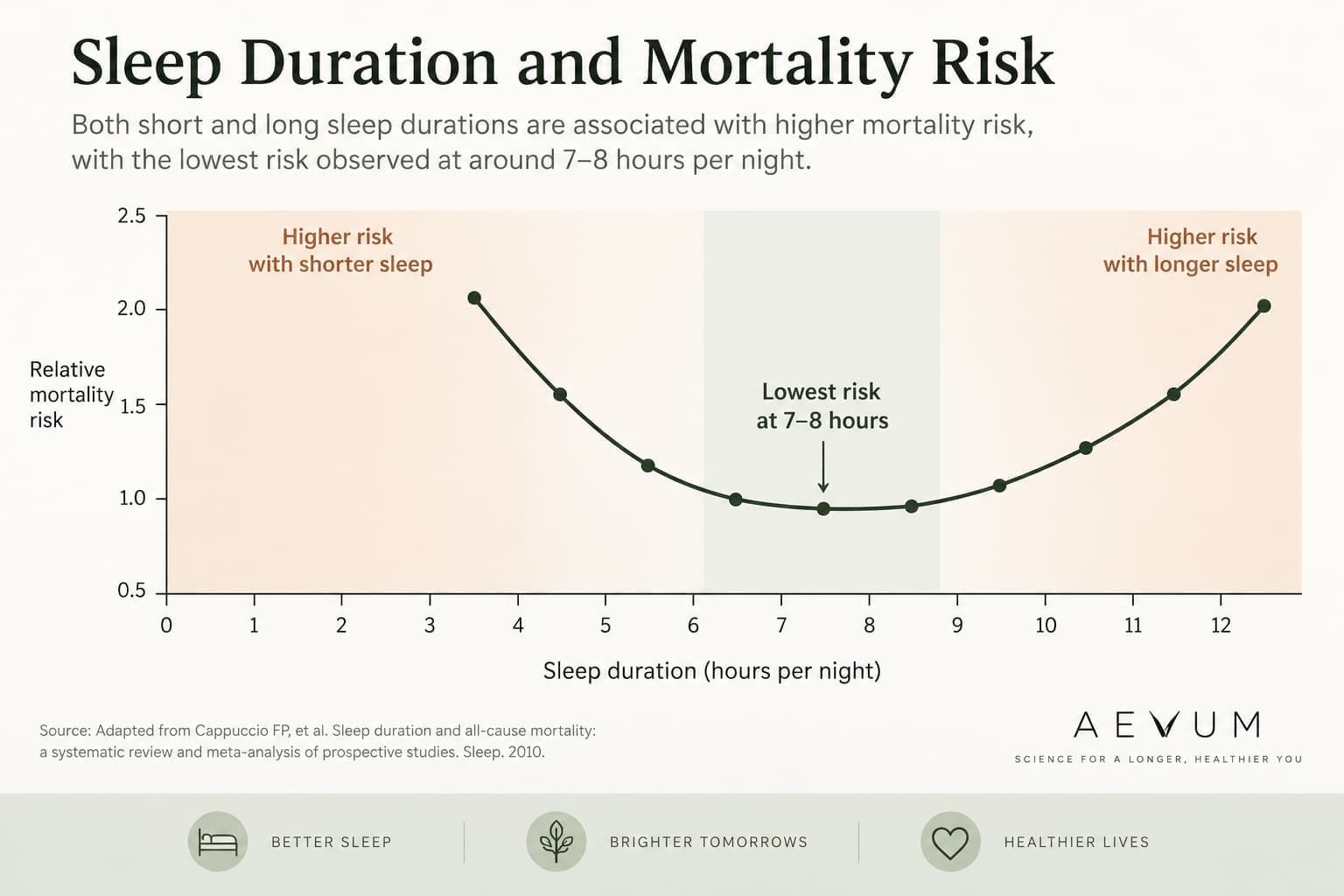
- →The relationship between sleep duration and mortality risk is U-shaped, not linear — both consistently short sleep (under 7 hours) and consistently long sleep (9+ hours) are associated with higher all-cause mortality than the middle range, across dozens of large studies
- →The lowest risk consistently clusters around 7 hours in the largest meta-analyses — not 8, as commonly assumed, though the difference between 7 and 8 is modest compared to the risk at the extremes. Practically, 7–8 hours is a reasonable nightly target for most healthy adults
- →The long-sleep side of the curve is genuinely more debated than the short-sleep side — a meaningful amount of evidence suggests long sleep may partly reflect underlying illness rather than cause harm on its own, a distinction worth understanding rather than assuming oversleeping is equally dangerous to undersleeping
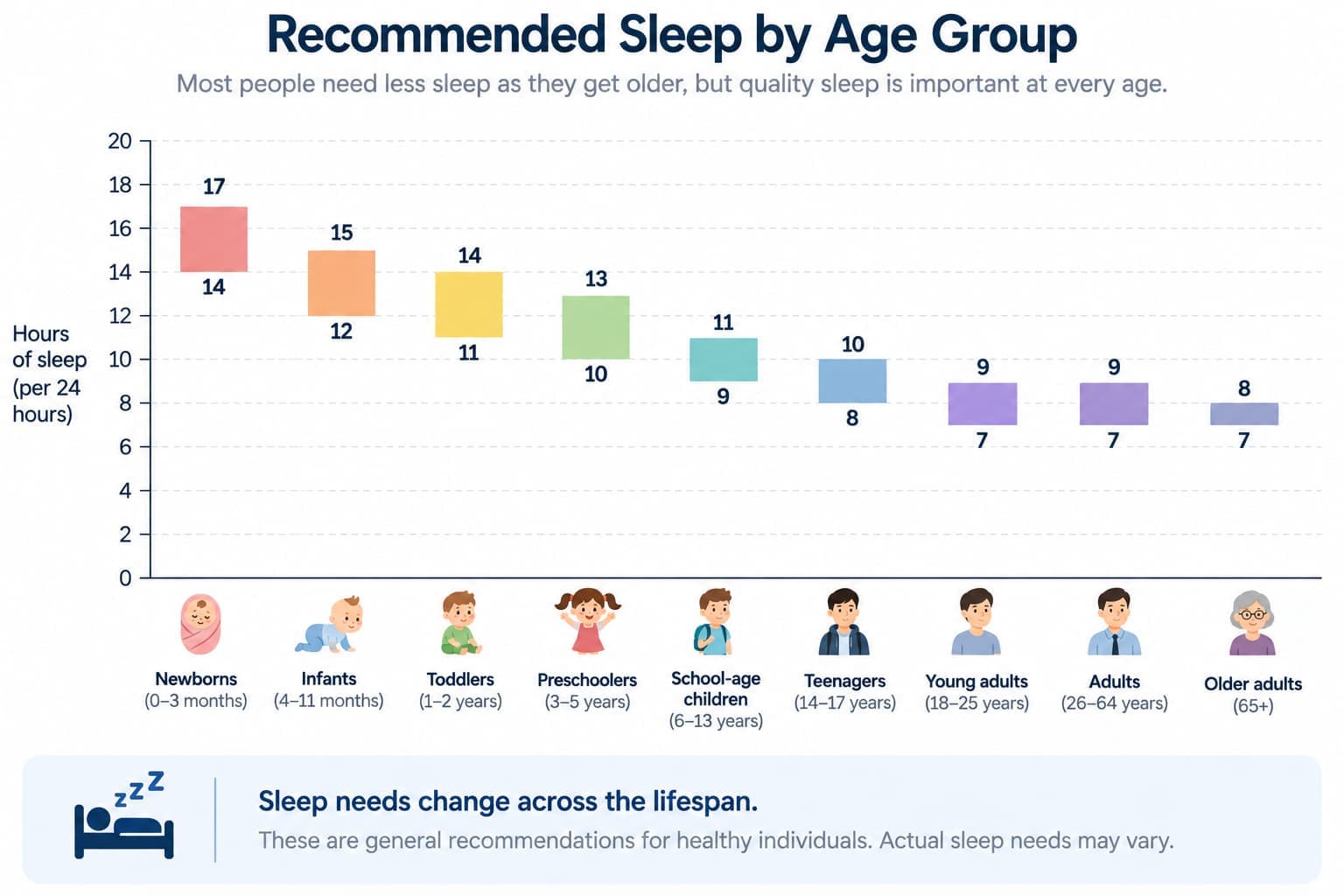
- →Recommended sleep duration changes dramatically across life — from 14–17 hours for newborns down to 7–8 hours for older adults, reflecting real, well-documented biological differences, not arbitrary guidance
- →A small number of people genuinely thrive on less sleep due to a rare genetic mutation — a real phenomenon, but one that applies to a tiny fraction of the population, not a licence for most people to assume they're the exception
Key numbers at a glance
| Measure | Figure |
|---|---|
| Lowest-mortality-risk sleep duration (large meta-analyses) | ~7 hours/night |
| Relative mortality risk at 4 hours, vs. 7 | ~7% higher |
| Relative mortality risk at 11 hours, vs. 7 | ~55% higher |
| Type 2 diabetes risk at <6 hours, vs. 7 | ~30% higher |
| Recommended adult range (AASM/NSF) | 7–9 hours |
| Natural short sleepers in the general population | Rare (specific gene mutation) |
The recommended range, by age
Sleep needs change substantially across a lifetime, reflecting real underlying biology — particularly during childhood and adolescence, when sleep supports active brain and physical development, not just daily recovery. The consensus figures below come from a joint panel of the American Academy of Sleep Medicine and National Sleep Foundation, following a systematic review of the scientific literature.
| Age Group | Recommended Sleep (per 24 hours) |
|---|---|
| Newborns (0–3 months) | 14–17 hours |
| Infants (4–11 months) | 12–15 hours |
| Toddlers (1–2 years) | 11–14 hours |
| Preschoolers (3–5 years) | 10–13 hours |
| School-age children (6–13 years) | 9–11 hours |
| Teenagers (14–17 years) | 8–10 hours |
| Young adults (18–25 years) | 7–9 hours |
| Adults (26–64 years) | 7–9 hours |
| Older adults (65+) | 7–8 hours |
Sleep needs generally decline with age up to around 60, then plateau — the drop from childhood to adulthood is genuinely dramatic, while the difference between adults and older adults is comparatively small.
What the research shows
The U-shaped curve. Large-scale research on sleep duration and mortality consistently finds a U-shaped (or J-shaped) curve, not a straight line where more sleep is simply better. One dose-response meta-analysis of over 1.5 million participants found the lowest mortality risk at approximately 7 hours per night, with risk rising on both sides — a 2016 meta-analysis found that, compared to 7 hours, sleeping 4 hours carried roughly 7% higher relative mortality risk, while sleeping 11 hours carried a striking 55% higher relative risk. The pattern holds specifically for cardiovascular disease and stroke as well as all-cause mortality, and it's been replicated across numerous independent cohort studies and meta-analyses spanning different countries and populations. Short sleep is thought to contribute to this risk through mechanisms including increased sympathetic nervous system activity, systemic inflammation, and the metabolic disruption covered in our Sleep Architecture article's discussion of insulin sensitivity.
Long sleep's association with higher mortality is real and consistently observed — but the direction of that relationship is less settled than the short-sleep side. A meaningful body of research suggests long sleep duration may often be a marker of underlying poor health (depression, chronic inflammation, undiagnosed illness, or conditions that cause fatigue and excessive sleep) rather than something that independently causes harm the way short sleep appears to. Some methodological reviews have gone further, arguing that measurement inconsistencies and inadequate control for underlying illness across studies make the long-sleep mortality association harder to interpret confidently than it's often presented. This isn't a reason to dismiss the long-sleep finding — it's remained consistent across too many independent studies to ignore entirely — but it is a reason to treat "I regularly need 9+ hours and still feel tired" as a signal worth investigating with a doctor, rather than either ignoring it or assuming the extra sleep itself is the direct problem.
What short sleep specifically does. Unlike the long-sleep association, short sleep's negative effects are more consistently supported by both observational and experimental research, including studies that manipulate sleep duration directly rather than just observing it.
- →Cardiovascular risk rises measurably with chronic short sleep, reflected in the stroke and cardiovascular disease findings from the same large meta-analyses covered above
- →Metabolic and insulin effects — covered in more depth in our Sleep Architecture article, where a landmark study found that reduced deep sleep specifically (with total duration held constant) meaningfully worsened insulin sensitivity, showing the mechanism runs through sleep quality and quantity together
- →Immune function is measurably impaired by short sleep — a widely cited study found that people sleeping under 6 hours a night were substantially more likely to develop a cold after controlled exposure to a common cold virus, compared to those sleeping 7+ hours
- →All-cause mortality risk, as covered above, rises incrementally with each hour of sleep lost below the 7-hour mark
The genetic exception. A small, well-documented population of people carry rare mutations — most famously in the DEC2 gene — that allow them to function normally, and apparently healthily, on around 6 hours of sleep a night, without the negative effects typically seen in short sleepers. Research since the gene's 2009 discovery has found these "natural short sleepers" don't show the usual markers of sleep deprivation, and animal studies suggest the same mutation may even support healthier aging through effects on cellular stress resistance, independent of the reduced sleep itself.
This is a genuinely interesting finding, but not a licence for the general population to assume they're a natural short sleeper. True DEC2-type natural short sleepers are rare, and most people who believe they function well on 5–6 hours are, in reality, chronically sleep-deprived and simply adapted to feeling that way — subjective feeling of alertness is a notoriously unreliable indicator of actual cognitive impairment from sleep loss, which is part of why the population-level mortality data remains the more reliable guide for nearly everyone.
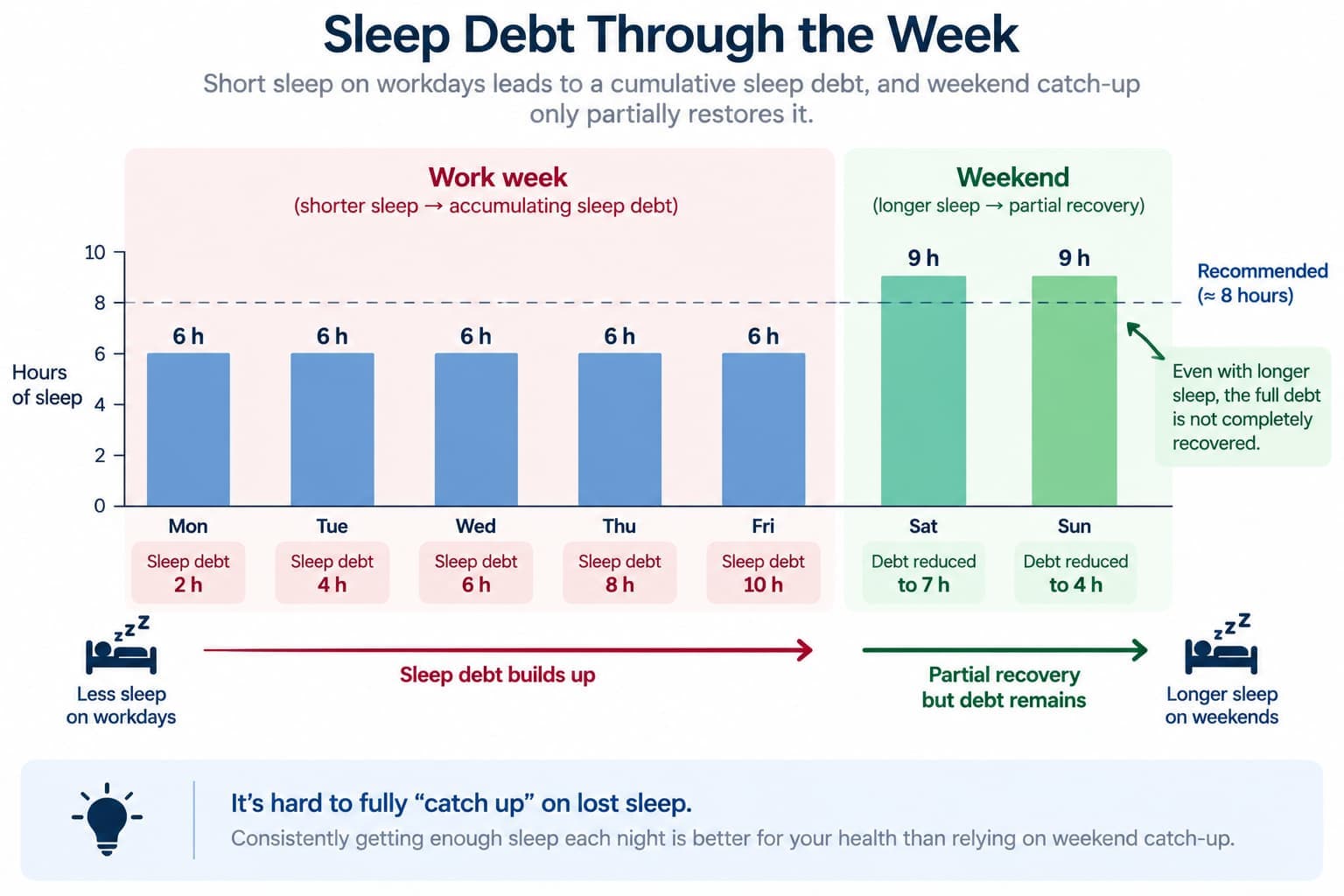
Can you "catch up" on lost sleep? This is a common and genuinely reasonable question, and the honest answer is: partially, but not completely. Some epidemiological research finds that people who get meaningful weekend catch-up sleep after short weekday nights have somewhat better outcomes than those who stay short all week — one study found an extra hour of weekend catch-up sleep associated with notably lower hypertension risk. But controlled experimental research on catch-up sleep's ability to reverse the metabolic effects of chronic short sleep — including insulin sensitivity — has produced more mixed results, suggesting recovery sleep helps but doesn't necessarily undo the full physiological cost of a pattern of chronic weekday sleep restriction. The more reliable takeaway: consistent, adequate sleep across the week is a better strategy than accumulating debt and attempting to repay it, even though some repayment is clearly better than none.
Recommendations by population group
- 1Older adults
The recommended range narrows slightly (7–8 hours) but doesn't drop dramatically — persistent short sleep in this group shouldn't be dismissed as a normal, harmless feature of ageing.
- 2Teenagers
Genuinely need more sleep than adults for real biological reasons tied to brain development, not personal preference — chronic short sleep in this age group deserves the same seriousness as in adults, arguably more given the developmental stakes.
- 3Anyone regularly sleeping 9+ hours and still feeling unrested
Worth raising with a doctor rather than assuming more sleep is inherently better — this pattern can be a signal of an underlying condition worth identifying.
- 4Shift workers and those with irregular schedules
Total hours matter, but consistency matters too, as covered in our Sleep Architecture article — accumulating debt during a working week and attempting to fully repay it on days off is a genuinely imperfect strategy, not a solved problem.
- 5General / longevity-focused
Given how consistently the 7-hour range shows the lowest mortality risk across independent, large-scale research, sleep duration is one of the more evidence-backed levers in a longevity strategy — arguably deserving the same deliberate attention typically given to diet and exercise, rather than being treated as whatever time is left over.
Practical notes
- →7 hours, not 8, is where the largest studies consistently place the lowest-risk point — a useful correction to the commonly assumed "8 hours" figure, though the practical difference between 7 and 8 is small compared to the risk at the extremes
- →The short-sleep side of the curve has stronger causal evidence than the long-sleep side — worth keeping this asymmetry in mind rather than treating both ends of the curve as equally well-established
- →Feeling alert on little sleep is not a reliable sign of being a genetic short sleeper — true natural short sleepers are rare, and subjective alertness is a poor judge of actual cognitive impairment from sleep loss
- →Weekend catch-up sleep helps, but doesn't fully reverse the effects of chronic weekday sleep restriction — consistency across the whole week is the more reliable strategy
- →Sleep needs by age reflect real, well-documented biology, not arbitrary guidelines — dismissing a teenager's higher sleep need as laziness, for example, runs against the evidence
Sleep duration is one of the more consistently studied, evidence-backed levers in longevity research — the U-shaped curve has been replicated often enough to be one of the more trustworthy findings in this area, even as the long-sleep side of that curve remains genuinely more complicated than the short-sleep side. For how sleep composition — not just duration — affects the same outcomes, see our Sleep Architecture article. If you'd like a clearer picture of your own sleep patterns and their impact on your long-term health, our Longevity Doctors offer a free longevity assessment as a starting point.
How does your sleep
score on your longevity assessment?
Take the free Aevum Protocol assessment to see how your sleep & recovery and 6 other longevity domains are performing — and get a personalised 90-day plan.
Take the Free Assessment →