Sleep & Recovery
Sleep Architecture: What Actually
Happens While You Sleep
Most people think about sleep in terms of hours — did I get seven, did I get eight. But total duration only tells part of the story. What happens inside those hours — the specific stages the brain cycles through, and how much time is spent in each — turns out to matter just as much, and is increasingly tied to some of the most consequential longevity research being done today, particularly around brain ageing and dementia risk. This article covers what sleep architecture actually is, what each stage does, and why it changes as we age.
Quick Summary
- →Sleep isn't one uniform state — it cycles through distinct stages roughly every 90–110 minutes, 4–6 times a night, each with a different brain activity pattern and a different job
- →Deep sleep (N3) is when the brain's waste-clearance system works hardest — the glymphatic system, which clears metabolic waste including amyloid-beta (a protein implicated in Alzheimer's disease), drains substantially faster during this stage than during wakefulness
- →REM sleep is concentrated in the second half of the night, which is why cutting sleep short at the end — even by an hour — disproportionately costs REM rather than deep sleep. Practically, this means protecting your wake-up time by going to bed earlier preserves REM better than sleeping in
- →Deep sleep declines significantly with age, and this decline is now understood to be mechanistically connected to reduced brain waste clearance and rising dementia risk, not just a harmless feature of getting older
- →A landmark study found that suppressing deep sleep alone — with total sleep duration held completely unchanged — dropped insulin sensitivity by roughly 25% in just three nights, an effect comparable to significant weight gain, showing architecture can matter as much as duration for metabolic health
- →Not all sleep disruptions affect architecture equally — alcohol suppresses REM specifically, sleep apnea fragments deep sleep specifically, and losing the right stage can matter more than losing the same number of total hours a different way
Key numbers at a glance
| Measure | Figure |
|---|---|
| Length of one full sleep cycle | ~90–110 minutes |
| Cycles per typical night | 4–6 |
| Share of night spent in NREM | ~75–80% |
| Share of night spent in REM | ~20–25% |
| Increase in brain fluid clearance during sleep vs. wakefulness | 60%+ |
| Drop in insulin sensitivity after 3 nights of selective deep sleep suppression | ~25% |
| Estimated decline in glymphatic clearance efficiency with advancing age | ~40% |
How it works: stages and the nightly cycle
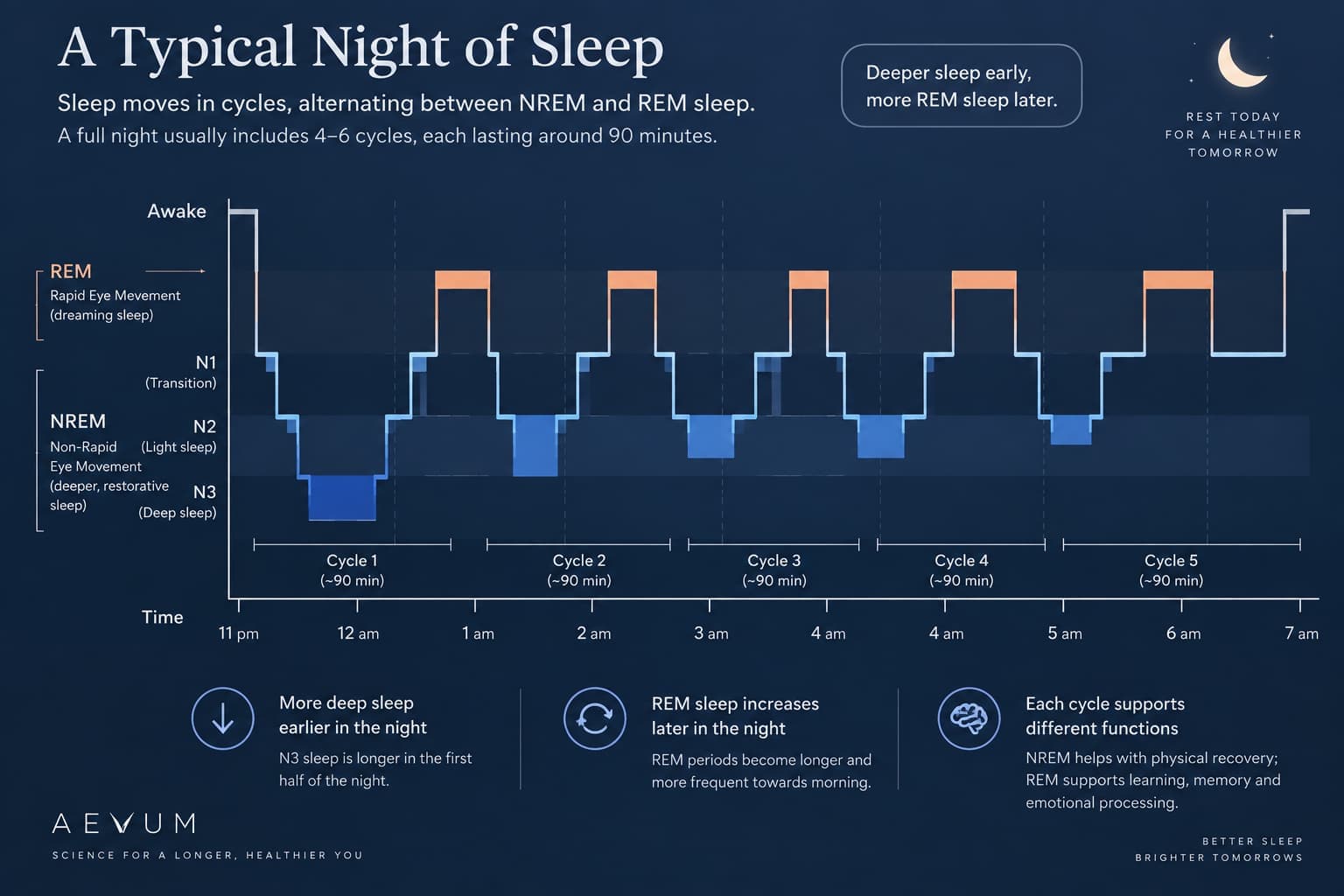
Sleep divides into two fundamentally different states: non-REM (NREM) sleep, which itself has three stages of increasing depth, and REM (rapid eye movement) sleep, a distinct and almost opposite state.
- 1N1
The lightest stage, essentially the transition from wakefulness into sleep. Brief, and easy to wake from.
- 2N2
The stage the body spends the most total time in, roughly half the night. Heart rate and breathing slow, body temperature drops, and the brain produces short bursts of activity called sleep spindles, thought to play a role in memory consolidation.
- 3N3
Deep sleep, also called slow-wave sleep. Breathing and heart rate reach their lowest points, the brain produces slow, high-amplitude delta waves, and this is the stage people are hardest to wake from. This is the stage most associated with physical restoration.
- 4REM
A genuinely distinct state, closer to wakefulness in some ways than to the NREM stages that precede it. Brain activity increases, breathing and heart rate become more irregular, the eyes move rapidly, and the body is temporarily paralysed (preventing the body from acting out dreams). Most vivid dreaming happens here.
A complete cycle through the stages — N1, N2, N3, back to N2, then REM — takes roughly 90 to 110 minutes, and the body repeats this cycle 4 to 6 times across a typical night. But the cycles aren't identical to each other: the balance between deep sleep and REM shifts substantially as the night goes on.
Early cycles are dominated by N3 — deep sleep tends to be longest and most concentrated in the first third of the night. REM periods early in the night are short, sometimes under 10 minutes. As the night progresses, this flips: deep sleep becomes shorter and less prominent in later cycles, while REM periods lengthen substantially, with the final REM period of the night sometimes exceeding an hour.
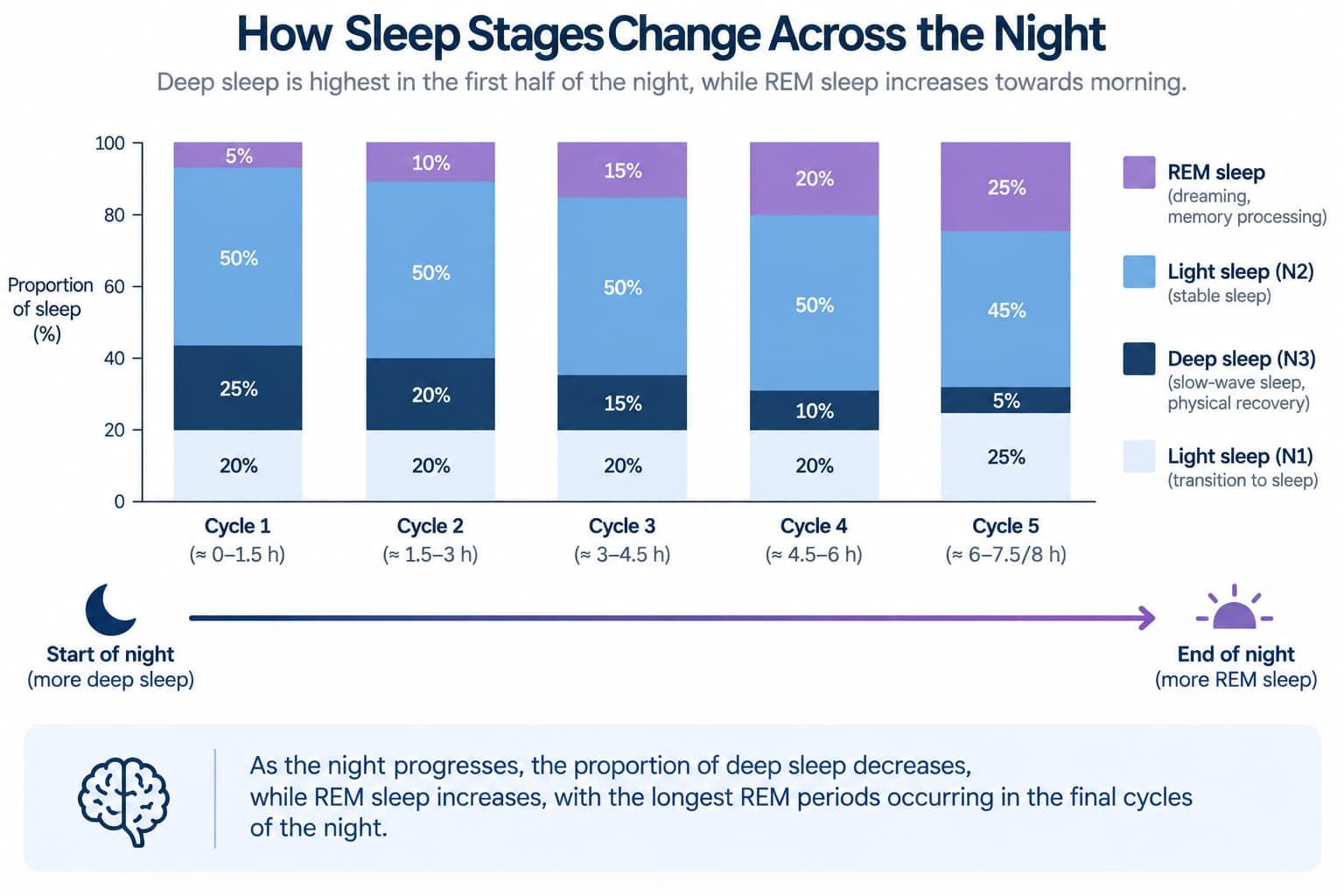
This has a genuinely practical consequence worth knowing: because deep sleep is front-loaded and REM is back-loaded, going to bed late but still waking at a fixed time doesn't cut evenly across all stages — it disproportionately cuts REM, since that's what would have happened in the final cycles. Waking up unusually early has the same effect. Someone who consistently shortens sleep from the back end may be getting adequate deep sleep while genuinely shortchanging REM, with consequences that look different from simply losing total hours.
This also gives a practical way to think about bedtime and wake time, rather than just total hours. Since a full cycle takes roughly 90–110 minutes, waking up in the middle of a cycle — particularly mid-deep-sleep — tends to produce more grogginess (known as sleep inertia) than waking at the natural end of one. Working backward from a fixed wake time in ~90-minute blocks, plus roughly 15 minutes to actually fall asleep, gives a rough, genuinely useful estimate of a bedtime likely to align with a cycle boundary rather than the middle of one — for example, someone needing to wake at 6:00am might reasonably target lights-out around 10:15pm or 11:45pm (five or four full cycles) rather than an arbitrary time in between. This is a rough heuristic, not a precise science, since actual cycle length varies somewhat night to night and person to person, but it's a more useful starting point than picking a bedtime based on total hours alone.
What each stage actually does
Deep sleep (N3) is where the body's most significant physical restoration work happens. Growth hormone secretion peaks during this stage, supporting tissue repair and physical recovery. But the function driving the most current research interest is brain waste clearance.
The glymphatic system is the brain's equivalent of a lymphatic system — a network that clears metabolic waste products, including amyloid-beta, a protein strongly implicated in Alzheimer's disease pathology. Research has found that interstitial fluid volume in the brain increases by more than 60% during sleep compared to wakefulness, and that glymphatic clearance operates roughly twice as fast during sleep as during waking hours — with deep, slow-wave sleep specifically identified as the period when this clearance is most active.
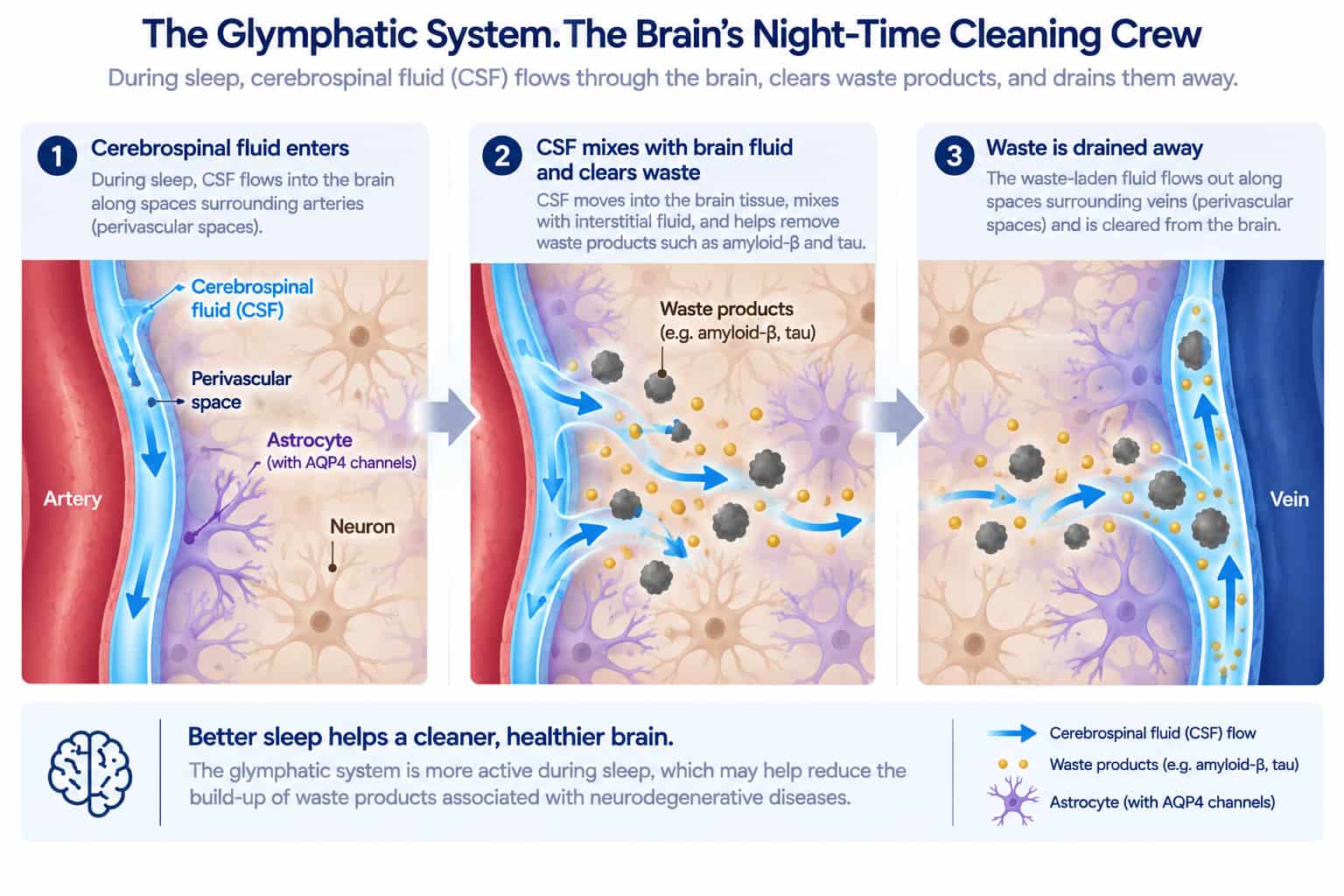
This is one of the more genuinely compelling pieces of longevity science to emerge in recent years: deep sleep isn't just "good for feeling rested" — it appears to be doing active, measurable maintenance work on the brain that's directly relevant to dementia risk over a lifetime.
Deep sleep also carries two further longevity-relevant functions worth knowing. A meaningful share of immune system activity is concentrated during N3 — including the release of certain immune cells and signalling proteins involved in fighting infection — making deep sleep relevant to immune resilience, which itself tends to decline with age (a pattern covered in our Minerals article's zinc section). And blood pressure normally drops significantly during deep sleep, a pattern called nocturnal "dipping." People whose blood pressure fails to dip properly overnight — often linked to disrupted or insufficient deep sleep — show measurably higher cardiovascular risk in the research literature, covered in more depth in our Sleep and Cardiovascular Health article.
REM sleep serves a different set of functions, centred more on the brain than the body. It plays a significant role in procedural memory consolidation (skills and learned patterns) and emotional processing — several studies suggest REM sleep helps the brain process and regulate emotional experiences from the day, which is part of why sleep deprivation is so closely tied to mood disturbance and emotional reactivity, covered in more depth in our Sleep and Brain Health article. Brain activity during REM is, in some respects, close to waking-level activity, even though the body itself is essentially paralysed.
The two stage types working together — NREM handling physical restoration and toxin clearance, REM handling memory and emotional processing — is part of why "total hours" alone is an incomplete way to think about sleep quality. A night that's technically long enough but heavily disrupted in a way that suppresses one stage more than the other can leave someone under-restored in ways a simple hours-slept number won't capture.
What the research shows
Deep sleep declines substantially and progressively with age — this is one of the most consistent findings in sleep research, and it isn't a minor or cosmetic change. Older adults spend meaningfully less time in N3 than younger adults, with sleep shifting toward the lighter N2 stage instead, alongside more frequent awakenings and generally more fragmented sleep overall.
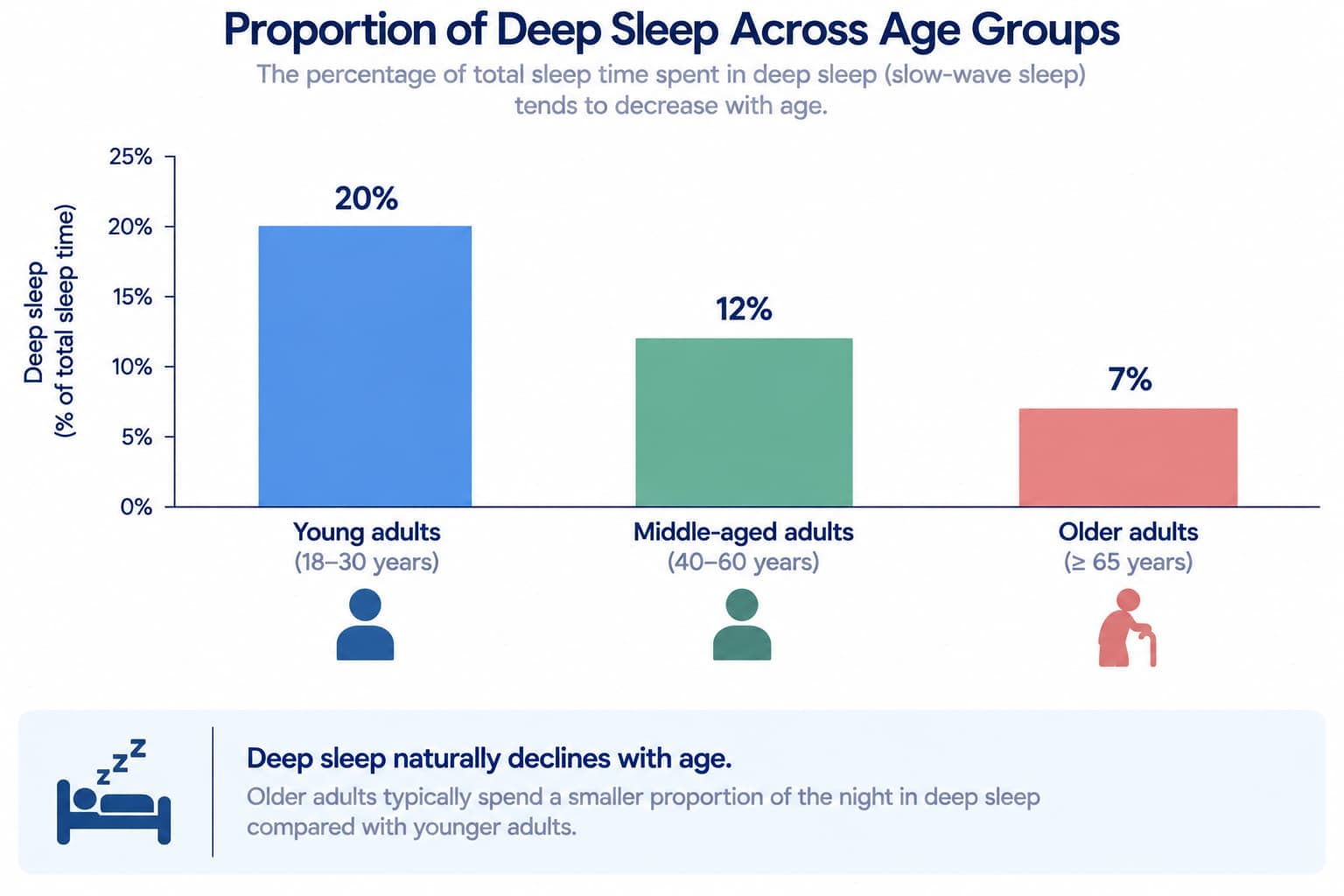
This matters more than it might first appear, given what's now understood about deep sleep's role in glymphatic clearance. Glymphatic function itself also independently declines with age — some animal research suggests waste clearance efficiency can drop by roughly 40% with advancing age — creating a plausible compounding effect: less deep sleep to drive clearance, occurring alongside a brain that's already less efficient at clearance in the first place. A 2021 human study (Eide et al., published in the journal Brain) reinforced this connection directly, using MRI tracer imaging to show that a single night of total sleep deprivation measurably impaired molecular clearance from the brain compared to normal sleep — showing the effect isn't limited to animal models or long-term decline, but shows up after just one disrupted night. This is now considered one of the more promising mechanistic explanations for why poor sleep in later life is so consistently associated with elevated dementia risk in observational research, rather than the relationship being purely coincidental or reverse-caused by early dementia itself disrupting sleep.
Researchers selectively suppressed slow-wave sleep in healthy young adults for just three nights, while keeping total sleep time completely unchanged — the volunteers slept the same number of hours, just with meaningfully less time in deep sleep specifically. Insulin sensitivity dropped by roughly 25%, an effect comparable to gaining 20–30 pounds of body weight, despite no change in diet, activity, or total sleep duration. The researchers noted that the resulting sleep pattern resembled the natural decline in deep sleep seen after roughly 40 years of ageing.
Several common factors disrupt architecture in similarly stage-specific ways, worth knowing individually rather than assuming all sleep disruption is equivalent.
- 1Alcohol
Suppresses REM sleep specifically, particularly in the second half of the night — someone who drinks in the evening may fall asleep quickly and sleep a normal number of hours, while still getting meaningfully less REM than usual.
- 2Sleep apnea
Repeatedly fragments sleep with brief arousals, disproportionately disrupting deep sleep, since the arousals prevent the brain from sustaining the slow-wave activity N3 requires.
- 3Sedative medications
Depending on the specific drug, can alter the normal balance between stages in ways that don't necessarily match what would be predicted from total sleep time alone.
- 4Cutting sleep short at either end
Going to bed late or waking early disproportionately costs whichever stage dominates that part of the night, as covered above.
The practical implication: two nights with identical total sleep duration can leave a person in genuinely different physiological states, depending on which stages were affected.
Recommendations by population group
- 1Older adults
Given the well-documented decline in deep sleep with age, and its now-understood connection to glymphatic clearance, protecting whatever sleep quality is achievable — consistent timing, a dark and cool sleep environment, limiting alcohol — is arguably more consequential for this age group than for younger adults, even if total sleep duration looks unchanged.
- 2Children and adolescents
Deep sleep needs are substantially higher during periods of active physical growth, which is part of the physiological basis for adolescents genuinely needing more total sleep than adults, not just preferring it.
- 3Shift workers
Working against the body's natural circadian timing doesn't just shorten sleep — it can disrupt the normal architecture pattern itself, since the stage balance described in this article assumes a full, uninterrupted, appropriately-timed sleep period.
- 4Anyone who drinks alcohol regularly in the evening
Worth knowing that even moderate evening drinking measurably suppresses REM sleep specifically, independent of total sleep duration — a genuinely underappreciated effect given how normalised an evening drink is in many routines.
- 5General / longevity-focused
Sleep architecture is a strong example of why "hours slept" is a necessary but incomplete metric — the composition of those hours carries real, mechanistically-understood consequences for brain health specifically, making sleep quality a genuine longevity lever, not just a comfort issue.
Practical notes
- →Deep sleep and REM aren't interchangeable — they do different jobs, and losing one specifically (through alcohol, apnea, or a shortened sleep window) has different consequences than losing the other
- →Working backward from your wake time in ~90-minute blocks (plus ~15 minutes to fall asleep) gives a rough, more useful bedtime estimate than picking one arbitrarily — waking at the end of a full cycle tends to feel less groggy than waking mid-cycle, even if total sleep time is similar either way
- →Keeping bedtime and wake time consistent, including on weekends, helps the body maintain a stable architecture pattern night to night — irregular timing is one of the more common, self-inflicted disruptions to sleep quality
- →The glymphatic system connection is one of the more genuinely exciting recent findings in sleep science — it gives a concrete, mechanistic reason why sleep quality in earlier life may influence dementia risk decades later, rather than the link being purely statistical
- →Cutting sleep short from the back end (staying up late, waking early) costs REM disproportionately, while disruption throughout the night (like sleep apnea) costs deep sleep disproportionately — the way sleep is shortened or disrupted matters, not just the total amount lost
- →Age-related decline in deep sleep is normal, but not something to dismiss as unimportant — it's directly connected to the mechanisms researchers now believe link poor sleep to cognitive decline
- →Total hours still matter — none of this is a reason to disregard sleep duration; architecture is a layer of nuance on top of duration, not a replacement for it
Sleep architecture is a genuinely good example of how longevity science increasingly moves beyond simple, single-number metrics — it's not just how long you sleep, but what your brain and body are actually doing during that time. If you'd like a clearer picture of your own sleep quality and how it may be affecting your longer-term health, our Longevity Doctors offer a free longevity assessment as a starting point.
How does your sleep
score on your longevity assessment?
Take the free Aevum Protocol assessment to see how your sleep & recovery and 6 other longevity domains are performing — and get a personalised 90-day plan.
Take the Free Assessment →