Sleep & Recovery
Sleep and Brain Health: Memory,
Mood, and Long-Term Cognitive Risk
Our Sleep Architecture article touched on the glymphatic system and its role in clearing brain waste during deep sleep. This article widens the lens to the fuller picture of sleep's relationship with the brain — how memory actually gets built overnight, what a landmark 25-year study found about midlife sleep and dementia risk, why sleep deprivation is more dangerous than most people treat it, and the genuinely two-way relationship between sleep and mood.
Quick Summary
- →Memory isn't simply "stored" during sleep — it's actively reorganised, with the brain transferring new information from short-term to long-term storage overnight, a process that continues to be disrupted by insufficient sleep even in otherwise healthy people
- →A 25-year study following nearly 8,000 people found that persistently sleeping 6 hours or less at age 50 and 60 was associated with a 30% higher risk of developing dementia later in life — one of the longest and most rigorous studies connecting midlife sleep habits to long-term brain health
- →Sleep deprivation impairs cognitive and motor performance to a degree directly comparable to legal alcohol intoxication — a classic, frequently replicated finding that most people don't take as seriously as they would the equivalent level of drinking. Practically, treat a night of significant sleep loss as a reason to avoid driving, the same way you would after drinking
- →Drowsy driving is a genuine, underrecognised public safety issue — conservatively estimated to contribute to thousands of road fatalities annually in the US alone, likely undercounted since it's harder to detect after the fact than alcohol
- →Sleep and mood affect each other in both directions — poor sleep is a genuine risk factor for developing depression, not just a symptom of it, making sleep a modifiable lever in mental health rather than a passive bystander
Key numbers at a glance
| Measure | Figure |
|---|---|
| Dementia risk increase, persistent ≤6h sleep at 50/60 vs. 7h | ~30% higher |
| Whitehall II study follow-up period | 25 years |
| Participants in the Whitehall II study | ~8,000 |
| Cognitive/motor impairment after ~24h awake | Equivalent to 0.10% blood alcohol |
| Estimated annual US drowsy-driving road fatalities | Thousands (likely undercounted) |
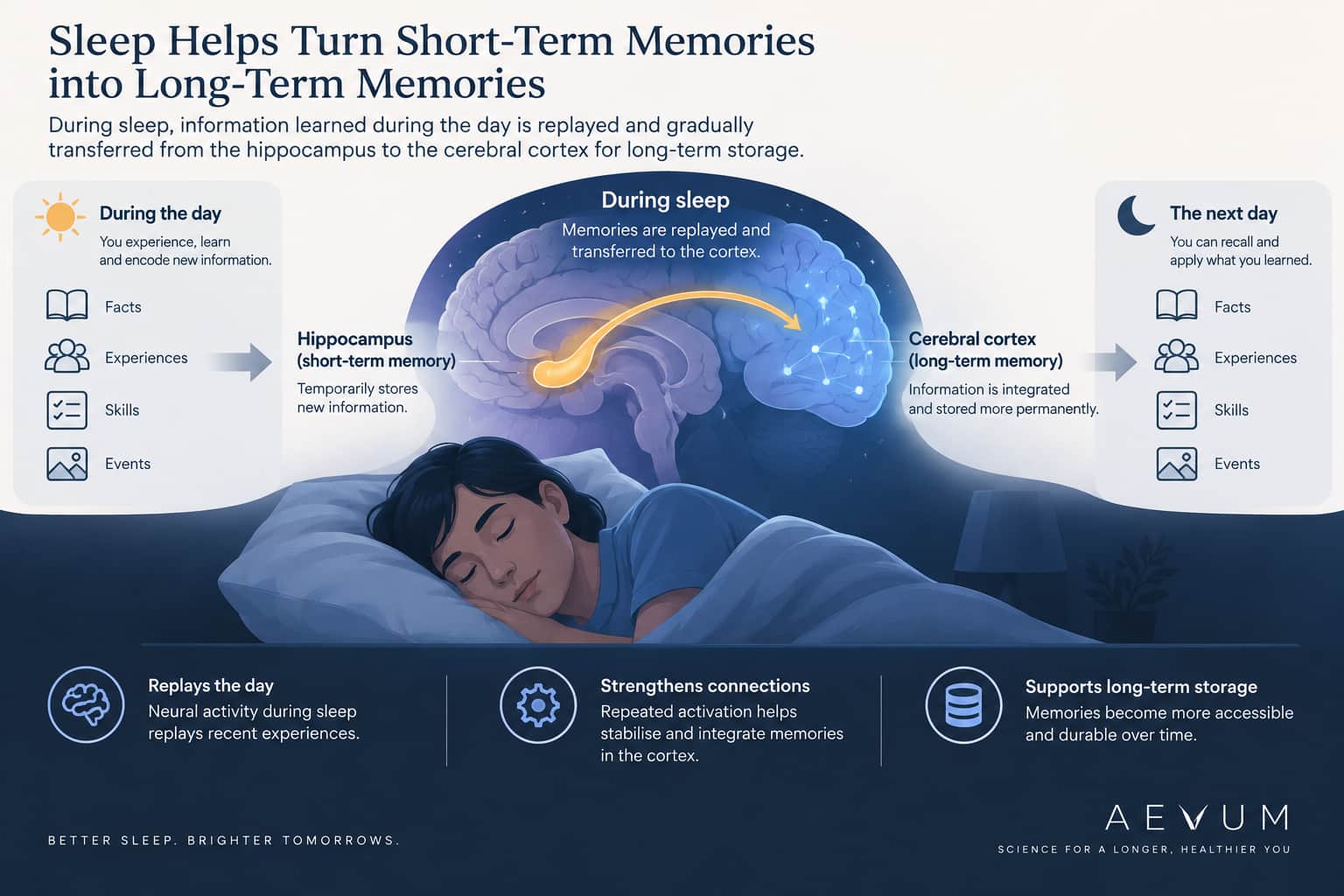
How it works: memory consolidation during sleep
Memory consolidation — the process of converting a fresh, fragile memory into a stable, long-term one — happens substantially during sleep, not just during the waking moment something is learned. Newly formed memories are initially held in the hippocampus, a temporary storage structure, before being gradually transferred to the cortex for long-term storage. This transfer is thought to happen largely during sleep, particularly during the sleep spindles that occur in N2 sleep, covered in our Sleep Architecture article, which appear to help coordinate this hippocampus-to-cortex handoff.
The two major sleep stages appear to specialise in different kinds of memory. Deep sleep (N3) is more closely tied to declarative memory — facts, events, and information that can be consciously recalled. REM sleep, covered in more depth in our Sleep Architecture article, plays a larger role in procedural memory (skills and learned physical or mental patterns) and in emotional memory processing specifically. This is part of why a single bad night doesn't just leave someone tired — it can genuinely impair how well information learned that day gets locked in, an effect demonstrated repeatedly in studies comparing memory retention after a full night's sleep versus a night of sleep restriction.
What the research shows
The dementia connection: what a 25-year study found. This is arguably the most consequential sleep-and-brain finding available, and it's worth understanding properly. In 2021, researchers published findings from the Whitehall II study, following nearly 8,000 participants in the UK for up to 25 years, with sleep duration assessed repeatedly starting in their 50s. The study found that people who persistently reported sleeping 6 hours or less at both age 50 and age 60 had a 30% higher risk of developing dementia later in life, compared to those sleeping a more typical 7 hours — an association that held even after adjusting for a wide range of other health, behavioural, and socioeconomic factors.
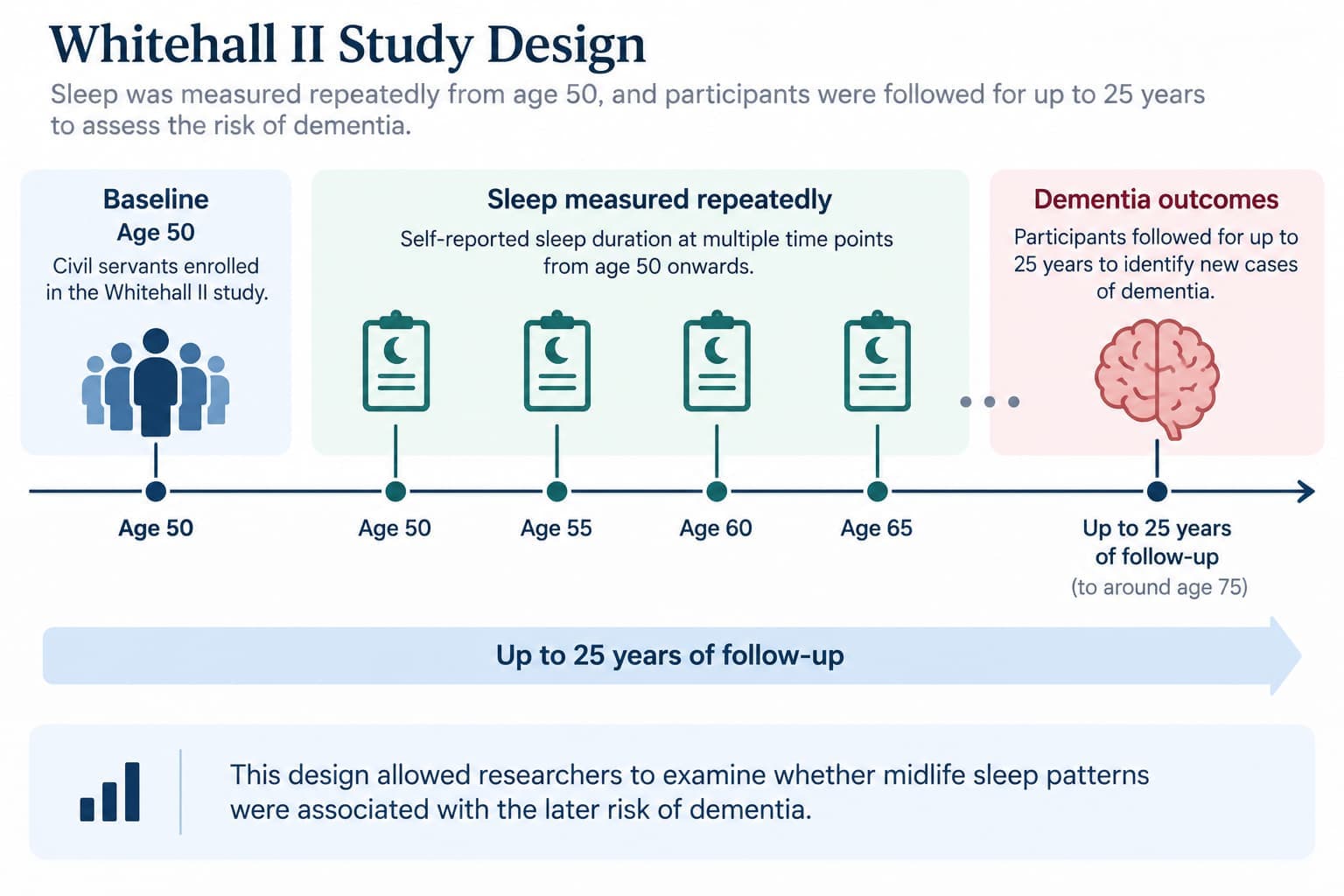
The timing: sleep was measured in midlife, more than two decades before the average age of dementia diagnosis in the study — addressing a common criticism of shorter studies, where early, undiagnosed dementia could itself be causing poor sleep rather than the other way around (reverse causation). The researchers were careful to note this remains an association, not definitive proof of causation, but the long follow-up period and consistent pattern across repeated measurements make it one of the more credible pieces of evidence connecting sleep habits earlier in life to brain health decades later. This connects directly to the glymphatic clearance mechanism covered in our Sleep Architecture article — chronically insufficient deep sleep, sustained over decades, is a plausible biological pathway linking short sleep in midlife to the gradual accumulation of the same proteins implicated in dementia pathology.
Sleep deprivation's acute effects: more dangerous than people treat it. Beyond the long-term dementia connection, sleep deprivation has well-documented, immediate effects on cognitive and motor performance — and the scale of that impairment is genuinely underappreciated by most people. A now-classic 1997 study published in Nature found that performance after roughly 24 hours of sustained wakefulness was equivalent to a blood alcohol concentration of 0.10% — above the legal driving limit in most jurisdictions at the time. This finding has been replicated across multiple independent research groups since, consistently showing that moderate sleep deprivation produces cognitive and psychomotor impairment comparable to legally intoxicating levels of alcohol, even though no alcohol is involved at all.
This has genuine, serious real-world consequences. Drowsy driving is conservatively estimated to contribute to thousands of road fatalities annually in the United States alone, and most researchers believe this figure meaningfully undercounts the true toll, since drowsiness is far harder to detect and document after a crash than blood alcohol level. Unlike alcohol, there's no roadside test for sleep deprivation, and unlike drunk driving, driving tired carries little social stigma — despite performance research suggesting the two can be functionally comparable.
Sleep and mood: a two-way street. The relationship between sleep and mood runs in both directions, which is an important distinction. Poor sleep is well known as a symptom of depression and anxiety — but a substantial body of research also supports poor sleep as an independent risk factor for developing depression in the first place, not merely a downstream consequence of it. This bidirectional relationship is part of why sleep is increasingly treated as a genuine, modifiable target in mental health care, rather than something that will simply resolve once mood improves. REM sleep's role in emotional processing, covered in our Sleep Architecture article, is thought to be part of the underlying mechanism — a night of REM-disrupted sleep leaves the brain less able to process and regulate the emotional content of the previous day, which can compound over successive nights of poor sleep into a more persistent effect on mood and emotional reactivity.
Recommendations by population group
- 1Older adults and anyone with a family history of dementia
Given the Whitehall II findings, treating persistent short sleep as a genuine, addressable risk factor — rather than an inevitable feature of a busy life — is worth taking seriously well before any cognitive symptoms would normally prompt concern.
- 2Drivers, shift workers, and anyone in safety-critical roles
The alcohol-equivalence research deserves to be taken as seriously as it would be if framed around drinking — driving after a night of significantly reduced sleep carries comparable risk to driving after drinking, even though it doesn't feel or look the same in the moment.
- 3Anyone experiencing low mood or anxiety
Given the bidirectional relationship between sleep and mental health, addressing sleep quality directly is a legitimate, evidence-supported part of managing mood, not a secondary concern to address only once mood improves.
- 4Students and anyone in intensive learning periods
Given sleep's direct role in memory consolidation, sacrificing sleep to extend study time is frequently counterproductive — the information learned during those extra waking hours is less likely to be effectively retained without adequate sleep afterward.
- 5General / longevity-focused
The dementia risk findings specifically make sleep one of the more concrete, actionable levers available for long-term brain health — a genuinely rare case where a daily habit has direct, well-studied evidence connecting it to a specific, serious, age-related disease outcome.
Practical notes
- →A single night of poor sleep measurably affects next-day memory formation, not just alertness — this is a genuine cost, not just a feeling of tiredness
- →The Whitehall II findings are strong specifically because of their long follow-up period — the 25-year gap between sleep measurement and dementia diagnosis makes reverse causation a much less likely explanation than in shorter studies
- →Treat significant sleep deprivation as seriously as drinking before driving — the performance research genuinely supports the comparison, even though social attitudes toward the two remain very different
- →Sleep is a legitimate, modifiable factor in mood and mental health, not just a symptom to wait out — this cuts both ways, meaning improving sleep can genuinely help mood, not only the reverse
- →None of this requires perfection — the dementia findings are about persistent, chronic patterns over years and decades, not the occasional bad night
Sleep's relationship with the brain runs deeper than feeling rested or foggy — it touches memory formation, long-term dementia risk, next-day safety, and mood regulation, all through genuinely well-studied mechanisms rather than vague wellness claims. For how sleep stages, duration, and circadian timing each contribute to this picture, see our Sleep Architecture, Sleep Duration, and Circadian Rhythm articles. If you'd like a clearer picture of your own sleep and its impact on your long-term cognitive health, our Longevity Doctors offer a free longevity assessment as a starting point.
How does your sleep
score on your longevity assessment?
Take the free Aevum Protocol assessment to see how your sleep & recovery and 6 other longevity domains are performing — and get a personalised 90-day plan.
Take the Free Assessment →