Sleep & Recovery
Circadian Rhythm & Light Exposure:
How Your Body Clock Actually Works
Our Sleep Duration and Sleep Architecture articles both cover what happens once sleep begins. This article covers what determines when the body wants to sleep in the first place — the internal clock that governs it, and the single external cue that controls that clock more powerfully than anything else: light.
Quick Summary
- →The body's master clock runs on a period slightly longer than 24 hours — around 24.2 hours on average — meaning it must be reset daily by external cues, primarily light, or it gradually drifts out of sync with the actual day
- →A specific type of light-sensing cell in the eye, separate from the ones used for vision, exists mainly to feed timing information to this clock — and it's most sensitive to blue light specifically, around 480 nanometres
- →Morning light exposure is a genuinely underused lever — outdoor daylight is often 100 times more intense than typical indoor lighting, a gap most people never experience because so much time is spent indoors. Getting outside within the first hour of waking is the single highest-leverage habit this article covers
- →Night shift work with circadian disruption has been classified as a probable human carcinogen by the WHO's International Agency for Research on Cancer — one of the more serious classifications applied to a lifestyle-related exposure
- →Blue-light blocking glasses are more oversold than the evidence supports — a recent meta-analysis of rigorous trials found no statistically significant improvement in objective sleep measures, despite how confidently they're often recommended
Key numbers at a glance
| Measure | Figure |
|---|---|
| Average intrinsic clock period (no external cues) | ~24.2 hours |
| Peak light sensitivity of circadian photoreceptors | ~480nm (blue light) |
| Outdoor daylight vs. typical indoor lighting | ~100x more intense |
| Time spent indoors in modern life (estimate) | ~90% |
| IARC classification of night shift work with circadian disruption | Group 2A, "probable human carcinogen" |
| Statistically significant sleep benefit from blue-light glasses in rigorous RCTs | None found |
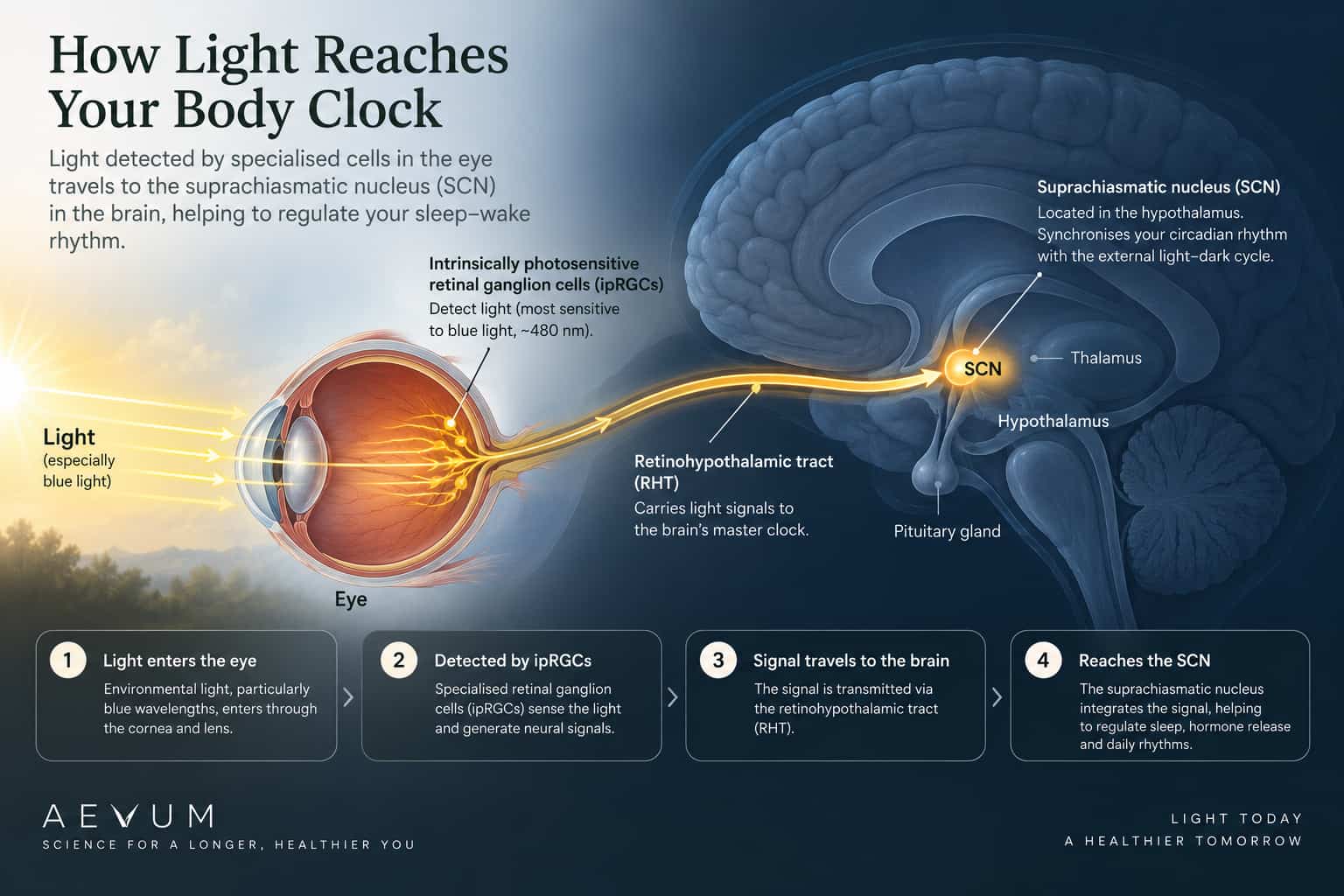
How it works: the clock and its reset signal
The body's master clock sits in a small cluster of roughly 20,000–50,000 neurons in the hypothalamus called the suprachiasmatic nucleus (SCN). This clock doesn't just control sleep timing — it coordinates daily rhythms in body temperature, hormone release, blood pressure, and metabolism, and it does so partly by synchronising smaller "peripheral clocks" running in nearly every organ and tissue in the body, from the liver to individual muscle cells.
Left entirely to its own devices, with no external time cues at all, the SCN doesn't run on exactly 24 hours. A landmark 1999 study using tightly controlled lighting conditions found the average human intrinsic period to be approximately 24.2 hours, ranging across individuals from roughly 23.5 to 25 hours. This might sound like a trivial difference, but left uncorrected, a clock running even 12 minutes long each day would drift a full 6 hours out of alignment with actual daytime within a month — which is exactly why the body needs a daily reset mechanism, and why that mechanism matters so much.
The primary reset signal is light, detected through a dedicated system separate from normal vision. A small population of cells in the retina called intrinsically photosensitive retinal ganglion cells (ipRGCs) — distinct from the rods and cones used for seeing — contain a light-sensitive protein called melanopsin, most sensitive to blue light around 480 nanometres. These cells feed directly into the SCN via a dedicated neural pathway, the retinohypothalamic tract, essentially separate from the circuitry used for conscious sight.
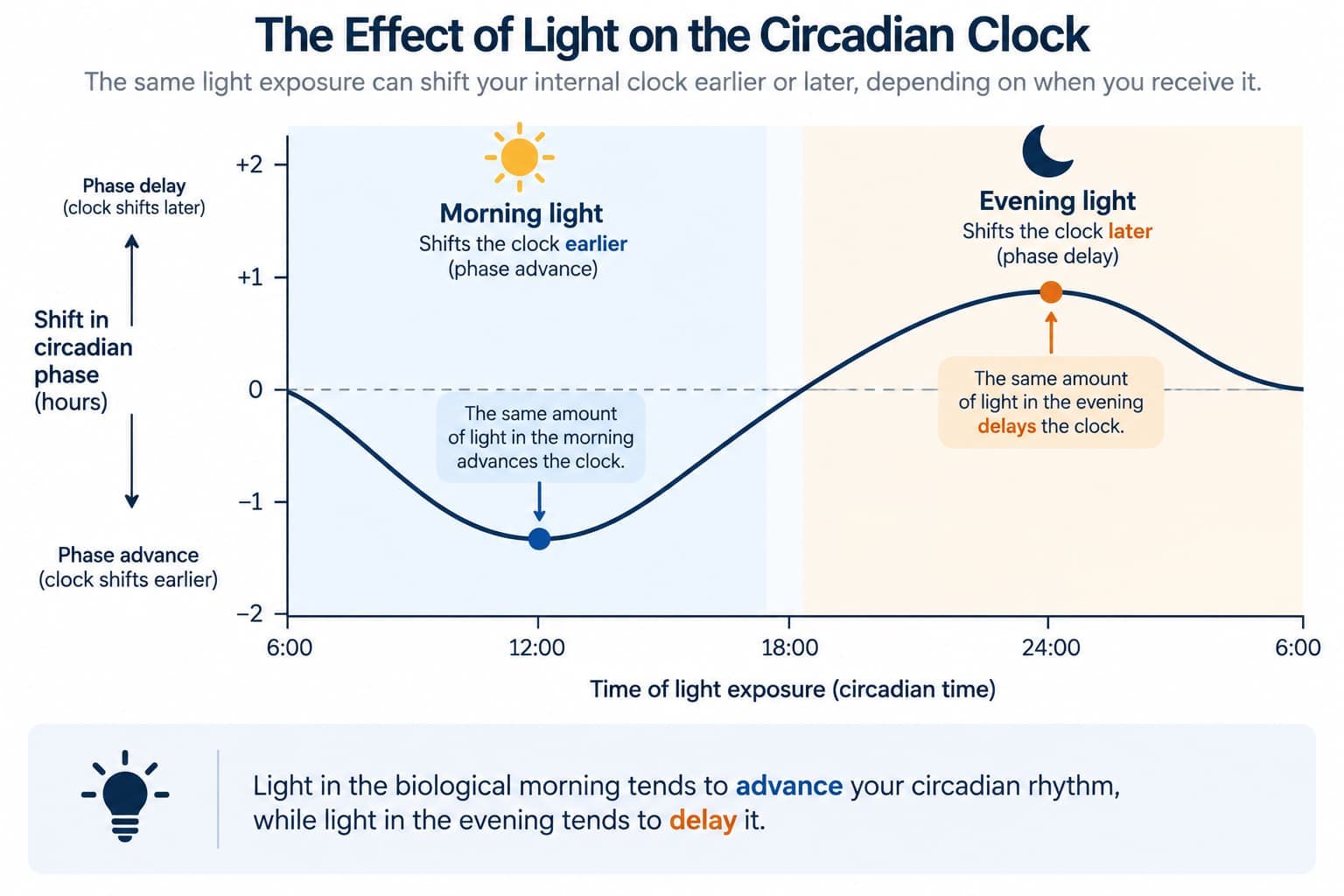
The timing of light exposure matters enormously, not just the amount. Light in the morning generally shifts the clock earlier (a "phase advance"), while light in the evening or night shifts it later (a "phase delay") — the same stimulus produces close to opposite effects depending purely on when it's received relative to the body's internal timing.
Melatonin is often thought of simply as "the sleep hormone," but its real role is more precise: it's the body's chemical signal for darkness, released by the pineal gland once light input drops, and suppressed whenever the ipRGCs detect enough light — including from ordinary indoor lighting and screens, not just direct sunlight. Melatonin doesn't force sleep the way a sedative does; it signals to the rest of the body that it's biological night, reinforcing the timing set by the SCN rather than driving sleep directly on its own.
What the research shows
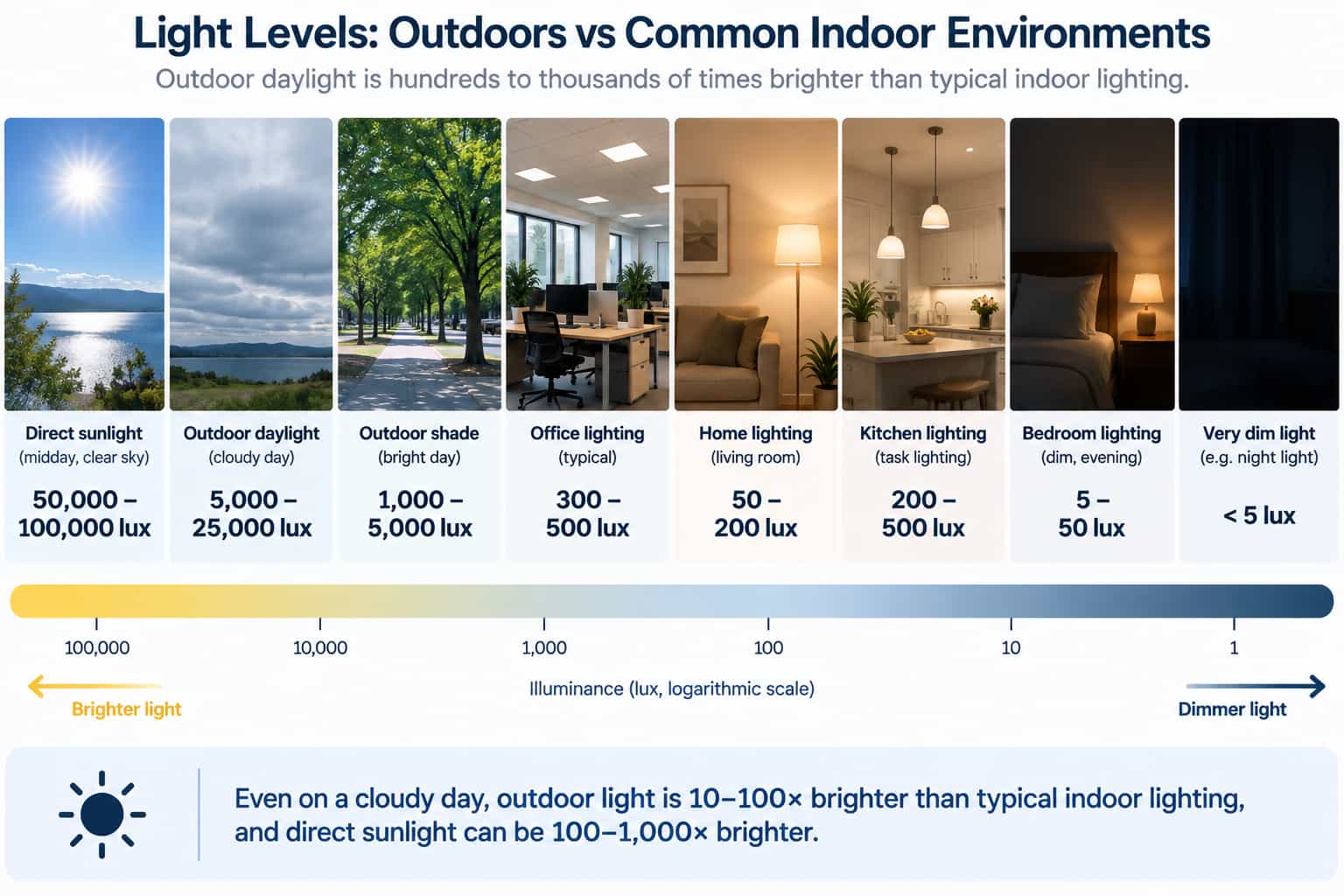
Morning light is a genuinely underused lever. One of the more practically significant facts in this entire area is simply how much dimmer indoor environments are compared to outdoors. Natural daylight can be 100 times more intense than typical indoor lighting, even on an overcast day — a gap most people never experience directly, given that an estimated 90% of time in modern life is spent indoors. Since the circadian system responds to actual light intensity, not just the presence or absence of light, this means many people are functionally under-exposed to the strong morning signal that would otherwise reinforce a healthy, well-timed rhythm — spending their brightest hours behind a desk under lighting far too dim to meaningfully anchor the clock. Getting outside, or at least near a bright window, within the first hour or so of waking is one of the more evidence-supported, low-effort ways to reinforce a stable, appropriately-timed circadian rhythm.
Evening light and the blue light question. The mechanism behind evening light's effect on sleep is genuinely well established: blue-enriched light in the evening suppresses melatonin and delays circadian phase, and this is one of the more consistently replicated findings in circadian research, mediated through the same melanopsin-ipRGC pathway described above. Where the evidence gets more genuinely uncertain is the popular solution: blue-light blocking glasses.
A recent meta-analysis of rigorous, actigraphy-based randomised controlled trials found no statistically significant improvement in sleep onset time, total sleep time, or sleep efficiency from wearing blue-light blocking glasses, despite how confidently they're marketed and recommended. This doesn't mean the underlying mechanism is wrong — blue light genuinely does suppress melatonin — but it does suggest blue-light glasses specifically, as a real-world product, may not be delivering the benefit assumed, possibly due to inadequate filtering strength in many commercial lenses or the fact that screens are only one of several light sources in a typical evening environment. Simply dimming overall light exposure in the evening, rather than relying on a specific product, remains the more evidence-backed approach.
Circadian disruption and longevity: the shift work evidence. This is one of the more serious findings connected to circadian health. In 2007, the World Health Organization's International Agency for Research on Cancer (IARC) classified night shift work involving circadian disruption as a Group 2A "probable human carcinogen" — a classification reaffirmed after further review in 2019, with the strongest associations found for breast, prostate, and colorectal cancer. The mechanistic evidence in animal studies is considered strong; the human epidemiological evidence, while consistent across many studies, is still considered somewhat more limited, which is part of why the classification sits at "probable" rather than the highest certainty category. This finding elevates circadian rhythm from a comfort-and-alertness issue to a genuine longevity consideration — chronic circadian misalignment isn't simply about feeling tired at the wrong times, but appears to be a biologically meaningful stressor with measurable long-term health consequences.
How the clock changes with age. Two related changes affect circadian rhythm as people age. First, the clock tends to phase-advance — older adults commonly shift toward earlier natural sleep and wake times, the biological basis behind the "early to bed, early to rise" pattern often associated with ageing, rather than it being purely a lifestyle choice. Second, the lens of the eye gradually yellows with age, reducing the amount of blue light reaching the retina — since blue light is exactly the wavelength the circadian system relies on most, this can genuinely weaken the strength of the daily light signal reaching the clock in older adults, independent of how much time is actually spent outdoors.
Recommendations by population group
- 1Shift workers
Given the IARC classification, this is the group where circadian health carries the most serious long-term stakes — strategic light exposure (bright light during a night shift, dim light and blue-light avoidance afterward) and consistent off-day scheduling, where feasible, are genuinely worth prioritising rather than treating shift work as an unavoidable, health-neutral inconvenience.
- 2Older adults
The natural tendency toward earlier sleep and wake times, combined with reduced blue light reaching the retina, means deliberately seeking bright morning light matters more for this group, not less, even though ageing eyes reduce the strength of the signal being received.
- 3Adolescents
Puberty causes a genuine, biologically-driven delay in circadian timing, pushing natural melatonin release later — the reason many teenagers struggle to fall asleep early even when told to.
- 4Frequent travellers
Jet lag is essentially a temporary, acute version of the same misalignment problem — strategically timed light exposure (or avoidance) before and after travel can meaningfully shorten adjustment time, following the same phase advance/delay logic covered above.
- 5General / longevity-focused
Given the shift-work cancer classification and the broader research connecting circadian disruption to metabolic and cardiovascular health, treating light exposure as a deliberate daily input — not an incidental byproduct of where you happen to be — is a genuinely underrated longevity lever.
Practical notes
- →Get outside, or near a bright window, within the first hour of waking. Given the roughly 100-fold intensity gap between outdoor and indoor light, this is one of the highest-leverage, lowest-effort habits for reinforcing a well-timed clock
- →Dim overall light exposure in the evening, rather than relying on blue-light glasses specifically as a complete solution, given the mixed evidence above
- →Keep sleep and wake times consistent, including on days off — irregular timing repeatedly asks the clock to re-adjust, working against the entrainment process described throughout this article
- →Treat regular night shift work as a genuine, serious health exposure, not just an inconvenience — the IARC classification reflects real biological risk, not just tiredness
- →The circadian clock naturally shifts earlier with age — this is a normal biological pattern, not simply a lifestyle preference
- →Blue-light blocking glasses are more popular than their evidence currently supports — dimming actual light exposure in the evening remains the better-supported approach
Circadian rhythm is a genuinely good example of how a single, freely available input — light, and specifically its timing — has outsized influence over sleep, metabolism, and even long-term disease risk. For how sleep composition and total duration fit alongside this, see our Sleep Architecture and Sleep Duration articles. If you'd like a clearer picture of your own sleep and circadian health, our Longevity Doctors offer a free longevity assessment as a starting point.
How does your sleep
score on your longevity assessment?
Take the free Aevum Protocol assessment to see how your sleep & recovery and 6 other longevity domains are performing — and get a personalised 90-day plan.
Take the Free Assessment →