Sleep & Recovery
Sleep Tracking & Wearables:
What the Data Can and Can't Tell You
Our Sleep Apnea article covered polysomnography — the monitored, EEG-based overnight study that remains the true gold standard for sleep assessment. Consumer sleep trackers (rings, watches, mattress sensors) promise a more convenient, everyday alternative. This article covers what these devices actually measure, how their accuracy compares to genuine clinical assessment, and a genuinely important, well-documented downside: the data itself can, for some people, become a source of the very sleep problems it was meant to solve.
Quick Summary
- →Consumer trackers are quite good at detecting whether you're asleep or awake — sensitivity above 95% in validation studies — but meaningfully less reliable at determining which stage of sleep you're in, since they infer this from movement and heart rate rather than measuring brain activity directly
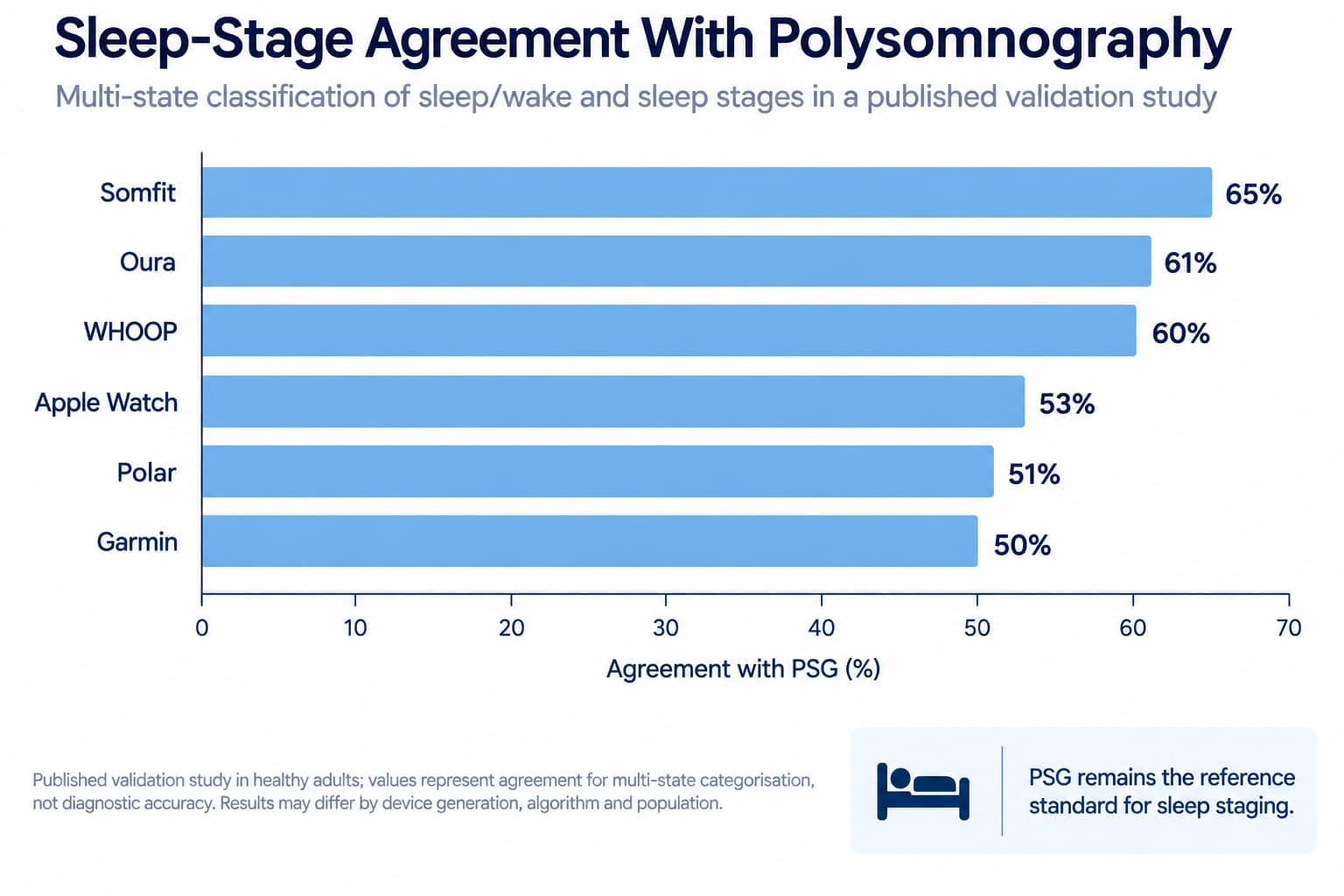
- →Sleep-staging accuracy varies significantly by device and study, with reported agreement to gold-standard polysomnography ranging from roughly 50% to 86% depending on the specific stage and device tested — a real, device-dependent gap worth knowing about
- →Even polysomnography itself isn't perfectly precise — two trained human technicians scoring the same night of PSG data only agree with each other about 83% of the time, useful context for how much precision to expect from any sleep measurement, including the clinical gold standard
- →"Orthosomnia" is a real, named clinical phenomenon — an unhealthy preoccupation with achieving perfect sleep-tracker data that can itself cause or worsen insomnia, first described by sleep researchers in 2017 and estimated to affect a meaningful minority of regular tracker users
- →Trackers are most useful for trends over time, not single-night precision — night-to-night changes in your own data are generally more meaningful than treating any one night's exact numbers as clinically precise facts
Key numbers at a glance
| Measure | Figure |
|---|---|
| Sleep vs. wake detection sensitivity (consumer devices) | ~95%+ |
| Sleep stage detection sensitivity (varies by device/stage) | ~50-86% |
| Inter-rater agreement between two human PSG scorers | ~83% |
| Estimated orthosomnia prevalence among general population | ~3-14% (definition-dependent) |
| Tracker users regularly wearing a device (one 2024 study) | ~36% |
How it works: what trackers actually measure
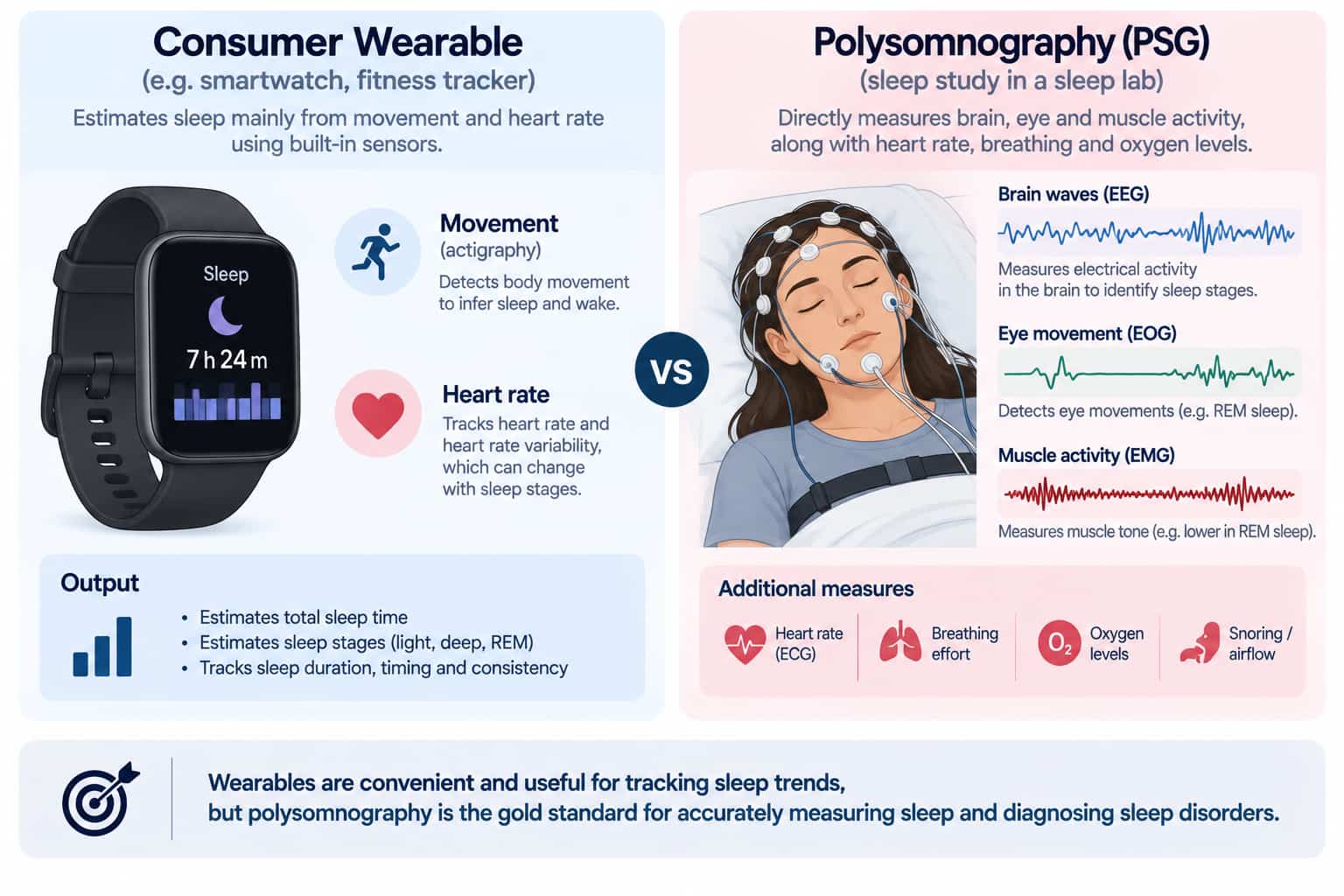
Consumer sleep trackers — rings, watches, and under-mattress sensors — primarily rely on accelerometry (detecting movement) combined with heart rate and heart rate variability (HRV), and sometimes blood oxygen sensors, to infer sleep state. Because a sleeping body moves very little and heart rate patterns shift in reasonably predictable ways across sleep stages, these signals can be used to build a statistical estimate of when someone is asleep, awake, and — with more sophisticated algorithms — which broad sleep stage they're likely in.
This is fundamentally different from polysomnography, covered in our Sleep Apnea article, which directly measures brain electrical activity (EEG), eye movement, and muscle tone — the actual physiological signals that define each sleep stage, rather than an inference based on movement and heart rate patterns. This distinction is the single most important thing to understand about consumer trackers: they're measuring correlates of sleep stages, not the stages themselves.
What the research shows
Sleep versus wake: genuinely reliable. Across multiple validation studies comparing consumer devices to polysomnography, sensitivity for simply detecting whether someone is asleep or awake is consistently high — 95% or above in controlled studies. This is the part of sleep tracking that works well and can be reasonably trusted.
Sleep staging: considerably more variable. A study conducted at Brigham and Women's Hospital, comparing the Oura Ring, Apple Watch, and Fitbit Sense against polysomnography in 35 participants, found meaningful differences between devices — the Oura Ring showed the strongest agreement with PSG (a Cohen's kappa of 0.65, generally interpreted as "substantial" agreement), compared to 0.60 for Apple Watch and 0.55 for Fitbit. Sensitivity for individual stage detection ranged from roughly 50% to 86% depending on the specific device and stage. Notably, the Apple Watch tended to overestimate light sleep while underestimating deep sleep, and the Fitbit showed a similar pattern — systematic, not random, errors. A separate, independently funded multicenter study across 11 different consumer devices, tested against polysomnography in 75 participants, found more modest agreement overall across the board, underscoring that accuracy varies not just device-to-device but study-to-study, and that industry-funded validation studies (including the one above) may show somewhat more favourable results for the sponsoring company's own device.
Useful context: even polysomnography isn't perfectly precise. It's worth knowing that gold-standard PSG scoring itself isn't flawless — inter-rater reliability studies find that two trained human technicians scoring the identical night of PSG data agree with each other only around 83% of the time. This doesn't excuse consumer tracker inaccuracy, but it's useful context: sleep staging in general involves some irreducible imprecision, even at the clinical gold-standard level.
In 2017, sleep researcher Kelly Baron and colleagues at Rush University Medical Center coined the term orthosomnia — modelled on "orthorexia," the unhealthy obsession with perfect eating — to describe patients arriving at sleep clinics fixated on their tracker data rather than how they actually felt, in some cases refusing to accept clinical reassurance that contradicted their device's numbers. A 2024 cross-sectional study estimated orthosomnia's prevalence at roughly 3-14% of the general population, depending on how strictly it was defined, and found that people meeting criteria for it had measurably higher insomnia scores than those without it — a genuinely concerning finding, since it suggests the tracking behaviour itself may be contributing to worse sleep, not just reflecting it. As Baron herself has put it, the marketing claims made by these devices have tended to outpace the actual validation behind them — a useful, honest framing for how to hold this technology.
Recommendations by population group
- 1General tracker users
Treat the data as directionally useful for spotting trends — a gradually worsening pattern over weeks is more meaningful than any single night's exact numbers, particularly for sleep-stage breakdowns specifically, given the accuracy limitations above.
- 2Anyone who checks their sleep score anxiously each morning, or feels distress when the numbers look "bad"
This is worth recognising as a potential early sign of orthosomnia — consider a deliberate break from checking the data (wearing the device without looking, or not wearing it at all for a week) to see whether sleep-related anxiety improves.
- 3Anyone with diagnosed or suspected insomnia
Given the sleep effort paradox covered in our Insomnia article — where increased anxious monitoring of sleep itself worsens the problem — sleep tracker data can genuinely feed this cycle; discussing tracker use directly with a treating clinician is reasonable if it seems to be adding stress rather than useful information.
- 4Anyone using a device's sleep apnea or heart rhythm screening features
Several modern devices now offer legitimate, in some cases regulator-cleared, screening features for irregular heart rhythm or blood oxygen patterns suggestive of sleep apnea — these can be a reasonable prompt to seek proper clinical evaluation, but should be understood as a screening nudge, not a diagnosis; the Sleep Apnea article's actual diagnostic standard (polysomnography or a validated home sleep apnea test) remains the real answer.
- 5General / longevity-focused
Sleep trackers are a reasonable, low-effort way to notice broad patterns and consistency over time, covered in our Sleep Duration and Circadian Rhythm articles — but shouldn't be mistaken for clinical-grade precision, particularly around sleep-stage percentages specifically.
Practical notes
- →Trust trend direction over exact numbers — a consistent decline over several weeks is more informative than obsessing over last night's specific deep sleep percentage
- →Sleep-stage breakdowns are the least reliable part of most trackers — treat REM and deep sleep percentages as rough estimates, not precise clinical facts
- →If checking your sleep score is making you anxious about sleep, the tracker may be working against you — this is a real, named phenomenon (orthosomnia), not an overreaction
- →A device flagging a possible sleep issue (irregular heart rhythm, low oxygen patterns) is worth following up on clinically — but is a prompt for proper evaluation, not a diagnosis in itself
- →No consumer tracker replaces polysomnography for actually diagnosing a sleep disorder — covered in more depth in our Sleep Apnea article, this remains genuinely true regardless of how sophisticated consumer devices become
Sleep tracking technology offers something genuinely useful — accessible, continuous, everyday insight into broad sleep patterns — without being a substitute for clinical-grade precision, particularly around sleep staging specifically. The most important skill with this technology may be knowing when to stop looking at it. For how sleep stages, apnea diagnosis, and insomnia connect to this picture, see our Sleep Architecture, Sleep Apnea, and Insomnia articles. If you'd like a clearer, clinically-grounded picture of your own sleep health, our Longevity Doctors offer a free longevity assessment as a starting point.
How does your sleep
score on your longevity assessment?
Take the free Aevum Protocol assessment to see how your sleep & recovery and 6 other longevity domains are performing — and get a personalised 90-day plan.
Take the Free Assessment →