Movement & Strength
Fitness Tracker Calories:
How Apple Watch, WHOOP, Fitbit, Garmin and Others Calculate Them, and Which Is Most Accurate
Wear an Apple Watch, a WHOOP strap and a Garmin on the same day and you'll probably get three different calorie totals, sometimes hundreds of calories apart. That's because no wearable actually measures calories. Calorie burn can only be measured properly in a laboratory, by analysing the oxygen you breathe in and the carbon dioxide you breathe out, or with a technique called doubly labelled water. Wearables instead estimate calories, using formulas that combine your age, sex, height and weight with signals they can measure, mainly heart rate and movement. Each company uses its own formula, counts different things (some show "active" calories, others "total" calories including the energy you burn at rest) and handles different activities in different ways. The research is consistent: wearables are good at measuring heart rate and reasonably good at counting steps, but poor at estimating calories. In a 2017 Stanford study of seven popular devices, even the best was off by about 27% on average. A 2020 review of 158 studies across nine brands found that only about 9% of calorie estimates were within 3% of the true value, and no brand was consistently accurate. A 2025 review of 56 studies found the Apple Watch was accurate for heart rate (about 4% error) but off by about 28% for calories. No device is clearly the most accurate in independent studies. The most useful approach is to treat the numbers as rough estimates, stick with one device, watch trends rather than single days, and check against changes in your weight. This article explains how each major tracker calculates calories, why they differ, what the evidence shows and how to use the numbers sensibly.
Key numbers
| Finding | Detail |
|---|---|
| Stanford study (7 devices, 60 volunteers) | Best device's calorie error averaged about 27%; target for consumer use is under 10% |
| Review of 158 studies, 9 brands (2020) | Only 9.2% of lab calorie estimates within ±3%; no brand accurate |
| Apple Watch review (56 studies, 2025) | Heart rate error 4.4%; steps 8.2%; calories 28.0% |
| Daily calories, free living (Apple Watch, Fitbit Charge HR) | Underestimated by about 400 kcal a day |
| Samsung Galaxy Watch 6 and 7 (148 adults, running) | Calorie error about 10-13% (Samsung-funded study) |
| Oura Ring (32 adults) | Underestimated calories more as intensity rose; overcounted about 2,100 steps a day |
How calories are really measured
To know how accurate a tracker is, researchers compare it with a "gold standard":
- Indirect calorimetry: you breathe through a mask or sit in a sealed room while oxygen use and carbon dioxide production are measured. This is very accurate but only practical in a laboratory, for short periods.
- Doubly labelled water: you drink water containing harmless, traceable forms of hydrogen and oxygen, and urine samples over one to two weeks show how much carbon dioxide your body has produced. It's the gold standard for daily energy use in everyday life, but it's expensive and gives only an average over days.
Wearables can't measure gases or isotopes, so they have to estimate energy use from indirect signals.
How fitness trackers estimate calories
The three building blocks. Your total daily energy use has three main parts:
- 1. Resting energy (basal metabolic rate, BMR): the energy needed to keep you alive at rest: heart, brain, breathing, body temperature. It's usually 50-70% of the total.
- 2. Active energy: the energy used in exercise and everyday movement.
- 3. The thermic effect of food: energy used digesting food, about 10% of the total.
Estimating resting energy. Trackers estimate BMR from the profile you enter, usually your age, sex, height and weight, using equations developed from population studies, such as the Mifflin-St Jeor or Harris-Benedict equations. These equations can be off by 10% or more for an individual, because people with the same height and weight can have different amounts of muscle and different metabolic rates.
Estimating active energy. To estimate active energy, trackers use one or more of:
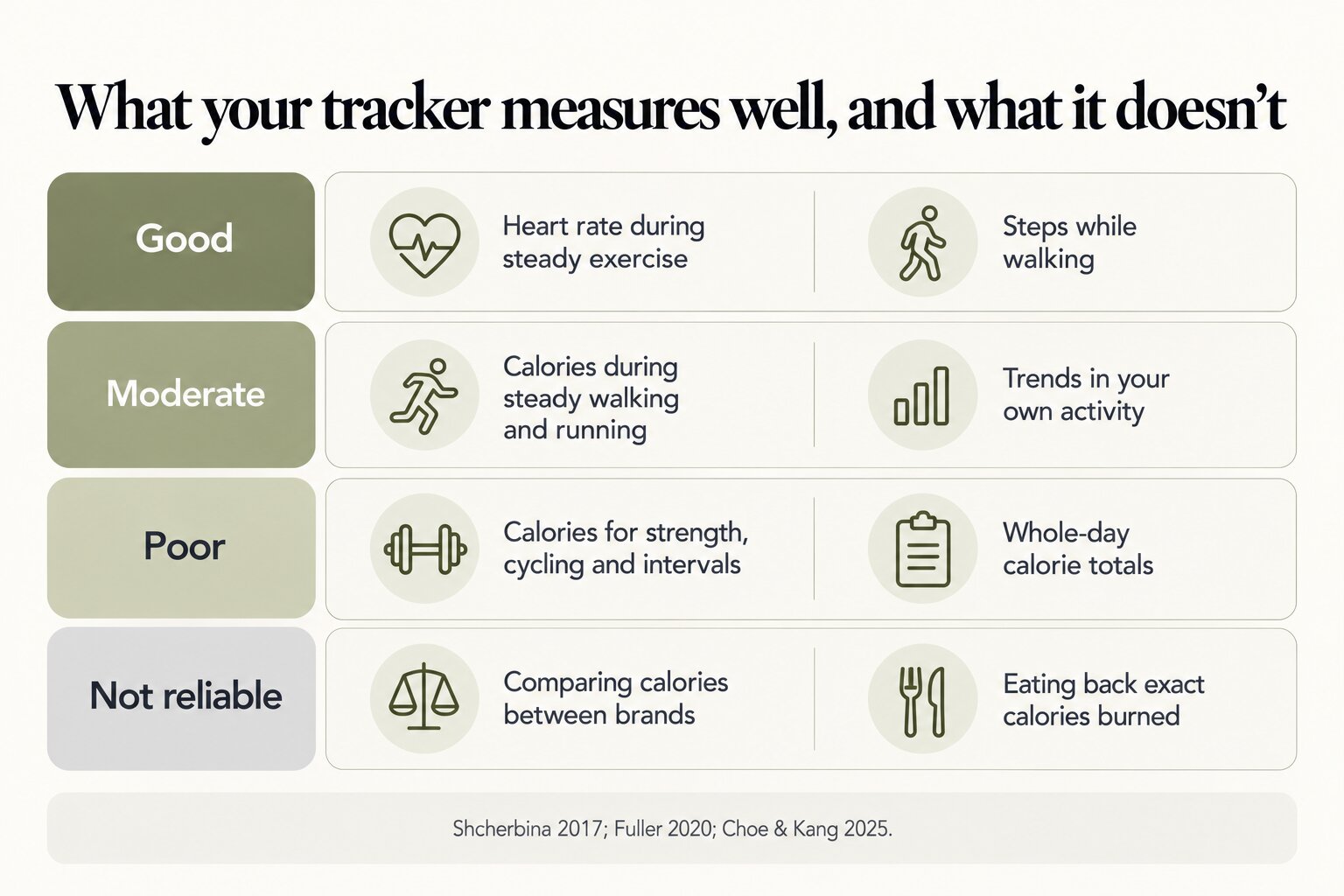
- Motion (accelerometers): counting steps and movement intensity. Works reasonably well for walking and running, but poorly for cycling, strength training, rowing, swimming and activities where the wrist doesn't move much.
- Heart rate (optical sensors): the green or red lights on the back of the device detect blood flow under the skin. Heart rate rises with effort, so it can indicate intensity. But heart rate is also raised by heat, stress, caffeine, dehydration and illness, and the relationship between heart rate and calorie burn differs between people, especially with different fitness levels.
- GPS: distance and speed for outdoor walking, running and cycling.
- Your fitness level: some devices estimate your VO2 max (aerobic fitness) and use it to personalise the heart-rate-to-calorie relationship.
- The workout type you select: each activity mode uses a different formula.
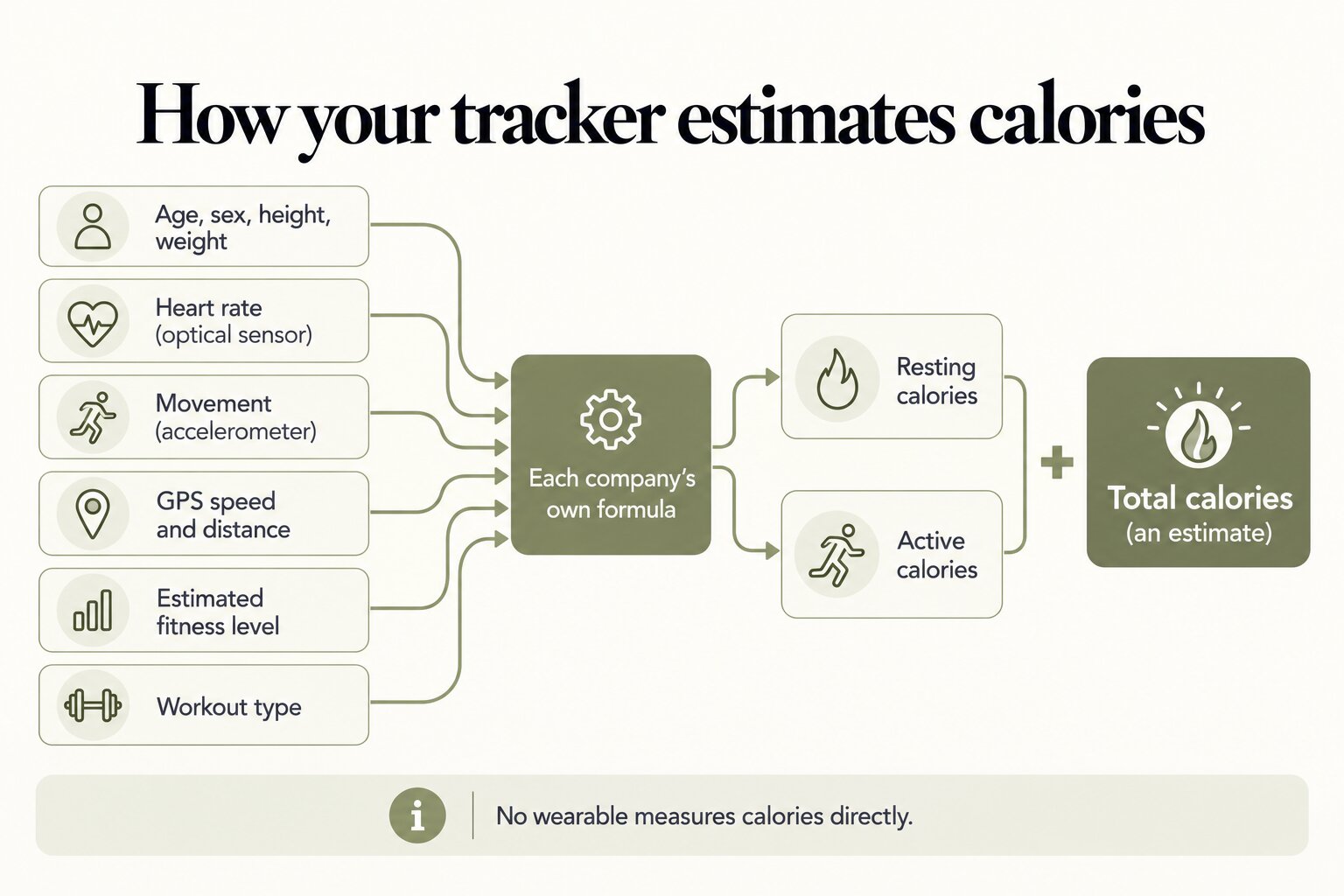
How each major tracker does it
Companies don't publish their full formulas, so the details below are based on what they've disclosed publicly and what independent studies show.
Apple Watch. Apple Watch splits calories into Active Energy (shown in the red Move ring) and Resting Energy; the total is the two combined. It uses heart rate, motion, GPS where available, the workout type and your profile (age, sex, height and weight). Apple also estimates cardio fitness (VO2 max) during outdoor walks, runs and hikes, and recommends keeping your profile up to date and wearing the watch snugly. Because the Move ring shows only active calories, its number is much lower than a device that shows total calories, which is one of the most common reasons people think their devices disagree.
Independent evidence: in a 2025 review of 56 studies, Kang and Choe at the University of Mississippi found the Apple Watch was accurate for heart rate (average error 4.4%) and reasonable for steps (8.2%), but calorie estimates were off by an average of 28%, across walking, running, cycling and mixed workouts. A 2020 review found Apple Watch heart rate readings were within 3% of the reference 71% of the time, the best of the brands studied, but its calorie estimates most often overestimated in laboratory tests.
Fitbit and Google Pixel Watch. Fitbit, now owned by Google, shows total calories burned, which includes your BMR from the moment you wake up. Its BMR is based on the height, weight, sex and age in your profile, and it adds activity calories from movement, with heart rate data used mainly to estimate calories during exercise. Because BMR is included, your calorie count starts above zero in the morning and rises even while you're sitting still. Fitbit recommends using the Exercise app or GPS for workouts such as spinning or yoga, where steps don't reflect effort.
Independent evidence: Fitbit is the most studied brand. In the 2020 review, Fitbit calorie estimates were split, underestimating in about 48% of comparisons and overestimating in about 40%. In a 2017 study from the University of Bath, the Fitbit Charge HR and the Apple Watch both underestimated free-living daily energy use by about 400 calories a day.
Garmin. Garmin devices use energy expenditure analytics developed by Firstbeat, a Finnish company Garmin acquired. Firstbeat's method uses heart rate, an estimate of breathing rate derived from heart rate variability, and your estimated fitness level (VO2 max), along with age, sex, height and weight, to estimate oxygen use and then calories. Garmin shows both resting and active calories. Firstbeat says this approach is within about 7% of laboratory measurements in its own studies, much better than simple heart-rate formulas, but these are company figures.
Independent evidence: in the 2020 review, Garmin devices underestimated calories in 69% of laboratory comparisons. Setting your maximum heart rate and keeping your profile updated may help.
WHOOP. WHOOP is a screenless strap that tracks heart rate continuously and focuses on "strain", recovery and sleep. It estimates calories mainly from heart rate, combined with your age, sex, height and weight, and shows total daily calories. Because it relies heavily on heart rate, anything that raises your heart rate without real physical effort, such as stress, heat or illness, may increase the estimate, while effort that doesn't raise heart rate much, such as heavy lifting with long rests, may be underestimated.
Independent evidence: WHOOP's heart rate and sleep tracking have been studied, but we couldn't find any independent, peer-reviewed study of the accuracy of its calorie estimates. A 2024 review of WHOOP research noted that the device "does not specifically measure energy metabolism".
Oura Ring. Oura estimates calories from movement measured at the finger, heart rate and your profile, and shows active and total calories.
Independent evidence: in a 2023 study of 32 adults aged 20-40, Oura's calorie estimates in the laboratory correlated strongly with indirect calorimetry (r = 0.93) but underestimated energy use, with the error growing as exercise got harder. In 14 days of everyday life, its total calorie estimates were within about 13% of a research-grade wrist monitor, but it overcounted about 2,100 steps a day. The authors concluded Oura detected large changes in activity but not finer differences, and shouldn't replace research-grade monitors.
Samsung Galaxy Watch. Samsung estimates calories from heart rate, motion and your profile, and shows active and total calories.
Independent evidence: in a 2026 study of 148 active adults doing intermittent running on a treadmill, the Galaxy Watch 6 and 7 had average calorie errors of about 10% and 13% compared with a portable gas analyser. That's better than many older studies, but the study tested only running in healthy adults and was funded by Samsung, with authors from a Samsung partner institute.
Polar and other sports watches. Polar's OwnCal system uses heart rate, your estimated fitness level, maximum heart rate and profile. In a 2023 pilot study of 16 elite male military personnel, the Polar Grit X Pro gave good overall agreement with laboratory measurements across a range of running intensities, but poor agreement within individual heart rate zones. Other brands such as Coros, Amazfit (Zepp) and Xiaomi use similar approaches; independent calorie validation for these is limited.
| Tracker | Main inputs for calories | What the main number shows | Independent calorie evidence |
|---|---|---|---|
| Apple Watch | Heart rate, motion, GPS, workout type, profile | Active calories (Move ring); total in Health app | About 28% average error across 56 studies |
| Fitbit and Pixel Watch | BMR from profile, motion, heart rate | Total calories, including BMR | Mixed over- and underestimation; about 400 kcal/day underestimate in one free-living study |
| Garmin | Heart rate, HRV-derived breathing, VO2 max, profile | Active and resting calories | Underestimated in 69% of lab comparisons |
| WHOOP | Mainly heart rate, profile | Total calories | No independent calorie validation found |
| Oura Ring | Finger movement, heart rate, profile | Active and total calories | Underestimates at higher intensity; about 13% error for daily total |
| Samsung Galaxy Watch | Heart rate, motion, profile | Active and total calories | About 10-13% error during running (company-funded) |
| Polar | Heart rate, VO2 max, max heart rate, profile | Total and exercise calories | Good overall agreement, poor by intensity zone (small pilot) |
Why different trackers give different numbers
- 1. They count different things. Apple's Move ring shows only active calories, while Fitbit and WHOOP show total calories including BMR. Comparing these directly can make one device look 1,500 calories "higher" than another.
- 2. Different BMR formulas. Small differences in the resting estimate add up over 24 hours.
- 3. Different formulas for active calories. Some rely mainly on heart rate, others on movement, others combine both with fitness estimates.
- 4. Different definitions of "activity". Devices differ in when they start counting movement as "active" and whether they include the extra calories burned after exercise.
- 5. Heart rate errors. Optical heart rate is less accurate during high-intensity intervals, weightlifting, boxing and activities with lots of wrist movement, and can be affected by a loose fit, tattoos, cold skin, sweat and skin tone.
- 6. Activity type. Calories are estimated better for steady walking and running than for cycling, swimming, strength training, yoga or household tasks.
- 7. Individual differences. Two people of the same age and weight can burn very different amounts of energy for the same activity, depending on fitness, muscle mass and efficiency of movement.
- 8. Wear time and placement. Wrist, finger and upper-arm devices see different signals, and taking a device off to charge loses data.
- 9. Wrong profile settings. An out-of-date weight or wrong age changes every estimate.
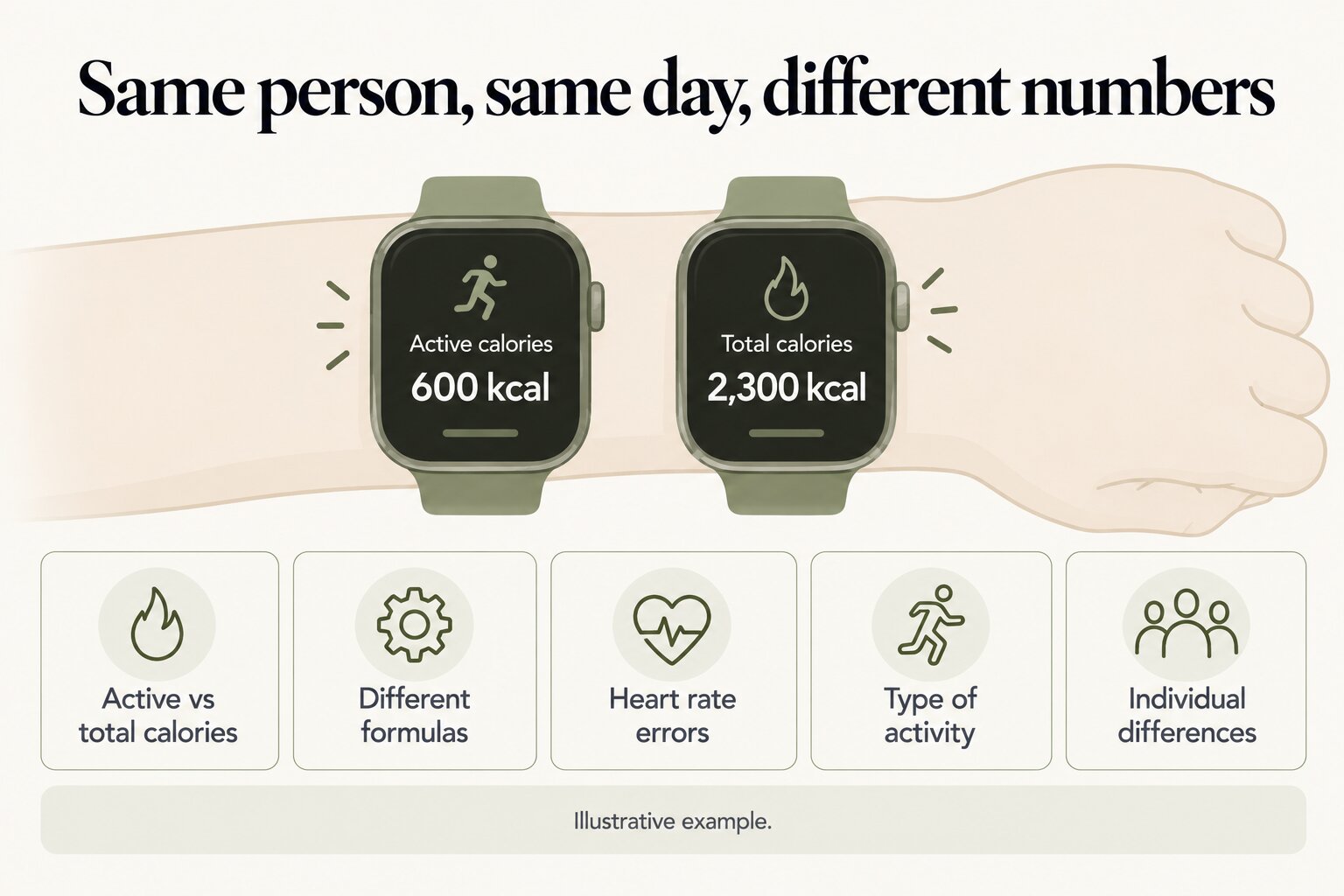
What the evidence shows
Wearables measure heart rate well, calories poorly. In a 2017 study at Stanford University, 60 volunteers wore seven devices (Apple Watch, Basis Peak, Fitbit Surge, Microsoft Band, Mio Alpha 2, PulseOn and Samsung Gear S2) during treadmill and cycling tests. Heart rate was measured much better than the researchers expected, but even the most accurate device was off by an average of 27% for calories. As senior author Euan Ashley put it, "the energy expenditure measures were way off the mark." The researchers suggested an error below 10% as a reasonable target for consumer use.
No brand is consistently accurate. In a 2020 review in JMIR mHealth and uHealth, Daniel Fuller and colleagues analysed 158 publications testing devices from nine brands: Apple, Fitbit, Garmin, Mio, Misfit, Polar, Samsung, Withings and Xiaomi. In controlled settings, only 9.2% of calorie estimates were within 3% of the reference value, and no brand achieved this more than 13% of the time. Garmin and Withings tended to underestimate; Apple and Polar tended to overestimate; Fitbit did both. In everyday life, only 18% of estimates were within 10%. The authors concluded that wearables were accurate for steps and heart rate in the laboratory, but "no brand was accurate" for energy expenditure.
Errors grow over a whole day. In a 2017 study from the University of Bath, 30 adults wore several devices for 24 hours. In the laboratory, the Apple Watch's average estimate was close to the reference, although individual activities were still off by about 27%, but over a whole day both the Apple Watch and the Fitbit Charge HR underestimated energy use by about 400 calories, and the errors got bigger in people who were more active. No consumer device matched research-grade monitors.
Newer devices may be improving. The 2025 Apple Watch review noted a trend towards gradual improvement over time, and the 2026 Samsung study found errors of about 10-13% during running. But most studies are short, done in young, healthy, mostly Western volunteers, and focused on walking and running. Many newer studies are funded by manufacturers.
Which tracker is most accurate?
The honest answer is that no tracker is reliably accurate for calories, and independent studies don't show a clear winner.
- For heart rate, the Apple Watch has performed best in reviews, and a chest strap is more accurate than any wrist device during hard exercise.
- For calories, the best-case errors in independent studies are usually around 10-30%, and errors for a whole day can be several hundred calories.
- Devices that personalise using fitness level, such as Garmin with Firstbeat and Polar, may handle differences in fitness better in theory, but independent studies haven't consistently confirmed that they're more accurate.
- Brand matters less than how you use it: an accurate profile, a snug fit, the right workout mode, a chest strap for hard sessions and consistent wear make more difference than switching brands.
Why this matters for longevity
Wearables are excellent tools for building healthy habits: tracking steps, activity minutes, heart rate, sleep and fitness trends, all of which are linked to long-term health (see Resting Heart Rate and HRV and Sleep Trackers). The problem comes when people treat calorie estimates as precise. Eating back "burned" calories from an overestimate can stall weight loss, while underestimates can lead athletes to under-fuel. Use calorie numbers as a rough guide and focus on the measures that matter more: regular movement, strength, cardiorespiratory fitness and a healthy diet (see The Minimum Effective Dose and Zone 2 Training).
Recommendations by situation
| Situation | What to do |
|---|---|
| Trying to lose weight | Don't eat back all "burned" calories; judge by your weight and waist trend over 2-4 weeks |
| Comparing two devices | Check whether each shows active or total calories before comparing |
| Strength training, cycling, yoga or swimming | Expect larger errors; select the right workout mode; consider a chest strap |
| High-intensity intervals | Use a chest strap for heart rate if accuracy matters |
| Endurance athlete planning fuelling | Use device numbers as a rough guide; adjust based on performance, hunger and weight |
| Older adult or living with a heart condition | Focus on steps, activity minutes and heart rate trends rather than calories |
| Taking beta-blockers | Heart rate-based calorie estimates may be low; rely more on effort and time |
| Want more precise numbers | Lab-based testing with indirect calorimetry measures resting and exercise energy use directly |
Practical notes
Keep your profile accurate, especially your weight, and wear your device snugly, just above the wrist bone. Use the correct workout mode and, for hard or interval workouts, pair a chest strap. Stick with one device so your numbers are at least consistent, and focus on trends over weeks rather than single days. If your goal is weight change, the most reliable "tracker" is your body weight and waist measurement over time, alongside an honest record of what you eat. Our Longevity Doctors can help you interpret your wearable data, measure your fitness and body composition, and set realistic goals, starting with the free longevity assessment.
- Shcherbina A, et al. Accuracy in wrist-worn, sensor-based measurements of heart rate and energy expenditure in a diverse cohort. Journal of Personalized Medicine, 2017;7(2):3.
- Fuller D, et al. Reliability and validity of commercially available wearable devices for measuring steps, energy expenditure, and heart rate: systematic review. JMIR mHealth and uHealth, 2020;8(9):e18694.
- Choe JP, Kang M. Apple Watch accuracy in monitoring health metrics: a systematic review and meta-analysis. 2025.
- Chowdhury EA, et al. Assessment of laboratory and daily energy expenditure estimates from consumer multi-sensor physical activity monitors. PLOS ONE, 2017;12(2):e0171720.
- Kristiansson E, et al. Validation of Oura ring energy expenditure and steps in laboratory and free-living. BMC Medical Research Methodology, 2023;23:50.
- Ferreira, et al. Validity of Samsung Galaxy Watch energy expenditure estimates during intermittent running. JMIR Formative Research, 2026.
- Kloss, et al. Validation of Polar Grit X Pro for estimating energy expenditure during military field training: a pilot study. Journal of Sports Science and Medicine, 2023;22(4):658.
- Murakami H, et al. Accuracy of 12 wearable devices for estimating physical activity energy expenditure using a metabolic chamber and the doubly labeled water method: validation study. JMIR mHealth and uHealth, 2019;7(8):e13938.
- Google. How does my Fitbit device estimate calories burned? Fitbit Help.
- Firstbeat. Energy expenditure estimation.
Free longevity assessment
Want to know what your
wearable data really means?
Take the free Aevum Protocol assessment to see how your movement & strength and 6 other longevity domains are performing — and get a personalised 90-day plan.
Take the free assessmentKeep reading