Sleep & Recovery
Insomnia: Why It Happens
and What Actually Works
Our Sleep and Brain Health article covered the bidirectional relationship between sleep and mood — insomnia sits right at the centre of that relationship. This article covers what insomnia actually is, why it isn't simply "not being tired enough," and what the evidence shows about treatment, including a genuinely important mismatch between what's most commonly prescribed and what actually works best over time.
Quick Summary
- →Insomnia isn't a lack of sleepiness — it's often a state of physiological over-arousal. People with chronic insomnia frequently show elevated cortisol, higher metabolic rate, and heightened brain activity at bedtime, essentially the opposite of what's needed to fall asleep
- →Chronic insomnia affects roughly 10–15% of adults, with a much larger share experiencing occasional insomnia symptoms — it's the most common sleep disorder in the general population
- →Cognitive Behavioural Therapy for Insomnia (CBT-I) is comparably effective to medication in the short term, and more effective in the long term — yet medication remains far more commonly prescribed as a first response, despite clinical guidelines recommending CBT-I first
- →Common sleep medications carry real, well-documented risks, particularly in older adults — Z-drugs (like zolpidem) are associated with a meaningfully higher risk of falls and fractures, an effect strong enough that one widely cited analysis found the number of people harmed exceeded the number who benefited
- →"Trying harder" to sleep tends to backfire — increased mental effort and monitoring of sleep itself is a well-recognised way chronic insomnia becomes self-perpetuating, distinct from the original cause
Key numbers at a glance
| Measure | Figure |
|---|---|
| Chronic insomnia prevalence, general population | ~10–15% (up to 22% by some diagnostic criteria) |
| CBT-I vs. medication, short-term effectiveness | Comparable |
| CBT-I vs. medication, long-term durability | CBT-I superior |
| Z-drug fracture risk (meta-analysis) | OR ~1.63 |
| Zolpidem injury risk (same meta-analysis) | OR ~2.05 |
| Benzodiazepine sleep benefit: number needed to treat vs. harm | 13 (treat) vs. lower (harm) — risks can outweigh benefit |
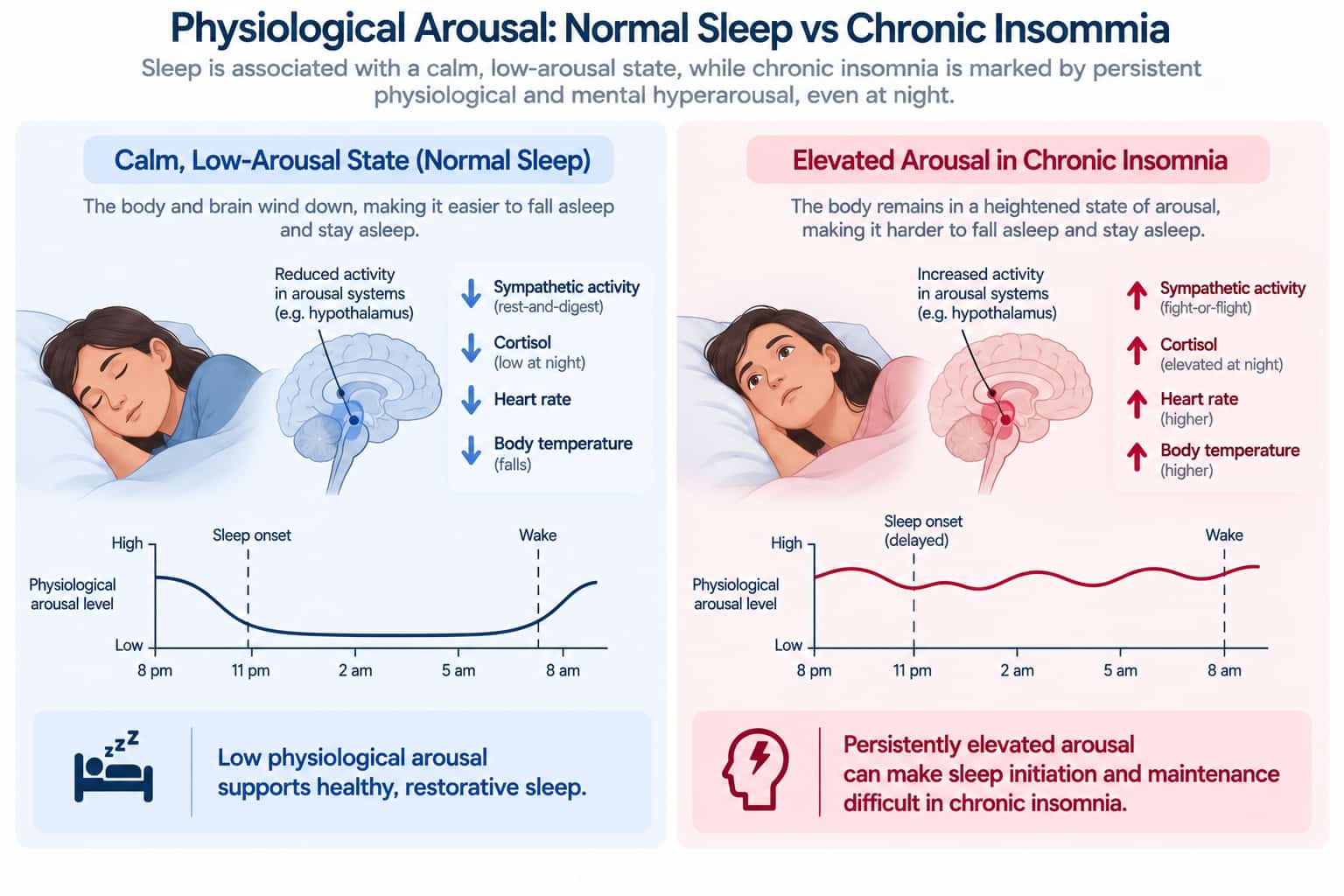
How it works: the hyperarousal model
Insomnia is often misunderstood as simply "not being sleepy enough" — but a large body of research points to something closer to the opposite: a state of hyperarousal. People with chronic insomnia frequently show measurably elevated cortisol levels, higher resting metabolic rate, and increased fast-frequency brain activity around bedtime — physiological signs of an activated, alert system working against the very state a person is trying to enter.
This distinction matters clinically. Acute insomnia — a few nights of poor sleep tied to stress, travel, or a specific stressor — is common, generally self-limiting, and doesn't require the same approach as chronic insomnia, typically defined as difficulty falling or staying asleep at least three nights a week for three months or more, alongside daytime impairment.
Chronic insomnia often develops a self-perpetuating quality distinct from whatever originally triggered it. Trying harder to fall asleep, monitoring the clock, and worrying about the consequences of not sleeping all actively work against the low-arousal state sleep actually requires. This is part of why chronic insomnia frequently persists well after an original stressor has resolved — the anxious relationship with sleep itself becomes the maintaining factor.
What the research shows
CBT-I: the most effective treatment, and the least commonly prescribed first. Cognitive Behavioural Therapy for Insomnia (CBT-I) is a structured, multi-component approach including stimulus control (rebuilding the association between bed and sleep), sleep restriction therapy (temporarily limiting time in bed to consolidate sleep before gradually expanding it), and cognitive techniques addressing the anxious thoughts that fuel the hyperarousal cycle described above. Systematic reviews comparing CBT-I directly against sleep medication have found the two comparably effective in the short term, but CBT-I shows superior long-term durability — its benefits tend to persist after treatment ends, while medication benefits often diminish once a person stops taking it, and relapse rates after discontinuation are notably higher with medication than with CBT-I. This evidence base is strong enough that clinical guidelines in Europe and elsewhere recommend CBT-I as the first-line treatment for chronic insomnia, with medication reserved for short-term use when CBT-I isn't effective or available — yet in practice, medication remains a very common first response, in part because CBT-I access and awareness both lag behind its evidence base.
The medication risk picture, particularly for older adults. Benzodiazepines and "Z-drugs" (such as zolpidem, zopiclone, and eszopiclone) are effective for short-term symptom relief, but carry real risks that become particularly significant with regular or long-term use. A meta-analysis of Z-drug use found a meaningfully elevated fracture risk (odds ratio of roughly 1.63), and the same analysis found zolpidem specifically associated with an increased risk of injury of roughly 2.05 — nearly double. The mechanism is straightforward: these medications cause measurable impairment in balance and coordination, including during nighttime awakenings and sometimes persisting into the following morning, which becomes a serious concern in a population — older adults — where falls are already a leading cause of injury and loss of independence.
One widely cited analysis of benzodiazepine risk-benefit found that for every 13 people who experienced improved sleep from treatment, a comparable or greater number experienced a harmful outcome — a genuinely striking risk-benefit ratio for a medication class this widely prescribed. Tolerance, dependence, and rebound insomnia upon stopping are additional, well-documented concerns with regular use.
The mood connection. As covered in our Sleep and Brain Health article, the relationship between sleep and mood runs in both directions — insomnia is both a common symptom of depression and anxiety and an independent risk factor for developing them. This is part of why CBT-I's benefits often extend beyond sleep measures alone; addressing the hyperarousal and anxious thought patterns at the centre of chronic insomnia frequently improves mood symptoms as a secondary effect, not just sleep itself.
Recommendations by population group
- 1Anyone with chronic insomnia (3+ nights a week, 3+ months)
CBT-I is worth actively seeking out as a first approach, given its comparable short-term and superior long-term effectiveness relative to medication — worth specifically asking a doctor about referral or access, since it isn't always offered by default.
- 2Older adults
Given the well-documented fall and fracture risks associated with Z-drugs and benzodiazepines, this is the group where the medication risk-benefit calculation deserves the most scrutiny, and where non-pharmacological approaches are particularly worth prioritising.
- 3Anyone currently on long-term sleep medication
Worth raising a conversation with a prescribing doctor about whether CBT-I could be introduced alongside a gradual taper, rather than assuming indefinite medication is the only option — abrupt discontinuation isn't recommended, but a planned transition is a reasonable thing to discuss.
- 4Anyone experiencing short-term, situational insomnia (stress, travel, a specific life event)
This is a different picture from chronic insomnia and often resolves on its own — the sleep effort paradox is worth knowing about here too, since anxious monitoring of a temporary bad patch can be exactly what turns it into a longer-term pattern.
- 5Anyone with co-occurring low mood or anxiety
Given the bidirectional relationship covered in our Sleep and Brain Health article, addressing insomnia directly is a legitimate part of managing mood, not a separate issue to defer until mood improves first.
Practical notes
- →Insomnia is a state of over-arousal, not under-tiredness — this reframing matters, since it explains why "just try harder to relax" style advice often doesn't work on its own
- →CBT-I is genuinely underused relative to how well-supported it is — it's worth actively asking about rather than assuming medication is the only or best first option
- →Z-drug and benzodiazepine risks are real and well-documented, particularly for older adults — this isn't a reason to panic about existing prescriptions, but a reason to have an informed conversation with a doctor rather than assume indefinite use is risk-free
- →The sleep effort paradox is worth recognising in yourself — increased anxiety about not sleeping is a common way a temporary bad patch turns into a persistent pattern
- →Acute and chronic insomnia are different problems requiring different responses — a few rough nights tied to a specific stressor isn't the same condition as insomnia lasting months, and doesn't need the same level of intervention
Insomnia is one of the more genuinely treatable conditions in this sleep series, with a well-established, evidence-backed treatment that remains underused relative to its effectiveness. For how insomnia connects to mood, circadian timing, and sleep architecture more broadly, see our Sleep and Brain Health, Circadian Rhythm, and Sleep Architecture articles. If you'd like a clearer picture of your own sleep health, our Longevity Doctors offer a free longevity assessment as a starting point.
How does your sleep
score on your longevity assessment?
Take the free Aevum Protocol assessment to see how your sleep & recovery and 6 other longevity domains are performing — and get a personalised 90-day plan.
Take the Free Assessment →