Sleep & Recovery
Sleep Apnea: Symptoms, Diagnosis,
and Why Treatment Matters
Our Sleep and Cardiovascular Health article introduced obstructive sleep apnea (OSA) as one of the strongest, most consequential sleep-related health conditions, given its independent links to stroke, heart failure, and arrhythmia. This article gives OSA the full, dedicated treatment it deserves — what it actually is, how it's diagnosed and measured, and what the evidence shows about treatment, including the genuinely large gap between how well treatment works and how consistently people actually use it.
Quick Summary
- →OSA is measured by the apnea-hypopnea index (AHI) — the number of breathing interruptions per hour of sleep — with standard thresholds of mild (5–15), moderate (15–30), and severe (30+)
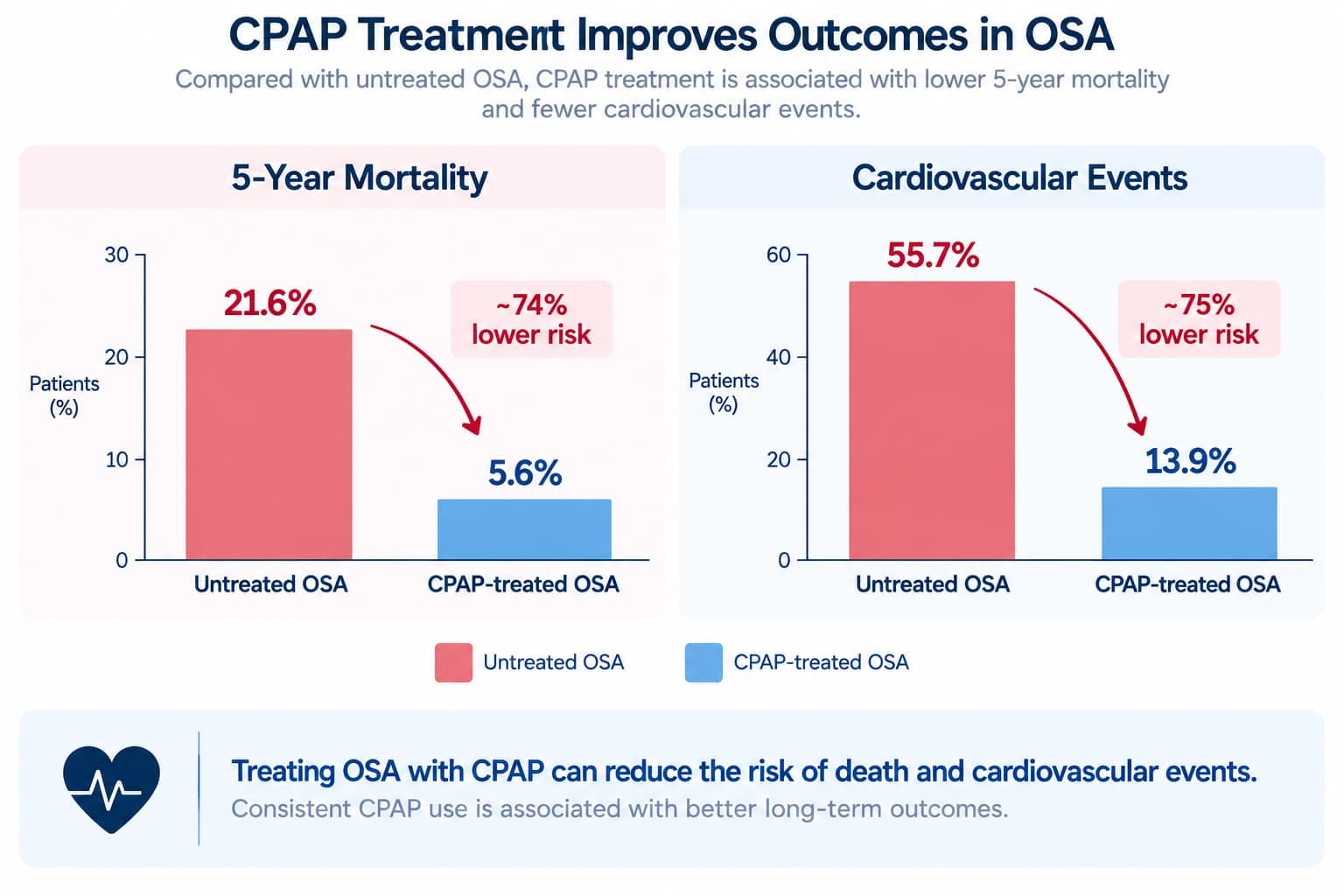
- →A study following elderly patients with moderate-to-severe OSA for around 5 years found mortality was nearly 4 times higher in untreated patients (21.6%) than in those treated with CPAP (5.6%) — a striking, direct illustration of what's at stake with treatment
- →CPAP (continuous positive airway pressure) is the gold-standard treatment and is genuinely effective, but adherence is a real, significant problem — estimates across studies range from roughly 46% to 80%, meaning a substantial share of people prescribed CPAP don't use it consistently enough to get its full benefit
- →CPAP treatment has been shown to reduce motor vehicle accident risk by an estimated 65–78% in a meta-analysis of long-term studies — directly relevant given the drowsy-driving risks covered in our Sleep and Brain Health article
- →Untreated OSA doesn't just raise cardiovascular risk — it's also linked to impaired glucose control, cognitive impairment, and road traffic accidents, making it one of the more genuinely high-stakes, addressable conditions covered in this entire sleep series
Key numbers at a glance
| Measure | Figure |
|---|---|
| AHI threshold for diagnosis | ≥5 events/hour |
| Mild / Moderate / Severe OSA (AHI) | 5–15 / 15–30 / 30+ |
| Moderate-to-severe OSA prevalence, ages 30–70 (Wisconsin Sleep Cohort) | ~13% men, ~6% women |
| Moderate-to-severe OSA prevalence, ages 50–70 (same study) | ~17% men, ~9% women |
| 5-year mortality, untreated vs. CPAP-treated (elderly, moderate-severe OSA) | 21.6% vs. 5.6% |
| CPAP adherence rate across studies | ~46–80% |
| Motor vehicle accident risk reduction with CPAP | ~65–78% |
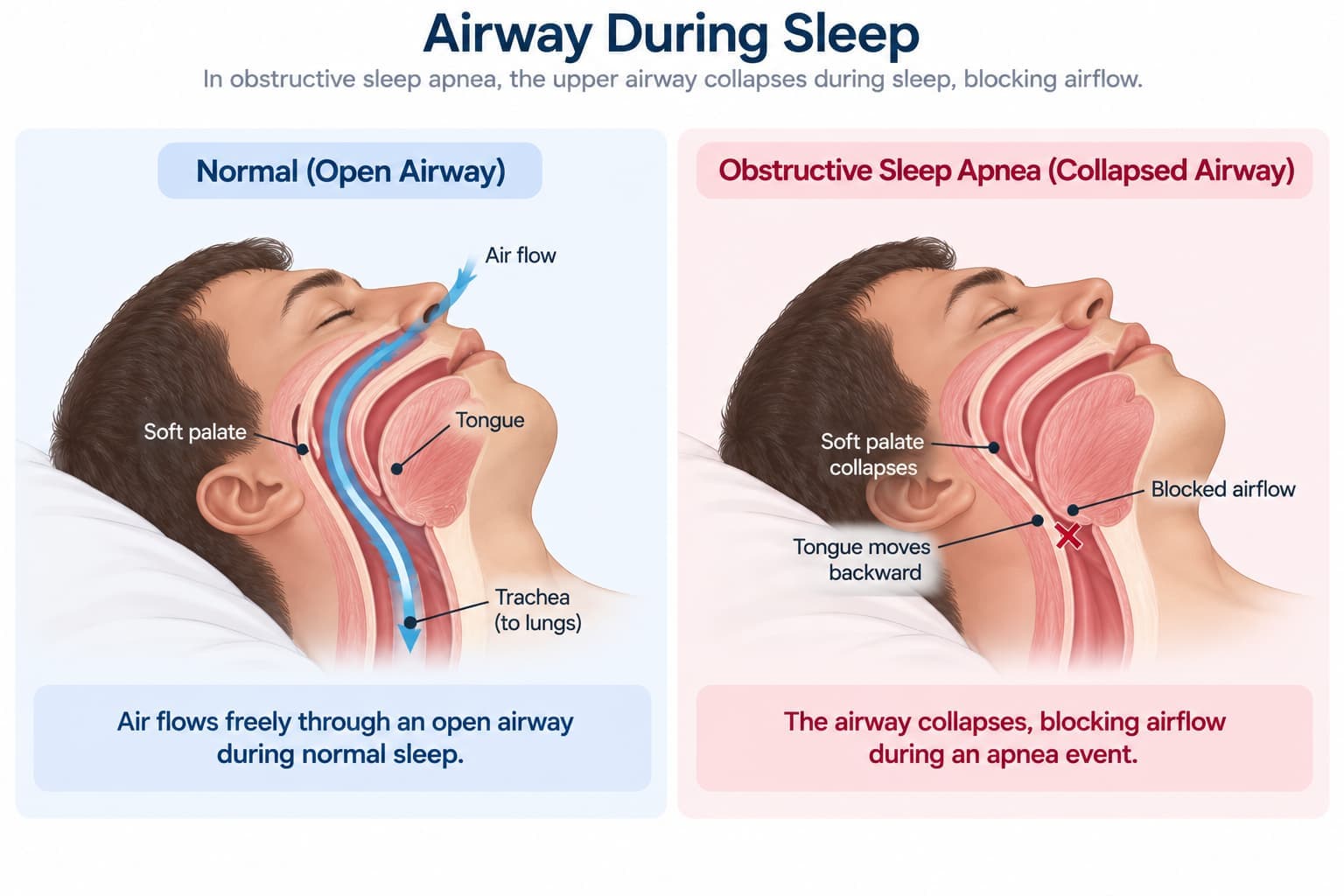
How it works: what OSA actually is
Obstructive sleep apnea occurs when the soft tissue at the back of the throat collapses or narrows during sleep, partially or fully blocking airflow. Each event — whether a complete pause in breathing (apnea) or a significant reduction in airflow (hypopnea) — typically triggers a brief arousal, often too short to be consciously remembered, as the brain partially wakes to reopen the airway. This can happen dozens or even hundreds of times a night in more severe cases, repeatedly fragmenting sleep and causing repeated drops in blood oxygen.
Severity is measured using the apnea-hypopnea index (AHI) — the average number of these events per hour of sleep, typically assessed via polysomnography (an overnight, monitored sleep study) or increasingly through validated home sleep apnea testing devices.
- 1Normal
Fewer than 5 events/hour.
- 2Mild OSA
5–15 events/hour.
- 3Moderate OSA
15–30 events/hour.
- 4Severe OSA
30+ events/hour.
This is distinct from central sleep apnea, a less common condition where the brain temporarily fails to send proper signals to the breathing muscles, rather than the airway physically collapsing — most sleep apnea discussed in general health contexts, including this article, refers to the obstructive form.
What the research shows
Prevalence and underdiagnosis. As covered in our Cardiovascular Health article, OSA is far more common than most people assume — the landmark Wisconsin Sleep Cohort study found moderate-to-severe OSA in roughly 13% of men and 6% of women overall (ages 30–70), rising to 17% of men and 9% of women aged 50–70, with the large majority of cases going undiagnosed. Common symptoms include loud, habitual snoring, witnessed pauses in breathing, gasping or choking during sleep, excessive daytime sleepiness, morning headaches, and difficulty concentrating — but because many of these symptoms are experienced during sleep and reported by a bed partner rather than the person themselves, or dismissed as "just snoring," diagnosis often lags well behind the underlying condition.
Why treatment matters: the mortality evidence. A cohort study following 130 elderly patients with moderate-to-severe OSA for an average of 5 years found a striking difference in outcomes based on treatment status: mortality was 21.6% in untreated patients compared to 5.6% in those treated with CPAP, with a corresponding survival rate of 78.4% versus 94.4%. Cardiovascular events followed a similar pattern, occurring in 55.7% of untreated patients compared to 13.9% of CPAP-treated patients. While this is an observational study rather than a randomised trial, and treated and untreated groups may differ in other ways, the scale of the difference is large enough to be a genuinely important data point for anyone weighing whether treatment is worth the effort.
The CPAP adherence problem. CPAP — a machine that delivers continuous pressurised air through a mask to keep the airway open during sleep — is the first-line, most effective treatment for OSA. But its real-world benefit depends entirely on consistent use, and adherence is a genuine, widely-documented problem. Estimates across studies range from roughly 46% to 80%, with one large study finding non-adherence associated with a 74% higher mortality risk compared to adherent patients. Interestingly, adherence tends to correlate with severity — one study found 89% adherence among severe OSA patients compared to 55% among those with mild OSA, suggesting people with more noticeable symptoms are more motivated to persist with treatment despite its discomforts (a mask, noise, and an adjustment period are common barriers).
This adherence gap is a genuinely important, underappreciated part of the OSA treatment picture — a highly effective treatment is only as good as a person's ability to actually use it consistently. If CPAP feels uncomfortable or difficult to stick with, that's a common, solvable problem worth raising with a doctor for troubleshooting, not a reason to quietly abandon treatment altogether.
CPAP and accident risk. Given the drowsy-driving risks covered in our Sleep and Brain Health article, OSA's effect on road safety deserves specific mention. A meta-analysis of long-term observational studies found that CPAP treatment was associated with a 65–78% reduction in motor vehicle accident risk compared to before treatment — a substantial safety benefit on top of the cardiovascular and mortality findings above, directly relevant given how commonly excessive daytime sleepiness features in OSA.
Treatment options beyond CPAP. While CPAP remains the gold standard, it isn't the only option, and isn't right for everyone. Weight loss can meaningfully reduce OSA severity in people with obesity, since excess tissue around the airway is a major contributing factor. Positional therapy (avoiding sleeping on the back, where gravity worsens airway collapse) helps some people with milder, position-dependent OSA. Oral appliances, fitted by a dentist to reposition the jaw and tongue, are a reasonable alternative for mild-to-moderate cases or for those who cannot tolerate CPAP. Surgical options exist for select cases but are generally considered after other approaches haven't worked.
Recommendations by population group
- 1Loud snorers, or anyone with witnessed breathing pauses or excessive daytime sleepiness
This combination of symptoms is worth raising with a doctor specifically, rather than assuming it's simply heavy sleeping — early diagnosis matters given how significant the treatment benefit appears to be.
- 2Older adults
OSA prevalence rises with age, and the strongest mortality-benefit data available comes specifically from an elderly population — making diagnosis and treatment particularly relevant for this group rather than something to dismiss as an inevitable part of ageing.
- 3Anyone with obesity
Given obesity's role as a major OSA risk factor, weight management is a genuinely relevant part of addressing OSA directly, alongside — not instead of — other treatment where indicated.
- 4Commercial drivers and anyone in safety-critical roles
Given the accident-risk reduction data, OSA screening and consistent treatment carries safety stakes that extend beyond personal health, making this a group where treatment adherence deserves particular attention.
- 5Anyone diagnosed with OSA who struggles with CPAP
Given how significant the adherence gap is, raising difficulties directly with a doctor — rather than quietly abandoning treatment — is worth doing, since alternatives (positional therapy, oral appliances, mask refitting) may meaningfully improve tolerance without giving up on treatment altogether.
Practical notes
- →Snoring plus daytime sleepiness is a combination worth taking seriously, not dismissing — it's one of the more accessible signals pointing toward a highly treatable condition with real long-term stakes
- →The mortality difference between treated and untreated OSA is large enough to take seriously — a nearly 4-fold difference in one study is a substantial number, even accounting for the observational nature of that research
- →CPAP adherence is a genuine, common problem, not a personal failing — discomfort and difficulty adjusting are common enough that raising them with a doctor for troubleshooting is the right response, not silently discontinuing treatment
- →Treatment isn't limited to CPAP — weight loss, positional therapy, and oral appliances are all legitimate options depending on severity and individual circumstances
- →The road safety data is a genuinely underappreciated part of the OSA picture — this isn't just a personal health condition, but one with real implications for driving and workplace safety
Sleep apnea sits at a genuinely important intersection in this sleep series — a highly prevalent, frequently undiagnosed condition with strong evidence for both its risks and the benefit of treating it, provided treatment is actually used consistently. For how OSA connects to cardiovascular risk, cognitive safety, and metabolic health specifically, see our Sleep and Cardiovascular Health, Sleep and Brain Health, and Sleep and Metabolic Health articles. If you'd like a clearer picture of your own sleep health, including screening for sleep apnea, our Longevity Doctors offer a free longevity assessment as a starting point.
How does your sleep
score on your longevity assessment?
Take the free Aevum Protocol assessment to see how your sleep & recovery and 6 other longevity domains are performing — and get a personalised 90-day plan.
Take the Free Assessment →